

.png?width=1252&height=362&name=QUID_Logo_WHITE%20(2).png)
.png?width=1380&name=template%20even%20text%20(8).png "<span id=\"hs_cos_wrapper_name\" class=\"hs_cos_wrapper hs_cos_wrapper_meta_field hs_cos_wrapper_type_text\" style=\"\" data-hs-cos-general-type=\"meta_field\" data-hs-cos-type=\"text\" >How Are AI Agents Changing Market Research?</span>")
Key takeaways:
AI agents seem to be all the rage these days, with businesses exploring how AI can move beyond answering questions to actually taking action and completing tasks.
But what exactly is an AI agent? And more importantly, what does it actually change for a research or insights team?
In this article, we’ll look beyond the hype to unpack what AI agents are, how they can be used in market research, and what they can reliably do to help research teams work faster and uncover more meaningful insights. Let’s get started.
AI agents are AI systems or programs that independently carry out a series of tasks to achieve a specific goal, rather than simply responding to a single prompt. That ability to work through multiple tasks in a defined process is what sets AI agents apart from the more familiar chatbots and generative AI tools many already use.
So, for example, instead of just asking an LLM to summarize a report and getting an answer back, you could give an AI agent a research goal and have it search for information, identify patterns, and bring the findings together for you.
For market research teams, the value of AI agents comes from them handling the more repetitive, time-consuming parts of the research process. An agent can gather information from multiple sources, monitor a market for changes, or work through large amounts of data much faster than a person could.
AI agents can help market research teams automate time-consuming research tasks, analyze information continuously, and surface insights.
In a traditional research workflow, you might spend hours or even days searching across sources, pulling together relevant information, comparing developments, and looking for patterns. Dashboards can make data easier to monitor, but they still require someone to know what to look for and interpret what they’re seeing.
An AI agent, on the other hand, can take on more of that work itself, working across sources and steps to get from a research question to a set of findings.
That fundamentally changes the pace of research. Instead of relying on quarterly studies, scheduled reports, or one-off research projects, teams can move toward a more continuous “ad hoc” approach, with AI agents ready to work whenever a question comes up.
You simply prompt an AI agent to work through a specific research workflow and it’ll work in the background for you to surface findings quickly. If ongoing monitoring is needed, agents can also continuously track markets, competitors, customers, and emerging trends over time.
The result is faster research, as well as more opportunities for deeper analysis. With AI agents speeding up the process, your team has more time to ask deeper questions, investigate emerging developments, and turn information into something useful for the business.
While AI agents can take on many market research tasks, they don't eliminate the need for researchers. Deciding what questions to ask, understanding the context behind a finding, judging its significance, and assessing the viability of a recommended decision still require human expertise.
Rather than replacing researchers, AI agents can take repetitive and time-consuming work off their plates and give human experts more time to focus on the parts of research that require nuanced judgment and strategic thinking.
The short answer? Sometimes. How much you can trust an AI agent’s output depends largely on what information it has access to, where that information comes from, and whether you can trace its findings back to the original sources.
Generally, an agent working from a controlled set of reliable sources is more trustworthy than one pulling information indiscriminately from across the internet. The “reliable” sources are up to you and could mean an extensive list of approved and vetted sources, a curated research database, or your own internal data.
Meanwhile, traceability is essential for verifying insights. When an AI agent produces a finding, you should be able to see where that finding came from and follow it back to the relevant source. That makes it easier to validate the information, understand the context, and spot when something doesn't look right.
In other words, the more visibility you have into what an agent is working with and how it reached its conclusions, the more confidently you can use its output as part of your research process.
So we’ve covered what AI agents can do in theory, but what does that actually look like in practice? Here’s a look at Quid’s very own Q Agents as an example.
Q Agents are purpose-built AI agents that run multi-step research workflows around specific business research questions. With more than 30 agents available, teams can use them for research flows ranging from brand sentiment and competitive analysis to social media benchmarking, patent research, and SWOT analysis.
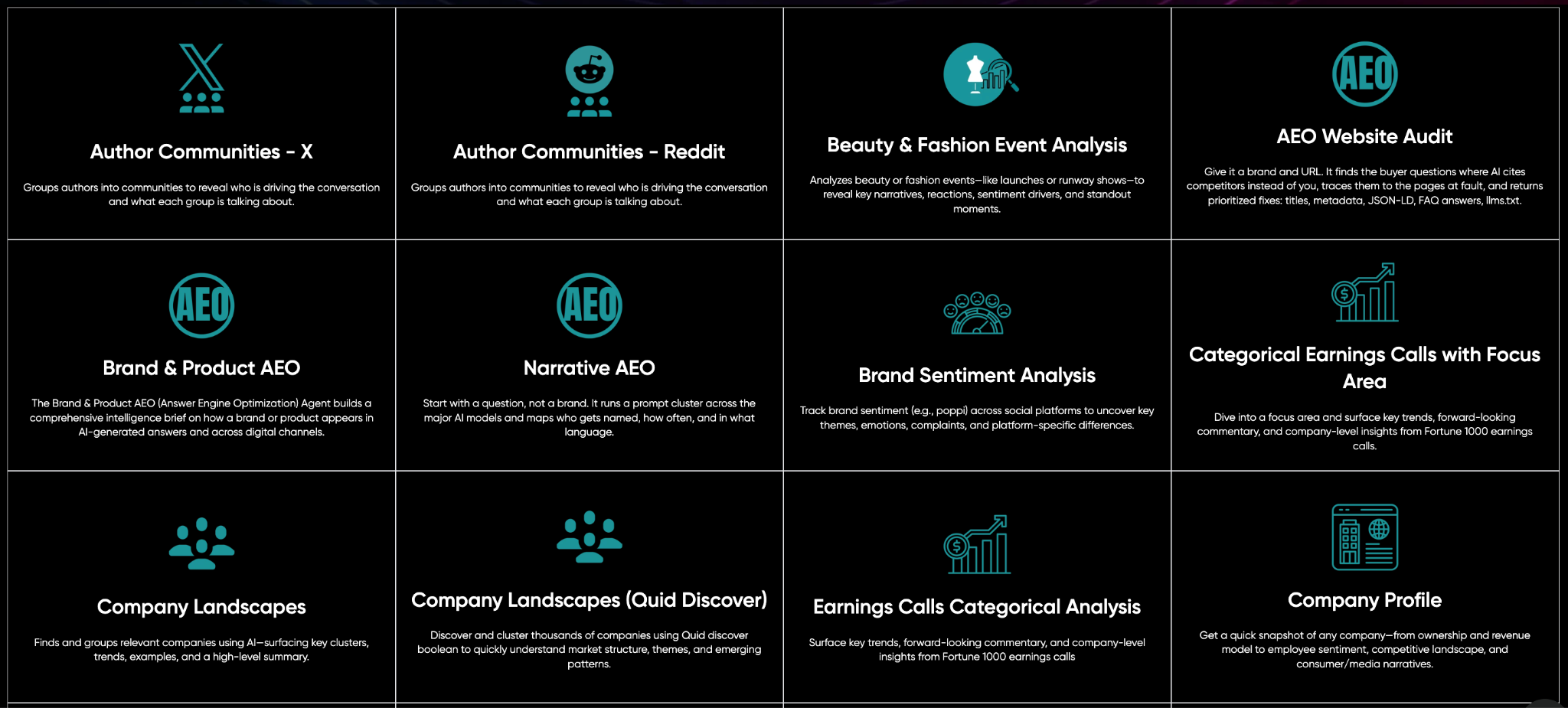
Browse through our full list of Q Agents.
The agents draw on Quid’s datasets, which are built from more than two petabytes of data sourced through direct partnerships across social, search, news, broadcast, patents, and investment sources. You can also layer in your own data, such as customer feedback, CRM records, or search trends, to give the analysis even more context.
Here’s how it works:
The briefs are shareable and executive-ready, providing a clear snapshot of what matters and the context behind it. Sources are also linked throughout so you can quickly validate the analysis or dig deeper.
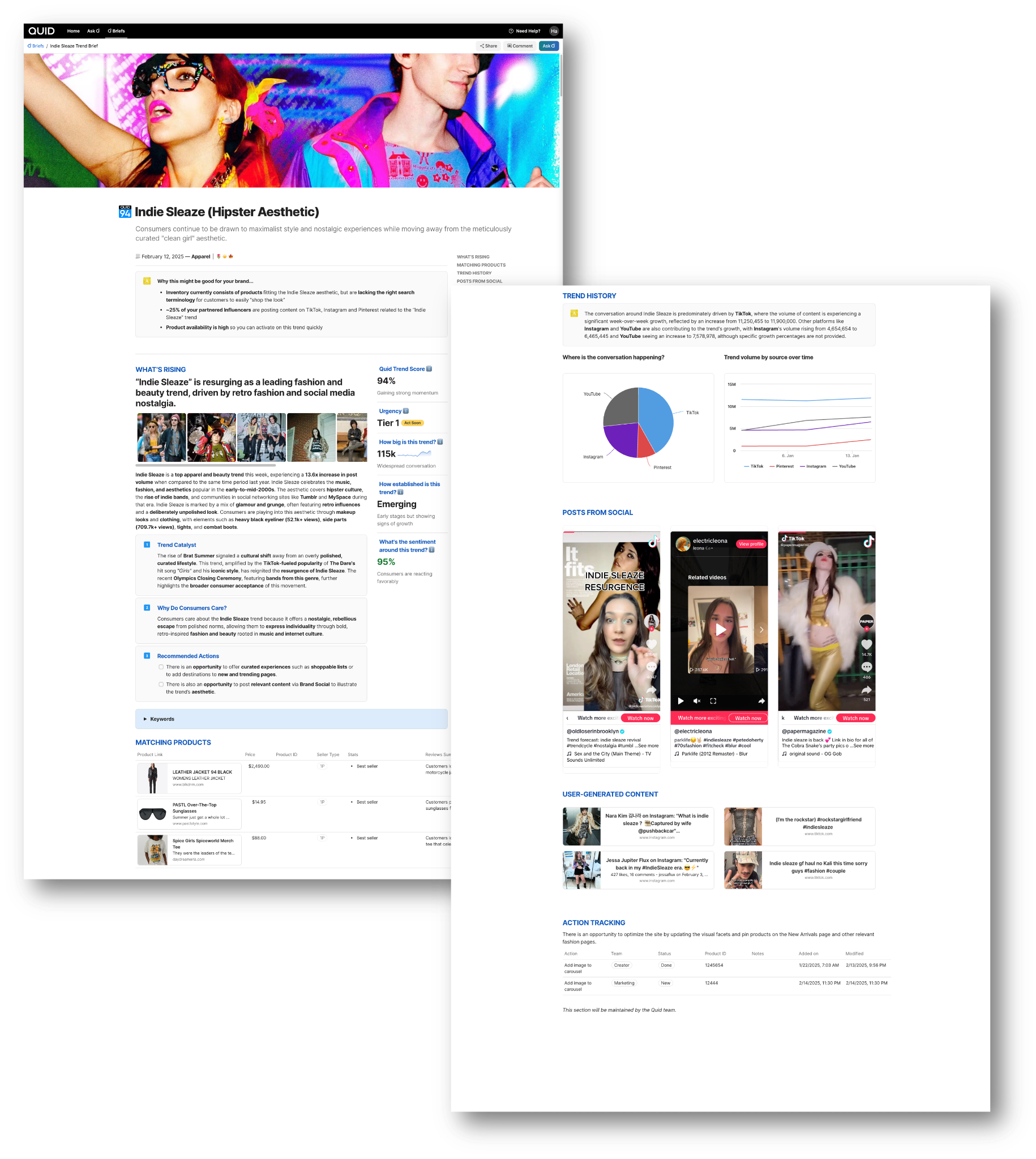
Instead of sifting through raw data yourself, Q Agents do the heavy lifting and give you a research output you can actually use. That frees your team to spend less time gathering information and more time exploring what it means for the business.
AI agents can take a lot of the repetitive work off a researcher’s plate, from gathering information to pulling findings together. That leaves more time for the parts of research that still benefit from human judgment: asking better questions, digging into what matters, and deciding what to do with the findings.
With more than 30 purpose-built agents built on Quid’s extensive data foundation, Q Agents gives teams a faster way to get actionable insights they can trust and use.
Want to see it in action? Request a free demo to explore how our agents can fit into your research workflow.
The difference between an AI agent and a chatbot is that a chatbot responds to individual prompts in a single exchange while an AI agent works through a multi-step process on its own.
The accuracy of AI agents for market research depends heavily on the data sources. Agents working from a controlled, vetted database are far more reliable than those pulling from the open internet. Traceability matters, too. If you can follow a finding back to its source, you can verify it and catch errors before they influence decisions.
AI agents can automate time-consuming market research tasks like gathering information across multiple sources, monitoring markets continuously, and surfacing patterns in large datasets. This helps shift research from scheduled, periodic studies toward on-demand analysis where teams can get findings when a question arises rather than waiting on a formal research cycle.
No, AI agents don’t replace market researchers. AI agents can't replace the judgment, curiosity, and strategic thinking researchers bring. Deciding what questions matter, interpreting with context and nuance, and assessing whether a recommendation is viable for the business still require human expertise.