

.png?width=1252&height=362&name=QUID_Logo_WHITE%20(2).png)
.png?width=1380&name=template%20even%20text%20(10).png "<span id=\"hs_cos_wrapper_name\" class=\"hs_cos_wrapper hs_cos_wrapper_meta_field hs_cos_wrapper_type_text\" style=\"\" data-hs-cos-general-type=\"meta_field\" data-hs-cos-type=\"text\" >How Niche Trends Become Mainstream Demand</span>")
A trend doesn’t become mainstream because everyone suddenly decides they like the same thing. Before barrel-leg jeans appear everywhere, K-Beauty earns permanent shelf space, or a niche fragrance becomes the scent everyone is talking about, something else happens first. A look, product, or behavior begins moving through a series of adoption layers.
Creators introduce it, and communities validate it. Media gives it language, and retailers make it accessible. Social platforms then repeat it until consumers recognize it. Eventually, something that once required insider knowledge becomes easy to find, understand, and buy.
Quid's analysis of TikTok conversations and top media coverage reveals how that transition happens and, more importantly for brands, where the signals appear before a niche trend reaches mass adoption.
How do niche trends become mainstream?
Niche trends gain broader adoption through repeated exposure, social validation, easier access, and translation into familiar products, experiences, and shopping language.
What role do creators play in trend adoption?
Creators introduce and interpret emerging aesthetics through content such as hauls, comparisons, recommendations, and styling ideas, helping audiences understand how a trend fits into everyday life.
Does retail availability matter?
Yes. Our TikTok analysis shows mainstream retailers and sellers replicating niche aesthetics, making previously specialized looks easier for consumers to find and purchase.
Can brands identify trends before they become mainstream?
Quid can help brands examine connected signals across consumer conversations and media coverage to understand how trends are developing, who is amplifying them, and how adoption patterns are changing.
Our TikTok data suggests that accessibility plays a major role. The largest cluster in the influencer network centers on mainstream retailers and sellers replicating niche aesthetics, accounting for 13% of the displayed network.
Consumers compare mass-market products with more distinctive originals, point out similar styles appearing at familiar retailers and share where previously niche looks can now be found. Adoption is easier when participation no longer requires insider knowledge or specialized access.
K-Beauty offers another example. It accounts for 8.5% of the displayed influencer network, with retailers, creators, and events presenting Korean beauty products as accessible, affordable, and collectible. Hauls, recommendations and comparisons help translate a category that developed through enthusiast communities into ordinary shopping behavior.
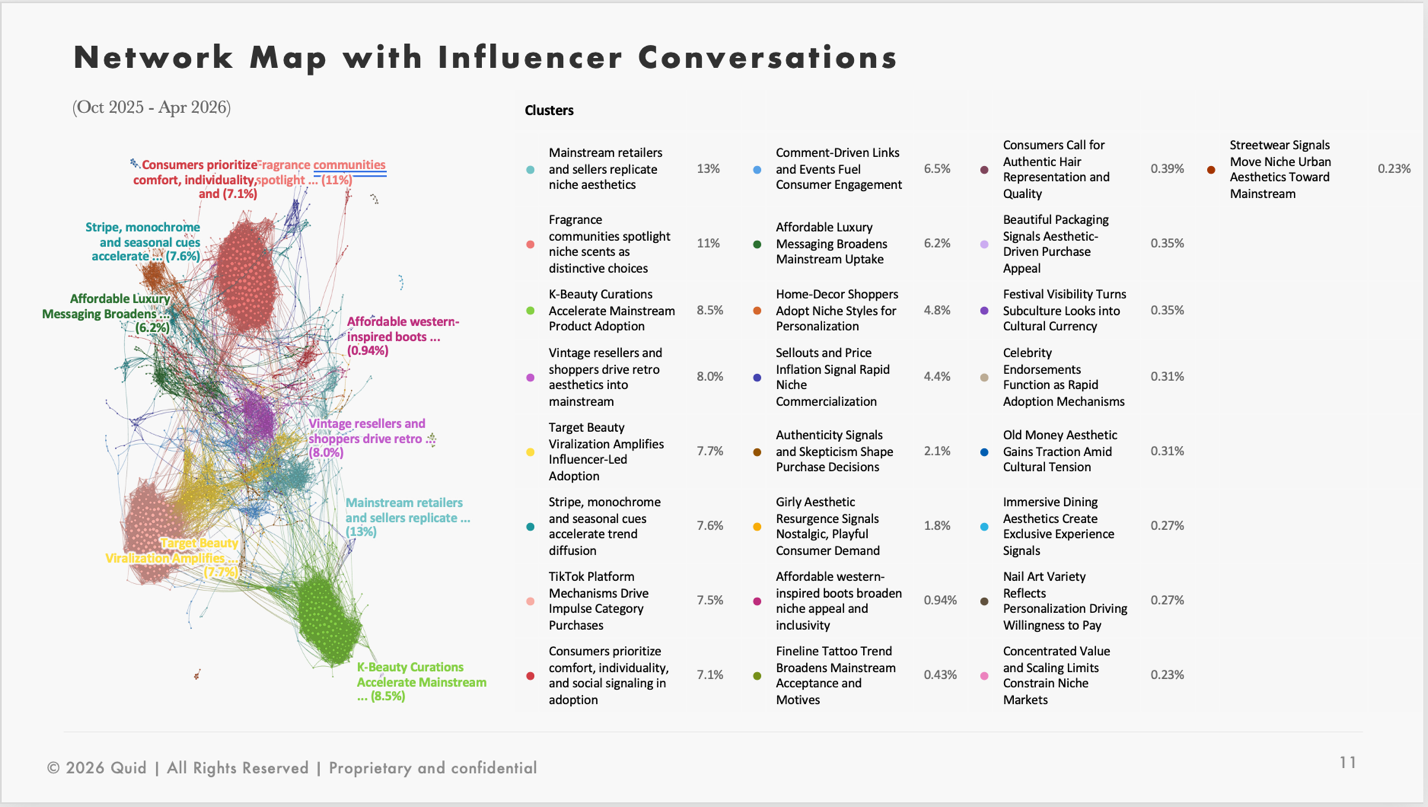
Quid's influencer network shows the different consumer conversations helping niche aesthetics move toward broader adoption, from mainstream retail replication and K-Beauty to fragrance, vintage fashion, and affordability. The network shows there is no single pathway from niche to mainstream. Several mechanisms can operate simultaneously.
Visibility alone does not guarantee adoption. Consumers also need ways to interpret what they are seeing. Creators provide that translation layer.
Fragrance communities, representing 11% of the displayed influencer network, illustrate the process particularly well. Creators describe scent profiles, compare niche, designer and dupe options and position fragrances around individuality and personal expression. Vintage creators do something similar by showing how retro and Y2K pieces can work in contemporary wardrobes.
TikTok also shortens the distance between discovery and purchase. The analysis identifies TikTok Shop, #TikTokMadeMeBuyIt, viral posts and shoppable links as mechanisms that can move consumers from seeing something to buying it.
Creators therefore do more than amplify trends. They can help audiences understand what a trend means, how to participate and where to get it.
For brands, that distinction matters. A rapidly growing aesthetic may represent awareness. Repeated creator interpretation, retail availability and purchase behavior provide additional evidence about whether consumers are beginning to adopt it.
The TikTok network points to several recurring adoption cues: affordability, comfort, individuality, personalization and visual appeal.
Affordable alternatives lower the financial barrier. Vintage combines nostalgia with practical styling and longevity. Home décor allows consumers to personalize an aesthetic rather than reproduce it exactly. Even western-inspired boots gain broader appeal when creators emphasize comfort, inclusive sizing, and versatility.
That suggests consumers may copy niche aesthetics wholesale, but they also adapt them. A trend becomes easier to adopt when consumers can fit it into their existing wardrobes, homes, routines, or identities.
This helps explain why replication matters so much. Retailers translate specialized aesthetics into forms more consumers can use.
The media network reveals another stage of the process. Its largest displayed cluster, at 9.5%, centers on community events bringing together creators, designers, media, partners and enthusiasts. Influencer-driven social platforms account for another 6.1%, while seasonal promotion, nostalgia, hospitality collaborations, cultural platforms and celebrity visibility all appear as significant pathways.
Media coverage also gives emerging trends recognizable language. Barrel-leg jeans provide a straightforward example. Editors and shopping publications package the silhouette as something consumers should consider now, pairing styling guidance with seasonal relevance and shopping recommendations.
Once an aesthetic has a recognizable name, visible examples and products consumers can readily purchase, participation requires much less explanation.
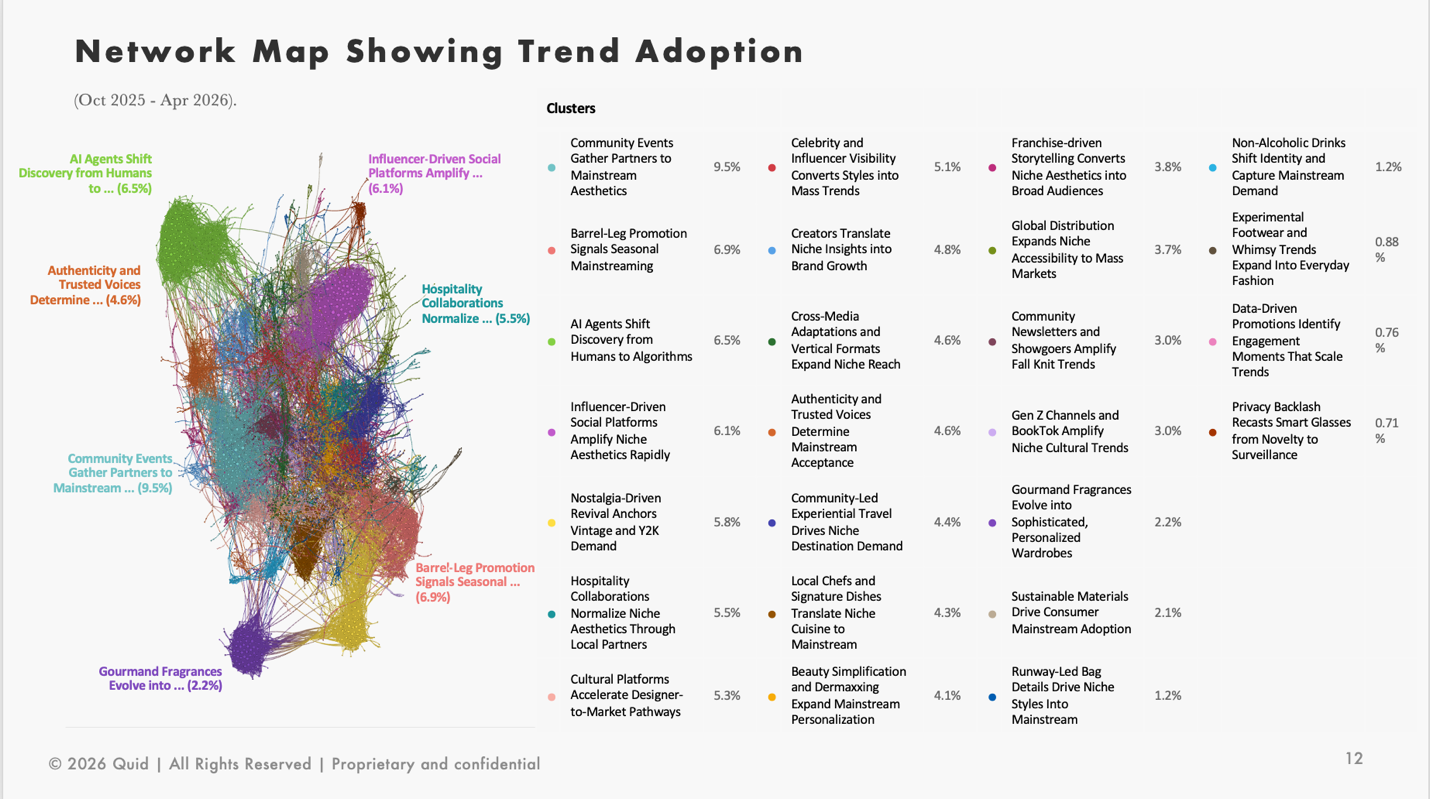
The media network shows how communities, editorial coverage, creators, cultural platforms, retail distribution and other forces interact as niche interests move toward wider adoption.
Placed beside the influencer network, the difference is useful. The TikTok network captures many consumer-facing signals around adoption. The media network reveals a broader infrastructure that can scale those signals. Brands need both views.
Some niche aesthetics already have one enormous advantage: consumers recognize them.
Vintage and Y2K demand accounts for 5.8% of the displayed media network and 8% of the influencer network. Across the source material, older styles return through vintage shopping, legacy products, reissues and contemporary reinterpretations.
Nostalgia gives consumers a familiar reference point while creators, retailers and media provide a current context. That pattern can help brands distinguish between something simply resurfacing online and something being rebuilt for contemporary demand.
Watch for the supporting signals: new retail availability, creator styling, updated products, editorial coverage, and repeated consumer adoption.
The media analysis surfaces a newer variable that could change the adoption path considerably.
AI agents shifting discovery from humans to algorithms account for 6.5% of the displayed media network. The underlying coverage describes shopping agents evaluating structured information such as pricing, specifications and availability as part of product discovery and evaluation.
That introduces another audience brands need to consider. A niche product may have strong cultural momentum among consumers and creators while remaining difficult for machine-mediated discovery systems to interpret. In that environment, product information and availability become part of discoverability alongside cultural relevance.
The adoption path can therefore involve both human and machine intermediaries.
Waiting until a trend is everywhere defeats much of the advantage of identifying it early. Our Quid analyses suggest brands should look for combinations of signals rather than treating virality as proof of future demand:
When several of those patterns appear together, brands have much more context for evaluating what they are seeing. That is the difference between spotting something popular and understanding how demand is forming.
The Trend Adoption Path: Community or niche interest → creator translation → repeated visibility → media normalization → retail accessibility → consumer adoption → broader distribution
The most valuable question for brands isn’t, "What's trending?" By the time the answer is obvious, competitors can see it too. The more useful questions are where a trend is coming from, which communities are carrying it, what is making participation easier and whether the surrounding signals indicate that interest is spreading beyond its original audience.
Quid helps brands examine those relationships across millions of conversations and sources, giving teams a way to see not only what is gaining attention but how ideas, aesthetics and behaviors are moving through the market.
Want to understand which emerging signals could become your next market opportunity? Contact Quid to see how connected consumer and media intelligence can help you identify the patterns behind trend adoption.
What is trend adoption?
Trend adoption describes the process through which an idea, product, aesthetic or behavior spreads from an initial audience into broader consumer use.
What signals suggest a niche trend may be expanding?
The analysis identifies signals including repeated creator exposure, community participation, editorial coverage, retail replication, increased accessibility, social validation and broader distribution.
Why are influencers important to trend adoption?
Influencers can introduce niche products and aesthetics to wider audiences while demonstrating how to understand, style, use or purchase them.
How can retailers accelerate trend adoption?
Retailers can make niche aesthetics easier to participate in by increasing availability, offering accessible versions and incorporating emerging styles into familiar shopping environments.
How is AI changing product discovery?
The media analysis identifies AI agents as an emerging discovery mechanism in which structured product information such as price, specifications and availability can influence whether products enter machine-mediated consideration.
How can brands use Quid to understand emerging trends?
Quid allows brands to analyze connected consumer conversations and media coverage, helping teams examine the communities, themes and adoption mechanisms surrounding an emerging trend.