


Key Takeaways
Skincare innovation signals show up in four places, and rarely in the same place first. Social conversation shows what consumers want now, patents show what engineers are building, company data shows how products reach market, and news shows the wider shifts around all three. Reading them side by side, in one search, turns scattered signals into a pipeline view.
Social listening shows what consumers want today, but it can't show what's technically possible or already moving toward market. In a six-month skincare sample, several of the strongest innovation signals barely appeared on social at all.
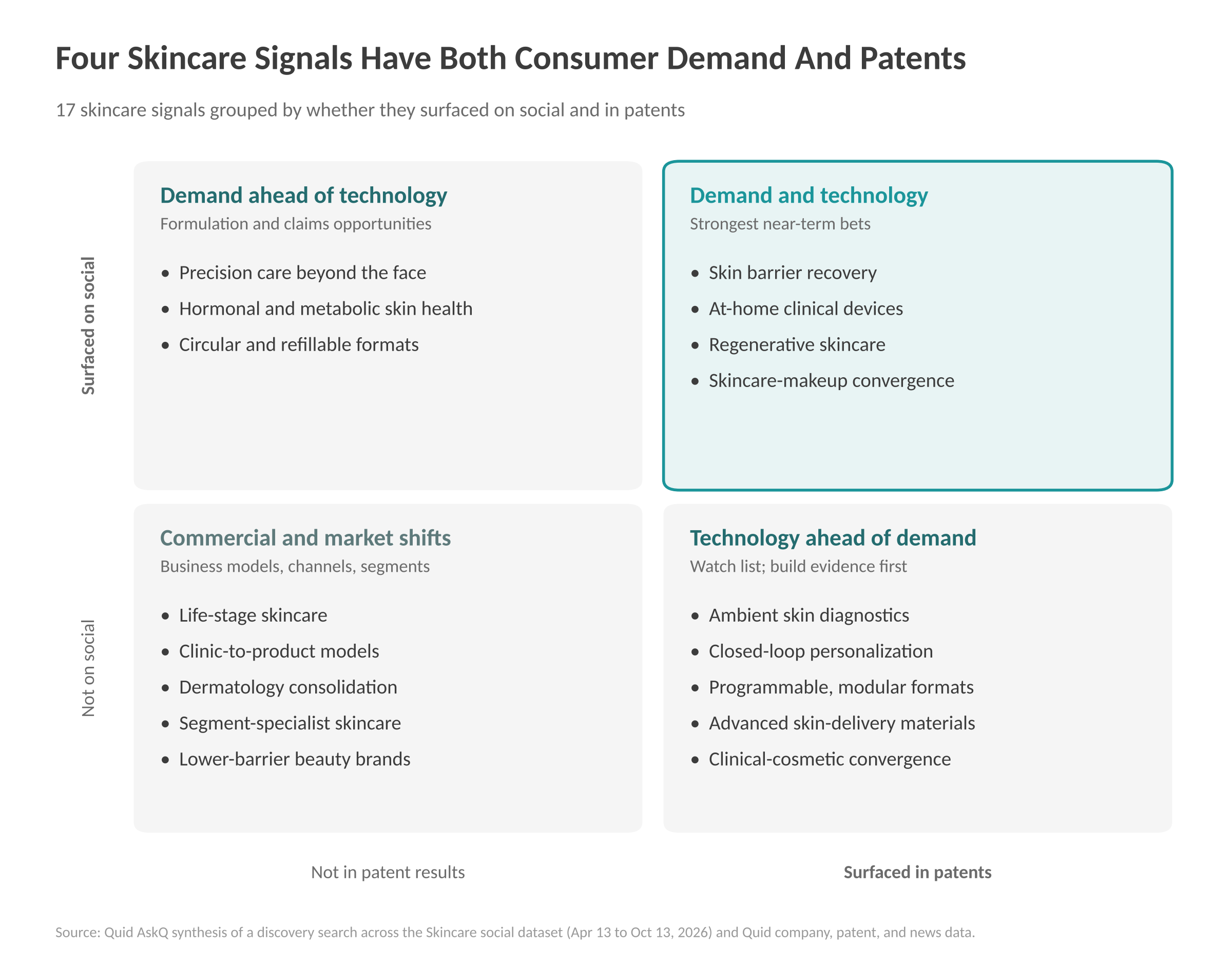
Ambient skin diagnostics, advanced delivery materials, and dermatology clinic consolidation came almost entirely from patents and company data. A team watching only social conversation would have missed all three.
The reverse holds too. Patents show that companies are filing on regenerative actives such as exosomes and PDRN, but only social shows how skeptical consumers are about whether those topicals work. That gap between engineering effort and consumer belief is what an R&D team needs to see before committing to a claim.
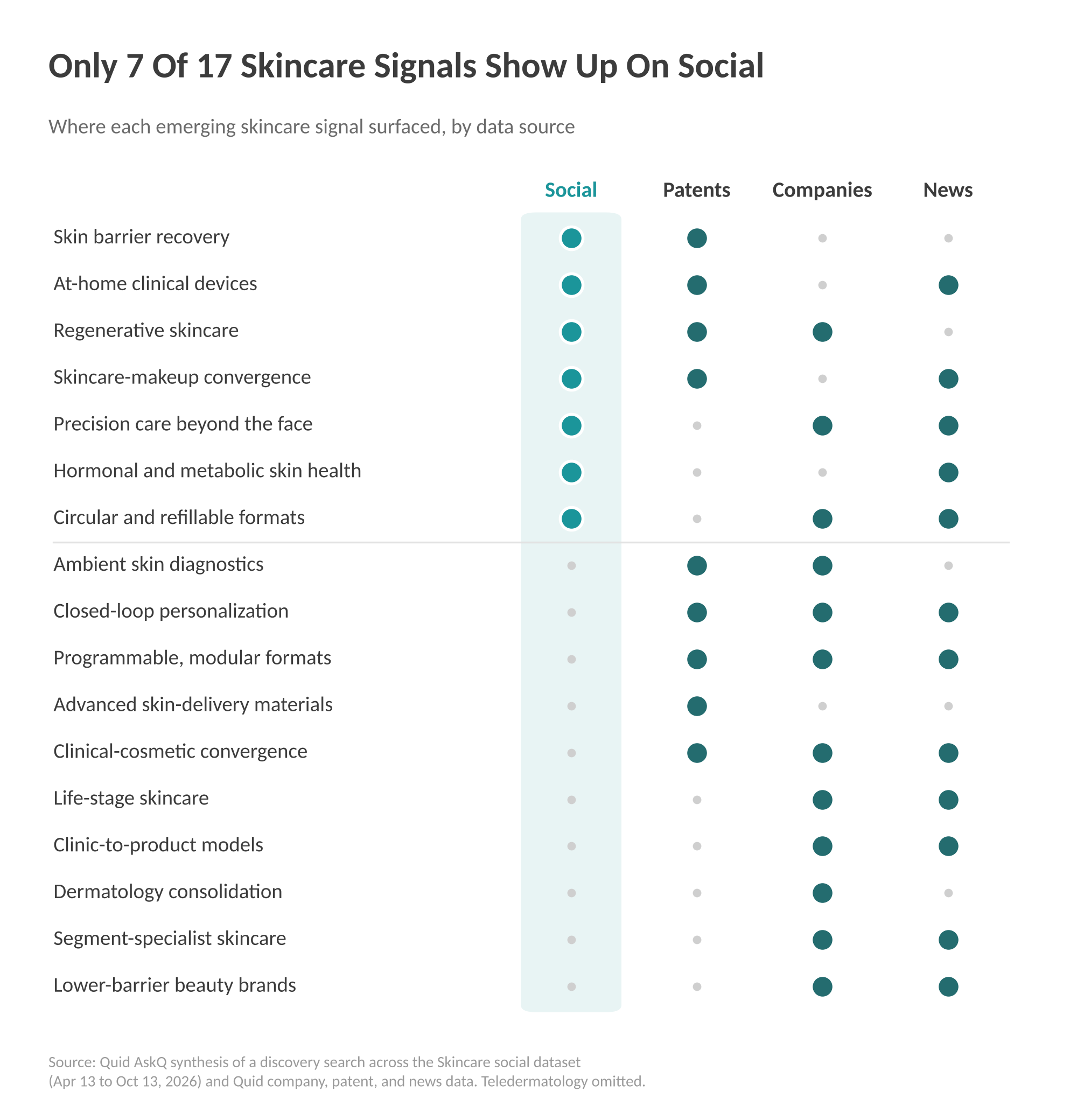
A discovery search asks one question across all four sources at once and tells the model not to start from a predefined list. The prompt behind this analysis asked AskQ for emerging opportunities in and around skincare using companies, patents, news, and the last six months of the Skincare dataset.
Two instructions did most of the work. The first told AskQ to go broad: ingredients, need states, formats, delivery technologies, diagnostics, consumer segments, business models, and innovation from outside the category, such as pharma, biotech, apparel, and digital health. The second told it to weight all four sources equally and not use companies, patents, or news only to confirm what social surfaced.
That second instruction matters most. Without it, a model tends to anchor on social volume and treat the other sources as supporting evidence, which hides anything that hasn't reached consumers yet.
The first answer returned eight themes, each with post counts, engagement, sample posts, and a summary of which sources carried it. A single follow-up asking for a list of signals by source produced 18.
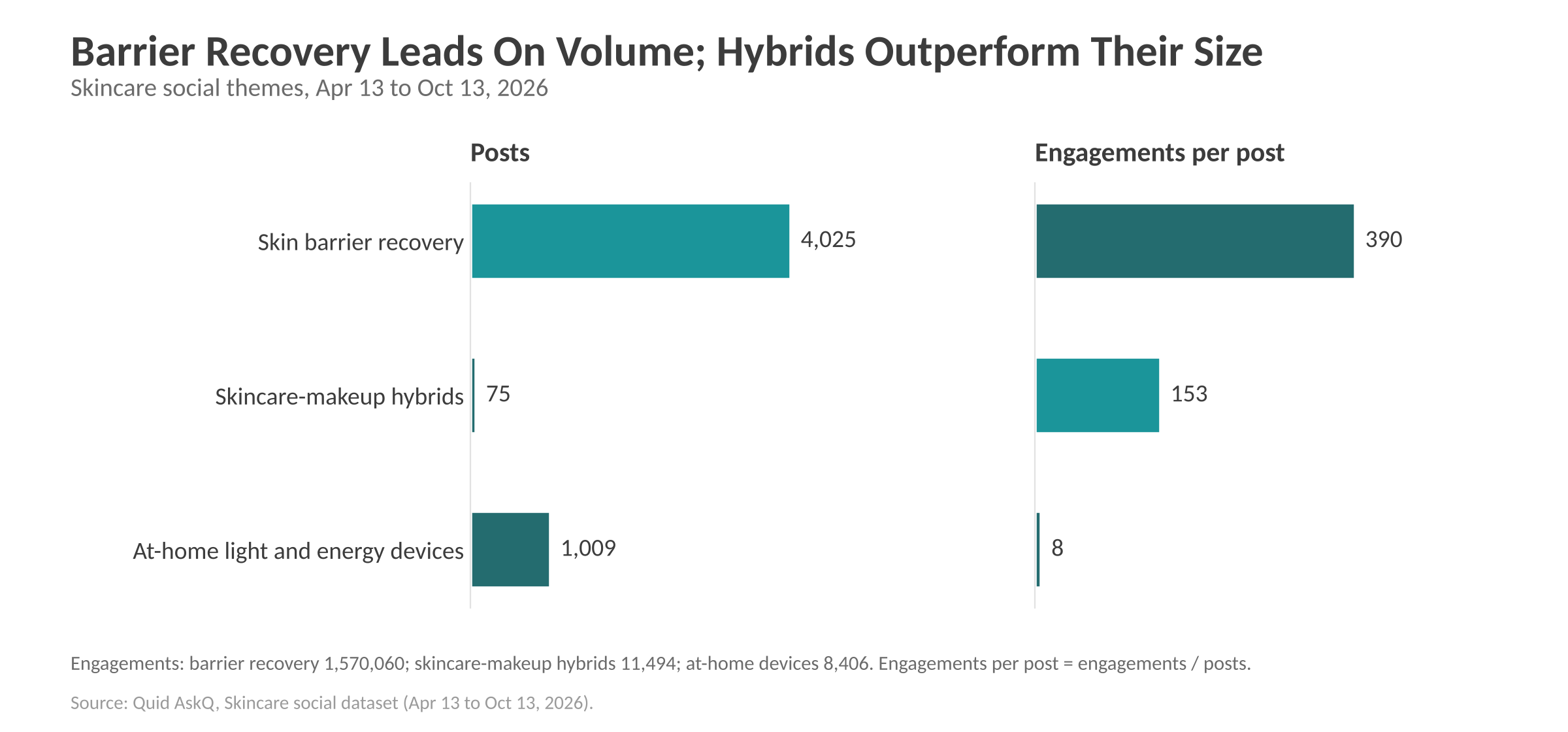
Skincare consumers want simpler routines that repair damage, and they're curious about clinic-style results at home. Between April 13 and October 13, 2026, skin barrier recovery generated 4K posts and 1.6M engagements, far more than any other theme.
The barrier conversation is a reaction to overuse. Posts describe damaged skin from too many actives and exfoliants, and a return to three or four gentle products until skin calms down.
At-home light and energy devices drew about 1K posts. The tone is evaluative: people test LED masks and home IPL for a month, compare results, and question build quality and price.
Skincare-makeup hybrids were small but sticky, with 75 posts and 11K engagements. Serum-based concealers and peptide cushion creams appealed to consumers who expect makeup to improve skin over time.
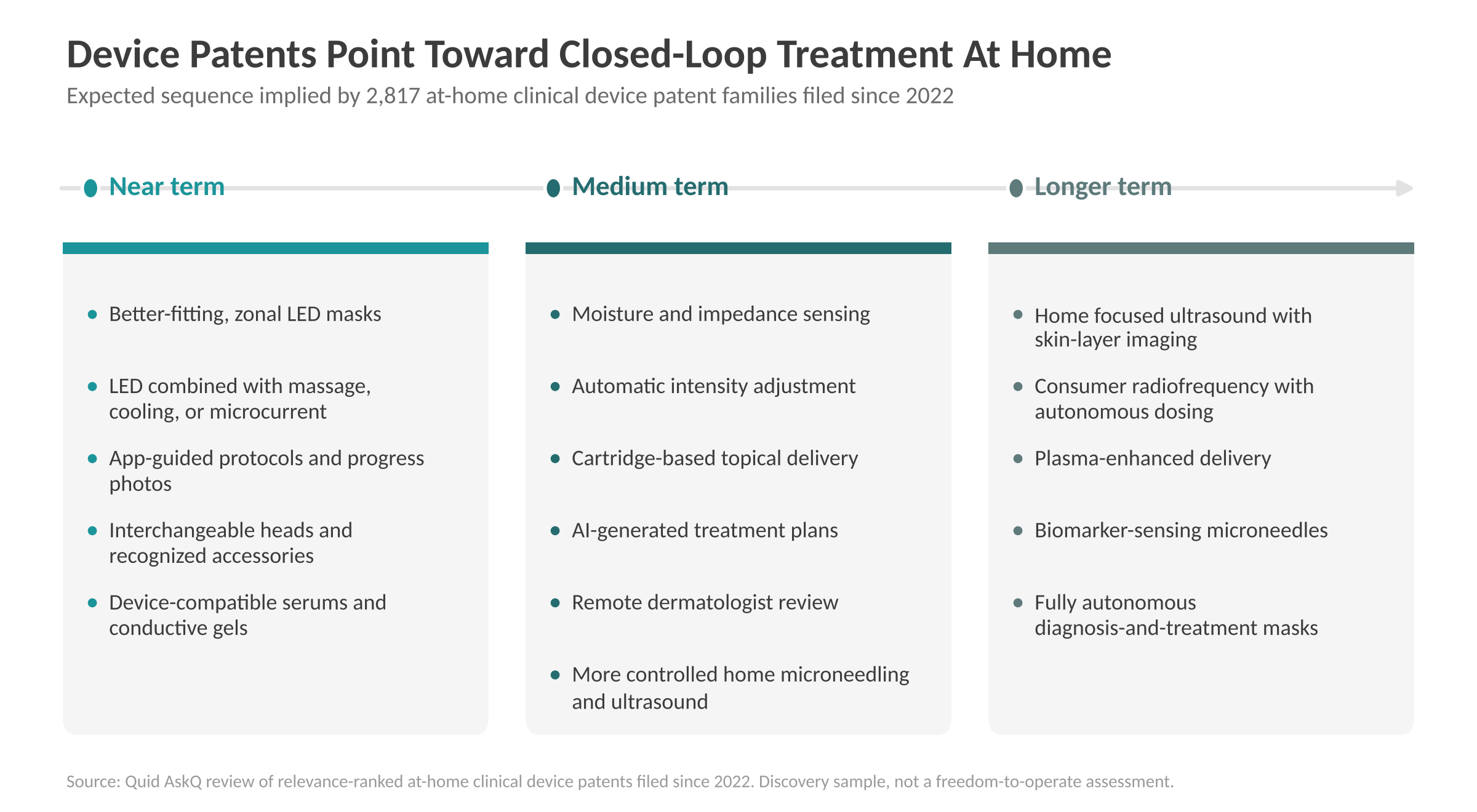
Patents point to at-home devices that diagnose before they treat, and to formulas built to work with them. A search of patents filed since 2022 surfaced 2.8K relevant families on at-home clinical devices.
The pattern across those filings is a closed loop: scan the skin, detect a condition, choose a protocol, deliver treatment, and track the result. LED masks become zonal, with different wavelengths by facial area and cameras that adjust in real time. Devices combine light, microcurrent, radiofrequency, and ultrasound in one handset.
The clearest signal for formulators is interdependence. Patents describe serum cartridges, devices that recognize which formula is attached, and ultrasound heads that push serum into the skin. That points toward device-plus-consumable systems where the repeat purchase is the formula, not the hardware.
A separate search on skin-delivery materials found 4K patent families. The closest to everyday formulation are nanocellulose carriers that stabilize vitamin C, masks that release ingredients in sequence, and microneedle patches for blemishes and post-procedure care.
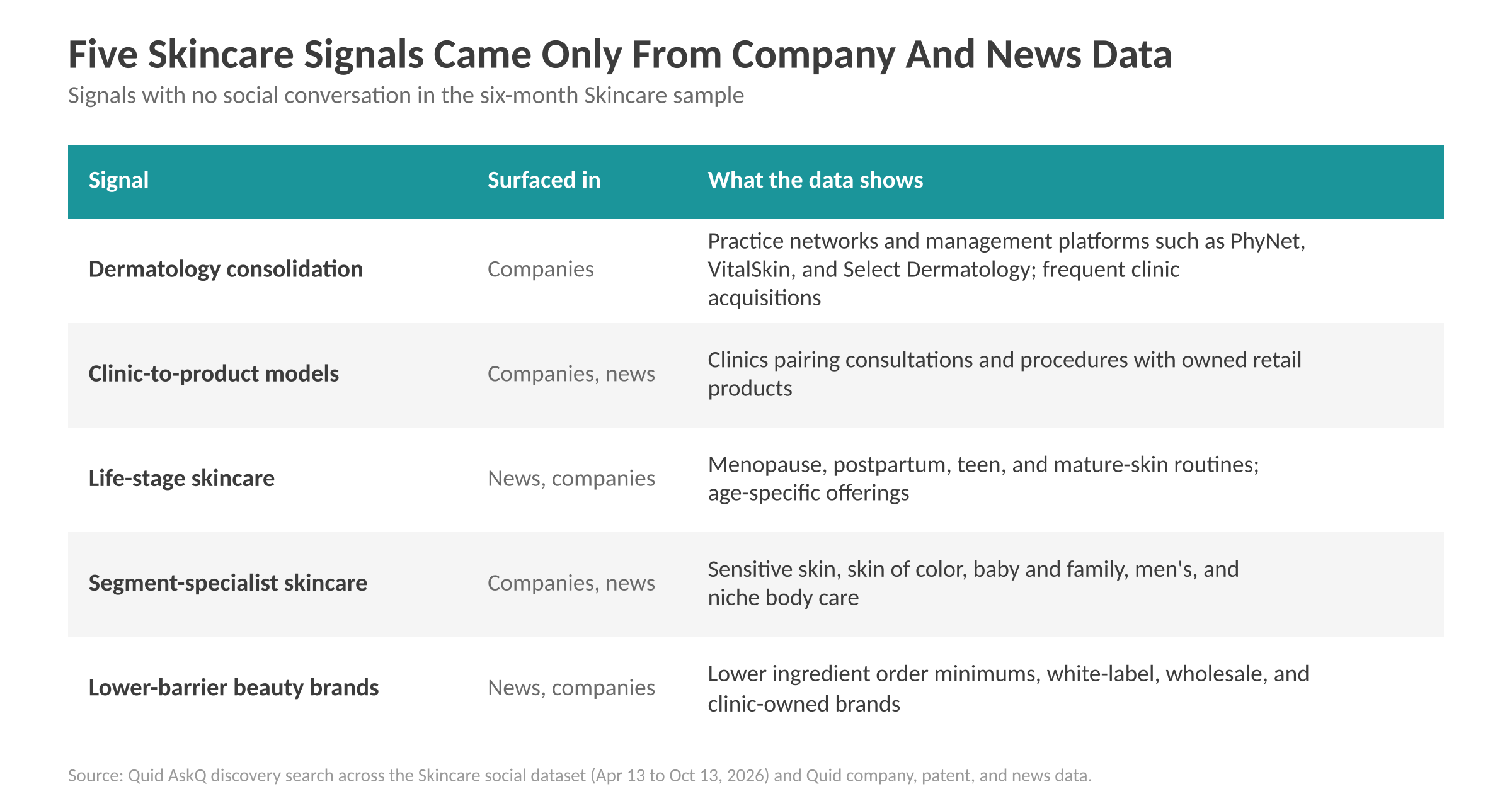
The commercial side of skincare innovation sits mostly in company and news data.
Dermatology consolidation is the clearest source-exclusive signal. Company data shows practice networks and management platforms, including PhyNet, VitalSkin, and Select Dermatology, alongside frequent clinic acquisitions. Many of those clinics now pair consultations and procedures with their own retail products.
News carried the life-stage and health signals: menopause and postpartum skin, hormonal acne, and skin and nail effects associated with GLP-1 drugs. It also flagged lower ingredient order minimums and white-label manufacturing, which lets smaller brands launch targeted products.
The strongest bets sit where social demand and patent activity overlap. The first answer already paired them, suggesting recovery serums and cartridge boosters for home LED masks; a follow-up on device patents then showed where that hardware is heading.
That overlap suggests a device-adjacent product: a barrier-recovery serum built for use after LED or microcurrent treatment, rather than new hardware. Consumer demand exists, the patents show where devices are heading, and the formula carries the repeat purchase.
Signals with heavy patent activity and little social conversation, such as ambient diagnostics, belong on a watch list. Signals with strong social demand and weak technology, such as skepticism around PDRN, call for evidence and clearer claims before launch.
What data sources help skincare product teams spot innovation early?
Social conversation, patents, company data, and news each reveal different signals. Social shows current consumer demand, patents show what is being engineered, company data shows business models and new entrants, and news tracks wider shifts such as life-stage and hormonal skin health. Reading all four together shows signals that any single source would miss.
Can social listening predict skincare trends?
Social listening shows demand once consumers start talking, which makes it strong for validating needs but late for technology-led change. In a six-month 2026 skincare sample, ambient skin diagnostics such as smart mirrors and skin sensors showed up mostly in patents, with little social conversation. Pairing social data with patents and company data catches signals earlier.
How do patents help consumer product innovation teams?
Patents show what companies are building before it reaches shelves. Skincare device patents filed since 2022, for example, describe serum cartridges, zonal LED masks, and skin sensors that adjust treatment. Product teams can use those filings to judge which formats, delivery systems, and device pairings are likely to arrive over the next few product cycles.
What are the biggest skincare innovation signals in 2026?
Skin barrier recovery led social conversation in 2026, with 4K posts and 1.6M engagements between April and October. Other signals include at-home devices that diagnose and treat, skincare-makeup hybrids, regenerative actives such as PDRN, precision care for the body and life stages, and dermatology clinics selling their own products.
How does Quid combine social, news, patent, and company data?
Quid holds social, news, patent, and company data in one platform, and its AskQ assistant can query all four with a single natural-language prompt. A team can ask for emerging opportunities across sources, then follow up on any signal, such as what device patents suggest is coming, without switching tools or exporting data.
Is a patent search in Quid a freedom-to-operate analysis?
No. Patent results in Quid are relevance-ranked discovery samples meant to show innovation direction, not legal assessments. They help R&D and product teams spot where filings are clustering and which technologies are gaining momentum. Freedom-to-operate and patentability questions still need review by patent counsel.