

.png?width=1252&height=362&name=QUID_Logo_WHITE%20(2).png)
Key Takeaways:
If you've read much answer engine optimization (AEO) advice lately, you've probably seen social media positioned as a direct lever for AI visibility that you can prioritize and optimize the way you would a blog or landing page.
The technical reality is more complicated than that. Most social platforms barely register in AI citation data, because their content isn't built to be crawled and indexed the way AI systems need. A handful of platforms are the exception, and they're cited for structural reasons that have nothing to do with likes or shares.
Here's what the research actually shows about social media's role in AI search visibility, and what that means for where to focus instead.
The technical requirements for getting cited in AI answers aren’t too different from ranking in traditional search. Before a page can be cited, it generally needs to pass a few hurdles:
These requirements are where many social platforms run into trouble. Instagram, TikTok, Facebook, and X/Twitter are all technically crawlable and indexable sites, but they show up rarely in AI citation data. A few structural patterns seem to be at play:
None of this means social content is categorically excluded. It just means the format itself works against the kind of persistent, parseable text that LLMs tend to rely on. That said, there are a few exceptions.
A small number of platforms appear in citation data far more often than others, largely because they behave more like traditional web pages than social feeds:
In short, these platforms provide what answer engines are designed to work with: publicly accessible content, stable URLs, and substantial amounts of indexable text. But showing up in the right format is only the start. So what determines whether your content actually gets surfaced?
Being in the right format gets you considered. Whether a social post is actually surfaced seems to come down to criteria like whether it fits the search intent and keywords, and how recent it is. Increasingly, LLMs are also looking at how consistently the same information shows up across other sources.
AI systems generally don't lean on a single source for a claim, even a well-structured one. They look for agreement across multiple sources — news coverage, forums, review sites, brand mentions — to corroborate the claim.
This reframes what social media's role likely is in AEO. Rather than being a citation source on its own, it tends to function more as an upstream amplifier. A TikTok video gains traction, that traction prompts a news article or a Reddit discussion, and it's that downstream coverage, not the original post, that's more likely to get cited.
Unfortunately, there’s still a lot of uncertainty. AI citation behavior is inconsistent across ChatGPT, Gemini, and Perplexity, and the way any one of them behaves can change without much warning.
The underlying mechanics aren't public, so a lot of this comes down to informed observation rather than confirmed rules. How recency is weighted, whether engagement (likes, shares, upvotes) factors in, and how source diversity actually gets scored are all still unclear.
Given all that, it's worth being skeptical of anyone offering a precise, repeatable formula for AEO. The mechanics described above (crawlability, format, consensus) hold up as directional patterns, but anyone promising a guaranteed checklist to visibility is overselling what's actually knowable right now.
Of course, that uncertainty doesn't mean there's nothing to act on. It just means the actions look more like principles than tactics.
While exact algorithms aren't fully knowable, we can still build toward the patterns that do seem to hold up. A few practices worth following:
Of course, all of this raises a practical question: if AI citation models are opaque and constantly changing, how can brands tell whether these efforts are actually working?
That's one of the biggest challenges in AEO today. Traditional SEO gives you rankings, impressions, and clicks. AI search is much harder to measure because visibility is distributed across multiple systems.
Tracking a handful of keywords or monitoring a single AI platform rarely tells the whole story. What's more useful is understanding how your brand is being described across the broader information ecosystem: news articles, forums, reviews, websites, search results, social conversations, and AI-generated answers.
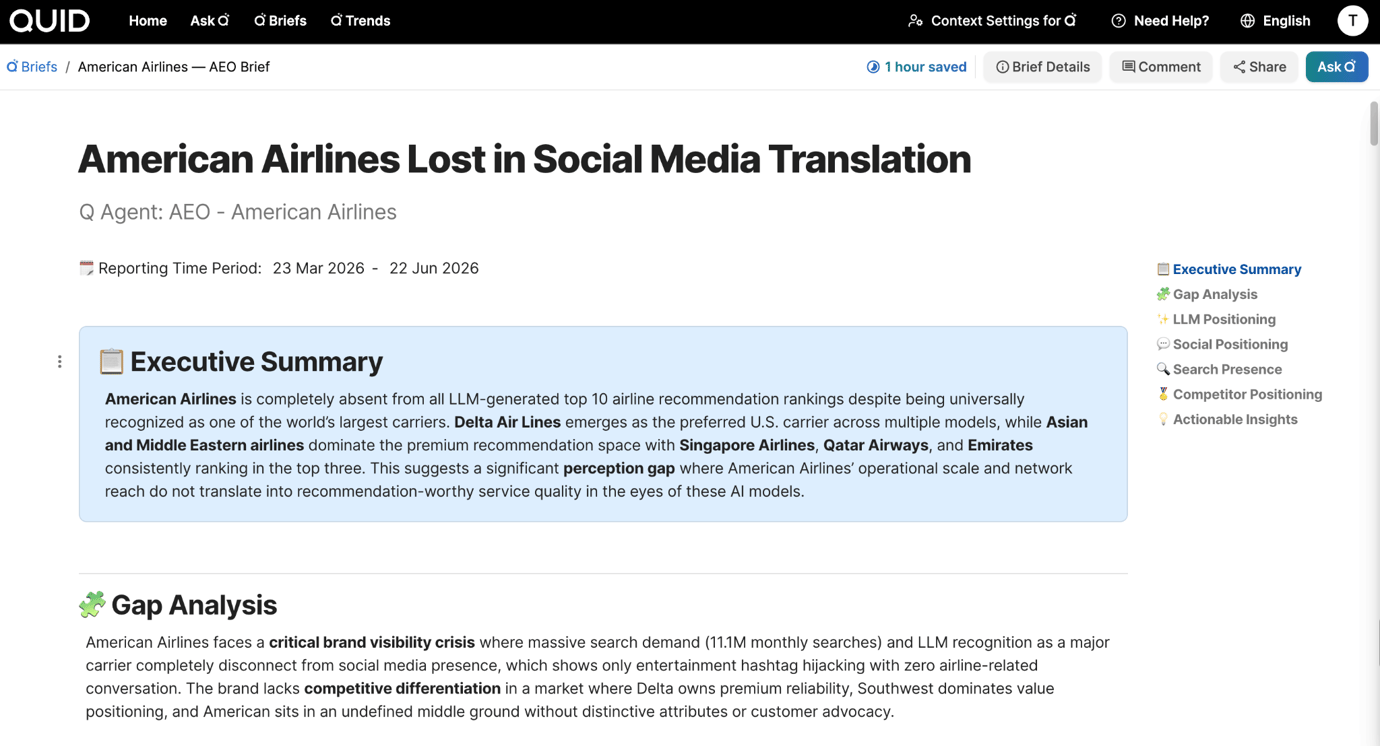
Quid's AEO Agent is designed to help brands see that bigger picture. Given a brand, product, and category context, it analyzes how they're represented across AI platforms, search, social media, news, forums, and other online sources. The purpose is to identify recurring themes, compare positioning against competitors, and uncover gaps between how a brand wants to be perceived and how it's actually being described online.
Take American Airlines, for example. By analyzing the company's cross-channel presence, the AEO Agent surfaced how the brand is positioned in AI-generated answers, how it appears in search, how it's discussed on social media, and how that compares with competing airlines. It then translated those findings into recommendations that can help strengthen visibility and messaging consistency over time.
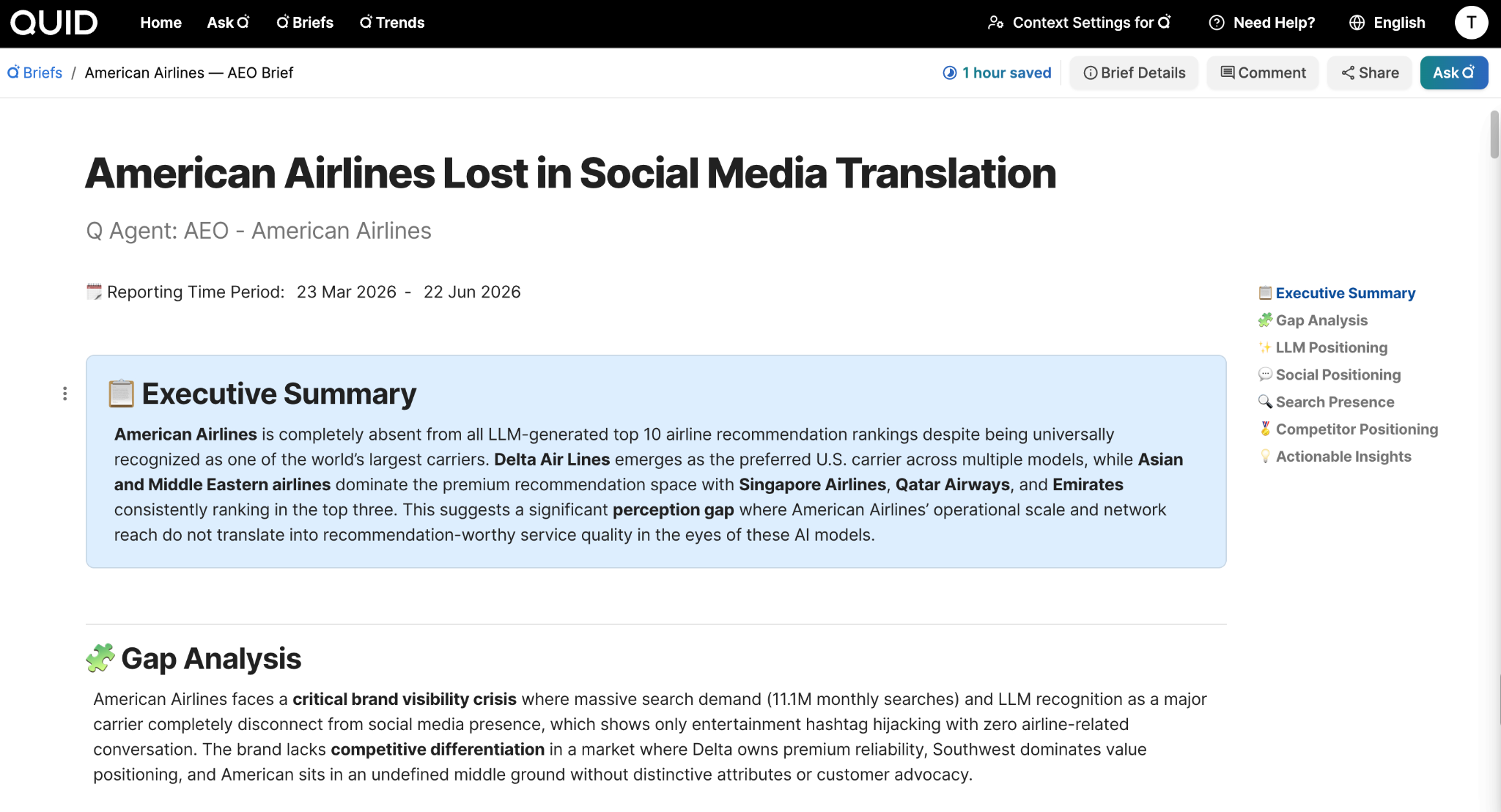
Check out the full brief to see the insights Quid's AEO Agent can surface.
The crawlability limitations of LLMs create a real intelligence gap in social media video content, which is where most trends start, thrive, or die. If AI systems can't process video content, and most analytics tools are limited to engagement metrics like views and shares, brands are largely flying blind on what's actually driving cultural traction on TikTok and similar platforms. High view counts tell you something resonated. They don't tell you what, or why, or whether it's a signal worth acting on.
This is the problem Quid's Popular Videos Q Agent is designed to solve. Instead of relying on what crawlers can passively extract from metadata, the agent actively analyzes the top-performing videos across TikTok, Instagram, YouTube, and X to surface the themes, moments, and narratives driving engagement. No manual review required.

The distinction matters for teams trying to connect social trends to broader strategy. A campaign manager who knows a hashtag is trending has a starting point. One who understands the content formats, creator behaviors, and audience dynamics fueling that trend has something they can act on: informing content strategy, spotting cultural moments before they peak, or tracking how competitors are showing up in a space.
For AEO specifically, this kind of intelligence helps close the gap between what's gaining momentum on social and what's likely to surface in AI-generated answers. Trends that start on TikTok often become news articles, forum discussions, and eventually the cross-platform consensus that answer engines cite (but after the trend has peaked). Catching those signals early, before they've spread to the sources AI systems can read, and being able to act before competitors, is where the advantage lives.
The relationship between social media and AI search is more nuanced than many AEO guides suggest. While most social media platforms aren’t major citation sources, they do help ideas gain traction, spread across the web, and become part of the broader body of information that answer engines draw from.
That distinction matters because it changes what brands should be paying attention to. Rather than asking whether a single post was cited by an AI system, the more useful question is whether your expertise, messaging, and brand narrative are showing up consistently across the ecosystem of sources that influence AI-generated answers.
As AI search continues to evolve, the brands with the strongest visibility won't necessarily be the loudest. They'll be the ones that understand how they're being presented across the wider landscape and can identify where that story needs strengthening.
No AI company publicly discloses exactly how its retrieval and citation systems work, but several factors appear consistently important. Content generally needs to be accessible to crawlers, contain clear and indexable text, and be supported by corroborating information elsewhere on the web. AI systems also seem to favor content that directly answers a user's question and is recent.
Social media appears to influence AI visibility mainly through amplification rather than direct citation. A social post can spark discussions, media coverage, reviews, blog posts, and community conversations that become part of the broader information ecosystem LLMs reference. In that sense, social helps create visibility signals even if the original post is never cited.
Brands should focus on making social content easy to understand, share, and reference. That includes using descriptive captions, publishing text-rich content where possible, sharing original insights, and using social channels to distribute content that can gain traction beyond the platform itself.
AEO is harder to measure than traditional SEO because visibility is spread across multiple AI platforms and information sources. Tools like Quid's AEO Agent can help by showing how a brand is represented across AI platforms, search, social media, news, forums, and other online sources.