

.png?width=1252&height=362&name=QUID_Logo_WHITE%20(2).png)
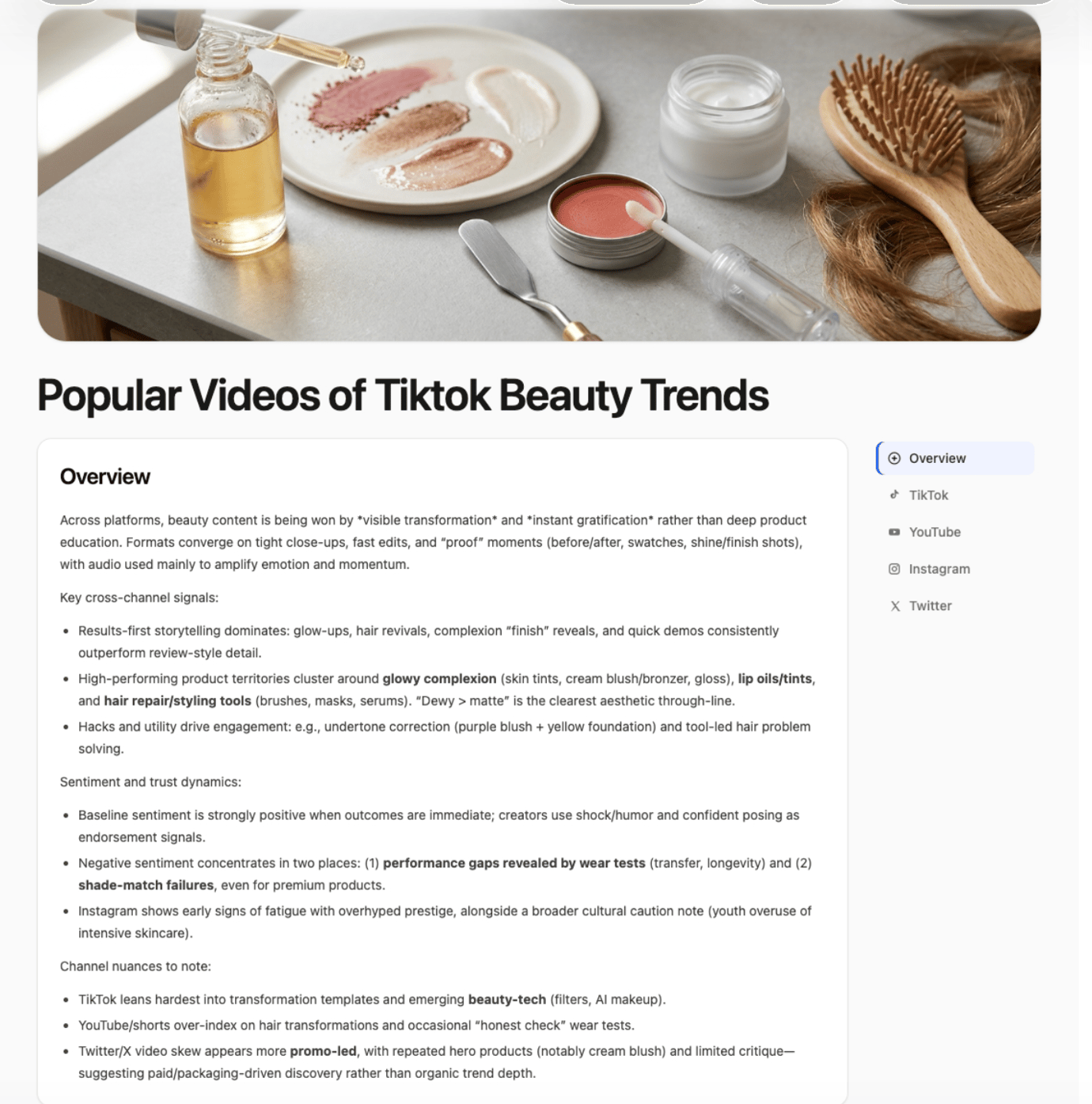
Most trend tools are reading text. Hashtags, captions, keywords — they're scanning what people write about content, not what the content actually is. That works up to a point, but it leaves out the most important part: what's happening in the video itself. The visual language, the edit style, the audio choices, the specific moment a creator holds a product up to the camera and why that moment lands. None of that lives in a caption.
Trend intelligence built on text signals is useful, but it's incomplete. And in a landscape where the difference between a piece of content that goes viral and one that doesn't often comes down to a creative decision made in the first two seconds, incomplete is a meaningful problem.
Quid's Popular Videos Q Agent was built to solve it.
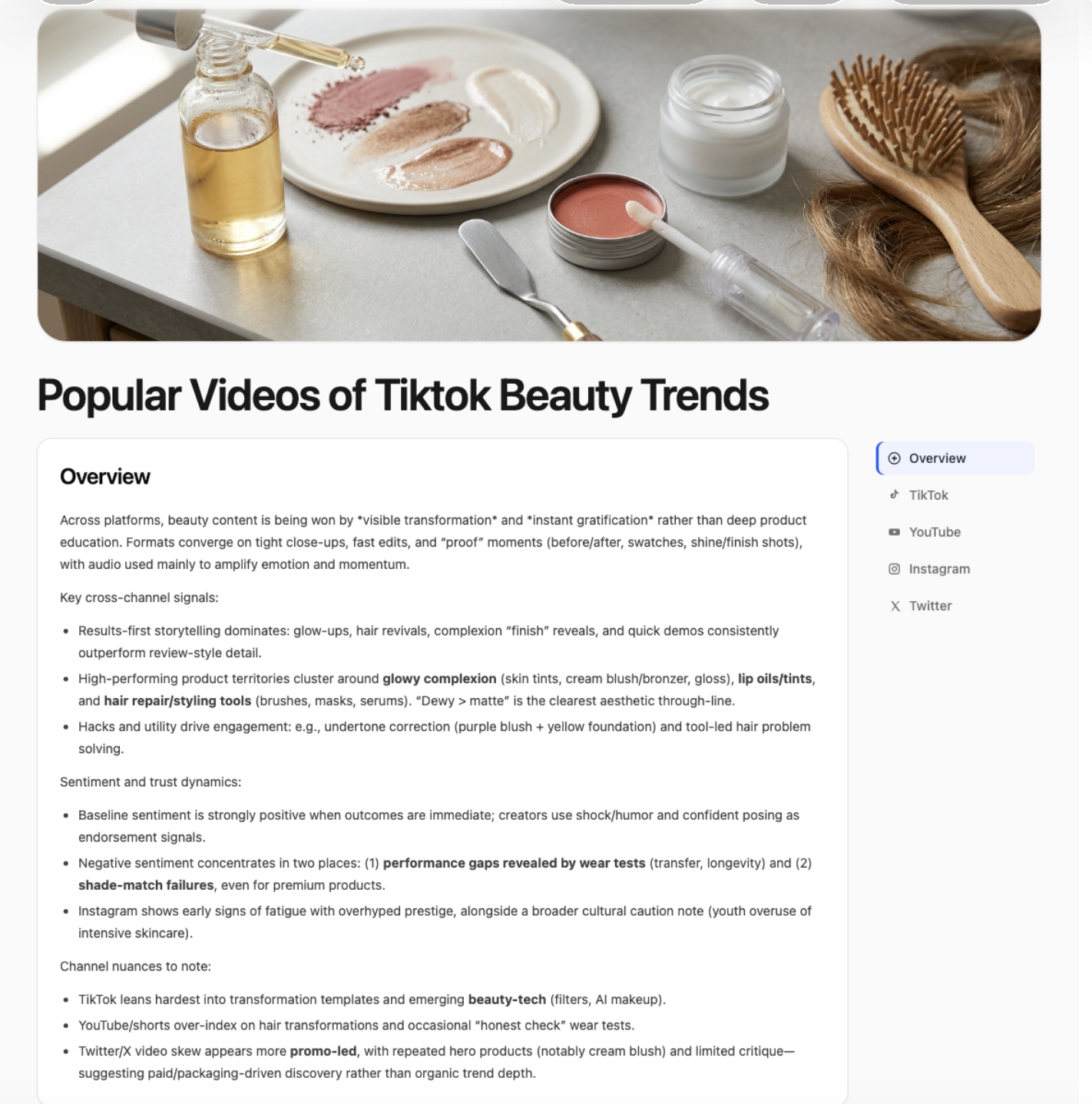
The Popular Videos Q Agent analyzes the highest-performing videos across major social platforms for any subject you define. You give it a topic, a brand, a category, a trend you want to understand. It pulls the top-performing videos from the past month, analyzes what's actually in them, and returns a structured brief covering cross-platform trends, platform-specific takeaways, visual and audio patterns, content formats, audience hooks, and brand safety risks like misinformation or content that creates category-level exposure. The whole thing runs in about 10 minutes.
What makes this genuinely different from most tools on the market is that the analysis starts with the videos, not the text around them. The brief tells you why content is performing, what creative mechanics are driving engagement, and what any brand or content team can actually learn from it. That's a different category of intelligence than knowing which hashtags are trending.
Running the agent on TikTok Beauty Trends produces a brief that covers TikTok, YouTube, Instagram, and Twitter/X, with a synthesis of cross-platform signals at the top before breaking down what each platform is doing differently.
The cross-platform picture that emerged from a June 2026 run of the brief: beauty content across all four platforms is being won by visible transformation and instant gratification rather than deep product education. Formats are converging on tight close-ups, fast edits, and proof moments including before/afters, swatches, and shine/finish shots, with audio used mainly to amplify emotion and momentum rather than explain a product. High-performing product territories cluster around glowy complexion products like skin tints, cream blush, bronzer, and gloss, along with lip oils and tints and hair repair and styling tools. Hacks and utility drive some of the strongest engagement: the brief surfaced a technique of mixing purple blush into overly yellow foundation to correct undertones that generated the strongest verbal reaction and most overwhelmingly positive sentiment of any content analyzed across the entire dataset.
Negative sentiment, when it does appear, concentrates in two predictable places: performance gaps revealed by wear tests, specifically transfer and longevity, and shade-match failures, even for premium products. That's useful not just as a content signal but as a product positioning and brand safety signal. Knowing where sentiment breaks is as valuable as knowing where it builds.
From there, the brief goes platform by platform.

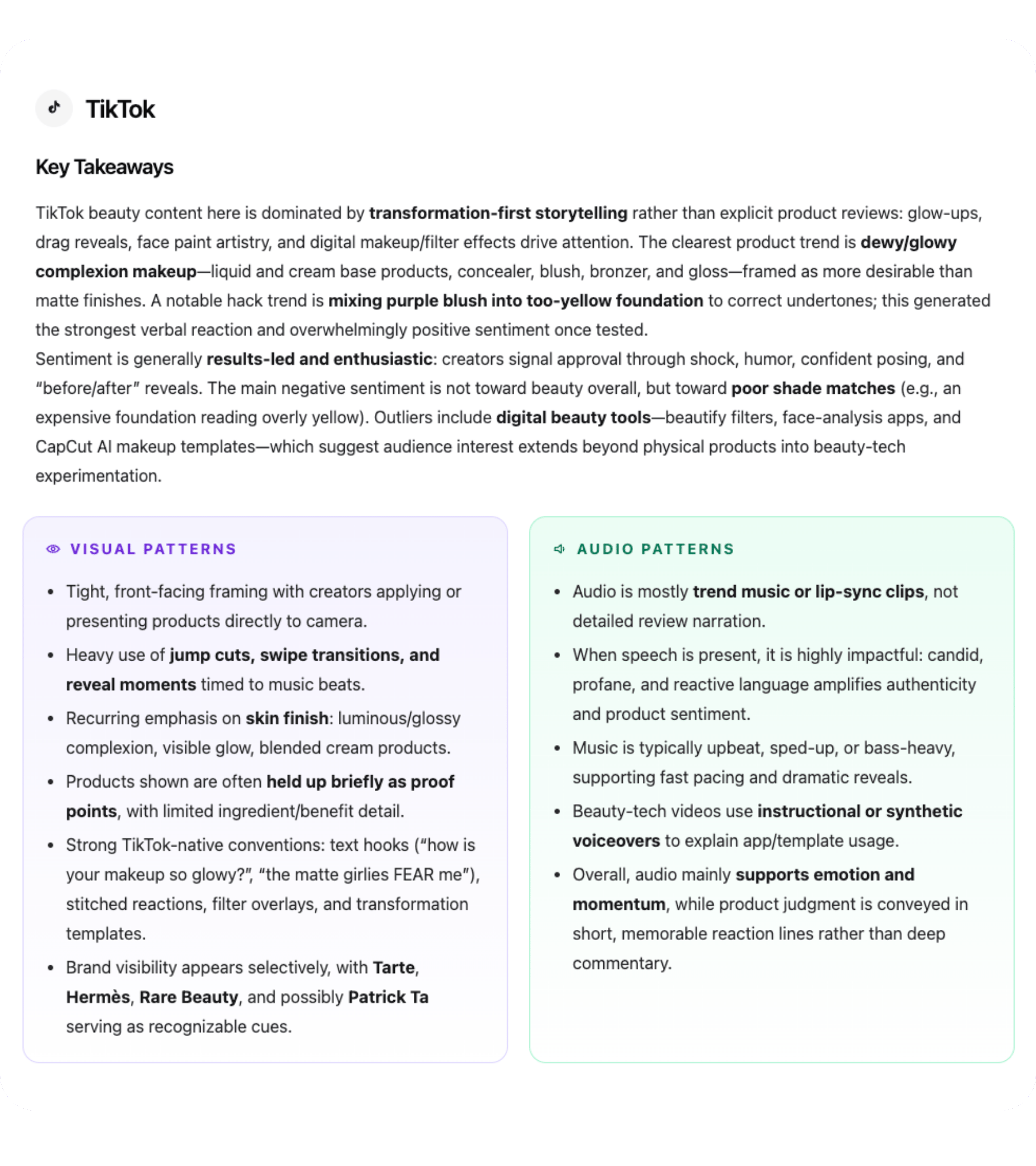
On TikTok, beauty content is dominated by transformation-first storytelling: glow-ups, drag reveals, face paint artistry, and digital makeup and filter effects drive attention far more than explicit product reviews. The clearest product trend is dewy and glowy complexion makeup, with liquid and cream base products, concealer, blush, bronzer, and gloss consistently framed as more desirable than matte finishes. Brand visibility is selective, with Tarte, Hermès, Rare Beauty, and Patrick Ta appearing as recognizable cues. The visual pattern is tight front-facing framing with creators applying or presenting products directly to camera, heavy use of jump cuts, swipe transitions, and reveal moments timed to music beats. Audio is mostly trend music or lip-sync clips rather than detailed review narration. Beauty-tech content, including beautify filters, face-analysis apps, and AI makeup templates, signals that audience interest is extending beyond physical products into experimentation with the tools themselves.
YouTube skews toward hair transformation and lip and suncare products, with sentiment strongly positive when results are immediate and dramatic. Hair content frames products as confidence-builders, positioning curl revival tools, blowout brushes, steam brushes, hair masks, and scalp serums as solutions to frizz, flatness, damage, and tangling. Lip products stand out too, particularly heritage-inspired items like Moroccan lipstick from Aker Fassi and celebrity-backed Huda Beauty lip combos. The notable outlier is a Huda wear-test piece where creator excitement turns to disappointment after a real-world check, which is one of the few places negative sentiment surfaces in a category that otherwise runs strongly positive. Platform-native hooks lean into reaction stitches, greenscreen framing, exaggerated problem setups, and rapid edits, with audio pairing visuals to upbeat music or mashups and letting the transformation sell itself without much narration.
Expanding a post also gives both visual and audio highlights to pain the full narrative picture.
.png?width=443&height=421&name=image%20(35).png)
.png?width=483&height=419&name=image%20(34).png)
Instagram presents a more complicated picture. The feed is dominated by makeup, lip, brow, skincare, and hair-repair products, with sentiment split between aspirational enthusiasm and growing skepticism. Positive momentum clusters around products that promise visible payoff with low effort: lip oils and tints, glosses, brow gels, blush-led routines, skin tints, and bond-repair hair care. Brand-led content from Kylie Cosmetics, Rare Beauty, Dove, La Roche-Posay, e.l.f., ColourPop, and Makeup By Mario frames those products as practical, hydrating, youthful, and accessible for beach or day wear. But there is a meaningful counter-theme developing: consumer backlash to overhyped prestige beauty, with one creator openly mocking expensive products as ineffective or poorly packaged. The strongest brand-safety flag the brief surfaced is a BBC editorial raising concerns about young users adopting intensive skincare routines, citing skin damage and self-esteem risks. That is the kind of risk that does not show up in a hashtag report.
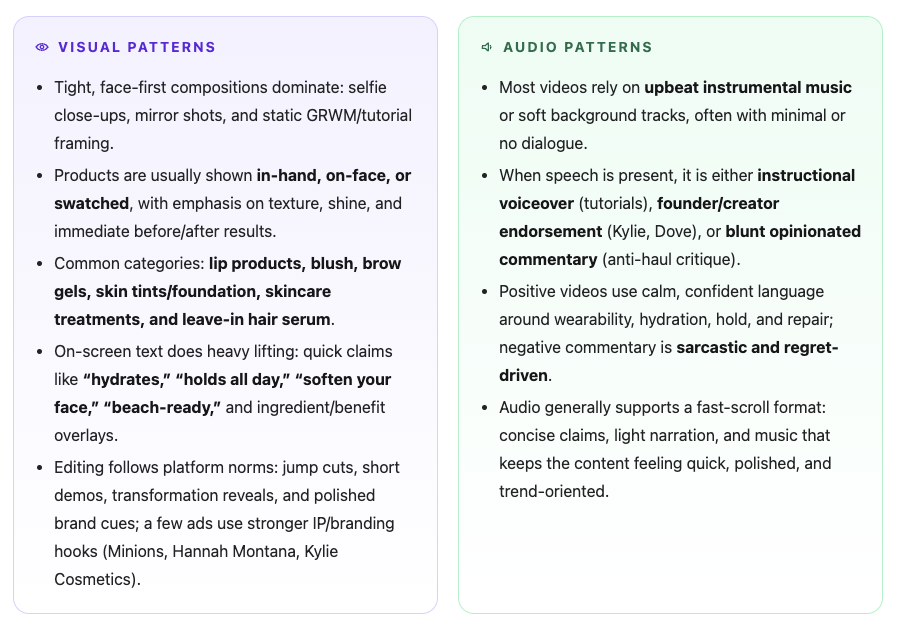
Twitter/X tells a distinctly different story from the other three platforms. The strongest beauty signal here is not organic trend reporting but highly positive promotional content clustering around a small number of repeated products. The clearest recurring product is SASI Sugar Rush Cream Blush, shown across multiple clips with influencers praising its color payoff, soft texture, blendability, and Gen Z-friendly keychain packaging. Overall beauty content on X is skewing toward playful, youth-oriented, celebrity and influencer-led discovery, with sentiment overwhelmingly positive and virtually no critical or balanced review language present in the dataset.
There are tools that track what hashtags are trending. There are platforms that monitor brand mentions and measure sentiment in text. What very few tools do, and what the Popular Videos Q Agent does, is analyze the actual content of high-performing video to surface the creative intelligence inside it. The framing. The pacing. The audio choices. The product moments that drive shares versus the ones that drive comments. The difference between knowing that dewy complexion content is performing well and knowing that tight front-facing framing with jump cuts timed to music beats is the specific creative pattern generating that performance is the difference between a general observation and something a creative director or content strategist can actually work from.
The brand safety dimension adds another layer that most trend tools simply do not address. This brief flagged the BBC skincare editorial on Instagram before it becomes a broader narrative. It flagged the wear-test dynamics on YouTube and Huda's transfer moment. Those signals matter for brands making decisions about category association, partnerships, and content tone, and they are not visible in a hashtag scan.
Every Q Agent brief starts from the same place: a question your business actually needs answered. You define the subject, the agent handles the rest. It pulls from Quid's compliant data sources, applies the analytical framework built for that brief type, and returns structured intelligence where every insight is grounded in real video performance data including likes, shares, replies, and view counts, not model-generated assumptions about what is probably popular.
The brief is delivered to your inbox and saved in Quid Terminal in about 10 minutes. From there, Ask Q sits alongside the brief for follow-up, letting you go deeper on a specific platform, a specific format, a specific brand, or any thread in the data you want to pull on further. It works like a conversation, but one that is running against the same sourced, verified data that built the brief, not generating answers from general training data.
For content and creative teams, the Popular Videos Q Agent produces something that goes well beyond what most creative briefs include: a real accounting of what is actually performing, why it is performing, and how it is structured, across every major platform your audience uses. That changes the quality of the brief you hand to an agency, a creator, or an internal team.
For brand and marketing strategy, the cross-platform synthesis surfaces where category narratives are forming and where they are breaking, which product territories are gaining traction, and where risk is emerging before it becomes a headline. That is early signal, not a recap.
For competitive intelligence, understanding how category leaders are showing up in high-performing video content, which brands are appearing as recognizable cues, and where their content is and is not gaining traction gives you a read on the competitive landscape that paid tracking and social listening alone cannot provide.
The Popular Videos Q Agent is available now inside Quid Terminal. Define your subject, run the agent, and in 10 minutes you have cross-platform video intelligence that no hashtag tool can produce.

Q Agent briefs are built on compliant, sourced data. Every insight is traceable and verifiable inside the platform.