

.png?width=1252&height=362&name=QUID_Logo_WHITE%20(2).png)
.png?width=1380&name=PRODUCT%20RELEASES%20(6).png "<span id=\"hs_cos_wrapper_name\" class=\"hs_cos_wrapper hs_cos_wrapper_meta_field hs_cos_wrapper_type_text\" style=\"\" data-hs-cos-general-type=\"meta_field\" data-hs-cos-type=\"text\" >Product Release: Podcast Data</span>")
Key takeaways:
If you search podcast data in Quid today, each result you get back is one segment of an episode rather than the whole thing: the interview on its own, the sponsor read on its own, the opening monologue on its own. Until this week a search returned the full episode as a single long transcript, and working out which part of it actually mattered was left to you.
The change went live on September 21.
Quid now runs each episode through AI that reads the transcript, works out where one section ends and the next begins, and labels every section according to what it is. An episode that used to appear once in your results now appears several times over, once per segment, with each one carrying its own label.
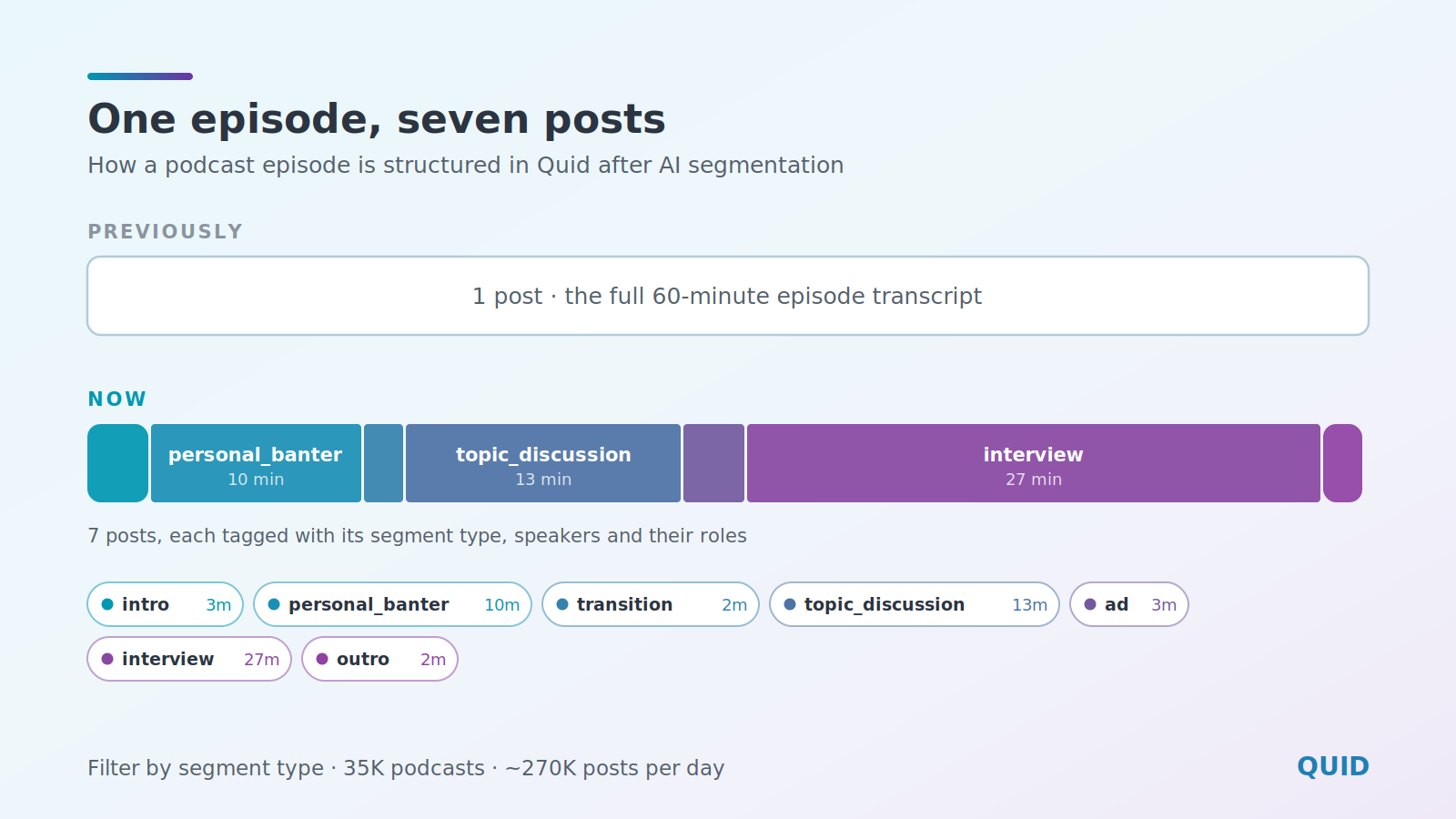
It comes down to how Quid measures things, which is per result. When an hour-long episode counted as a single result, one sentiment score had to stretch across the scripted intro, ten minutes of hosts catching up, a sponsor read, and a forty-minute interview, so whatever the interview actually sounded like ended up averaged in with everything around it. Now that the interview is a result in its own right, it carries its own score and you can look at it without dragging the rest of the episode along behind it.
The same split separates advertising from editorial. When a brand comes up during a sponsor read, that segment is labeled as an ad, so it no longer sits in the same pile as a host bringing the brand up unprompted. In a full-episode transcript those two mentions look identical, and in a report they mean completely different things.
There are seven, and every segment carries one:
Filtering to topic_discussion and interview gives you the substance of a show with the advertising and housekeeping stripped out, which is usually what you want when you're researching a category. Filtering to ad on its own answers a different question altogether, which is who is advertising on which shows.
Alongside the label, each segment lists the speakers by name and records whether each one is the Host, a Guest, a Panelist, or a Correspondent.
That opens up a set of questions which weren't really answerable before: what one person says across every show they appear on, how a host's framing of a topic compares with the answer a guest gives, or how often a particular expert is getting booked across your category.
Coverage now runs to 35,000 podcasts, up from roughly 24,000, which works out at around 270,000 new segments a day.
Everything published from September 10 onward is fully segmented and searchable now, and episodes going back to October 2025 are being added gradually.
New episodes reach you about ten hours after they're published, split between roughly seven and a half hours for an episode to arrive in Quid and another two and a half before it becomes searchable. Since podcasts publish on daily and weekly cycles rather than continuously, that lands new material well inside the window where it still tells you something useful.
Two things are worth knowing.
The first is that your podcast result counts will look higher than they used to, simply because one episode now produces several results instead of one. Broadcast data in Quid has always worked this way, so the pattern will be familiar if you use it.
The second is that if you want a topic to match whole episodes rather than individual segments, putting the episode title into your topic definition will do it.
Podcasts are one of the few places where people talk at length, unscripted, about the categories brands care about, and the difficulty has always been that same length. An hour of conversation covers a lot of ground, and when all of it arrived as a single block of text you could establish that a show had mentioned your category without being able to say where in the episode, in what context, or whether anyone was being paid to say it.
Segmenting the transcript answers all three. You can read the interview on its own, tell an ad from a genuine recommendation, and follow a single voice across every show they turn up on. Spread across 35,000 podcasts, that's the difference between a large pile of transcripts and something you can put a precise question to.
AI-segmented podcast data is live in Quid now. Want to see what it turns up in your category? Request a free demo or reach out to your Quid account manager.

AI-segmented podcast data means each episode is automatically divided into its parts and every part is labeled by what it is. In Quid, that means a search returns individual segments such as an interview or a sponsor read, rather than whole episodes.
There are seven labels to filter on: intro, outro, topic_discussion, interview, personal_banter, transition, and ad. Every segment carries exactly one of them.
Coverage runs to 35,000 podcasts, up from roughly 24,000, which produces around 270,000 new segments a day.
Counts are higher because a single episode now produces several results rather than one, with a separate result for each segment. Broadcast data in Quid has always worked the same way.
Everything published from September 10 onward is fully segmented and searchable now, and episodes going back to October 2025 are being added gradually.