

.png?width=1252&height=362&name=QUID_Logo_WHITE%20(2).png)
.png?width=1380&name=PRODUCT%20RELEASES%20(11).png "<span id=\"hs_cos_wrapper_name\" class=\"hs_cos_wrapper hs_cos_wrapper_meta_field hs_cos_wrapper_type_text\" style=\"\" data-hs-cos-general-type=\"meta_field\" data-hs-cos-type=\"text\" >Product Release: Ask Q's Been Upgraded!</span>")
Key takeaways:
Until now, asking a question in Ask Q started with a decision about where the answer lived, which is a reasonable thing to ask of someone running a narrow lookup and an unreasonable one when the question is genuinely open. The questions that matter most tend to sit across several bodies of data at once, and answering them meant asking the same thing three times and reconciling the results yourself.
This release removes that step. Ask Q can now work across datasets in one question, plan the sequence an answer needs, and reach company and patent data alongside the conversation data it already covered.
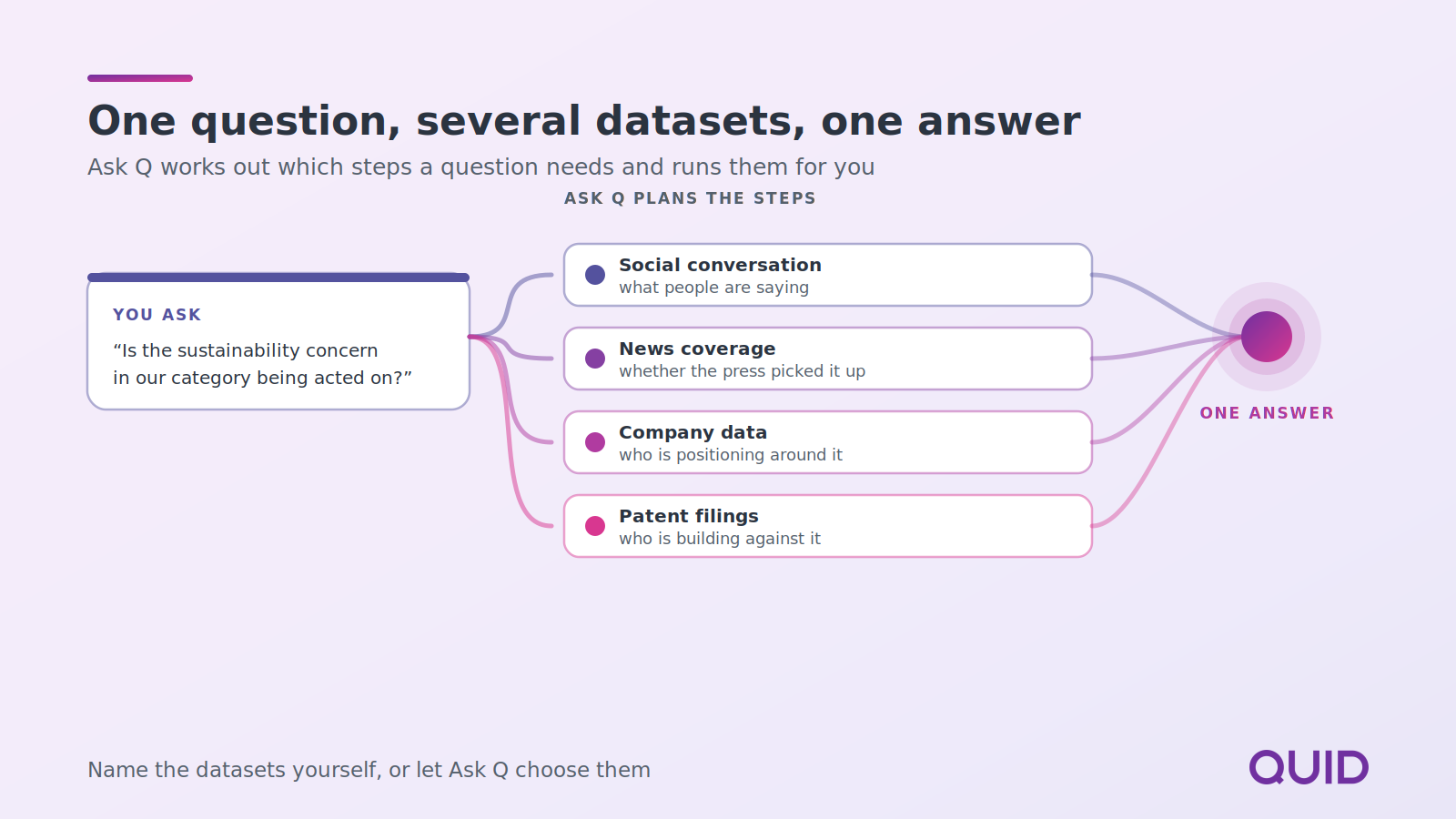
A single prompt can now query, cross-reference and compare across multiple datasets, which means a question like whether a concern surfacing in social conversation is also appearing in the press, and whether competitors have started positioning around it, is one question rather than three.
You stay in control of the scope. Name the datasets you want a question to run against and it will use those, or leave the choice open and Ask Q will select them for you. Specifying them is worth doing when precision matters, and asking Ask Q to list the datasets available to you is a quick way to see what you have to work with.
The more consequential change sits underneath, where Ask Q now plans before it answers.
Rather than treating every question as a single lookup, it works out what a question actually requires, breaks it into steps, runs them in sequence, and synthesizes what comes back into one response. A question that depends on establishing something first and then examining it in that light is now handled as exactly that, which is how a person would approach it and not how a search box does.
.png?width=1031&height=682&name=image%20(53).png)
The practical effect is that longer, more complicated questions hold together. You can ask something with several parts to it and get an answer that addresses the question you asked rather than the simplest fragment of it.
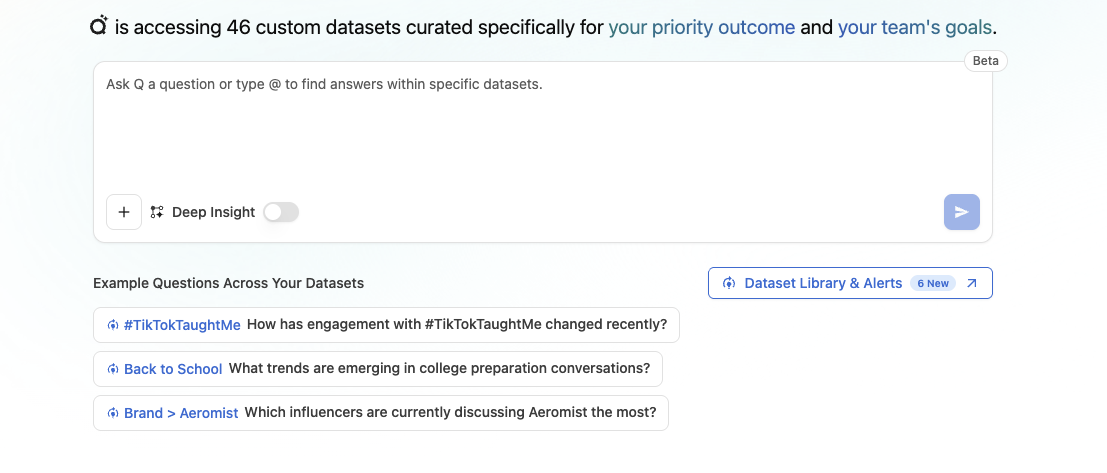
Ask Q now reaches the Company and Patents datasets from Quid Discover natively, without moving between tools.
That matters because it closes a particular gap. Conversation data tells you what people are saying and how that is changing, while company and patent data tell you what organizations are actually doing about it, and the interesting questions usually need both. Whether a need people keep raising is one anyone has built against, whether the companies in your category are moving on a theme or only talking about it, whether a shift in discussion is matched by a shift in filings: all of those become answerable in a single question.
The shape of a question no longer has to be negotiated against the shape of the data before you can ask it.
That sounds procedural and it isn't, because the negotiation was doing real damage. Deciding where an answer lives before you ask means committing to a hypothesis about the answer, and the questions worth asking are precisely the ones where you don't have that yet. Removing the requirement means the open questions, the ones that span conversation and coverage and commercial activity, can be asked as they occur to you.
Three changes landed together here, and they point the same way. Ask Q covers more ground, thinks through more of the problem before answering, and asks less of you before you can start.
What is left is the part that was always the hard bit, which is having a good question in the first place.
Ask Q's multi-dataset reasoning, step planning, and Company and Patents coverage are available in Quid Terminal now. Want to see what it turns up in your category? Request a free demo.

Yes. A single prompt can query, cross-reference and compare across several datasets at once. You can name the datasets you want used, or leave the selection to Ask Q.
Ask Q plans the route to an answer rather than running one lookup. It works out what the question requires, breaks it into steps, runs them in sequence, and synthesizes the results into a single response.
Alongside the social, news and other conversation datasets it already covered, Ask Q now natively reaches the Company and Patents datasets from Quid Discover, so commercial and filing activity can be examined in the same question as the conversation.
No. Naming the datasets is available when precision matters, but Ask Q will select them itself when you don't. Asking it to list the datasets available to you is a quick way to see your options.
Questions that span more than one body of data, such as whether a concern in social conversation is appearing in news coverage, whether competitors are positioning around a theme, or whether a need people keep raising has attracted patent activity.