

.png?width=1252&height=362&name=QUID_Logo_WHITE%20(2).png)
.png?width=1380&name=PRODUCT%20RELEASES%20(2).png "<span id=\"hs_cos_wrapper_name\" class=\"hs_cos_wrapper hs_cos_wrapper_meta_field hs_cos_wrapper_type_text\" style=\"\" data-hs-cos-general-type=\"meta_field\" data-hs-cos-type=\"text\" >Product Release: Dig Deeper with Ask Q in Terminal</span>")
Ask Q lets anyone on your team get a specific, sourced answer out of your market data within minutes by asking for it in plain English, which removes a bottleneck that has shaped how consumer and market research gets done for as long as these platforms have existed.
That bottleneck has always been access rather than data. The information required to answer most business questions already sits inside a platform like this one, but retrieving it has depended on fluency in query syntax and dashboard configuration, or on a standing relationship with the analyst who has that fluency. Between a question and its answer sits some combination of technical skill and waiting, which is why an answer has typically arrived as a deck several days later, after the moment that prompted the question has passed, and why a great many useful questions were never asked at all.
Ask Q returns its answers in sentences rather than as charts that still need interpreting, and the posts and articles behind each answer stay available underneath it, so the person who asked can verify what they were told and defend it to someone else without routing back through an analyst.
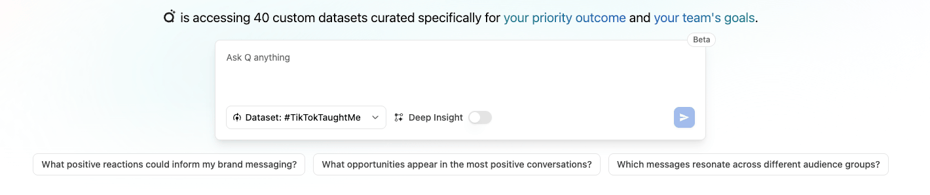
The capability underneath has broadened considerably this year. Ask Q now draws on news and social conversation from the rolling last thirty days, across every language rather than English alone, and answers at either of two depths depending on what the question warrants. All of it happens in a single place inside Quid Terminal, so choosing where to ask is no longer part of the process.
Quid is a consumer and market intelligence platform that compliantly ingests more than two petabytes of data through direct partnerships with social, news, broadcast, search, patent and investment sources, including Meta, Reddit, TikTok and YouTube, alongside your own material such as customer feedback and support tickets. Twenty years of proprietary natural language processing turns that volume into something a person can analyze.
Quid Terminal is the workspace where the analysis happens, and Ask Q is the conversational surface within it. Questions run against an AI dataset, meaning a defined body of text scoped to a particular business question: your brand, your category, your audience, your competitive set. Those definitions get built and validated in Quid Monitor, the other half of the platform, where you specify the terms, sources, languages and date ranges that determine what a dataset contains.
The questions people bring to Ask Q are the ones they would otherwise have to commission someone else to answer. What are people complaining about most in this category, and has that changed since last quarter. Which themes grew this month and which quietly faded. Whether sentiment moved after the launch, and if it did, around which specific attribute. Who is driving a conversation, and whether those voices belong to customers or to critics. What people are comparing you against when they mention you at all. Which audiences care about the attribute a campaign was just built around.
Answering any of those used to require boolean syntax, a dashboard configuration, or a request to whoever could operate the platform, and the effect of removing that requirement extends well beyond convenience. The brand manager with a hunch about a competitor, the comms lead watching a story develop over an afternoon, the product marketer trying to work out whether an objection is widespread or anecdotal: each of them previously had a question and a queue, and by the time an answer came back as a deck, the question had frequently moved on. Many questions were never asked at all, because the effort of asking exceeded the value of a maybe. The consequence worth noticing is therefore not that requests get answered faster, but that questions nobody would have bothered filing now get asked at all, and a meaningful share of them turn out to matter.
Analysts experience the same shift from the other direction and tend to welcome it. Routine lookups stop arriving on their desk, which returns their time to the work that genuinely requires their judgment: designing the dataset in the first place, deciding what a finding means in the context of the business, and making the case for what should be done about it.
Research rarely consists of a single question, because each answer reframes what you should ask next. You begin by asking why volume spiked last week and learn that a specific product complaint drove it, which prompts you to ask whether the complaint is new or has been building quietly for months, which turns out to be the latter, which leads you to ask which audiences are raising it and whether they happen to be the segment you recently started targeting. The sequence continues until you either understand the movement or establish that there is nothing behind it.
A dashboard cannot support that sequence, because a dashboard answers the questions someone anticipated at the moment they built it, and the questions that end up mattering are almost always the ones nobody anticipated. Conversation is the right shape for following a thread, and most of the value sits several exchanges in rather than in the first response. Having two depths available is what makes that practical: the quick links in a chain get quick answers, while the one question that warrants genuine reasoning across the data can have it, without either kind of question being dragged to the other's speed.
An answer nobody can verify has limited use in a decision, which is where general-purpose AI tools tend to struggle with this category of work. Ask one of them what consumers think about a category and the response arrives fluent, confident and impossible to check, assembled from whatever happened to be in its training data whenever that data ended.
Ask Q answers from a defined dataset of real content and keeps that content available behind the response. When it reports that a complaint is growing, the posts are there to read. When it summarizes a shift in sentiment, the language people used is there to examine. That traceability earns its keep at two separate moments: first when you are deciding whether to believe the answer yourself, and again when you take it into a room and someone reasonably asks where the number came from. The second moment tends to determine whether an insight ever becomes a decision.
Real-time news and social on a rolling window. Ask Q reaches news and social conversation from the last thirty days on a continuous basis, which means questions about what happened this week can be answered this week. That timing matters most for the category of question that is usually the most urgent, where something has clearly moved and nobody yet understands why.
Every language rather than English alone. For anyone researching a category beyond a single market, full language coverage is the difference between reading a market and inferring one. A brand's reputation in Brazil, Japan or Germany is discussed in Portuguese, Japanese and German, and an English-only view of that reputation answers a narrower question than the one being asked.
Two depths of answer. A fast mode handles the questions that surface mid-conversation, when a number or a direction is what you need and you need it immediately. A deeper-insight mode takes longer and reasons more thoroughly across the data for the questions that justify a few minutes. Most AI tools commit to a single speed and make every question live with the consequences, so quick questions feel slow or difficult questions receive shallow treatment, whereas letting the person choose per question maps far more closely to how research proceeds.
One consistent surface. Everything now runs through the same interface with the same behavior, which removes both the need to learn two systems and any uncertainty about which one produces the better answer.
Two changes in flight pursue the same objective of removing whatever still sits between having a question and asking it.
The first allows a Monitor topic or saved analysis to be questioned directly, without existing as a dataset first. For teams who have already done careful definition work in Monitor, that closes the remaining gap between defining a question precisely and asking it.
The second lets Ask Q answer across multiple datasets at once rather than requiring you to select one. Choosing a dataset assumes you know in advance where the answer lives, which is precisely the thing you do not know when a question is genuinely open, and real questions rarely respect dataset boundaries in any case. A shift in category conversation might be visible simultaneously in your brand data, your competitor tracking and your customer feedback, and any single dataset would show you a third of it.
There is a familiar version of AI-assisted research where the tool performs impressively in a demo and awkwardly in practice, because using it well requires understanding how it was assembled: which surface, which dataset, which mode, which time range. The knowledge required to operate the system ends up competing with the thinking you came to do.
These changes move in the opposite direction, reducing the number of decisions that precede a question, broadening reach so no answer is quietly scoped to whatever happened to be selected, and preserving control in the places where control is genuinely useful, such as choosing how deeply a question gets examined. What remains difficult, appropriately, is having a good question in the first place.
Ask Q is available in Quid Terminal. Request a free trial to try it against your own data.