

.png?width=1252&height=362&name=QUID_Logo_WHITE%20(2).png)
.png?width=1380&name=PRODUCT%20RELEASES%20(9).png "<span id=\"hs_cos_wrapper_name\" class=\"hs_cos_wrapper hs_cos_wrapper_meta_field hs_cos_wrapper_type_text\" style=\"\" data-hs-cos-general-type=\"meta_field\" data-hs-cos-type=\"text\" >Product Release: Live Briefs</span>")
Key takeaways:
A brief is accurate on the day it ships and a little less so every day afterwards, which is an awkward property for a document about something still in motion. Launches run for weeks, campaigns change shape as they go, and the category conversation you asked about on Monday rarely looks the same by the middle of the following week.
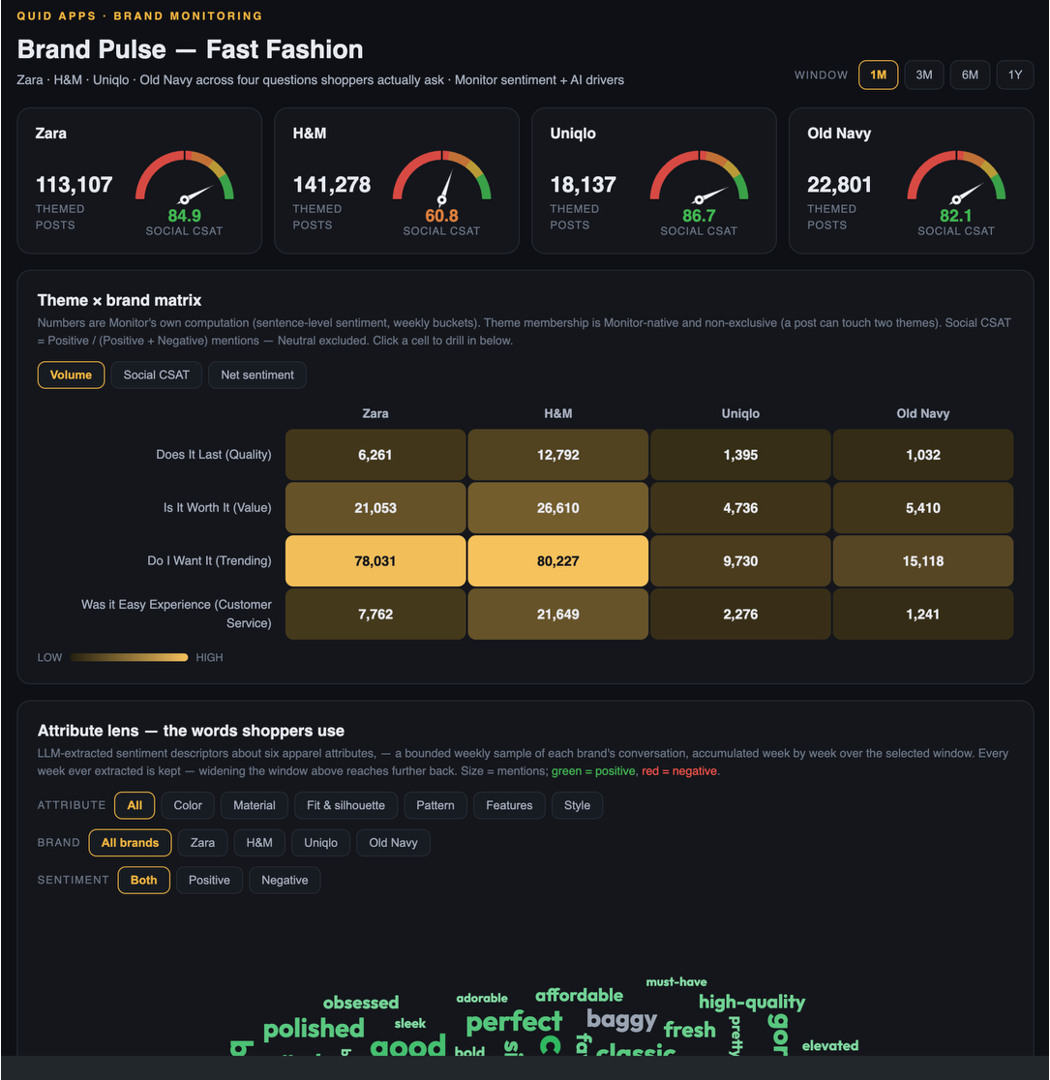
Live Briefs are built for those situations. The brief stays where it is while the data underneath it refreshes on whatever cadence the question calls for, so the version your team opens is the current one rather than the one that happened to be generated first. Same brief, live data.

A Live Brief is a brief that doesn't go stale. Data is pulled from your Quid datasets into a structure of its own, enriched, and rendered as a single interactive page with custom visuals and filters, while Ask Q runs on that same data underneath so the page can answer questions it was never explicitly built to answer. The refresh cadence is set per brief, which means a fast-moving launch can update hourly while a category tracker settles into something monthly.
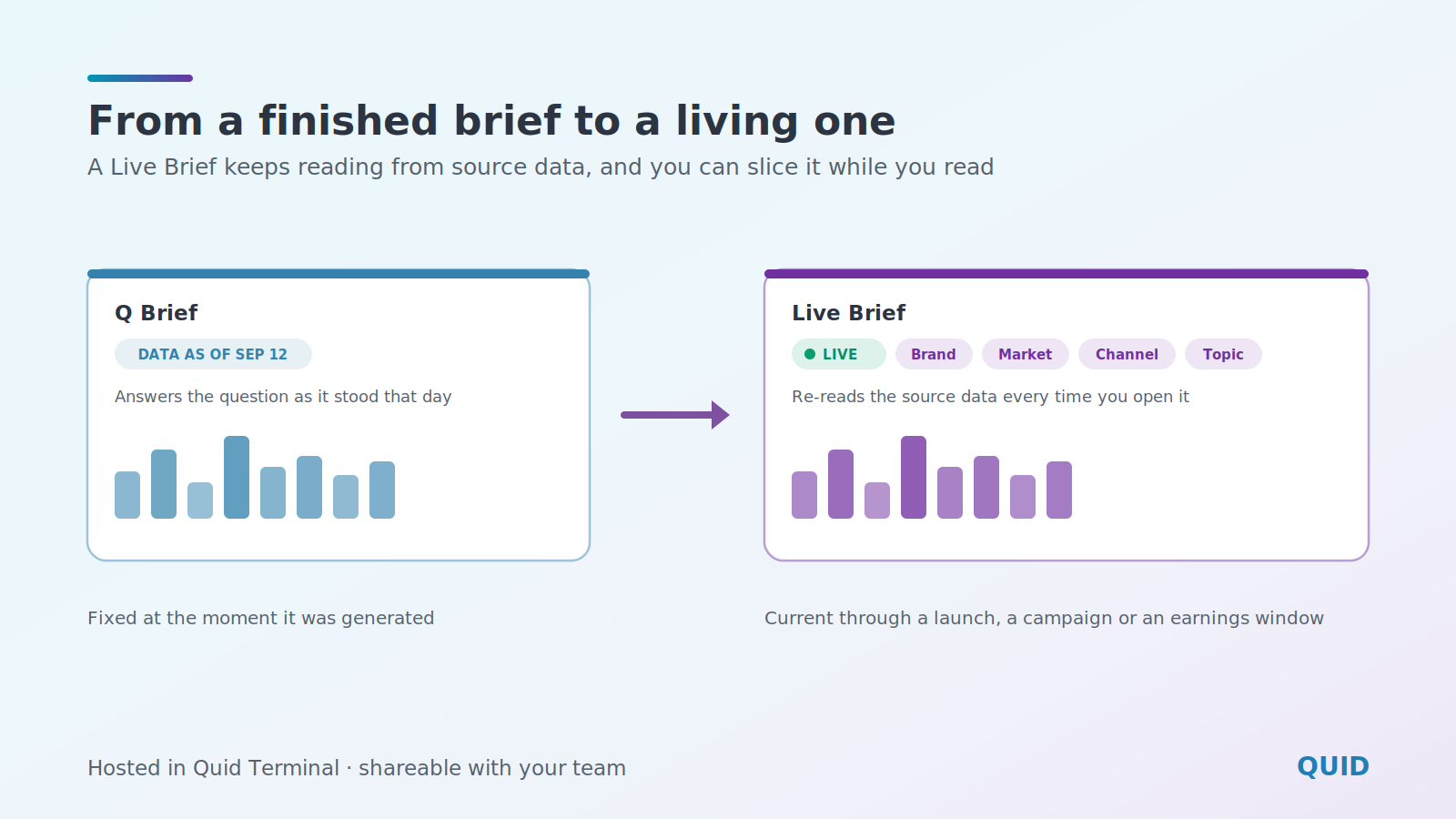
Three things separate them, and the first is the data itself. A conventional brief carries a point-in-time extract that was accurate the day it shipped and a week out of date by the time somebody circulates it again, whereas a Live Brief stays connected to a store that refreshes on its own schedule, so the numbers move as the conversation does.
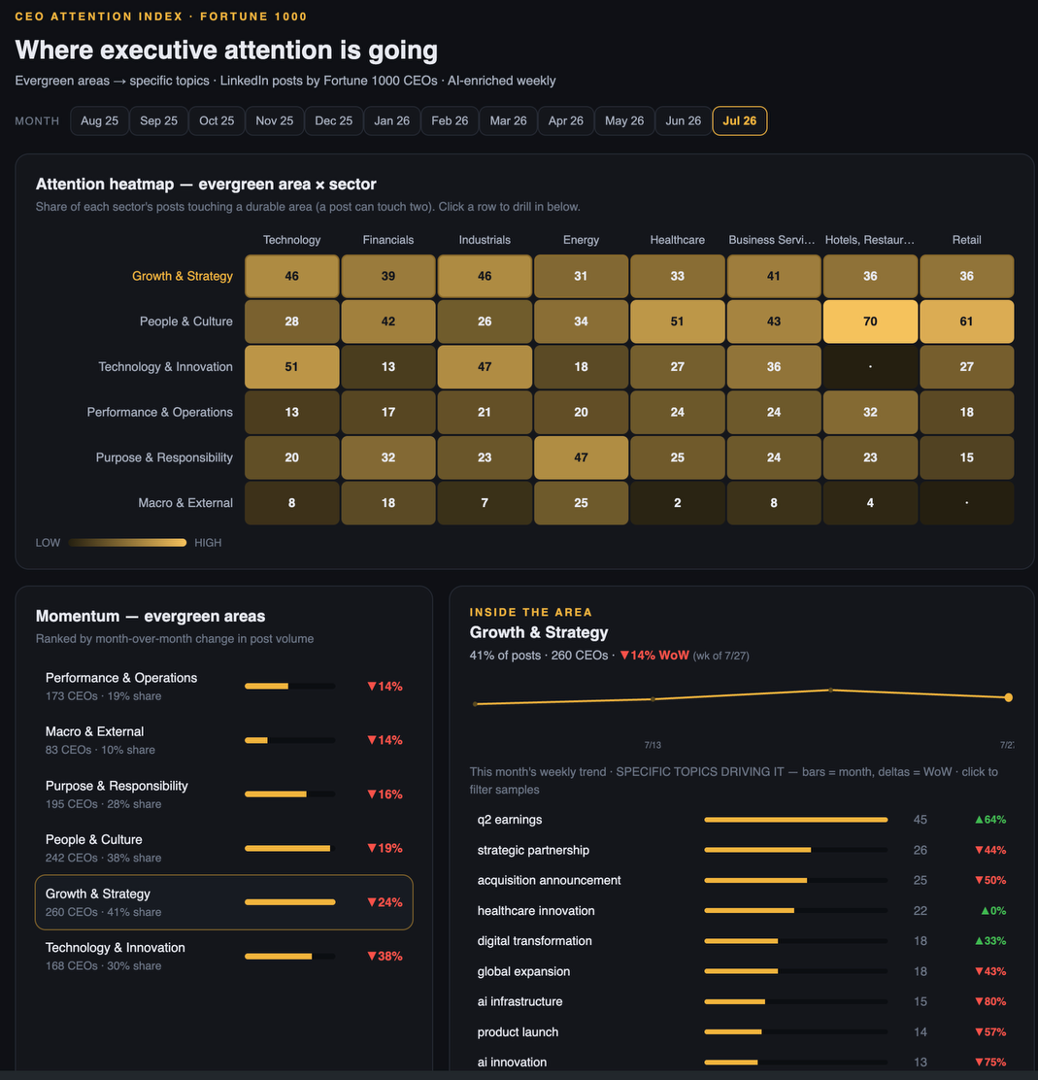
The second is access. A finished brief is read exactly as it was delivered, and any question it doesn't answer becomes a request to whoever produced it, while a Live Brief carries its own filters and lets the reader put questions to the data directly, so a team can work through its own follow-ups rather than queueing them.
The third is lifespan. Most briefs are one-offs, superseded as soon as someone runs the analysis again, but a Live Brief runs for as long as the moment it covers, which might be a fortnight around a launch or an indefinite view of a category nobody wants to keep re-commissioning.
Filters answer the questions somebody anticipated while the page was being built, and a well-designed set of them covers a great deal, though never everything. The questions that turn out to matter are usually the ones nobody thought to include, and they tend to surface halfway through reading something rather than in advance.
Because Ask Q sits on the same data the page is drawing from, those questions can be asked in the brief itself and answered from the same figures the charts are showing. That keeps a stakeholder who spots something unexpected from having to go back to the analyst who built it, and it means the brief stays useful well past the point where a static document would have run out of answers.
The clearest case is anything with a window, where interest runs across days or weeks rather than resolving in a single sitting. Product launches, premieres, tours, conference seasons and earnings periods all work this way, and in each of them the person asking rarely wants a document written last Tuesday so much as a current read they can check whenever they need it.
Live Briefs suit slower-burning questions equally well. An issue that a communications team is watching, a campaign whose performance shifts as it runs, or a category somebody checks every week all benefit from a page that maintains itself, and in the always-on case the value is less about speed than about not having to ask for an update at all.
That last situation is worth drawing out, because any team producing research for other teams eventually runs into the limit of how many reports one person can keep current. The categories that stay maintained tend to be the ones the analyst happens to work in, which leaves everybody else with something out of date or nothing at all. A format that refreshes on its own changes that arithmetic, since the effort lands in setting a brief up rather than in maintaining it indefinitely.
A Live Brief can be configured to present synthesized findings only, without surfacing individual posts, author names or links. For pharmaceutical and financial services teams, where that restriction is a condition of working with social data rather than a preference, it makes the format usable where a conventional brief full of verbatims would not be.
Live Briefs sit between the two formats most teams currently choose from. A dashboard is current but shallow, a written brief is thorough but fixed at the moment it was produced, and neither shape fits a question that stays open for a month while the answer keeps moving.
What a Live Brief offers instead is synthesis rather than charts alone, filters and conversational access rather than a single fixed view, and data that refreshes at whatever pace the subject demands. It is something you open rather than something you file.
Live Briefs are available in Quid Terminal from September 30. Want to see what you would build one for?
