

.png?width=1252&height=362&name=QUID_Logo_WHITE%20(2).png)
.png?width=1380&name=Q%20Agent%20Spotlight%20(6).png "<span id=\"hs_cos_wrapper_name\" class=\"hs_cos_wrapper hs_cos_wrapper_meta_field hs_cos_wrapper_type_text\" style=\"\" data-hs-cos-general-type=\"meta_field\" data-hs-cos-type=\"text\" >Q Agent Spotlight: Brand & Product AEO</span>")
When someone asks an LLM about a product category or the brand it mentions, how it describes that brand and what it leaves out are all decisions being made by that LLM, without the brand's input. There is no keyword to optimize, no ranking to check, and no dashboard that tells you whether you are being cited accurately, partially, or not at all. Most brands have no reliable way to know how they are being described in AI-generated answers right now, let alone how that description compares to competitors or where it diverges from their actual positioning.
That is the problem the AEO Q Agent is built to answer. Given a brand or product and its category context, the agent analyzes how that brand is being described across LLMs, social media, and search, compares it against competitors, and surfaces the gaps between how the brand is actually positioned and how the broader information ecosystem is representing it to AI systems.

Search engine rankings gave brands a legible performance signal. You could see where you ranked for a given query and measure the effect of changes over time. AEO does not work that way. LLMs construct answers dynamically, draw from training data that is not publicly disclosed, and do not cite sources in ways that make monitoring straightforward. Different models describe the same brand differently. A brand can be well-represented in one model's responses and almost absent from another's. It can be accurately described in one context and completely misrepresented in another. None of that is visible through conventional analytics.
What makes this consequential is the scale at which it is happening. AI tools are now generating an estimated 45 billion monthly sessions globally. Half of Google searches already surface an AI-generated summary. The answers being returned in those sessions are increasingly where brand perceptions are being formed, purchase decisions are being shaped, and competitive differentiators are being established or overlooked. For brands that are not actively monitoring their LLM positioning, that process is happening entirely outside their visibility.
The brief is structured to give a complete picture of where a brand stands across the channels that matter for AEO, starting with the LLM layer and working outward.
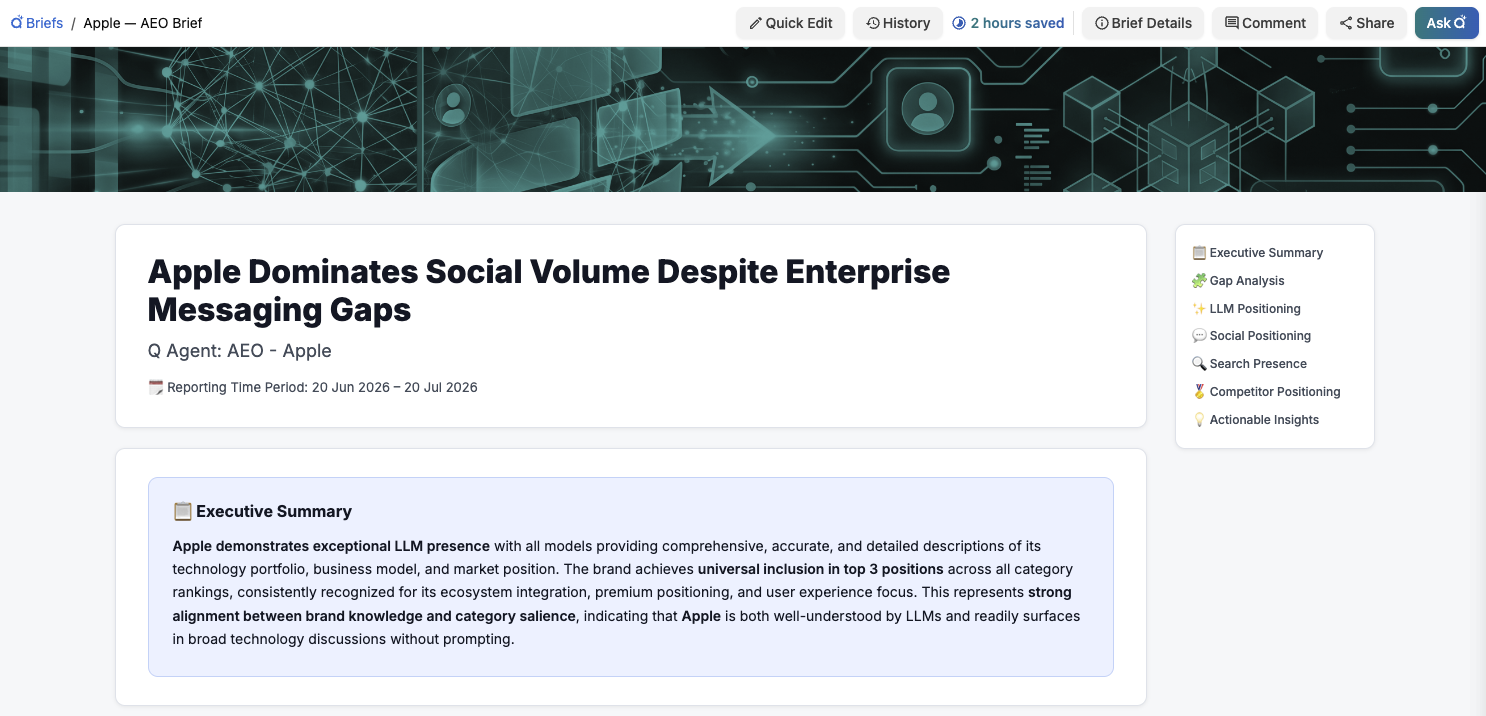
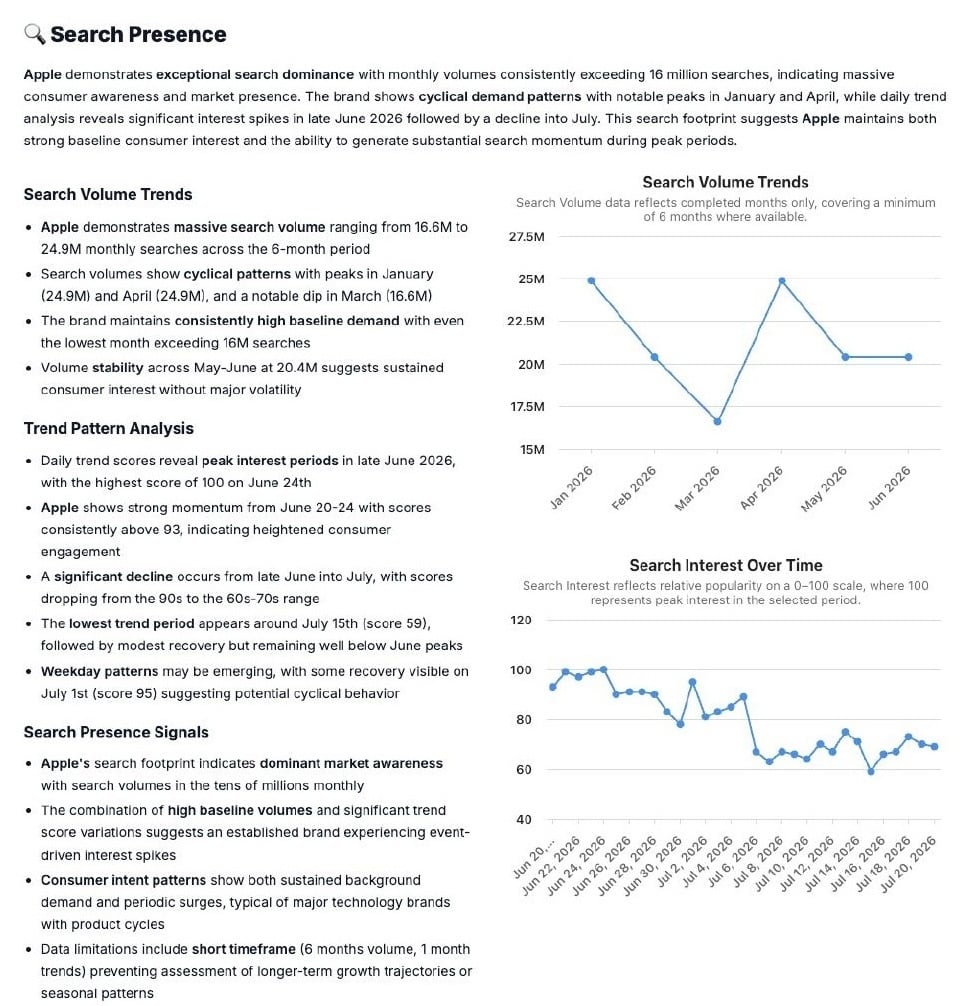
The executive summary leads with the headline finding about the brand's current AEO position. The gap analysis then maps three critical disconnects: how LLM descriptions compare to social conversation, where search demand and brand presence are misaligned, and where competitors are gaining attribution in areas the brand has not effectively established in the external information ecosystem. The LLM positioning section breaks down how each individual model describes the brand, where their descriptions converge and diverge, and what they are consistently not saying. The social, search, and competitor sections add the surrounding context. The brief closes with specific, prioritized recommendations tied directly to what the data shows.
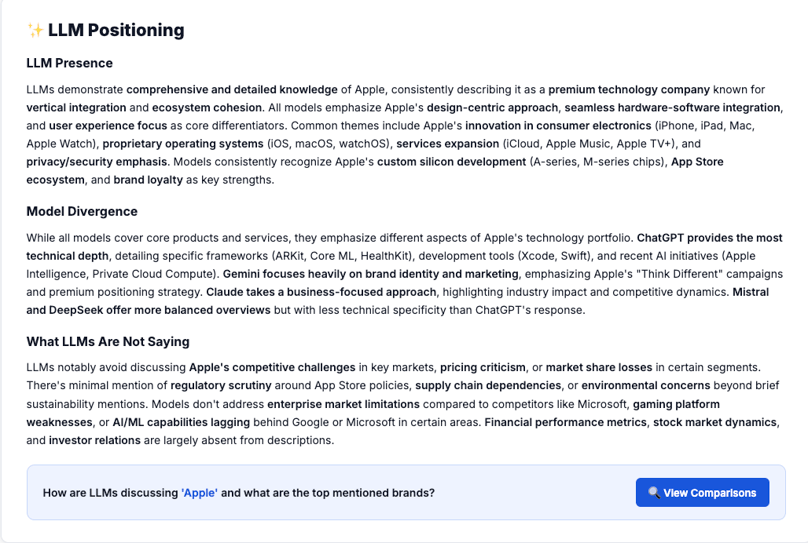
An AEO brief run on a major technology brand illustrates what this looks like. The agent analyzes positioning across ChatGPT, Gemini, Claude, Mistral, and DeepSeek, and across all five, this brand receives comprehensive, detailed descriptions. It is recognized for vertical integration, ecosystem cohesion, premium positioning, and user experience, and it appears in top rankings across every relevant category. That is the kind of LLM presence most brands are trying to build toward.
But the gap analysis reveals something the headline finding obscures. Social conversation about this brand is dominated by pricing concerns, cost increases, and product comparisons against competitors. Users are analyzing cost-benefit relationships, discussing specific price points, and expressing frustration with pricing strategy. LLMs describe the brand without acknowledging any of this, returning descriptions that emphasize premium value and ecosystem benefits while omitting the pricing criticism that represents the dominant theme in actual consumer conversation. The gap between what LLMs say and what consumers are talking about is significant, and it represents a messaging vulnerability that no amount of LLM presence alone resolves.
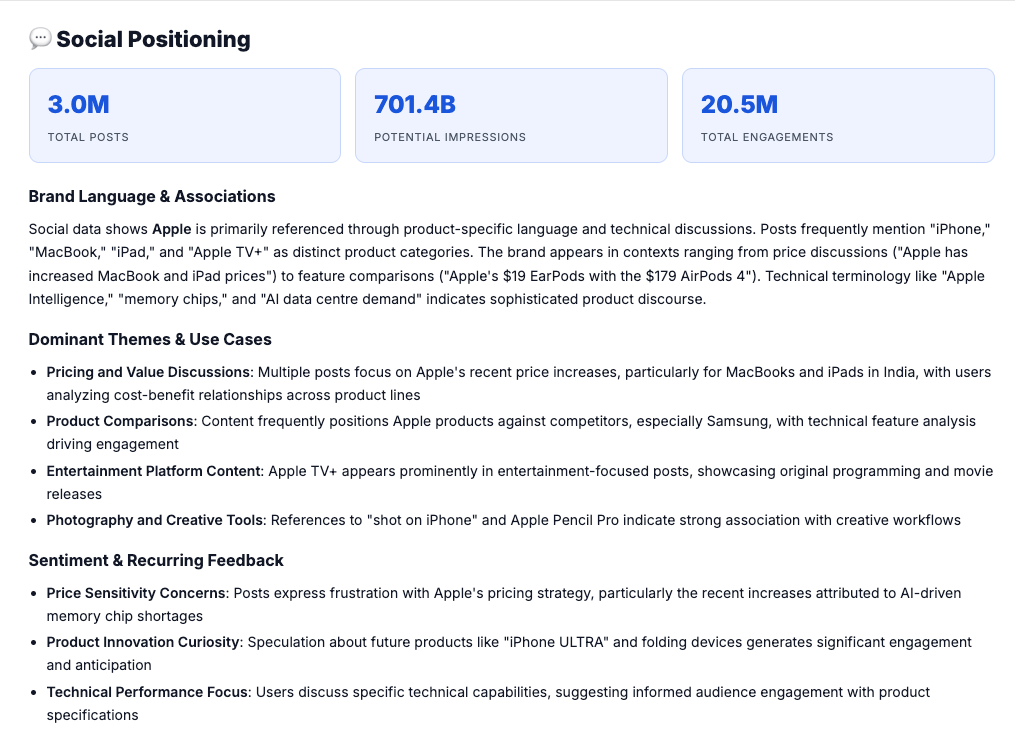
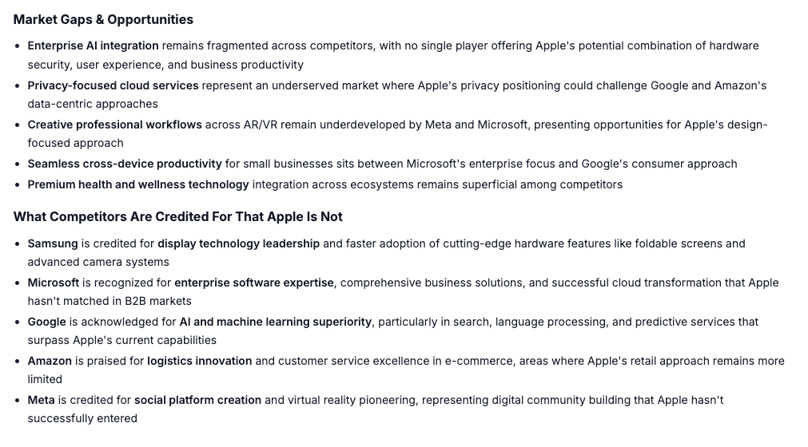
The competitive picture adds further dimension. In the same brief, Samsung is consistently credited for display technology leadership. Microsoft holds enterprise software expertise. Google is recognized for AI and machine learning superiority across both LLM responses and social data. These are attributions that have competitive implications for the brand being analyzed, and the brief identifies specifically where its social presence is not effectively countering those perceptions and where the information ecosystem that shapes LLM responses has not been built out sufficiently to reflect the brand's actual capabilities.
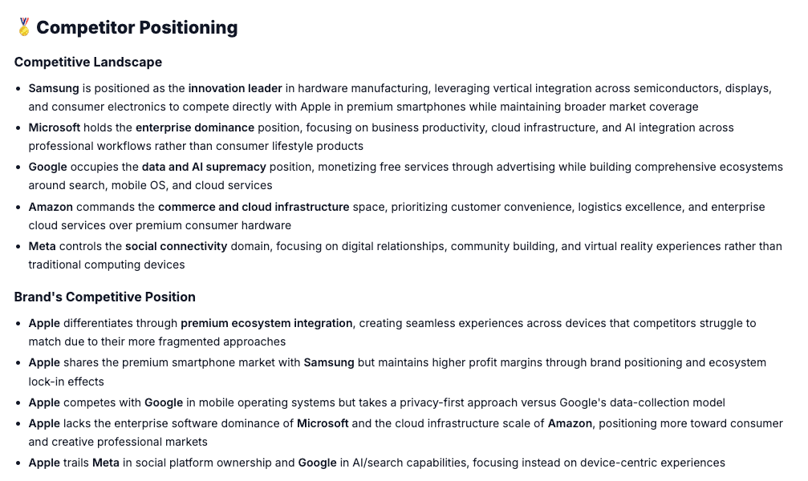
Social data is part of the AEO brief not because social posts drive LLM citations directly. Most social platforms are rarely cited by AI systems. Their content is not structured in ways that AI crawlers can reliably process at scale, and there is no visibility into the actual prompt data or training inputs that shape what LLMs learn about a brand over time.
Social is included because it is the most accessible signal for how people are actually talking about a brand, which reflects how they are likely to ask about it and describe it when they interact with an LLM. The language, concerns, comparisons, and associations that appear in social conversation shape the broader information ecosystem through the downstream coverage they generate, the forum discussions they spark, the news articles they inform. That downstream content is what LLMs do draw from. Understanding whether social positioning and LLM positioning are aligned, and where they are not, reveals gaps that neither data source shows on its own.
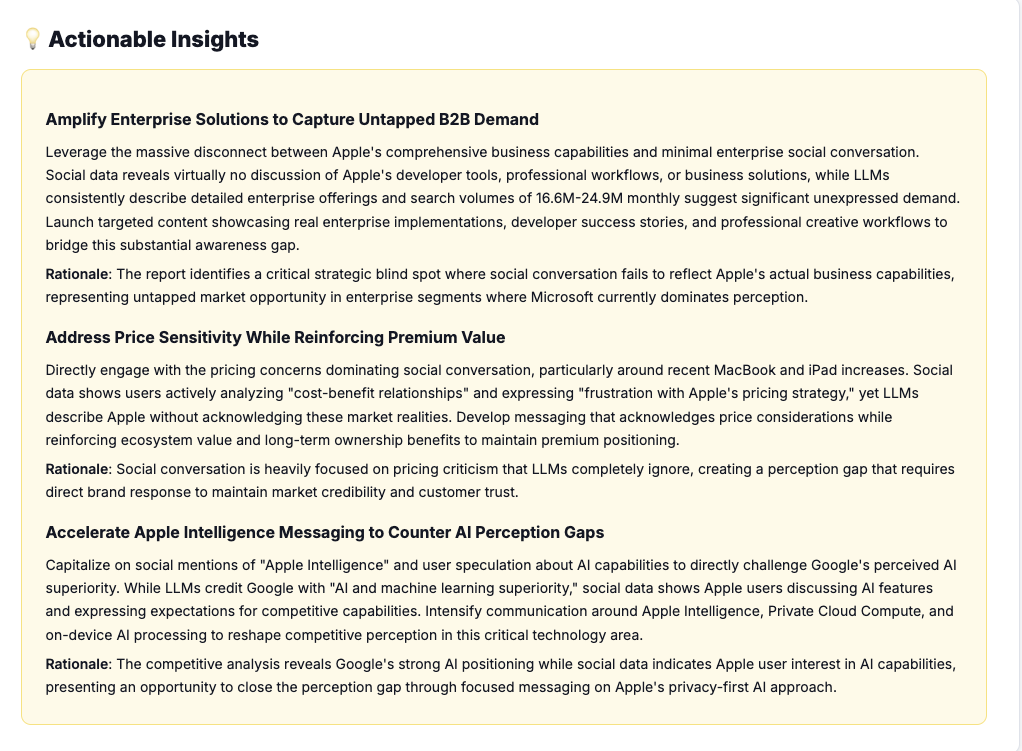
The brief does not stop at diagnosis. The actionable insights section translates findings into specific recommendations, each tied back to the data that generated it. In the technology brand brief, that includes a recommendation to address the pricing sensitivity that dominates social conversation while reinforcing ecosystem value, grounded in the finding that this is the central consumer concern that LLMs are not reflecting. It includes a recommendation to amplify enterprise solutions to address demand that search volumes indicate is substantial but that social conversation is almost entirely absent on. Each recommendation comes with explicit rationale connecting it to the gap or signal that makes it the right response.
That closing section is what makes the brief operational rather than informational. The analysis tells you where you stand. The recommendations tell you what to do about it.
You provide a brand or product name and its category context. The agent runs across LLMs, social data, and search, applying Quid's analytical framework for AEO intelligence, and delivers the complete brief to your inbox and inside Quid Terminal. The data is sourced from Quid's compliant data network, which means every finding reflects real signals rather than generated assumptions.
Ask Q is available inside Terminal alongside the brief. If you want to understand how a specific model describes a particular capability, how competitor social language compares to your own, or what the search demand signals suggest about a specific segment, Ask Q works through those questions against the same data that built the brief.
Monitoring LLM positioning manually, across multiple models, with competitive context, alongside social and search data, requires checking each model individually, pulling data from separate tools, and synthesizing everything into a coherent picture. That process is slow, incomplete, and difficult to maintain consistently over time.
The AEO Q Agent consolidates all of it into a single brief. For brand and marketing teams trying to understand whether they are being represented accurately in the places where purchasing decisions are increasingly being shaped, for agencies managing AEO strategy across clients, and for competitive intelligence functions tracking how the AI information landscape positions their brand relative to the field, the brief provides a level of visibility that no combination of manual monitoring and conventional analytics can match.
If you want to learn more about AEO and how Quid's AEO agent can help you get ahead, sign up for our webinar on July 28th.

The AEO Q Agent is available inside Quid Terminal. Provide your brand and category context, and the brief surfaces how you are being described across LLMs, social, and search, where your competitors stand, and where the gaps are.

Q Agent briefs are built on compliant, sourced data. Every insight is traceable and verifiable inside the platform.