

.png?width=1252&height=362&name=QUID_Logo_WHITE%20(2).png)
.png?width=1380&name=Q%20Agent%20Spotlight%20(25).png "<span id=\"hs_cos_wrapper_name\" class=\"hs_cos_wrapper hs_cos_wrapper_meta_field hs_cos_wrapper_type_text\" style=\"\" data-hs-cos-general-type=\"meta_field\" data-hs-cos-type=\"text\" >Q Agent Spotlight: The Patent Landscape Agent</span>")
Understanding where innovation is happening in a technology area, and where it isn't, requires more than knowing who filed what. It requires seeing how inventions cluster by technical domain, which organizations are building concentrated portfolios versus scattered positions, where grant rates signal validated technology versus speculative filings, and where the field is still genuinely open. The Patent Landscape Agent produces exactly that picture for any technology theme, converting a plain-language topic into a structured patent landscape brief built from real invention families.
Unlike the Patent Insights Agent, which analyzes patents around a specific brand or company, the Patent Landscape Agent starts from a technology theme or innovation focus area. It converts that input into patent Boolean queries, retrieves relevant invention families, clusters them by technical domain, and synthesizes the trends, leading organizations, competitive intensity, and whitespace across the full landscape. The output is a structured brief that a strategy, R&D, or competitive intelligence team can work from directly.

A brief run on Consumer Technology produced five distinct clusters spanning 730 patents, with invention families dated from early 2025 through mid-2026. The overview section surfaces four headline findings before the cluster-by-cluster analysis begins: the largest group, the most mature group by grant ratio, the youngest group by filing date, and the cluster showing the strongest innovation momentum. Together those four signals give a team an immediate strategic read on the landscape before they have read a single cluster.
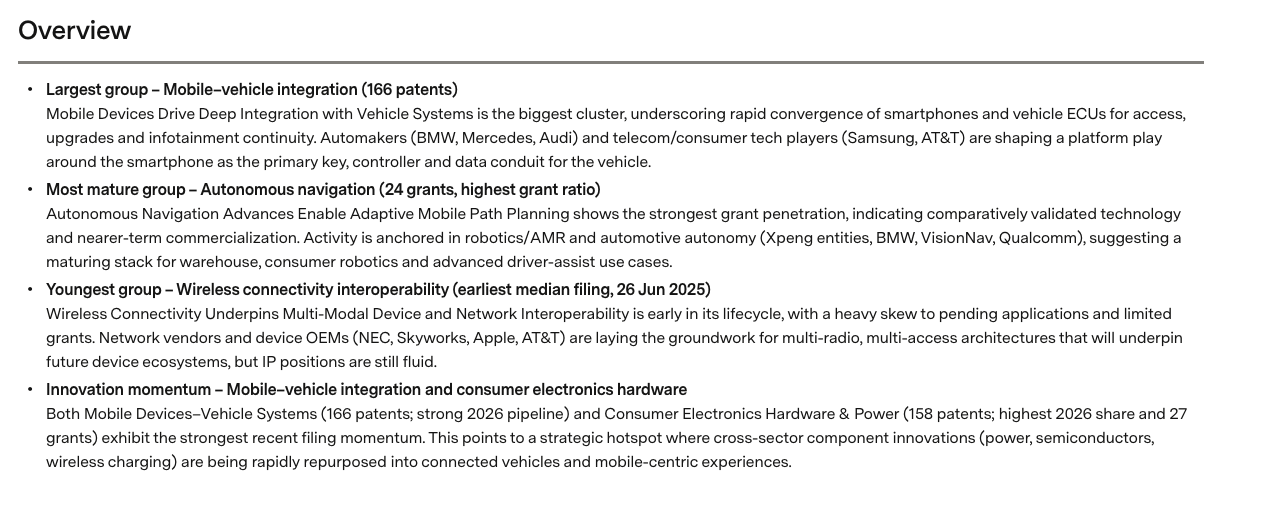
In the Consumer Technology brief, mobile-vehicle integration led at 166 patents, signaling that the smartphone-to-vehicle convergence is the most competitive territory in the landscape. Autonomous navigation carried the highest grant ratio, indicating comparatively validated technology and near-term commercialization potential. Wireless connectivity interoperability was the youngest cluster by median filing date, with positions still fluid and filings heavily skewed toward pending applications. Mobile-vehicle integration and consumer electronics hardware both showed the strongest recent filing momentum, pointing to a strategic hotspot where cross-sector component innovations are being rapidly repurposed into connected vehicle and mobile-centric experiences.
The five clusters in the Consumer Technology brief illustrate how different a patent landscape looks depending on which dimension you examine, and why reading each cluster as a distinct strategic context rather than a homogeneous field is what makes the brief useful.
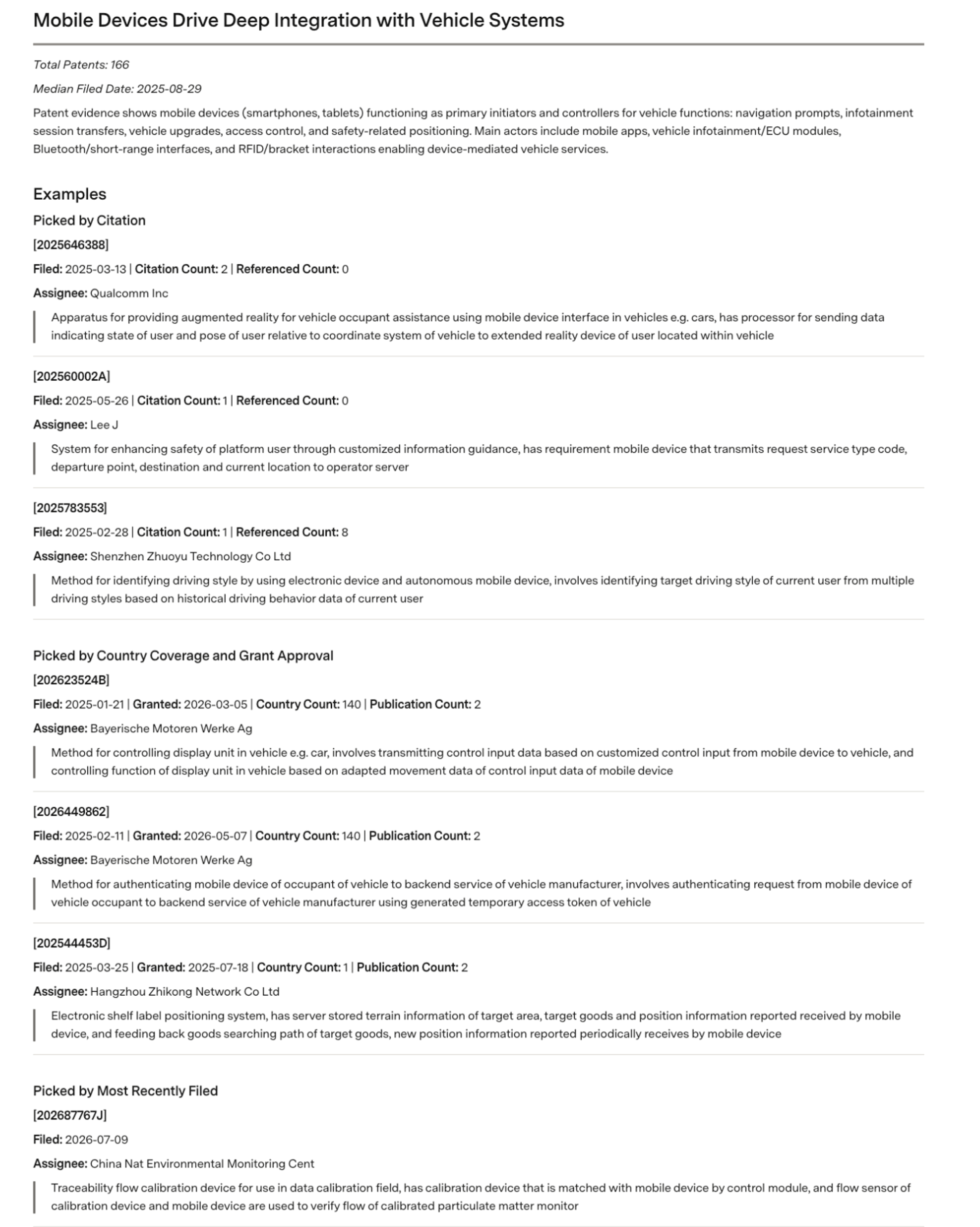
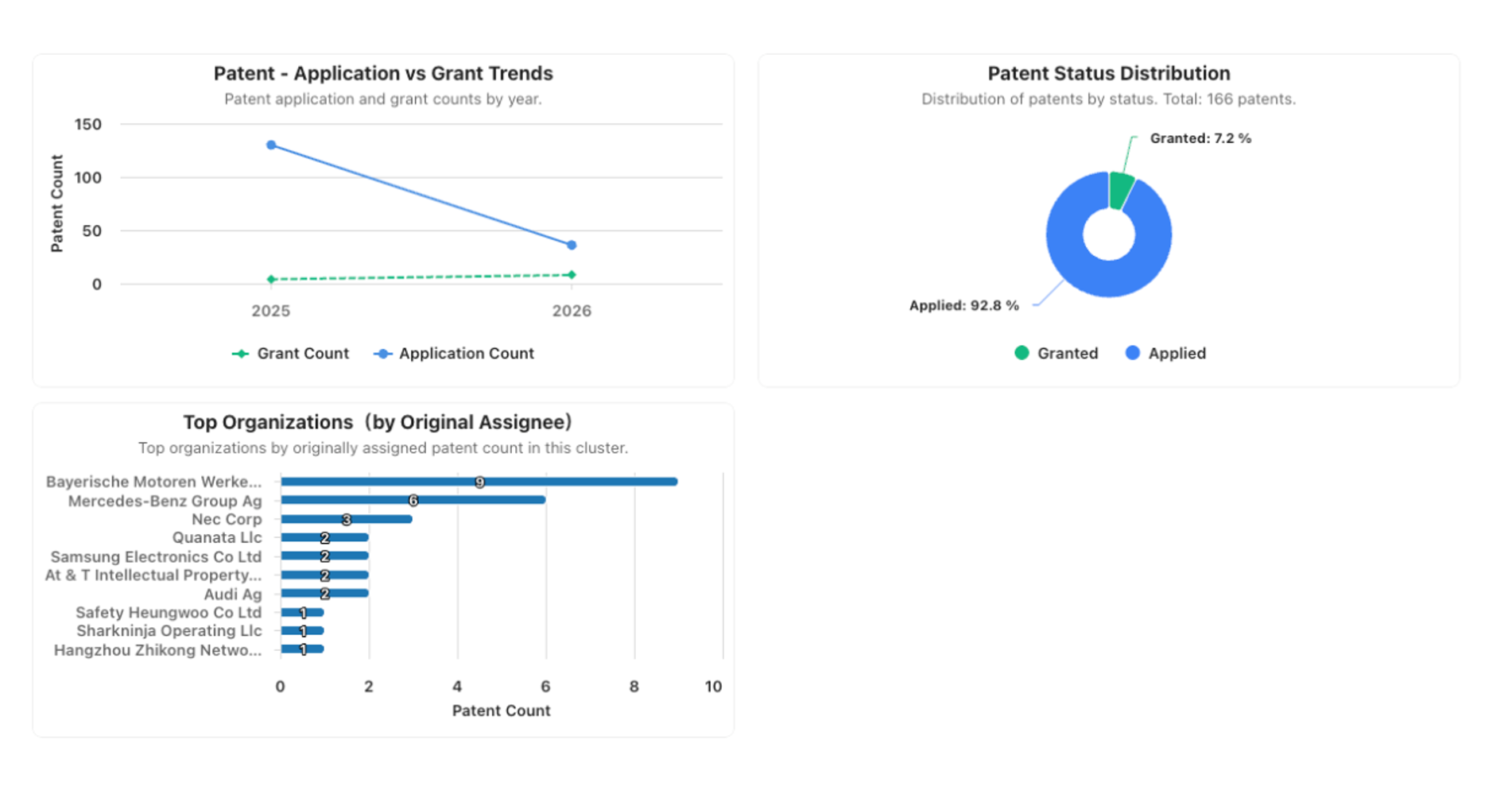
Mobile Devices Drive Deep Integration with Vehicle Systems led the landscape with 166 patents and a median filing date of August 2025, the most recent of the larger clusters. Patent evidence shows mobile devices functioning as primary initiators and controllers for vehicle functions: navigation prompts, infotainment session transfers, vehicle upgrades, access control, and safety-related positioning. Automakers including BMW, Mercedes-Benz, and Audi are filing alongside telecom and consumer tech players including Samsung Electronics and AT&T Intellectual Property, shaping a platform play where the smartphone functions as the primary key, controller, and data conduit for the vehicle. With only 7.2% of patents granted, the cluster is still predominantly pending, indicating active claiming rather than settled ownership.
Consumer Electronics Anchor Cross-Sector Hardware and Power Innovations contained 158 patents with a median filing date of October 2025 and the highest grant rate of the non-autonomous clusters at 17.1%. The patents cluster around hardware and energy technologies targeted at consumer electronics and adjacent markets including automotive, EVs, and energy storage. Key actors are semiconductor, battery, inductor, lens, and wireless-charging system manufacturers; applications span mobile phones, wearables, appliances, and EVs, indicating the reuse of component-level innovations across sectors. University Zhejiang leads the top organizations chart, reflecting the significant academic research presence in materials and components innovation.
Authentication Systems Centralize Mobile Identity and Payment Security contained 156 patents with a median filing date of June 2025 and a 12.2% grant rate. The cluster emphasizes mobile-centric authentication: biometric and multimodal identity, passkeys and tokenization, network authentication proxies, QR and physical-card verification, and continuous authenticated presence checks. Actors include mobile devices, backend service systems, point-of-sale terminals, and vehicle backends. Financial institutions dominate the top organizations: Wells Fargo, Mastercard, US Bank, and Bank of America each hold multiple patents, and the cluster also includes AT&T Intellectual Property and Private Tech Inc, indicating a convergence of financial services and telecom infrastructure around identity security.
Autonomous Navigation Advances Enable Adaptive Mobile Path Planning held 125 patents with a median filing date of August 2025 and the highest grant ratio in the entire landscape at 19.2%. Many patents focus on autonomous mobile devices including robots, chassis, mowing and warehouse units with dynamic path planning, obstacle avoidance, pose and data transmission, collision-risk judgment, and local and global re-planning. Actors include mobile chassis, control modules, mapping systems, and evaluation units. Guangzhou Xpeng, Zhejiang Miaray, BMW, and Qualcomm appear among the top organizations, suggesting a maturing stack for warehouse, consumer robotics, and advanced driver-assist use cases. The high grant rate relative to the other clusters is the clearest signal of technology validation in the brief.
Wireless Connectivity Underpins Multi-Modal Device and Network Interoperability was the youngest cluster by median filing date at June 2025, with 125 patents and a 7.2% grant rate, the lowest in the landscape. Evidence highlights multi-modal wireless communication as foundational: Wi-Fi, 5G, multi-antenna access, short-range protocols, satellite links, beamformed links, and gateway architectures. Actors include mobile terminals, gateways, routers, assistive and wearable devices, and access points. NEC Corp leads the top organizations, followed by Apple and AT&T Intellectual Property. With the earliest median filing date and the lowest grant rate, this cluster represents a technology area where network vendors and device OEMs are laying the groundwork for multi-radio, multi-access architectures that will underpin future device ecosystems, but where IP positions are still genuinely open.
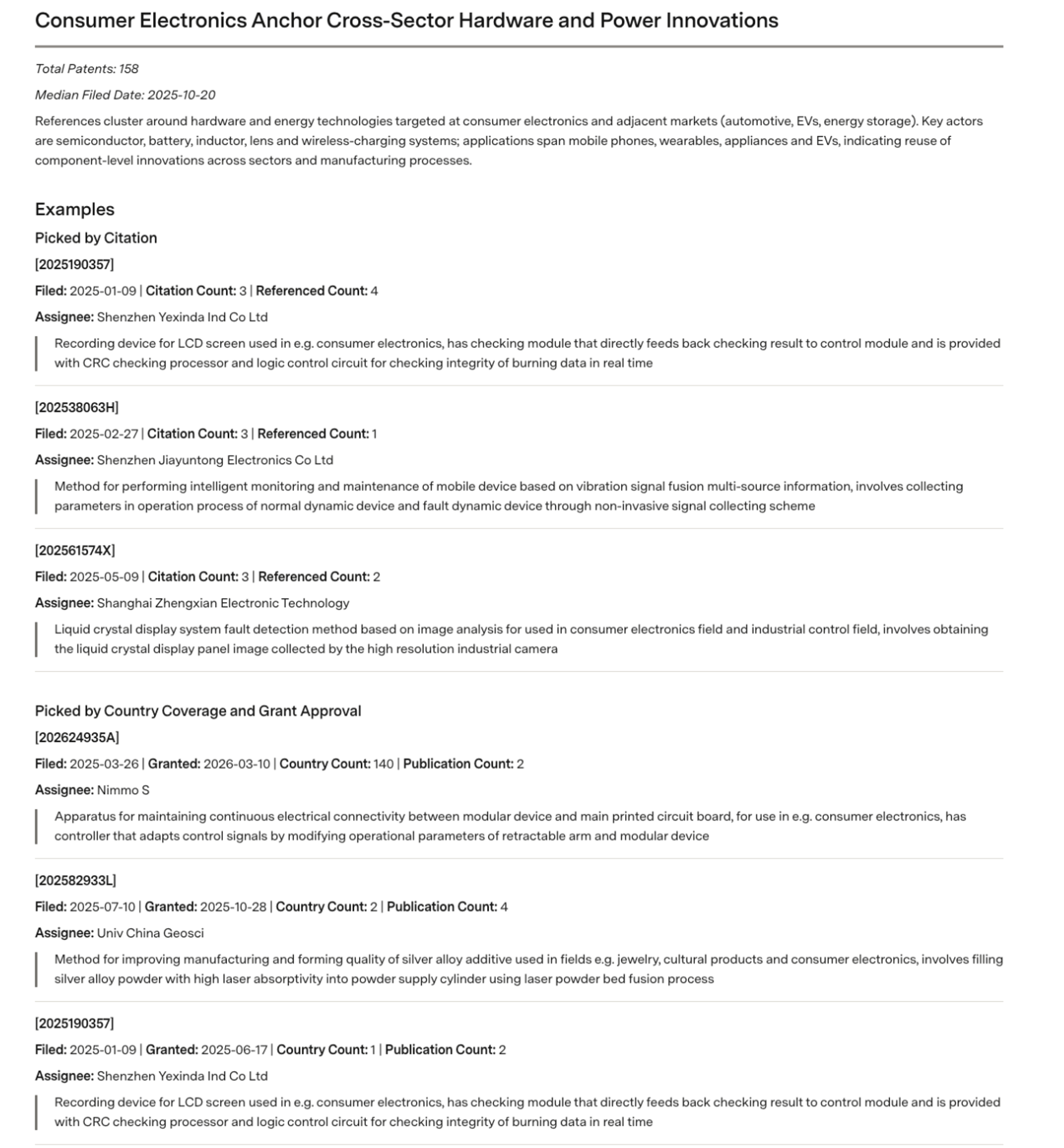
One of the most valuable things the brief surfaces is the variation in grant rates across clusters, because that variation tells a different story than patent counts alone. The autonomous navigation cluster at 19.2% granted means that nearly one in five patents in that space has cleared examination and become an enforceable position, which signals that the technology is validated and that the competitive moat is beginning to form. A team evaluating entry into that cluster faces a materially different landscape than a team evaluating entry into the wireless connectivity cluster, where 92.8% of patents are still pending and no single organization has established a dominant position.
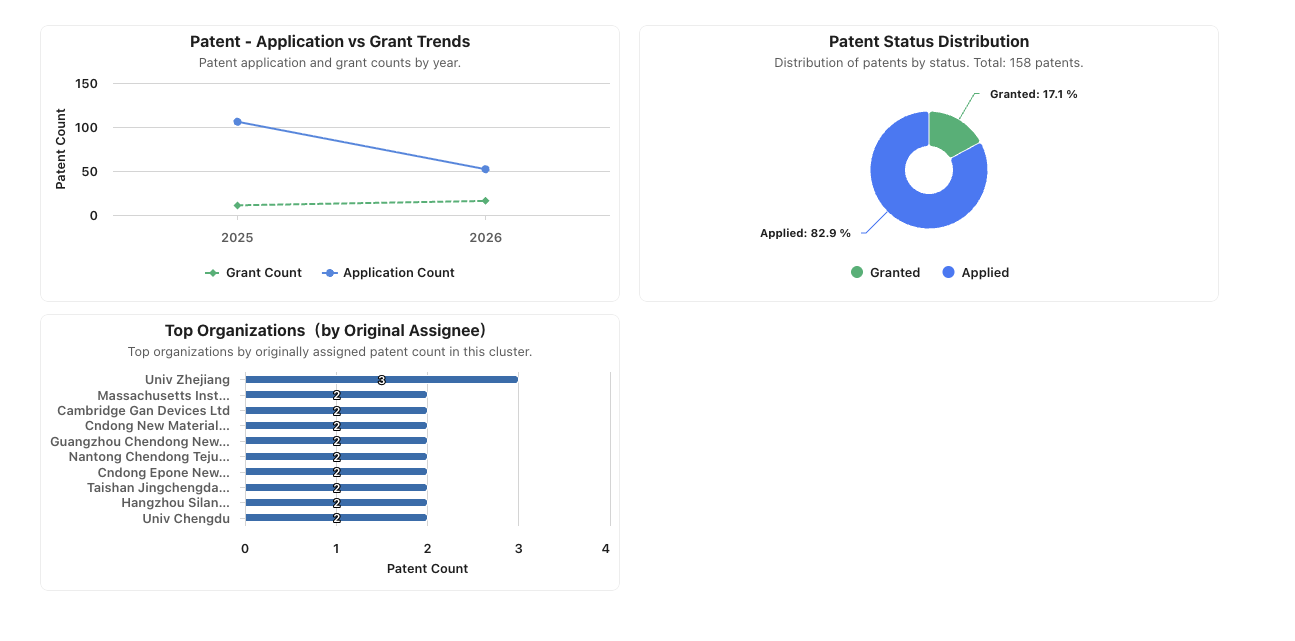
The brief makes those distinctions explicit for every cluster, which is what separates a patent landscape from a patent count. Knowing there are 166 patents in the mobile-vehicle integration cluster is directional. Knowing that BMW and Mercedes-Benz each hold multiple granted patents in that cluster, that Samsung and AT&T are filing heavily but with most positions pending, and that the median filing date is August 2025 indicating recent and accelerating activity, gives a strategy or business development team the inputs they need to make a decision rather than the starting point for more research.
For R&D and innovation teams, the cluster structure and grant rate analysis together answer the question that precedes any serious technology investment: where is the field validated versus speculative, and where is there still genuine room to build a defensible position?
For strategy and competitive intelligence teams, the top organizations charts across each cluster show which players are building concentrated portfolios in specific technical domains versus which are scattered across the landscape, and where new entrants from adjacent sectors are moving into a space.
For business development and M&A teams, the combination of cluster size, grant maturity, filing recency, and top assignees provides the intelligence needed to evaluate technology assets, identify acquisition targets with defensible IP, and assess where a strategic partnership would accelerate entry into a validated technical domain.
For agencies and consultancies advising technology clients, the brief provides a fast, sourced read of the innovation landscape in any technology area that changes the quality and specificity of strategic recommendations from day one of an engagement.
You enter a technology theme, an innovation focus area, or a concept you want to explore. The Patent Landscape Agent converts that input into patent Boolean queries, retrieves relevant invention families from Quid's Patents dataset covering more than 50 jurisdictions and filings back to the 1960s, clusters them by technical domain, and delivers the complete brief to your inbox and inside Quid Terminal. Each cluster includes its own patent count, filing timeline, application versus grant trend, status distribution, top organizations, and representative invention examples.
Ask Q is available alongside the brief for any follow-up, running against the same sourced patent data that built the landscape. The agent works best with a focused technology theme rather than a broad category, and the brief is explicit about what the collection window and jurisdiction spread mean for how to interpret the findings.
The Patent Landscape Agent is available now inside Quid Terminal. Enter any technology theme and get a structured patent landscape built from real invention families, clustered by technical domain, with the competitive intelligence to act on it.

The Quid Patent Landscape Agent is a Q Agent inside Quid Terminal that generates a comprehensive patent landscape for any technology theme or innovation focus area. It converts a plain-language topic into patent Boolean queries, retrieves relevant invention families, clusters patents by technical domain, and synthesizes trends, leading organizations, competitive intensity, and whitespace across the full landscape into a structured brief.
The Patent Landscape Agent starts from a technology theme and maps the full competitive landscape across all filers in that domain, revealing how the field is organized and where the whitespace is. The Patent Insights Agent starts from a specific brand or company and analyzes how that entity is positioned within a category, what the filing patterns mean for its competitive stance, and where its gaps are. The two agents complement each other: the Landscape Agent provides the field view, and the Insights Agent provides the brand-level view within it.
The grant rate in a patent landscape cluster indicates how much of the technology in that domain has cleared patent examination and become enforceable intellectual property. A higher grant rate signals a more mature technology with validated claims and a competitive moat beginning to form. A lower grant rate indicates a field where most positions are still pending, claims are still being tested, and there is more genuine whitespace available to new entrants.
The Patent Landscape Agent draws from Quid's Patents dataset covering more than 50 jurisdictions globally, including all four major patent offices and WIPO filings for international protection, with data extending back to the 1960s.
The Patent Landscape Agent works best with a focused technology theme rather than a broad category. Inputs like "consumer technology mobile integration" or "wireless authentication systems" produce more actionable cluster structures than inputs like "technology" or "electronics." The agent converts the input into patent Boolean queries, so specificity in the topic leads to more precise and useful cluster definitions in the brief.