


Your website might rank well on Google, but what happens when a potential customer asks ChatGPT, Perplexity, or Google AI Mode for recommendations? Will your brand appear in the answer? And if it does, will the assistant cite your website or direct the buyer toward a competitor?
As more buyers turn to AI assistants to research products, compare providers, and evaluate solutions, brands need to understand how their websites perform beyond traditional search. Having relevant content is important, but so is making that content accessible and easy for answer engines to retrieve, understand, and cite.
The AEO Website Audit Agent helps marketers evaluate both. It examines how a website is structured for AI retrieval, measures whether a brand appears in answers to relevant buyer questions, and identifies which competitors and sources are receiving attention instead.
The result is an actionable brief that connects website improvements with the questions buyers are actually asking, helping teams prioritize opportunities to strengthen their visibility in AI-assisted search.
The AEO Website Audit Agent combines a technical and structural website assessment with testing of AI-generated answers. Together, these evaluations reveal whether a brand's content is accessible to answer engines and whether that content is being used when potential buyers research the category.
The agent begins by attempting to retrieve publicly available website pages as they're delivered, without executing client-side JavaScript. It checks crawler permissions and evaluates five structural elements that can make content easier for AI systems to interpret: direct answer blocks, FAQ sections, byline and date metadata, heading hierarchy, and table of contents anchors.
These signals help identify whether pages clearly address specific questions, organize information in retrievable sections, and provide useful context about the content. For example, a page that directly answers a common buyer question under a descriptive heading provides a more clearly defined passage than one that buries the same information within several paragraphs of general marketing copy.
The agent then tests the brand's visibility using a fixed set of non-branded buyer questions relevant to its industry. For each response, it records whether the brand was mentioned, whether its website was cited, and which competing brands or sources appeared.
This produces two complementary views of AEO performance: how well the website is prepared to support AI answers and how frequently the brand actually appears in those answers.
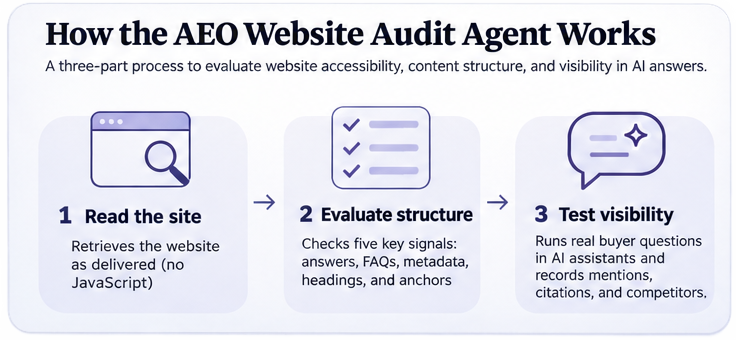
Each audit generates a structured brief covering site-wide answer-readiness, citation presence, buyer prompts, and methodology. These sections work together to distinguish technical accessibility problems from gaps in content structure, brand visibility, and competitive positioning.
A recent audit of Zoox, the autonomous vehicle company, demonstrates how these findings can reveal opportunities that traditional search reporting might not capture.
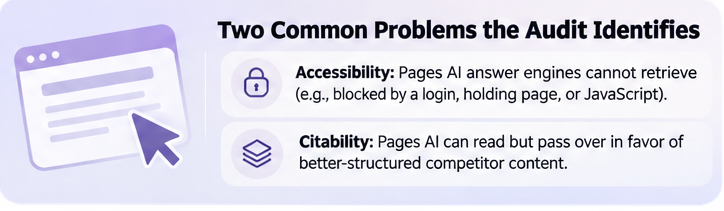
The first section examines whether AI crawlers are permitted to access the website and whether the agent can successfully retrieve and evaluate its content.
For Zoox, the agent confirmed that its robots.txt configuration allowed the AI crawlers it checked, including GPTBot, ClaudeBot, and PerplexityBot. However, the agent couldn't retrieve usable content from the three pages it attempted to inspect.
This revealed a potential accessibility issue worth investigating. A site may permit crawler access while still delivering content in a way that a particular automated retrieval system cannot read. Rather than assigning unsupported structural scores, the agent reported the limitation and recommended checking page accessibility and how the content was delivered.
For marketers, this is an important first step. Optimizing a page's content structure has limited value if the intended retrieval system cannot access the information in the first place.
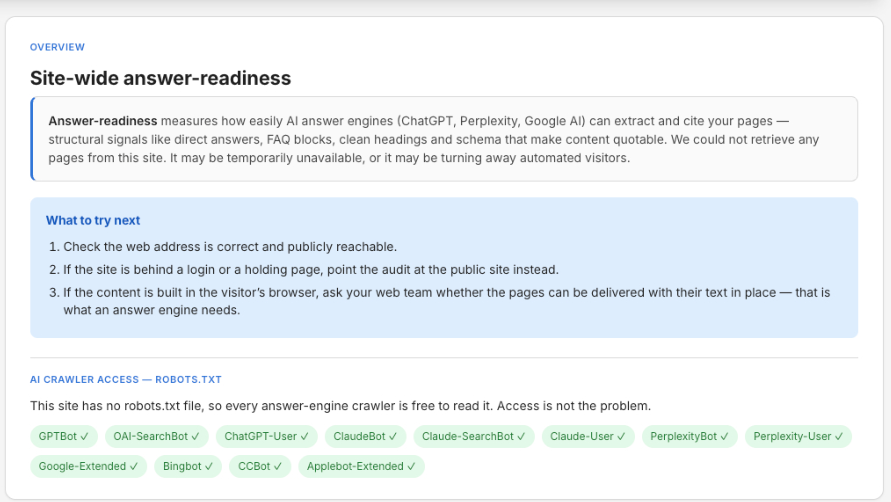
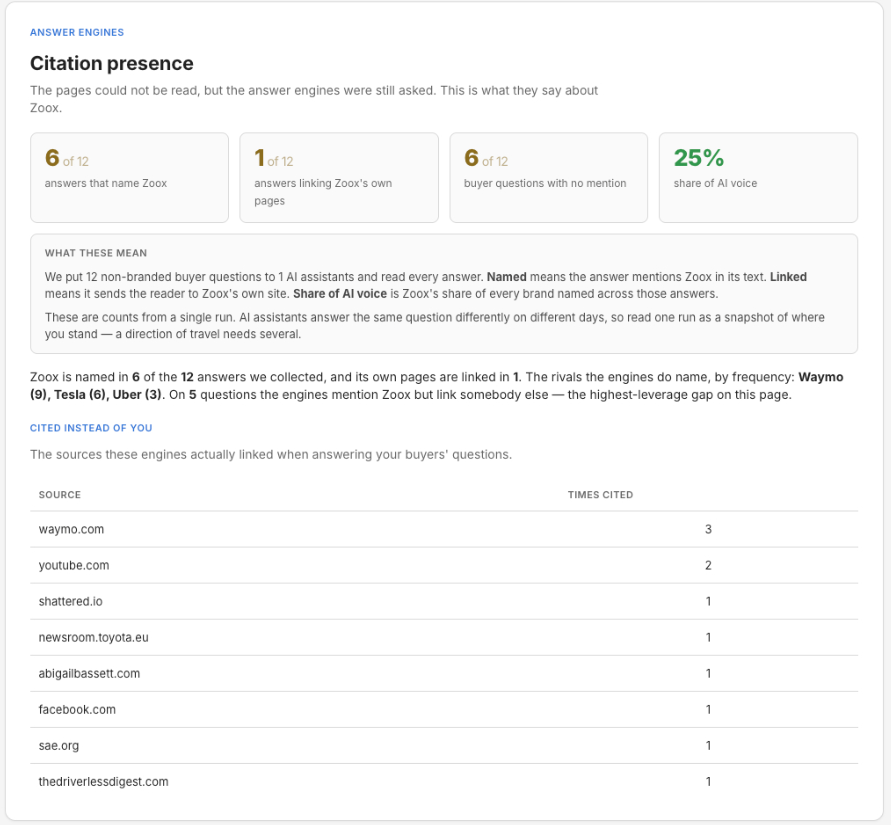
Once the website assessment is complete, the agent examines how the brand performs in AI-generated answers. It measures how often the brand is mentioned, how often its own website is cited, and which competing sources receive citations.
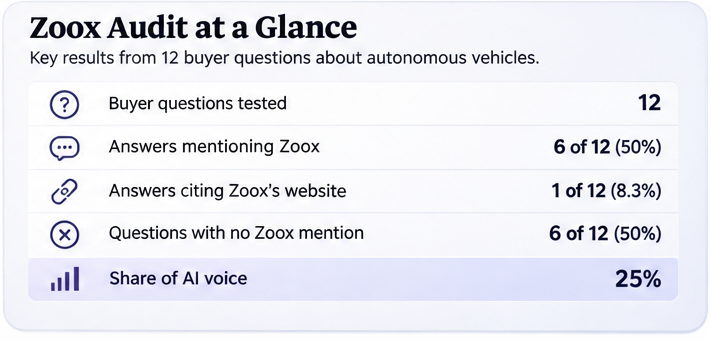
The Zoox audit tested 12 non-branded buyer questions using Google AI Mode. Zoox appeared in six of the 12 answers (50%), but its website was cited in only one (8.3%).
That difference highlights the value of measuring mentions and citations separately. An AI assistant may recognize a brand as a relevant provider without using its website as a supporting source. While the brand is part of the conversation, it may be missing an opportunity to direct potential buyers toward its own content.
The audit also identifies the domains the assistant cited. In Zoox's case, waymo.com received three citations and youtube.com received two, while several other third-party sources also appeared.
These findings give teams a starting point for investigating why their own content may be missing from AI-generated source recommendations, even when their brand is already part of the conversation.
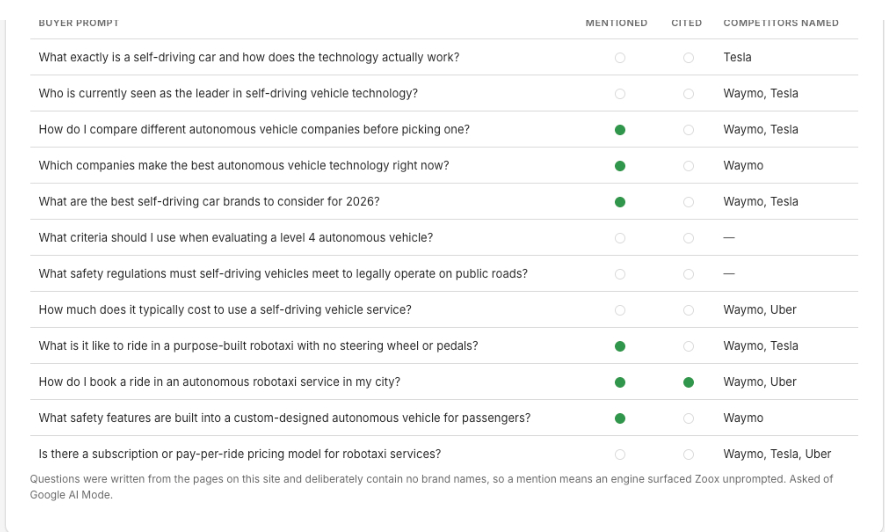
The buyer prompts section makes the findings more actionable by showing what happened for each individual question. Rather than simply reporting that a brand appeared in half of the answers, the agent identifies where it was mentioned, where it earned a citation, and which competitors appeared alongside or instead of it.
For example, Zoox was mentioned when the assistant was asked about the best self-driving car brands for 2026 and what it's like to ride in a purpose-built robotaxi without a steering wheel or pedals. However, neither answer cited Zoox's website.
When the question shifted to how someone could book an autonomous robotaxi service, Zoox was both mentioned and cited. In another example, the question about safety features in custom-designed autonomous vehicles produced a Zoox mention without a citation, alongside a mention of Waymo.
These distinctions are useful for marketers because they help identify different opportunities. Questions that generate mentions without citations are a starting point for reviewing existing pages, while questions where the brand is absent may reveal opportunities to improve content coverage or address topics competitors currently dominate.
The agent effectively connects the broader visibility metrics to the specific topics buyers are researching, making it easier to prioritize content improvements around actual questions rather than assumptions about what people might search for.
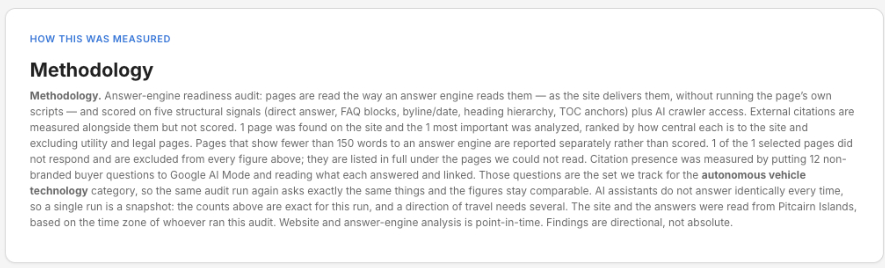
The final section documents how the analysis was conducted, including the AI surfaces tested, the buyer questions used, and the sampling approach.
This provides transparency into what the results represent. The Zoox audit, for example, used 12 non-branded questions spanning autonomous vehicle technology, provider comparisons, safety, pricing, and the practical experience of using robotaxi services.
Because AI assistants can generate different responses to the same question across multiple runs, the findings are directional rather than a permanent ranking. The methodology gives teams the context needed to interpret the results and establish a consistent approach for future comparisons.
In addition to tracking individual mentions and citations, the agent measures share of AI voice, a competitive metric showing how frequently the audited brand appears relative to other named brands.
The calculation takes the total number of brand mentions across the tested AI-generated answers and determines what percentage belongs to each company. This helps marketers understand their competitive presence rather than looking at brand visibility in isolation.
In the Zoox audit, the 12 buyer questions generated 24 total brand mentions. Waymo appeared nine times, Tesla and Zoox appeared six times each, and Uber appeared three times.
That gave Waymo a 37.5% share of AI voice, followed by Tesla and Zoox at 25% each, and Uber at 12.5%.
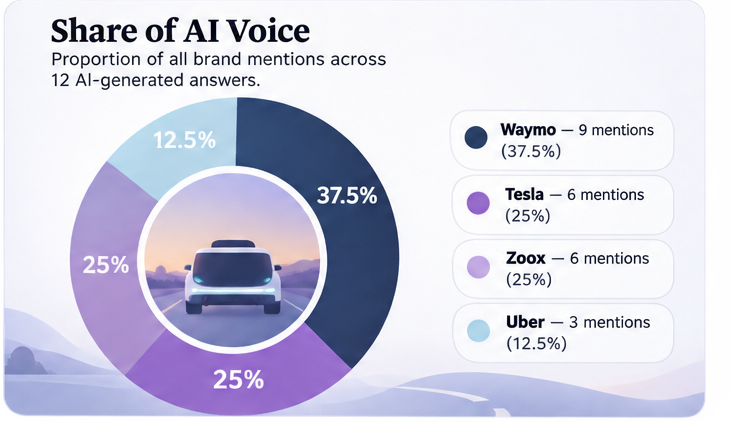
What makes this metric particularly useful is how it complements citation data. Zoox held the same share of AI voice as Tesla, indicating comparable mention frequency within the tested sample. Yet Zoox's website received only one citation across all 12 responses.
In other words, Zoox was achieving competitive visibility in AI-generated answers, but that recognition wasn't consistently translating into links to its own website.
By evaluating both metrics, marketers can distinguish between how often AI assistants recommend or discuss their brand and how often they rely on the brand's content to support their answers.
Monitoring these measures across repeated audits can also help teams understand whether improvements to their website and content strategy are associated with stronger visibility against competitors.
One of the agent's primary functions is evaluating structural elements that can make webpages easier for answer engines to retrieve and reference. It examines five signals associated with answer-readiness: direct answer blocks, FAQ sections, byline and date metadata, heading hierarchy, and table of contents anchors.
Each helps make relevant information easier to identify. Direct answer blocks address a question clearly without requiring additional context, while FAQ sections create opportunities to answer related questions using the conversational language buyers might use with an AI assistant. Heading hierarchy and table of contents anchors help organize information into distinct sections, and byline and date metadata provide useful context about the content's source and recency.
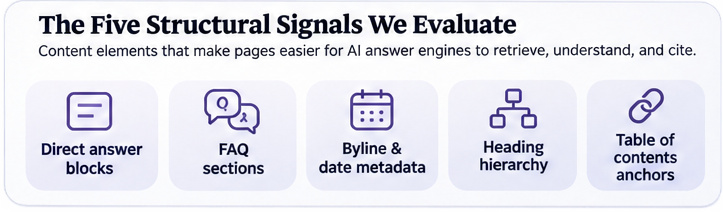
The agent evaluates these elements because a webpage may contain useful information without presenting it in a format that's easy for an automated system to navigate. Improving that structure can make relevant passages easier to locate, although no individual element guarantees a citation.
The audit also provides competitive context by showing which websites AI assistants actually linked to. For example, Waymo's website was the most frequently cited domain in the Zoox sample. Examining those cited pages alongside Zoox's corresponding content could help identify differences in question coverage, accessibility, and presentation.
This gives marketers a more informed approach to optimization, grounded in the sources appearing in actual AI-generated answers rather than relying on generic AEO recommendations.
A website retrieval failure and a lack of AI visibility aren't necessarily the same problem, which is why the agent reports accessibility findings separately from citation performance.
If the agent encounters pages that require JavaScript rendering, a login, or another condition preventing retrieval, it documents the limitation and continues testing buyer questions. This allows the brief to distinguish between what the auditing system could access and what the AI assistant actually said about the brand.
The Zoox audit provides a useful example. Although the agent couldn't retrieve usable content from the three pages it attempted to inspect, Zoox still appeared in six AI-generated answers and received one website citation.
Those findings don't prove that every AI system can successfully retrieve Zoox's current website. They show that the assistant used for the buyer-question test had enough information to include the brand in its responses.
By separating these results, the agent helps teams avoid treating every visibility gap as a content problem or every retrieval issue as proof that their brand is absent from AI search.
The AEO Website Audit Agent helps translate its findings into decisions about technical improvements, existing content, and opportunities to address unanswered buyer questions.
The first priority is resolving accessibility issues that prevent the agent from retrieving website content. In Zoox's case, that means investigating why the audit couldn't read the selected pages despite the site's permissive crawler configuration.
Once content is accessible, teams can use the structural assessment to identify opportunities to improve how relevant information is presented. This might involve adding direct answers to important pages, organizing content under more descriptive headings, expanding FAQ coverage, or ensuring authorship and publication details are available.
The buyer prompt results help focus those improvements on questions that matter. For example, Zoox's appearance in answers about the robotaxi passenger experience without a corresponding citation suggests an opportunity to review how its existing website addresses that topic. Its appearance without a citation in the passenger-safety answer could similarly prompt a closer look at whether its safety-related information is sufficiently accessible and useful to answer engines.
Competitor citations offer another valuable reference point. Rather than guessing which topics or formats answer engines prefer, marketers can examine the pages currently receiving citations and compare their coverage with their own.
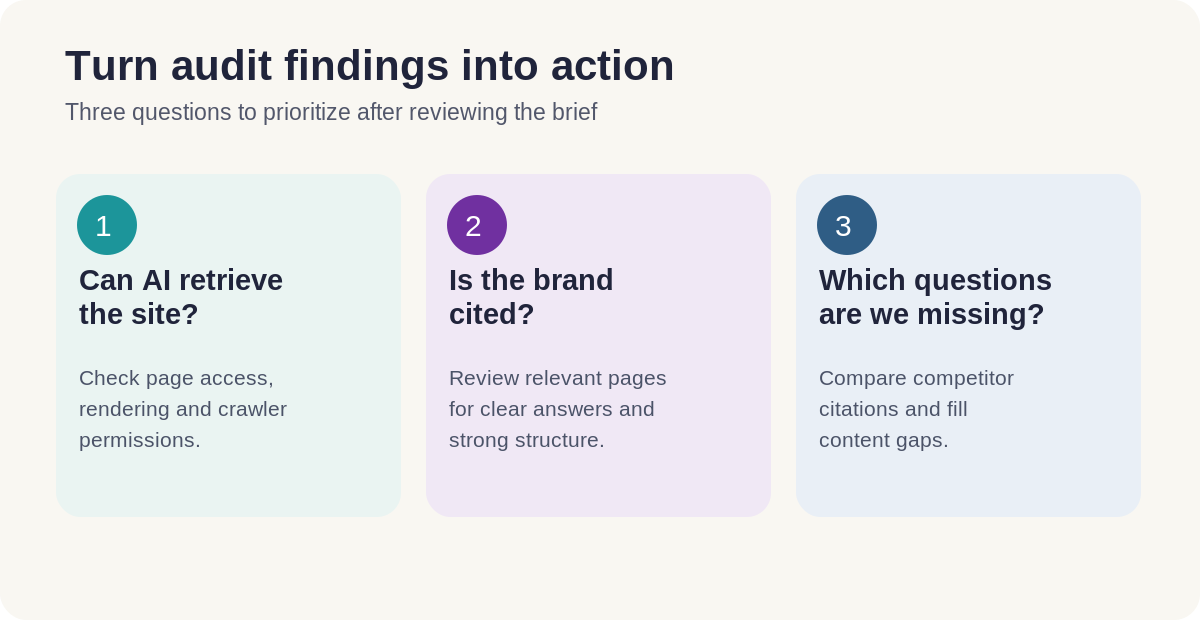
Ultimately, the agent helps teams prioritize improvements based on where their brand is visible, where its website is being cited, and where competitors are capturing opportunities instead. Repeating the audit after meaningful technical or content changes also provides a way to monitor whether those improvements are reflected in subsequent AI-generated answers.
As buyers increasingly use AI assistants to research their options, understanding how a brand appears in generated answers is becoming an important part of search and content strategy.
The AEO Website Audit Agent provides a practical way to evaluate that presence, combining website accessibility checks, structural analysis, buyer-question testing, and competitive citation data in one brief.
The Zoox audit illustrates why these measures matter together. The brand appeared in half of the tested answers and held 25% share of AI voice, but its website was cited only once. The audit also identified a retrieval limitation that warranted investigation before the site's structural readiness could be fully assessed.
For marketers, the value is in connecting those findings to specific decisions about website accessibility, content organization, and coverage of relevant buyer questions. With a clearer picture of how AI assistants represent their brand, teams can make more informed improvements and measure how their visibility changes over time.
Running the AEO Website Audit quarterly provides a useful way to monitor changes in citation performance, share of AI voice, and competitive visibility. Teams may also want to repeat the analysis after major website updates or content changes. Because AI-generated answers can vary across runs, comparing results over time using consistent questions and testing methods is more informative than relying on a single audit.
The audit evaluates the AI surfaces configured for each analysis, with the specific coverage documented in the methodology section. For example, the Zoox brief tested buyer-question visibility using Google AI Mode while separately checking crawler permissions for several AI services. Crawler accessibility checks and citation testing are distinct measurements and shouldn't be interpreted as equivalent coverage.
A mention occurs when an AI assistant names a brand in its response, while a citation occurs when it links to that brand's website as a supporting source. In the Zoox audit, the brand appeared in six answers but received only one website citation. Tracking both helps marketers distinguish general brand recognition from the use of their own content in AI-generated answers.
The agent assesses selected website pages for accessibility and structural signals, then connects those findings with buyer-question visibility and citation results. This helps teams identify which content areas deserve further attention. If a page can't be retrieved, the agent reports the limitation rather than assigning an unsupported structural score. Mapping individual buyer questions to specific pages may require additional review of the site's existing content.
The agent uses a defined set of non-branded questions relevant to the audited category. These reflect the kinds of information potential buyers seek when researching products and comparing solutions. In the Zoox example, the questions covered self-driving technology, competing providers, passenger safety, pricing, and robotaxi services. The complete question set is documented in the brief so teams can see exactly what was tested.