

.png?width=1252&height=362&name=QUID_Logo_WHITE%20(2).png)
.png?width=1380&name=Q%20Agent%20Spotlight%20(14).png "<span id=\"hs_cos_wrapper_name\" class=\"hs_cos_wrapper hs_cos_wrapper_meta_field hs_cos_wrapper_type_text\" style=\"\" data-hs-cos-general-type=\"meta_field\" data-hs-cos-type=\"text\" >Q Agent Spotlight: The Beauty & Fashion Event Analysis Agent</span>")
Every major event in beauty and fashion generates an enormous wave of conversation across news, social, forums, and editorial. The brands that activate, sponsor, or simply show up at these moments need to understand how they landed: what drove the coverage, which narratives took hold, which talent and products generated the most traction, and what the audience actually responded to versus what just generated noise. Assembling that picture manually, across platforms, in the days after an event, is slow, expensive, and incomplete. By the time the analysis is done, the moment to act on it has often passed.

The Beauty and Fashion Event Analysis Agent was built to change that. Give it an event: a product launch, a runway show, a brand activation, a gala, a conference. In about an hour, it delivers a structured intelligence brief covering the full scope of how that event was received across media and social platforms, what drove each dimension of the response, which brands and talent performed and how, and what the signals mean for the decisions that come next.
That last part matters. The agent is not producing a recap. It is producing strategic intelligence with a clear line from what happened to what to do about it.
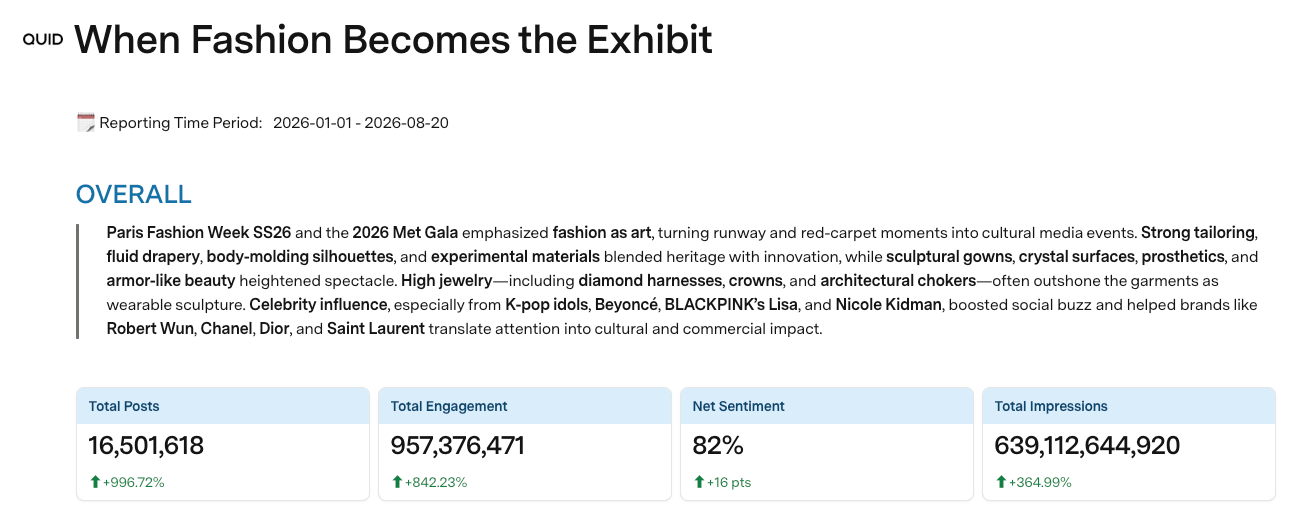
The brief opens with headline performance metrics that establish the scale and tone of the event's reception before the analysis begins. For a brief run on the 2026 Met Gala, those metrics showed 16.5 million posts, 957 million total engagements, 639 billion impressions, and net sentiment at 82 percent positive, up 16 points. Numbers at that scale can feel abstract, but in the context of post-event planning they are concrete inputs. They tell a brand team whether the event over-delivered or underdelivered relative to expectations, how their activation compares to the category benchmark, and whether sentiment moved in the right direction. For the Met Gala brief, they established that this was one of the highest-engagement fashion moments in recent memory, which contextualizes every finding that follows.
From there the brief moves into five structured sections, each designed to answer a specific category of question that post-event strategy requires.
The Key Trending Insights section is the most strategically important section for any team doing post-event evaluation or planning the next activation. It does not just document what happened. It explains the mechanisms behind the response, which is what makes the intelligence actionable rather than descriptive.
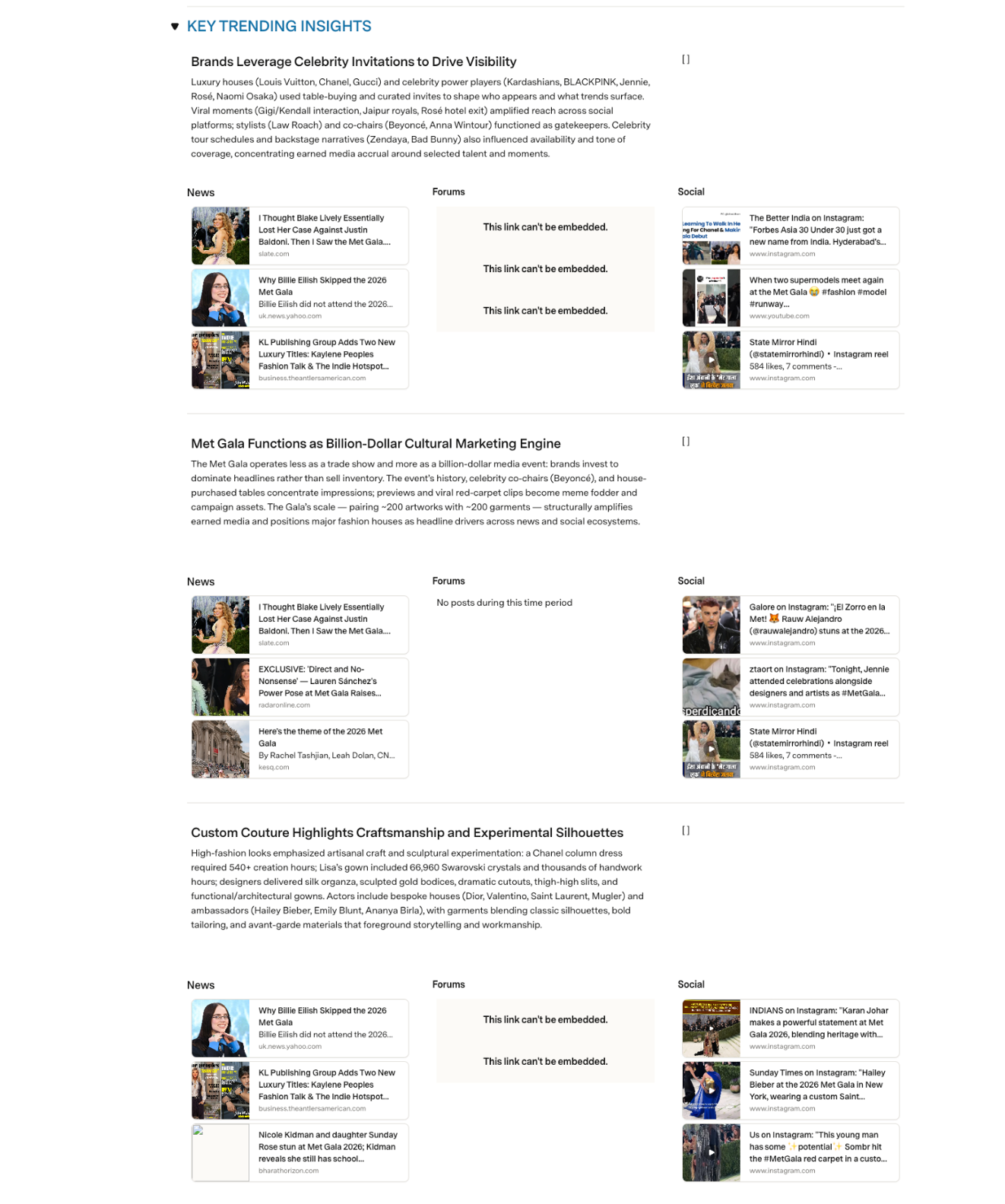
In the Met Gala brief, the agent identified that luxury houses used celebrity invitations strategically, with stylist relationships and co-chair roles functioning as amplification mechanisms that concentrated earned media around selected talent and moments rather than distributing it evenly. That is not an observation about this specific event. It is a transferable insight about how influence actually flows at events of this type, which changes how a brand should think about partnership selection, invitation strategy, and pre-event investment.
The brief also surfaced that high jewelry and accessories outperformed garments as primary drivers of conversation and share-of-voice, with specific pieces generating coverage that eclipsed the looks they accompanied. A $15 million necklace and a pair of 51.9-carat earrings drove more narrative than most of the custom couture on the carpet. For beauty and accessories brands evaluating event activation strategies, that signal is directly applicable to how they approach product placement, loan strategy, and the level of investment in statement pieces versus total look alignment.
The event theme itself, Fashion Is Art, drove a specific kind of coverage that framed brands less as commercial entities and more as cultural interpreters. That framing elevated certain houses and created a context where craftsmanship narratives, heritage references, and artisanal labor stories resonated more strongly than product-forward or sales-adjacent messaging. A brand that understood this going in could have shaped its storytelling accordingly. The brief surfaces it so the team understands it going forward.
Where the Key Trending Insights section explains the narrative landscape, the Trend Signals by Attribute section translates that landscape into the aesthetic, beauty, and commercial signals that creative and strategy teams can carry forward into upcoming work.
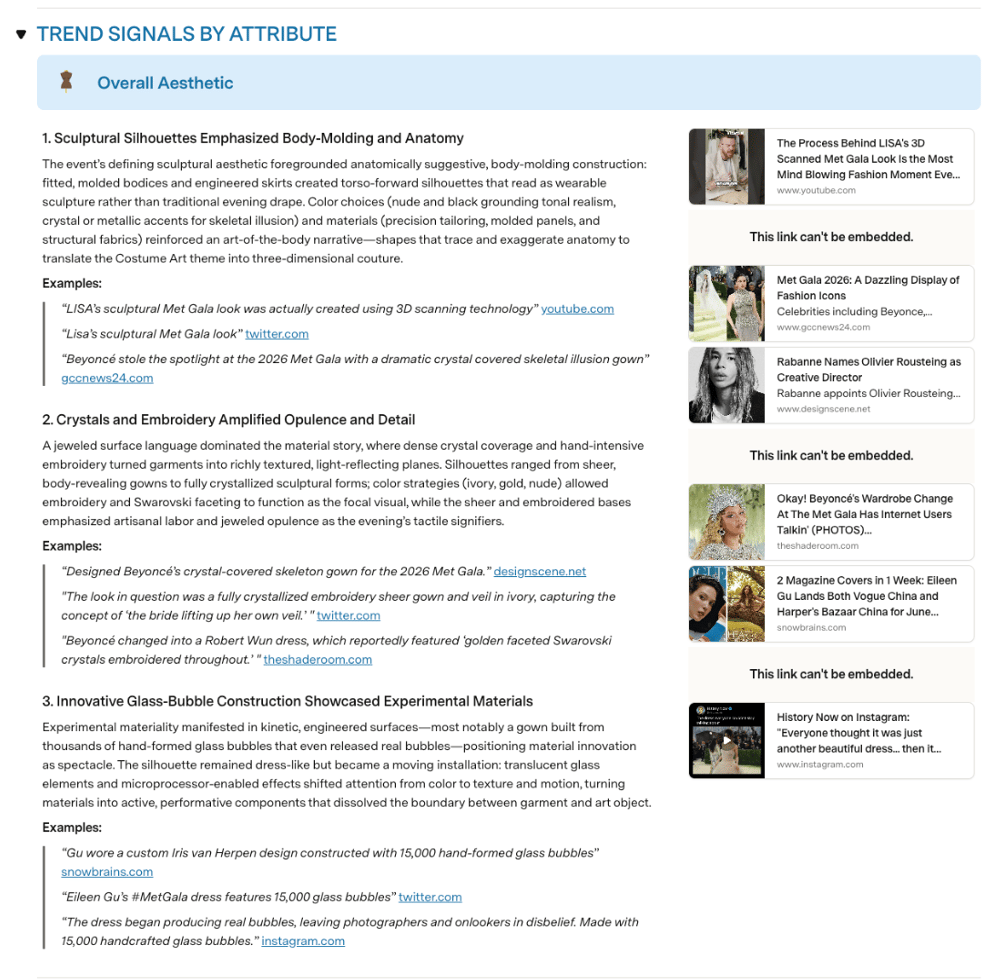
The aesthetic signals from the Met Gala brief are specific and actionable. Sculptural silhouettes that emphasized body-molding and anatomy defined the visual identity of the event. Crystal embroidery and jeweled surface language dominated material storytelling. And experimental materiality, most visibly through a gown built from 15,000 hand-formed glass bubbles that released real bubbles on the carpet, demonstrated that novel material choices create both cultural resonance and rapid post-event replication: the piece was being copied by other designers and referenced in editorial within days.
That last signal is particularly useful for product and creative teams. The bubble gown's performance showed how a materially innovative choice can operate as both an earned media driver at the event and a trend catalyst afterward. For a beauty brand planning a launch, or a fashion house briefing its design team, knowing which aesthetic bets generated that kind of cascading effect is the difference between a strong brief and a generic one.
On the commercial side, the brief quantified Earned Media Value by designer, showing one house generating $31 million in EMV by dressing multiple high-impact attendees and executing technical costume work that became one of the defining product stories of the evening. That is a precise measure of commercial return from an event investment, and it is the kind of figure that belongs in a post-event debrief and informs how a brand allocates its next sponsorship or talent budget.
The Most Referenced Brands section gives teams a competitive read on who won the event and how, which is intelligence that serves both evaluation and planning.
In the Met Gala brief, Vogue's role as the central narrative engine for the entire event is documented in specific terms: organizing guest lists, producing pre- and post-gala content across multiple formats, curating celebrity storytelling, and framing the theme interpretation in ways that shaped editorial coverage globally. Understanding Vogue's function at an event like this is useful for any brand trying to understand how institutional media partnerships translate into reach and narrative authority.
Charlotte Tilbury's presence is documented through the mechanism that drove it: high-visibility talent partnerships, a red carpet product launch timed to the event, and beauty applications that appeared in coverage as named brand touchpoints rather than incidental styling. That is a replicable playbook, and the brief makes the elements of it legible.
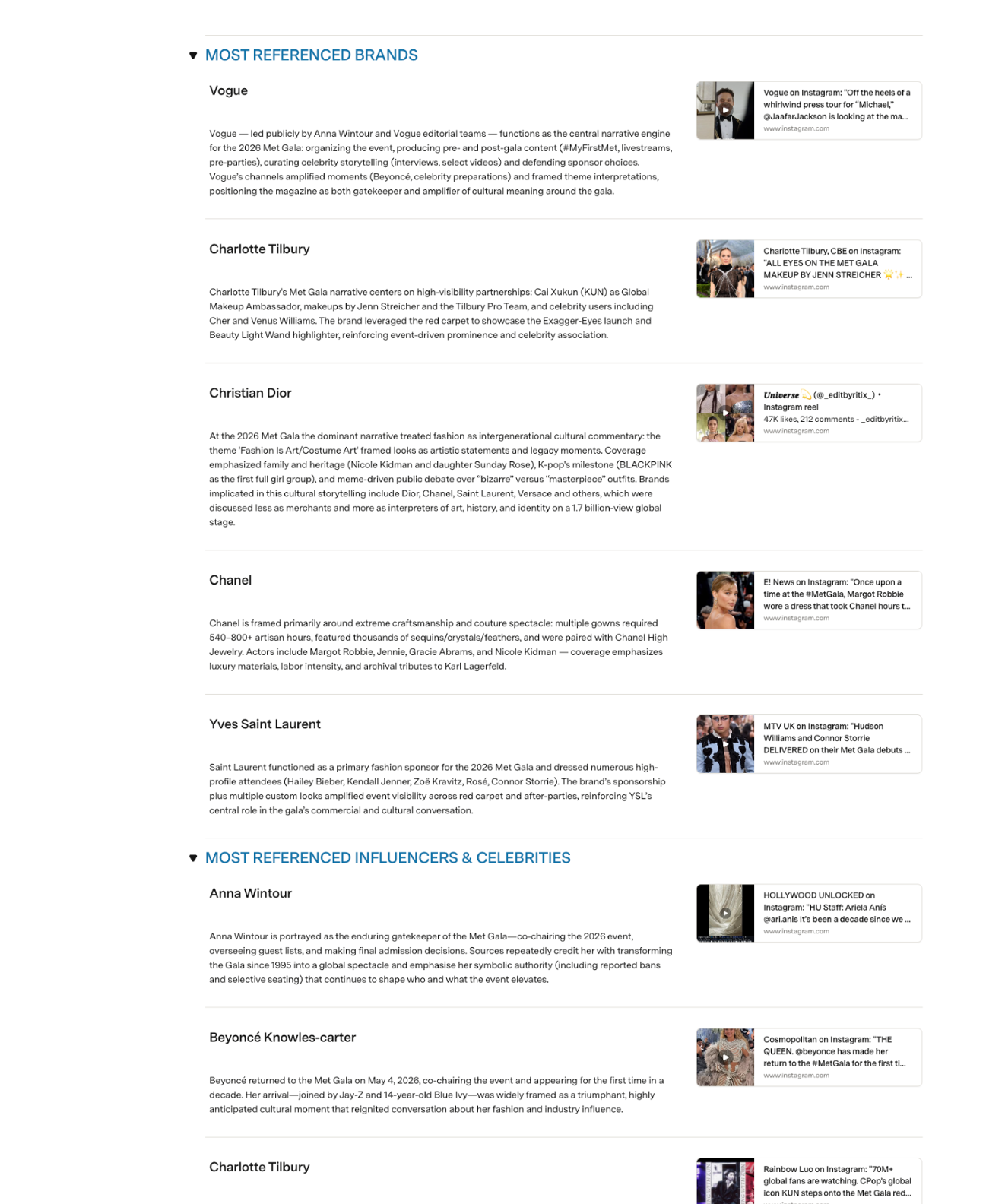
The Most Referenced Influencers and Celebrities section does the same for talent, and it is worth distinguishing this from a standard attendance list. The brief does not just document who was there. It explains how each person's presence functioned: which created sustained coverage momentum, which drove platform-specific engagement spikes, and which generated the kind of interlinked multi-platform storytelling that amplifies into cultural moments rather than single-day peaks. For a team making talent partnership decisions, knowing how specific individuals performed at a specific event type is a materially better input than follower counts or historical engagement averages.
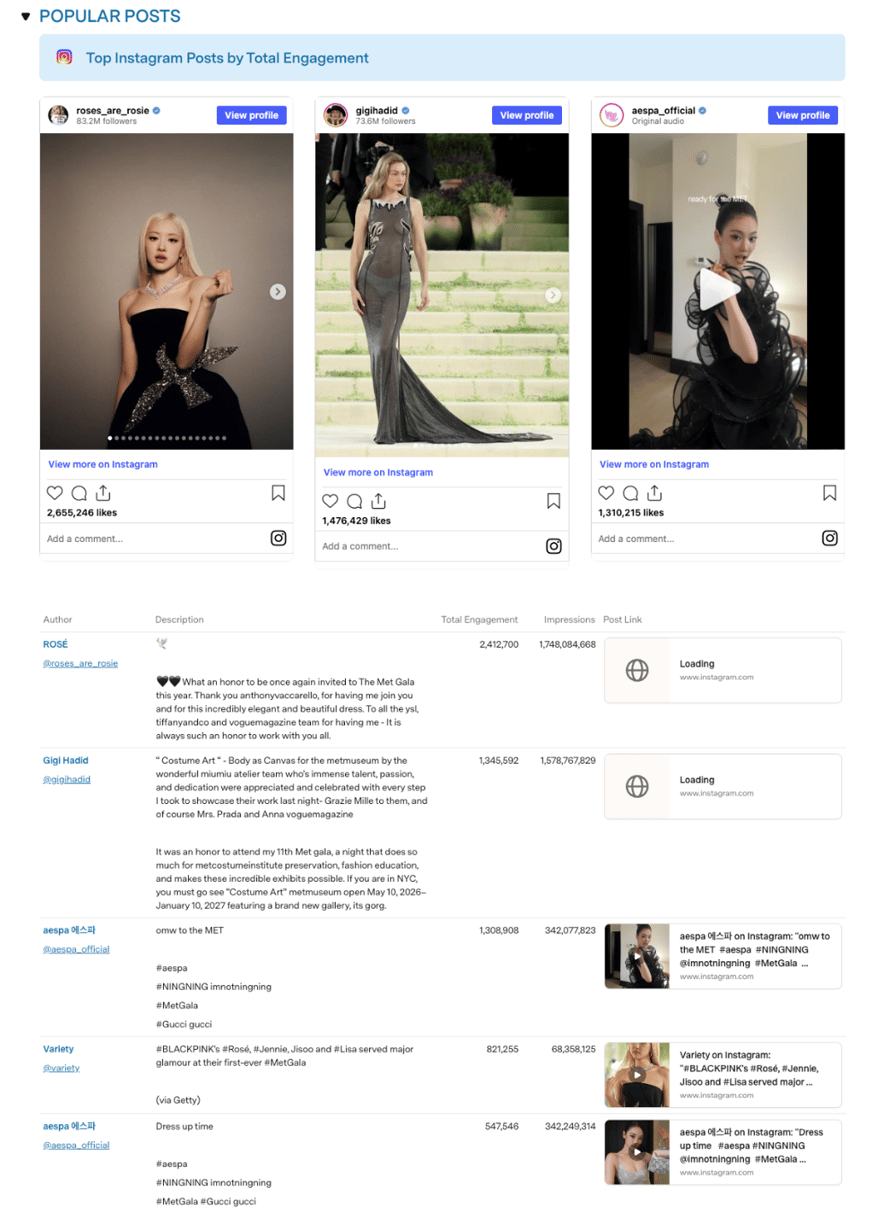
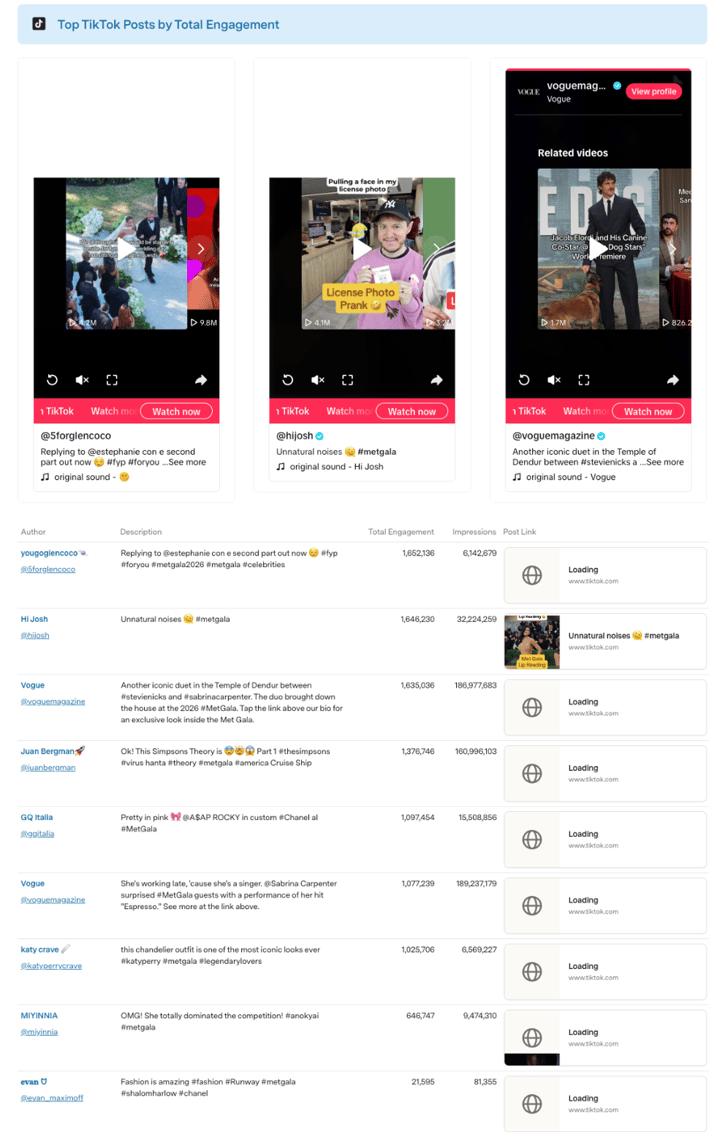
The Popular Posts section surfaces the highest-performing content across Instagram, TikTok, and Twitter/X with engagement totals and impression counts. In the Met Gala brief, Rosé's Instagram post generated 2.4 million engagements and 1.7 billion impressions. BLACKPINK's reunion at their first-ever Met Gala together generated some of the highest Twitter/X engagement of the evening, with individual posts reaching 218,000 replies.
These numbers matter for strategy because they show which moments actually captured audience attention at scale, as opposed to which moments were simply present. Coverage and impact are not the same thing, and the Popular Posts section makes that distinction concrete. For a brand evaluating whether their event investment drove the outcomes they intended, or trying to understand which talent or moment types to prioritize in the future, this section provides the evidence base that makes those decisions defensible rather than intuitive.
The speed argument is real. An hour from event to brief is a fundamentally different capability than a research team spending days pulling data across platforms, reconciling findings, and writing a report. Post-event intelligence has a short window of usefulness: the conversations it should inform are happening in the days immediately after an event, not two weeks later. The agent works within that window. Research teams do not always have the capacity to.
But speed alone is not the full argument. The brief the agent produces is structured in a way that makes it immediately usable across functions. A communications team, a brand strategy team, a creative team, and an insights team can all work from the same brief because it is organized around the questions each of those functions needs to answer rather than around a raw data export that requires interpretation before it becomes useful. That shared intelligence layer is something most organizations do not have after an event, because the work of producing it is too expensive and slow to be practical at the pace events move.
The agent changes that calculation. It works alongside teams rather than replacing the judgment they bring, surfacing the data and the patterns so the human decisions that follow are made with better information rather than against a blank page.
For brand teams activating at events or sponsoring cultural moments, the brief answers the questions that matter after the investment: what drove impact, which placements earned traction, which creative and talent choices performed, and what the signals mean for planning the next one.
For agencies managing post-event reporting and strategy for clients, the agent produces a comprehensive, organized read of how the event landed in an hour, ready to present. It replaces days of manual cross-platform analysis with a single brief that covers every dimension a client debrief requires.
For communications and PR teams, the brief shows exactly how a brand or talent client was framed in coverage, which specific posts and moments drove their reach, how their presence compared to others at the same event, and where the narrative gaps or risks were that need to be addressed.
For trend and insights teams, the Trend Signals by Attribute section is a structured read of the aesthetic, beauty, and commercial intelligence that major events generate, organized in a way that feeds directly into category forecasting, creative briefing, and strategic planning rather than being filed as a post-event recap that no one reads three months later.
You give the agent an event. It analyzes the conversations, media coverage, and social content surrounding that event across the reporting period, identifies the themes and signals that shaped reception, and delivers the complete brief to your inbox and inside Quid Terminal in about an hour. Every finding is grounded in Quid's compliant data network, which means the intelligence reflects what actually happened in the conversation rather than what a model estimates probably happened. Sources are traceable and findings are verifiable.
Ask Q is available alongside every brief inside Terminal for anything you want to explore further. If the brand intelligence raises a question about a specific designer's performance, if a talent insight needs more context, or if you want to connect the event data to other intelligence in the platform, Ask Q works through those questions against the same sourced data that built the brief.
The Beauty and Fashion Event Analysis Agent is available now inside Quid Terminal. Any event worth activating at is worth understanding fully. In about an hour, the conversation across every platform becomes a brief your team can walk into a meeting with.

Q Agent briefs are built on compliant, sourced data. Every insight is traceable and verifiable inside the platform.