

.png?width=1252&height=362&name=QUID_Logo_WHITE%20(2).png)
.png?width=1380&name=Q%20Agent%20Spotlight%20(19).png "<span id=\"hs_cos_wrapper_name\" class=\"hs_cos_wrapper hs_cos_wrapper_meta_field hs_cos_wrapper_type_text\" style=\"\" data-hs-cos-general-type=\"meta_field\" data-hs-cos-type=\"text\" >Q Agent Spotlight: The Company Landscape Agent</span>")

Understanding a competitive landscape means understanding who is in it, how the players cluster, what patterns define the space, and where it is heading. Assembling that picture manually requires pulling from company databases, investment records, revenue filings, and recent transaction histories, then synthesizing everything into a structure that is actually navigable. For a focused category, that might take a research team days. For a broad one, it can take weeks and still leave gaps.

The Company Landscape Agent compresses that process dramatically. You describe a topic in natural language, and the agent automatically retrieves and analyzes thousands of companies related to that space, applies AI-driven clustering to group them into meaningful themes, surfaces the patterns running through the landscape, and highlights representative examples across each cluster. The output is a structured competitive landscape with thematic groupings, key patterns, notable companies sorted by investment, revenue, and recent events, and an executive-level overview of how the space is organized and where it is evolving. It is the kind of intelligence that typically requires significant research overhead to produce, returned as a structured brief.
What sets the Company Landscape Agent apart is not the volume of companies it surfaces, but the way it organizes them into a structure that reflects how the market actually works. Rather than returning a flat list of players sorted by revenue or alphabetically, the agent clusters companies into thematic groups that reflects thr current state of the market. Each cluster represents a distinct segment with its own competitive dynamics, company profile, and strategic character.
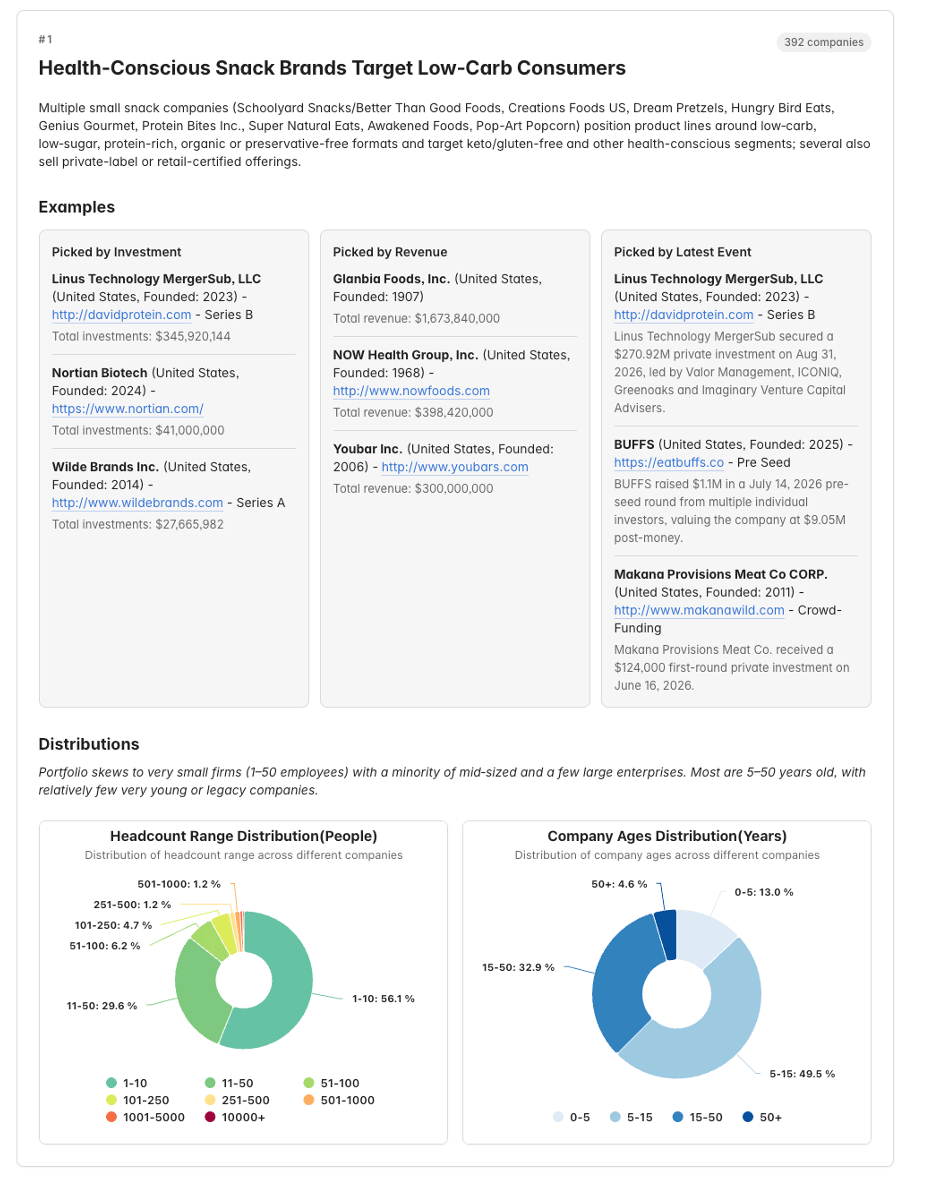
A brief run on protein-packed snack brands surfaced 10 distinct clusters across thousands of companies, ranging from 135 to 392 companies per cluster. The largest cluster, health-conscious snack brands targeting low-carb consumers, contained 392 companies and was flagged as the densest segment in the dataset, signaling where brand competition and consumer attention are most heavily concentrated.The agent specializes in creating the kind of structural read a database search can't return, and it's what makes the brief useful for actually understanding a landscape rather than just populating it with names.
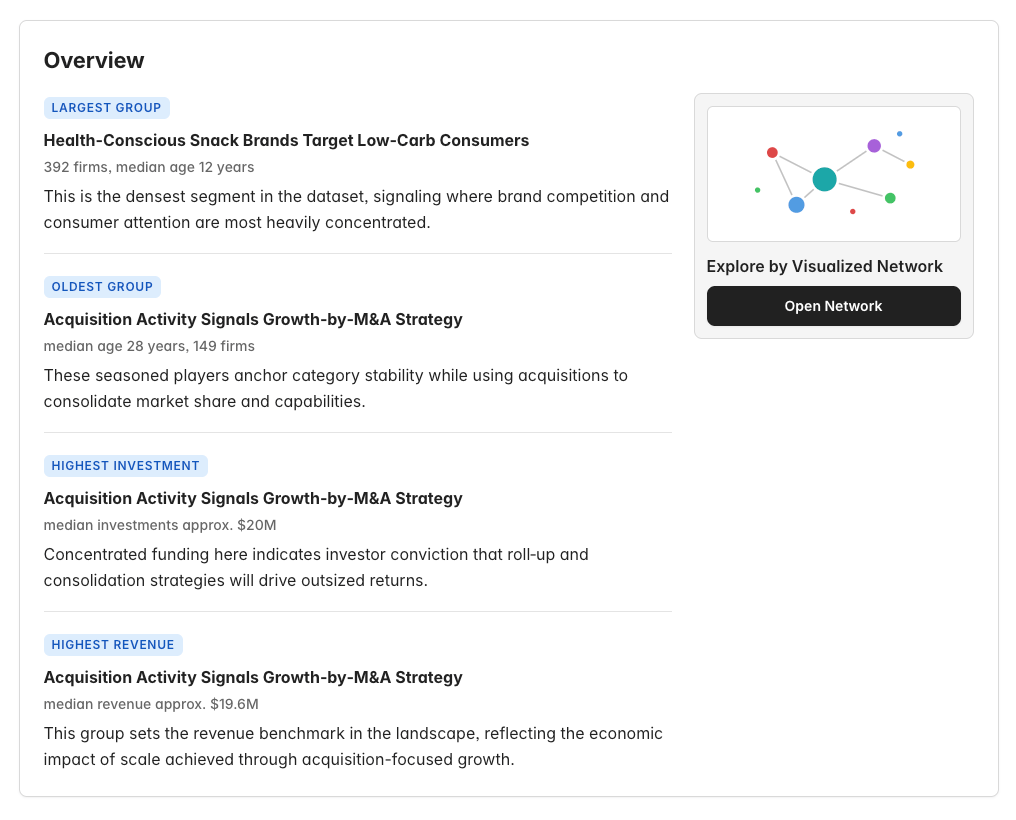
The overview section of the brief also identifies the oldest group, the highest-investment segment, and the highest-revenue cluster, giving an immediate read on where the market is most mature, where capital is most concentrated, and where scale has already been achieved. In the protein snack brief, the acquisition-focused cluster carried both the highest investment concentration and the oldest median company age at 28 years, which together signal that consolidation through M&A is already underway in a specific part of this market. That is a different strategic signal than simply knowing who the biggest players are.
Within each thematic cluster, the brief provides a description of what defines the companies in that segment, examples of notable players organized by investment, revenue, and latest event, and distribution charts showing headcount ranges and company ages across the cluster. That structure is designed to give three different but complementary views of each segment.
The investment column surfaces who is attracting capital, which is a forward-looking signal about which players or approaches investors believe have growth potential. The revenue column identifies who has already built scale, which is a different and often more stable signal about competitive position. The latest event column captures the most recent transaction, acquisition, funding round, or partnership, giving a real-time read on momentum within each segment. Reading those three columns together for a single cluster gives a richer and more accurate picture of what is happening in that part of the market than any single data point would provide.
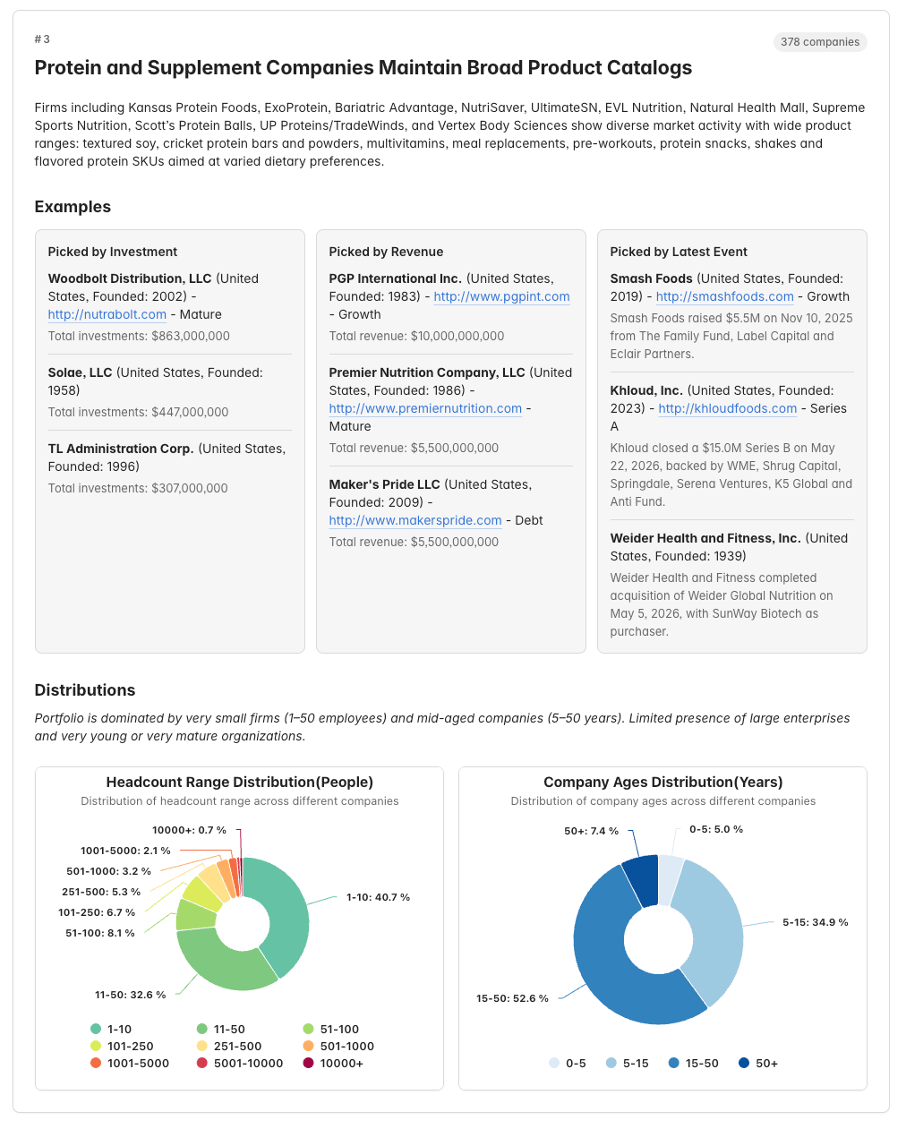
The distribution charts add a structural layer. The headcount distribution shows how the segment skews by organizational size. The company age distribution shows the maturity profile, distinguishing segments where new entrants are competing alongside decades-old incumbents from those where the competitive set is more uniformly established or uniformly early-stage. In the protein snack landscape, the pattern across most clusters is dominance by very small firms, which signals a fragmented, entrepreneurial market with limited large-scale consolidation at the segment level despite the M&A activity visible in specific clusters. That kind of structural context changes how a team interprets the company examples they are looking at.
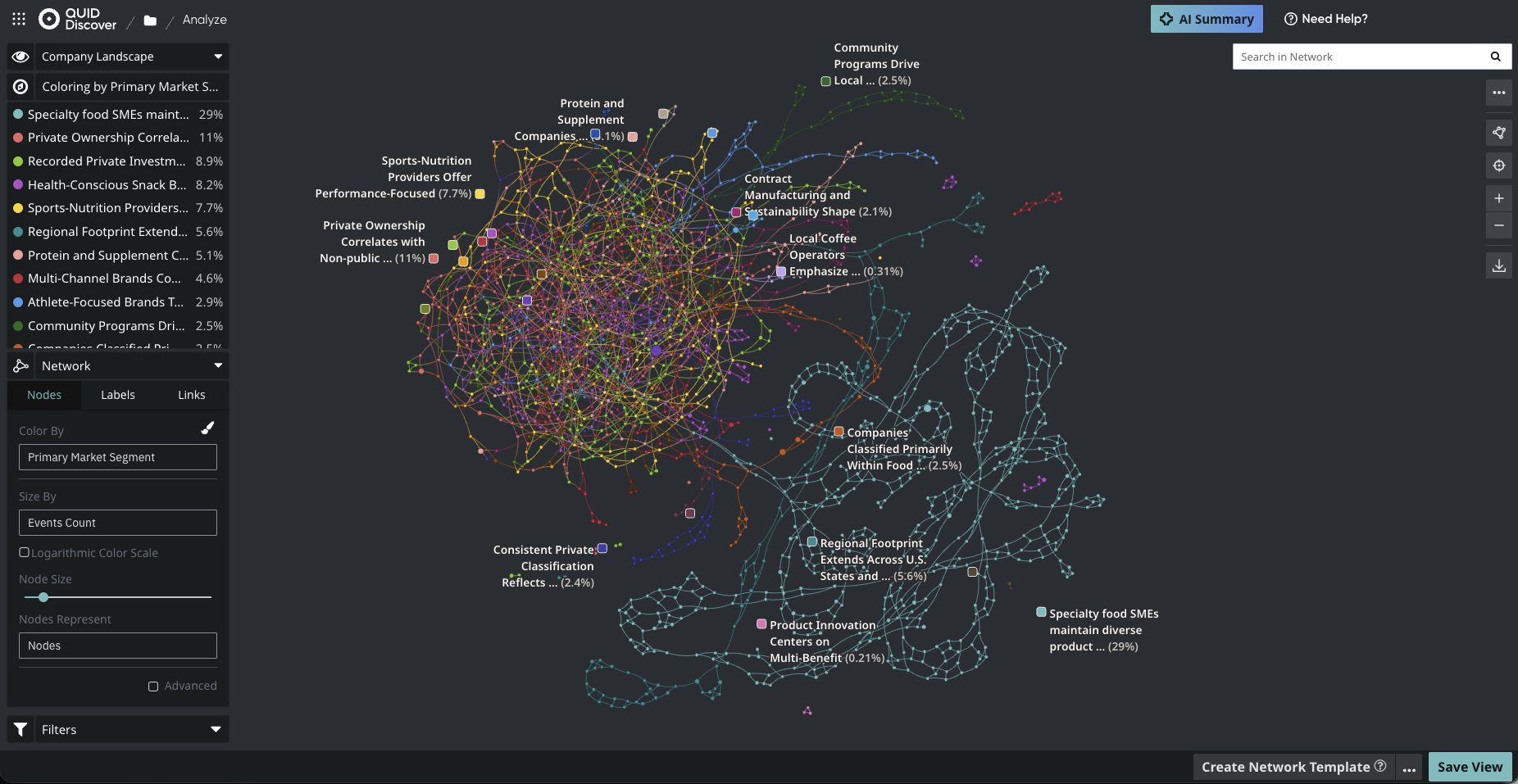
Once the brief is delivered, the full company network is also available to explore visually inside Quid Discover. The network view maps every company as a node, colored by primary market segment and sized by events count, so you can immediately see which clusters are densest, which are most active, and how companies relate to one another across the landscape. From there you can filter by segment, zoom into specific clusters, search for individual companies, and pull an AI summary of any portion of the network. It's a way to move from the structured brief into a live, interactive view of the same data, letting your team explore threads that the brief surfaces without having to leave the platform.
Competitive landscape intelligence has historically been one of the most resource-intensive research outputs a team can produce. Building it properly means pulling from multiple sources, reconciling inconsistent data, organizing companies into meaningful groups, and then interpreting what the structure of the competitive set actually signals about the market. The Company Landscape Agent does not just speed that process up. It fundamentally changes what is possible within a given research budget or timeline, making full landscape analysis accessible for decisions where it previously would not have been practical to commission one.
Because the agent operates across thousands of companies simultaneously, it surfaces patterns that would be difficult or impossible to identify through manual research. Which segments are most fragmented? Where is capital concentrating? Which parts of the market are being rolled up through acquisition while others remain founder-led? What does the age distribution of companies in a given cluster signal about how mature that competitive territory is? These are structural questions about a market that the cluster-level view answers in a way that a ranked list of individual companies never could.
The brief also functions as a living starting point rather than a static output. Because it is saved inside Quid Terminal and Ask Q is available alongside it, teams can interrogate specific findings, drill into individual clusters, compare segments, or connect what the landscape shows to other intelligence in the platform. A strategy team can move from the executive overview to a specific cluster to a question about a particular company's recent funding activity without leaving the brief, which changes how landscape intelligence gets used in practice: less as a reference document to be filed, more as an active intelligence layer that supports ongoing decision-making.
The brief replaces weeks of database research with a structured, thematic read of an entire competitive space, complete with company-level examples and the distribution context to interpret what those examples represent. Teams that previously had to choose between comprehensive and timely now get both.
The cluster structure immediately shows where the field is most crowded, which segments are most mature, and where the white space exists. Knowing that consolidation activity is already concentrated in a specific cluster is a material input for any team weighing whether to build, buy, or partner in a space, and it is the kind of signal that only becomes visible when you can see the full landscape organized by theme rather than sorted by a single variable.
The investment and revenue columns within each cluster surface the companies attracting capital and the ones generating scale, organized by the thematic segment they belong to. That makes it significantly faster to identify where to focus due diligence without scanning undifferentiated lists, and the latest event column provides a real-time pulse on transaction activity across every segment simultaneously.
The brief provides a grounded, comprehensive view of a competitive landscape that makes strategic recommendations more defensible and more specific. Walking into a new business pitch or a client strategy session with a structured read of thousands of companies organized into thematic clusters, complete with distribution data and recent investment and acquisition activity, is a materially different kind of preparation than what manual category research typically produces in the same timeframe.
You describe a topic in natural language. The agent retrieves thousands of companies related to that topic, applies AI-driven clustering to organize them into meaningful thematic groups, and builds the structured landscape brief with cluster summaries, company examples, distribution charts, and an executive overview. The output reflects the actual structure of the competitive space rather than a predetermined category framework, which means the clusters emerge from the data rather than being imposed on it.
The brief is delivered to your inbox and inside Quid Terminal, where the full network of companies is also available to explore visually through the network view. Ask Q is available alongside the brief for any follow-up, whether that is exploring a specific cluster further, asking about a particular company's position in the landscape, understanding what the distribution patterns in a segment imply, or connecting the landscape findings to other intelligence in the platform. Every finding is sourced and verifiable, which means the brief is usable in client-facing work, internal strategy sessions, and investment contexts without requiring a separate validation step.
The Company Landscape Agent is available now inside Quid Terminal. Describe a market, a category, a technology area, or any topic where you need to understand who is competing and how the space is organized. The structured landscape the agent returns is the kind of intelligence that typically takes a research team significantly longer to produce from scratch.

Q Agent briefs are built on compliant, sourced data. Every insight is traceable and verifiable inside the platform.
What is the best tool for competitive landscape analysis?
Quid's Company Landscape Agent is a leading tool for competitive landscape analysis, automatically retrieving and clustering thousands of companies into thematic segments with investment, revenue, and recent event data in a single brief.
How do you map a competitive landscape quickly?
The fastest way to map a competitive landscape is to use an AI agent that retrieves and organizes companies by theme automatically. Quid's Company Landscape Agent clusters thousands of companies into meaningful segments and delivers a structured brief without manual research.
What is AI-driven company clustering?
AI-driven company clustering is the process of using artificial intelligence to group companies into thematic segments based on shared characteristics, market positioning, and competitive dynamics, rather than sorting them by a single variable like revenue or size.
How do you identify white space in a competitive market?
Identifying white space in a competitive market requires understanding which segments are most crowded, which are most mature, and where consolidation is already underway. The Company Landscape Agent surfaces that structure by clustering thousands of companies into thematic groups and showing where capital, scale, and activity are concentrated.
What is the Company Landscape Agent in Quid Terminal?
The Company Landscape Agent in Quid Terminal is an AI agent that analyzes thousands of companies related to any topic, clusters them into meaningful competitive segments, and delivers a structured landscape brief with thematic groupings, company examples sorted by investment and revenue, distribution charts, and an executive overview of how the space is organized.