

.png?width=1252&height=362&name=QUID_Logo_WHITE%20(2).png)
.png?width=1380&name=Q%20Agent%20Spotlight%20(24).png "<span id=\"hs_cos_wrapper_name\" class=\"hs_cos_wrapper hs_cos_wrapper_meta_field hs_cos_wrapper_type_text\" style=\"\" data-hs-cos-general-type=\"meta_field\" data-hs-cos-type=\"text\" >Q Agent Spotlight: The Food Product Concepts Agent</span>")
Food innovation has always required understanding not just what people eat, but why they eat it, what frustrates them, what they're improvising at home, and where the market hasn't yet caught up with consumer behavior. Gathering that intelligence used to mean commissioning research, running focus groups, and hoping the findings stayed relevant by the time they informed a product decision. The Food Product Concepts Agent compresses that process into a single structured brief, built from real consumer conversation, that a product team, agency, or brand strategist can work from immediately.
Enter any food concept and the agent generates a comprehensive innovation report covering consumption drivers, cultural influences, occasions, consumer claims, unmet needs, adoption frictions, emerging ingredients and preparations, unusual consumption patterns, product concepts with full briefs, distribution and packaging considerations, sustainability signals, and topic engagement metrics. It's the kind of foundational intelligence that used to take weeks to assemble; the agent delivers it ready to act on.

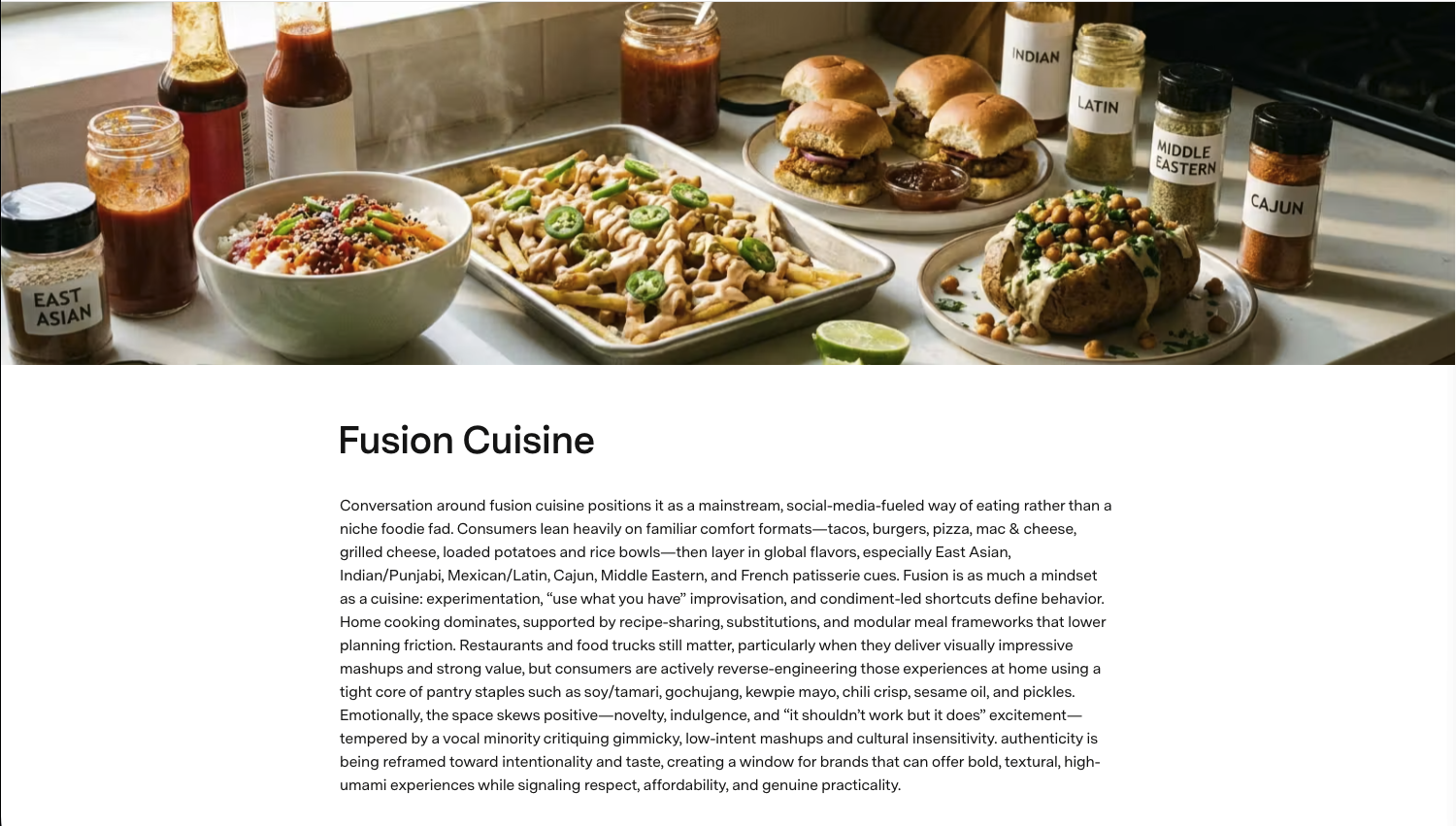
A brief run on Fusion Cuisine demonstrates the depth and breadth of what the agent produces. Across more than 300 posts and 600 mentions in the analyzed period, fusion cuisine is positioned as a mainstream, social-media-fueled way of eating rather than a niche foodie pursuit. Consumers lean heavily on familiar comfort formats — tacos, burgers, pizza, mac and cheese, grilled cheese, loaded potatoes, and rice bowls — then layer in global flavors, particularly East Asian, Indian/Punjabi, Mexican/Latin, Cajun, Middle Eastern, and French patisserie cues. Fusion is as much a mindset as a cuisine: experimentation, "use what you have" improvisation, and condiment-led shortcuts define behavior.
That overview is the starting point. The brief then builds out every dimension of the innovation opportunity from there.
The brief ranks consumption drivers by coverage score, which distinguishes between the motivations that are genuinely shaping behavior and the ones that simply appear in brand communications. In the fusion cuisine brief, low-friction creativity led at 35%: consumers want "out of the box" ideas that still fit weeknight realities, requiring few ingredients, repeatable formats, and easy swaps. Condiment-led flavor boosts came second at 30%, with a small set of Asian condiments treated as "secret weapons" that instantly make everyday comfort foods taste restaurant-level. Sensory payoff and texture play ranked third at 25%, with satisfaction tied to bold umami, sweet-heat balance, and "crispy plus creamy plus fresh" contrasts. Comfort-food upgrades, value and affordability, and self-expression and identity complete the picture.
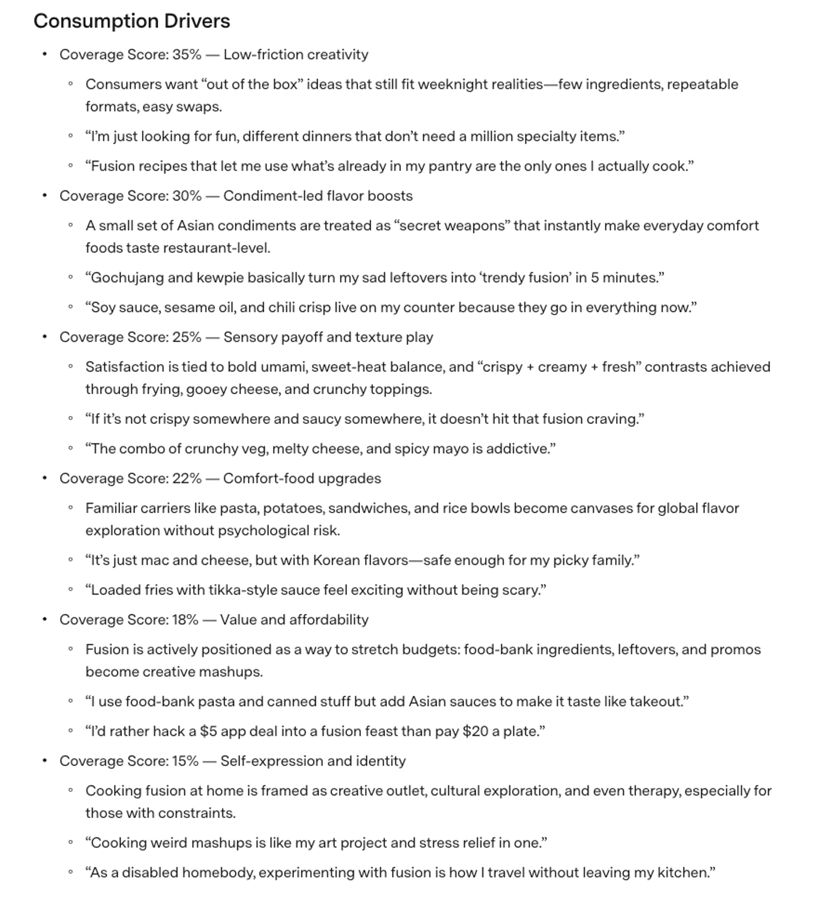
The coverage score ranking matters because it changes how a product or marketing team should prioritize. A brand leading with identity and self-expression messaging is addressing the 15% motivation, while the 35% motivation, low-friction creativity, remains underserved. The brief makes that misalignment visible before a product goes to market.
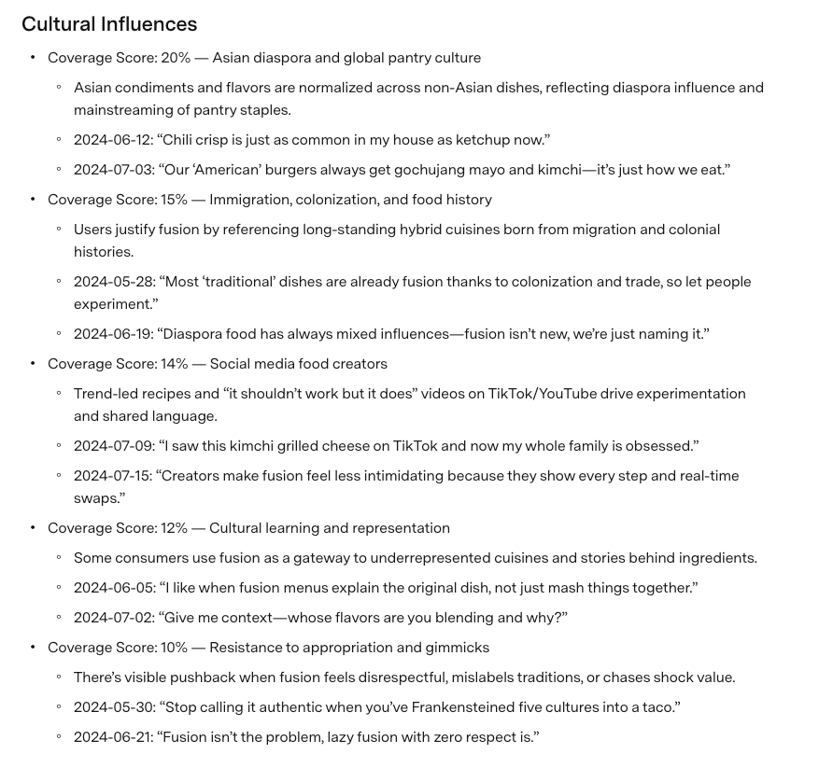
The Cultural Influences section maps where fusion cuisine behavior comes from, distinguishing between Asian diaspora and global pantry culture at 20%, immigration and food history at 15%, social media food creators at 14%, cultural learning and representation at 12%, and resistance to appropriation and gimmicks at 10%. That last signal is particularly important for brand positioning: 10% of the conversation is actively pushing back on fusion done without respect or intentionality, and that pushback shapes how the other 90% evaluates new products and brands in the space.
The Occasions section identifies eight distinct contexts where fusion cuisine behavior occurs, from weeknight family dinners where one cook needs to satisfy mixed tastes, to budget-stretching end-of-month meals where pantry staples and food-bank items get turned into restaurant-style dishes, to therapeutic solo cooking nights where individuals dealing with mental health or disability use fusion cooking as a creative outlet. Each occasion represents a distinct product brief and a distinct communications opportunity.
The Unmet Consumer Needs section is where the brief identifies the clearest opportunities for innovation. Intentional, respectful fusion cues led at 20%: consumers want clear flavor stories and cultural acknowledgment instead of vague "Asian-inspired" mashups. Truly practical weeknight-ready solutions came second at 18%, with explicit frustration at products claiming "20 minutes" but demanding long prep, niche ingredients, or complex steps. Fusion for constrained budgets and access ranked third at 16%, with consumers wanting products that work with food-bank and pantry basics rather than assuming access to specialty stores.
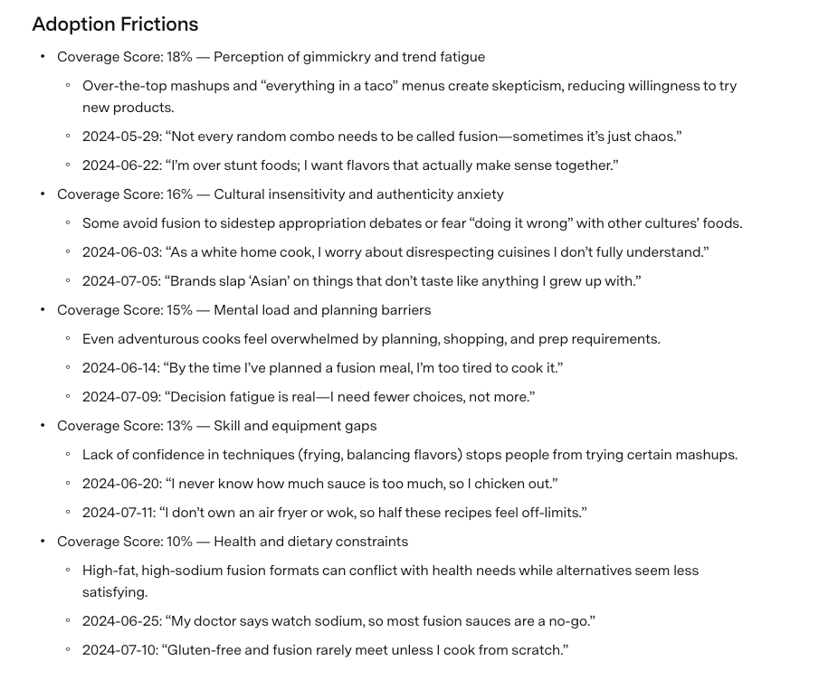
Adoption Frictions maps what is actively stopping consumers from engaging more deeply with the category. Gimmickry and trend fatigue led at 18%, with over-the-top mashups creating skepticism and reducing willingness to try new products. Cultural insensitivity and authenticity anxiety at 16% causes some consumers to sidestep fusion entirely to avoid appropriation debates or the fear of doing it wrong. Mental load and planning barriers at 15% affects even adventurous cooks who feel overwhelmed by planning, shopping, and prep. Skill and equipment gaps at 13%, health and dietary constraints at 10%, and texture-focused convenience formats at 12% complete the friction picture.
Reading unmet needs and adoption frictions together gives a product team the precise brief for what an innovation needs to be and what it needs to avoid. In fusion cuisine, the brief points clearly toward products that are practical, respectful, low-friction, accessible on a constrained budget, and honest about their cultural inspiration.
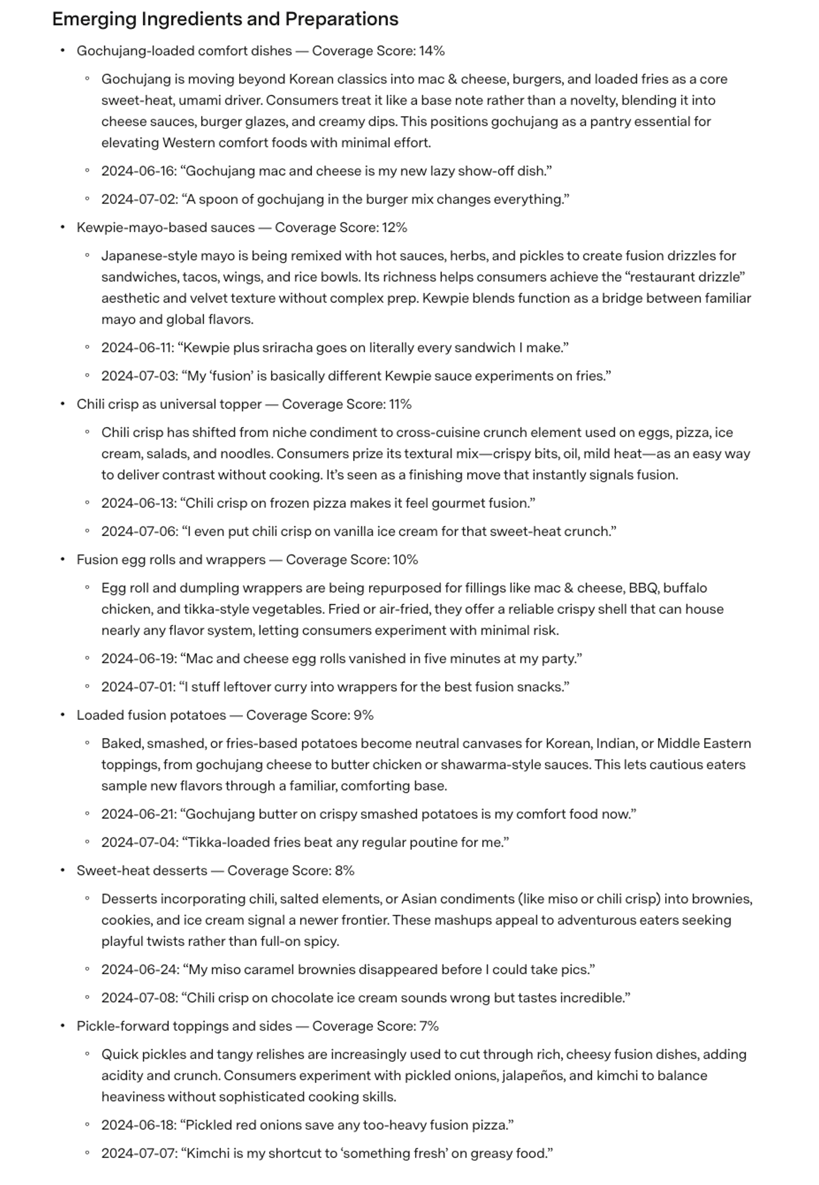
The Emerging Ingredients and Preparations section tracks which elements are gaining coverage in consumer conversation, indicating movement from niche to mainstream. Gochujang-loaded comfort dishes led at 14%: gochujang is moving beyond Korean classics into mac and cheese, burgers, and loaded fries as a core sweet-heat, umami driver, treated as a pantry essential rather than a novelty. Kewpie-mayo-based sauces came in at 12%, with Japanese-style mayo being remixed with hot sauces, herbs, and pickles to create fusion drizzles for sandwiches, tacos, wings, and rice bowls. Chili crisp as a universal topper ranked third at 11%, having shifted from niche condiment to cross-cuisine crunch element used on eggs, pizza, ice cream, and noodles. Fusion egg rolls and wrappers at 10% and loaded fusion potatoes at 9% round out the leading emerging ingredients.
The Unusual Consumption section documents behavior that doesn't fit standard category frames, including chili crisp on ice cream as a ritual treat, food-bank fusion experiments where creators showcase elaborate fusion meals built almost entirely from surplus ingredients, therapeutic solo fusion cooking nights, and breakfast reimagined with dinner leftovers. These patterns are signals about where consumer creativity is outpacing product availability, identifying white space that intentional innovation can address.
The Product Concepts section is where the brief moves from intelligence to direction. The agent generates fully formed product briefs, each structured around a consumer dilemma, a brand proposition, a product name, a reason to believe, a selling idea, occasions, and a target audience.
The three top-ranked concepts in the fusion cuisine brief were the Fusion Weeknight Bowl Kit, Street-Crisp Fusion Bakes, and Pantry Hero Fusion Sauces, selected for viability and trend fit because they directly address value, low-friction creativity, and texture expectations with scalable cross-channel potential.
The Fusion Weeknight Bowl Kit addresses the consumer who wants bold, creative weeknight dinners but has no time or mental energy to plan. The proposition is to build fast fusion bowls from a few pantry items using ready-to-use global sauces and crunchy toppers, with pre-balanced sauces and ambient crispy toppings turning rice, pasta, or potatoes into restaurant-style meals in under 15 minutes. Street-Crisp Fusion Bakes addresses the consumer who wants the crispy-creamy fusion textures they see online but can't replicate at home, using oven- and air-fryer-ready components engineered for crunch plus sauces for drizzle-worthy finishes. Pantry Hero Fusion Sauces is a value-forward line of concentrated, shelf-stable sauces and sachets explicitly formulated to work with food-bank and low-cost staples.
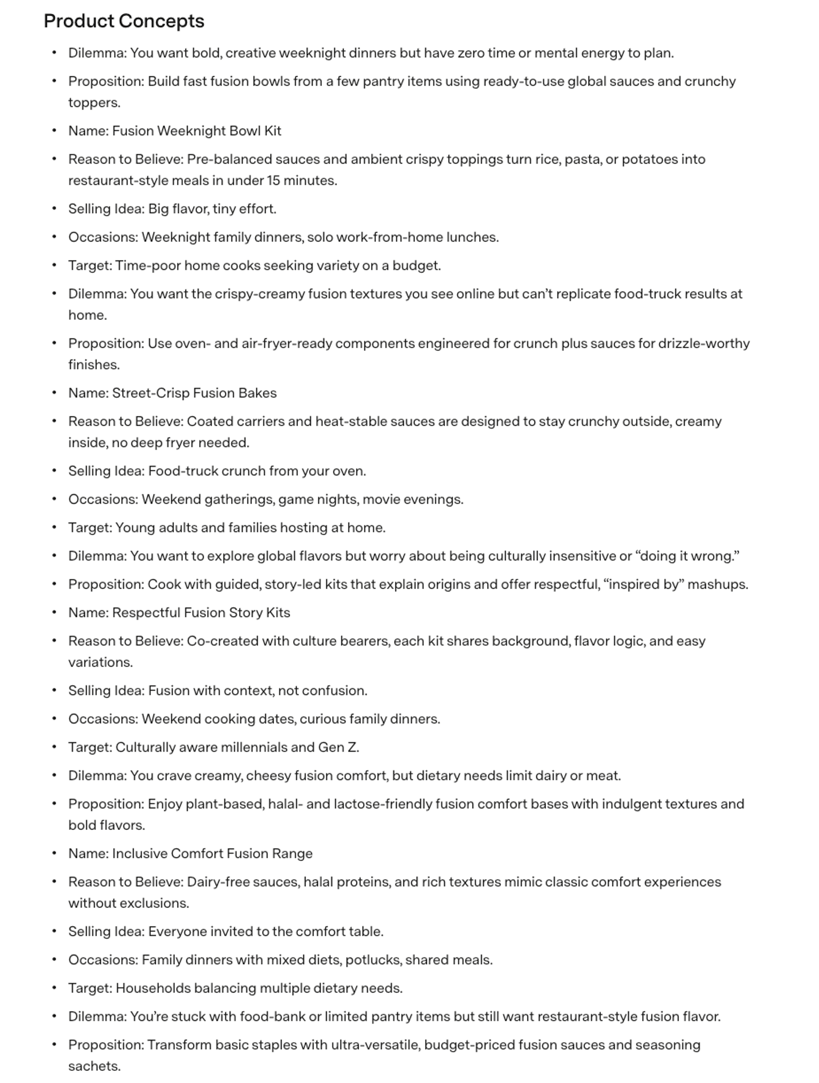
Eight additional concepts cover the full range of the innovation space: Respectful Fusion Story Kits, Inclusive Comfort Fusion Range, 3-Move Fusion Frameworks, Sweet Heat Dessert Lab, Core Four Fusion Condiments, At-Home Food Truck Feast, Solo Fusion Cups, and 3-Move Fusion Frameworks. Each comes with the same full brief structure, giving a product or innovation team a ready pipeline of testable directions rather than a blank page.
The brief closes with three sections that connect the consumer intelligence to the practical decisions that determine whether an innovation reaches the right audience at the right margin.
Distribution Considerations maps each concept to its natural channel: national grocery retailers for the core SKUs, value and dollar channels for Pantry Hero Fusion Sauces, mass merchandisers and club stores for multi-pack versions, ethnic and specialty grocers for Respectful Fusion Story Kits, quick-commerce and delivery apps for Solo Fusion Cups and Fusion Weeknight Bowl Kits, direct-to-consumer platforms for Sweet Heat Dessert Lab drops, meal kit and subscription services for 3-Move Fusion Frameworks, and university and workplace campuses for smaller-format Pantry Hero and Solo Fusion options.
Packaging Considerations addresses how packaging needs to communicate intentionality and reduce friction: high-impact food photography or illustrations showcasing the core fusion cues, descriptive flavor profiles rather than vague "Asian-inspired" claims, on-pack frameworks for base plus sauce plus crunch, substitution prompts for dietary needs, cultural background snippets via QR codes, and clear recycling instructions. The brief flags that on-pack communication should hero time and effort realism, with bold icons like "15 minutes, 3 steps" backed by honest prep descriptions.
The Sustainability Considerations section identifies how fusion cuisine products can align with sustainability expectations without overclaiming: positioning pantry-staple reliance as food-waste reduction through "rescue your leftovers" messaging, prioritizing recyclable or recycled-content plastics and fiber-based trays, leaning on plant-forward formats in Inclusive Comfort Fusion Range and Street-Crisp Fusion Bakes to reduce reliance on resource-intensive proteins, and communicating lower transport footprint for concentrated sauces and dry toppers.
For food and beverage brands, the brief provides the consumer intelligence foundation that typically precedes any serious innovation program, delivered in a form that a product team can work from directly rather than needing to interpret or translate from raw research.
For innovation and R&D teams, the combination of unmet needs, adoption frictions, and fully formed product concepts gives a structured starting point for a development sprint, with the consumer evidence built into each brief rather than living in a separate research document.
For agencies and consultancies advising food clients, the brief provides a fast, sourced read of any food category that changes the quality and specificity of the strategic recommendation from day one of a client engagement.
For marketing and brand teams planning campaigns, the consumption drivers, claims, and cultural influences sections give the exact language and motivation hierarchy needed to develop messaging that connects with how consumers actually think about a category rather than how the category has historically described itself.
You enter a food concept: a cuisine, an ingredient, a format, a trend, or any food idea you want to explore. The Food Product Concepts Agent analyzes consumer conversation around that concept, applies its innovation brainstorming framework across all dimensions of the brief, and delivers the complete report to your inbox and inside Quid Terminal. Ask Q is available alongside the brief for any follow-up, running against the same sourced data that built the report.
The Food Product Concepts Agent is available now inside Quid Terminal. Enter any food concept and get a complete innovation brief built from real consumer intelligence.
The Quid Food Product Concepts Agent is a Q Agent inside Quid Terminal that analyzes consumer conversation around any food concept and generates a comprehensive innovation report. The brief covers consumption drivers, cultural influences, occasions, consumer claims, unmet needs, adoption frictions, emerging ingredients, unusual consumption patterns, product concepts, distribution and packaging guidance, sustainability signals, and engagement metrics.
The Food Product Concepts Agent can analyze any food concept, including a cuisine type such as fusion or Mediterranean, a specific ingredient such as gochujang or kewpie mayo, a format such as meal kits or frozen bowls, a dietary approach such as plant-based or halal, or an emerging trend such as functional foods or street-food formats. The agent draws from real consumer conversation to build the brief, so the output reflects how people are actually talking about the concept rather than how it has been defined by the industry.
Each product concept in the Food Product Concepts Agent brief includes a consumer dilemma, a brand proposition, a product name, a reason to believe, a selling idea, relevant occasions, and a target audience. The brief also identifies the top concepts by viability and trend fit and provides extended narrative descriptions connecting each concept to the consumer intelligence that generated it.
Coverage score refers to the share of analyzed consumer conversation that a specific driver, need, friction, or ingredient accounts for. A higher coverage score indicates that more of the conversation is focused on that dimension, making it a direct measure of relative importance across the dataset rather than a simple count of mentions.
The Food Product Concepts Agent draws from recent consumer conversation in Quid's compliant data network, including social platforms, forums, and other sources where food consumers discuss recipes, products, and eating behaviors. The brief reflects the current state of the conversation rather than historical trends, making it particularly useful for identifying emerging ingredients and behavior patterns before they appear in lagging industry reports.
