

.png?width=1252&height=362&name=QUID_Logo_WHITE%20(2).png)
.png?width=1380&name=Q%20Agent%20Spotlight%20(11).png "<span id=\"hs_cos_wrapper_name\" class=\"hs_cos_wrapper hs_cos_wrapper_meta_field hs_cos_wrapper_type_text\" style=\"\" data-hs-cos-general-type=\"meta_field\" data-hs-cos-type=\"text\" >Q Agent Spotlight: The Industry Profile Agent</span>")

Good strategic decisions require a clear picture of the market. Not just what is happening right now, but where the category is headed, what is threatening it, where the growth is, how consumers are thinking about it, who the established players are, who is emerging, and what technology signals are worth watching. Assembling that picture manually takes days of research across dozens of sources, and it still tends to be incomplete. The Industry Profile Agent produces it in minutes.
Give the agent an industry and it returns a structured brief covering trends, challenges and risks, opportunities and growth areas, growth drivers, consumer perceptions, leading brands, emerging brands, and innovation and technology signals. It is one of the broadest intelligence outputs in the Q Agent library, and for any team that needs to get up to speed on a category quickly, enter a new market, brief a client, or build a strategic plan from a grounded foundation, it is one of the most immediately useful.

The Industry Profile brief is designed to give you the full strategic landscape of a category in a single output. Each section answers a different question that a strategist, researcher, or agency team would need to address before making a meaningful recommendation.
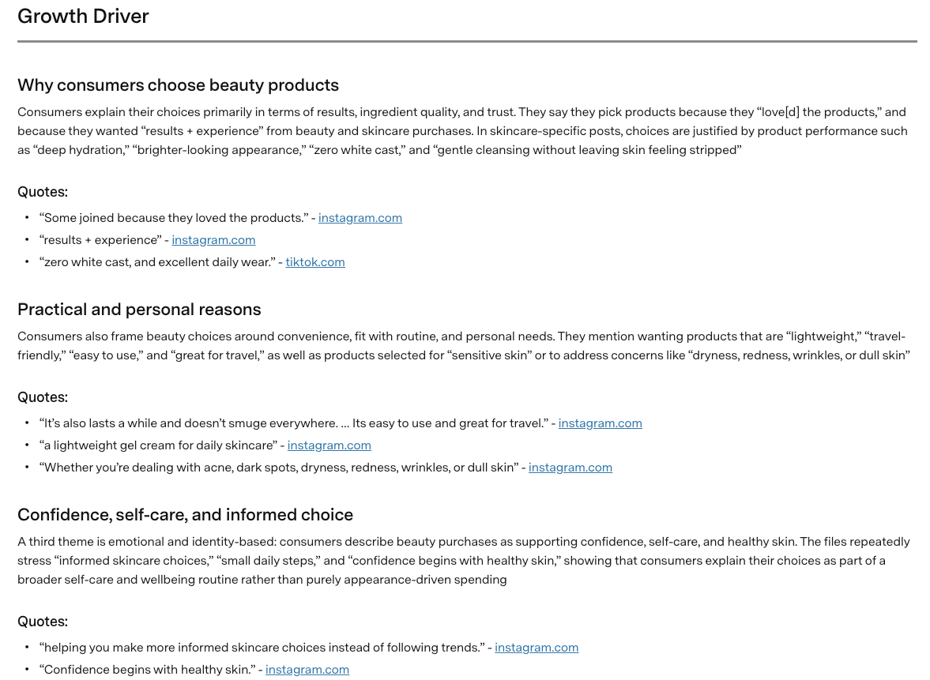
The Trends section grounds the brief in what is actually happening in the market, backed by cited sources. A brief run on the Beauty Products industry surfaced McKinsey data showing 7 percent annual market growth from 2022 to 2024 with a 5 percent annual outlook through 2030 toward a $590 billion market, NIQ reporting 10 percent year-over-year global beauty sales growth, demand shifting toward skincare, fragrance, and premium efficacy-led products, and digital adoption accelerating with online channels expected to reach nearly one-third of global beauty sales by 2030. Those are not estimates. They are sourced figures, cited with publication dates, that a team can use in a client presentation or internal planning document with confidence.
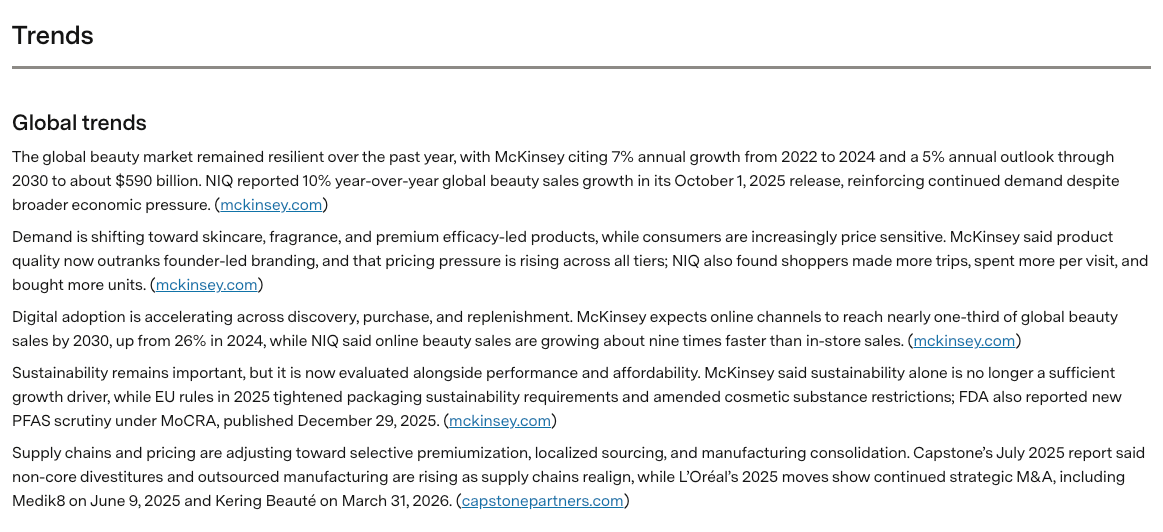
The Challenges, Threats, and Risks section surfaces what is working against the category. In beauty, that includes ingredient transparency pressure, where consumers are increasingly scrutinizing labels and feeling uneasy when formulation choices are not clearly explained; skepticism toward inflated marketing claims and unrealistic timelines that are generating consumer frustration and calls for more educational rather than hype-driven content; and product performance inconsistency causing skin issues and eroding trust. These are the signals that shape what brands need to address before they can build on the growth opportunity.
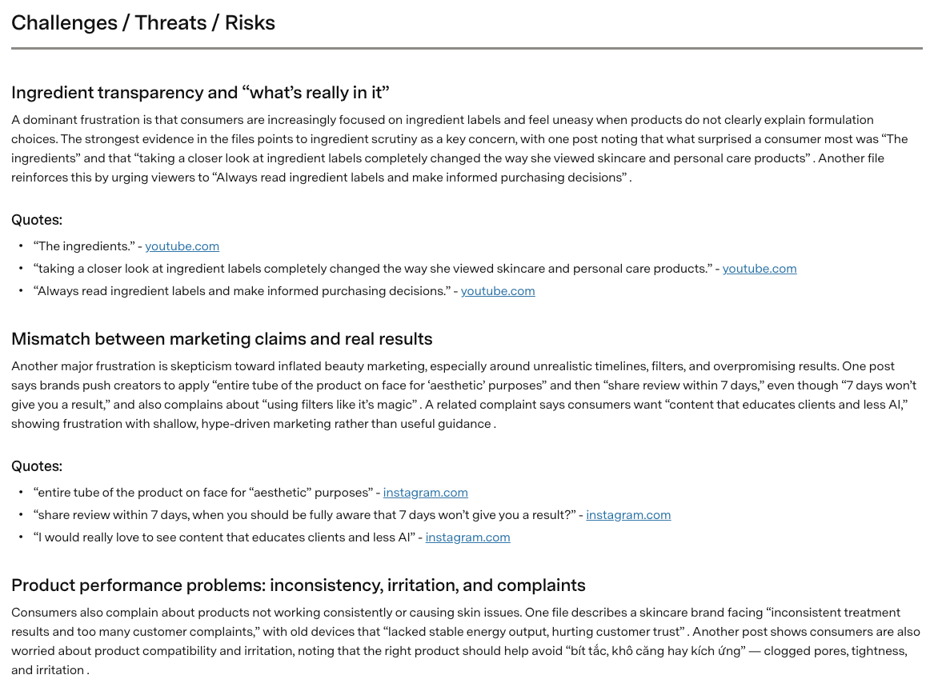
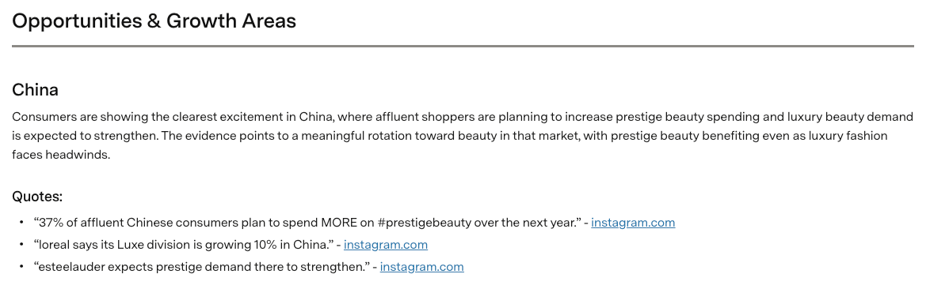
The Opportunities and Growth Areas section identifies where the market is expanding. China is highlighted as a particularly strong opportunity, with affluent shoppers planning to increase prestige beauty spending and luxury beauty demand strengthening even as broader luxury fashion faces headwinds. The Growth Driver section goes deeper into why consumers are choosing beauty products, covering the outcome-led, results-plus-experience framing that drives purchase decisions, the practical and personal needs dimensions like lightweight formulas and travel-friendly packaging, and the emotional and identity-based angle where beauty purchases are framed as confidence, self-care, and informed personal choice rather than purely appearance-driven spending.
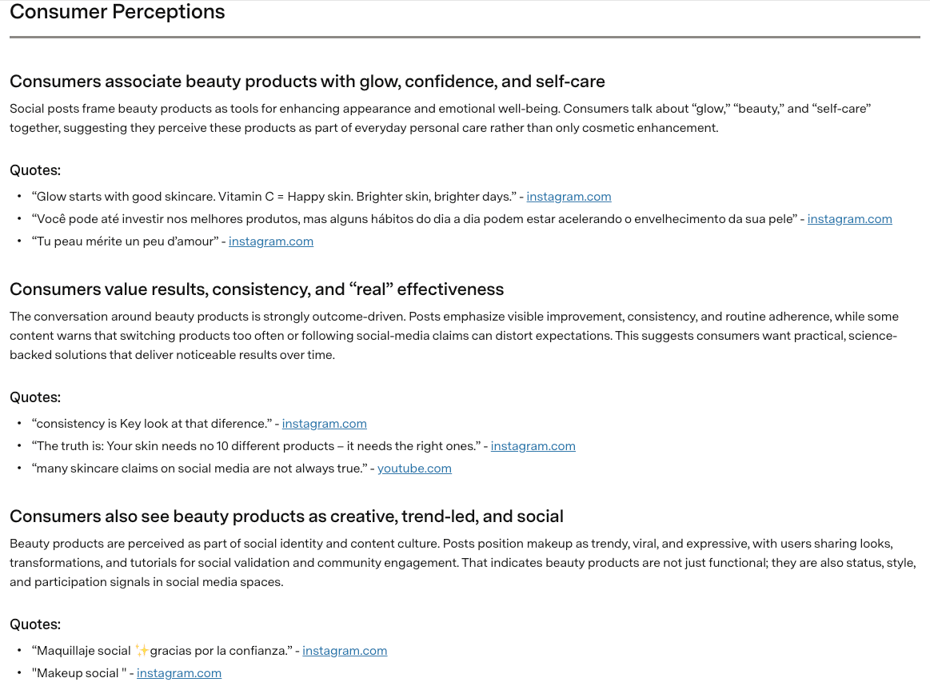
The Consumer Perceptions section maps how people actually think and talk about the category, which is a meaningfully different input from market data or brand performance figures. In the beauty brief, three perception clusters emerged. First, consumers associate beauty products with glow, confidence, and self-care, framing them as tools for everyday emotional and physical wellbeing rather than purely cosmetic enhancement. Second, consumers are outcome-driven and increasingly skeptical of overstatement: they value visible improvement and consistency, warn against switching products too frequently, and push back on social media claims that distort expectations. Third, beauty products carry a social and creative identity dimension, with makeup and skincare framed as participation in culture, community, and self-expression as much as personal care. Understanding those perceptions is what shapes how a brand should communicate, not just what it should say it does.
Two sections of the brief are dedicated specifically to the brand landscape, and they are worth examining separately because they answer different questions.
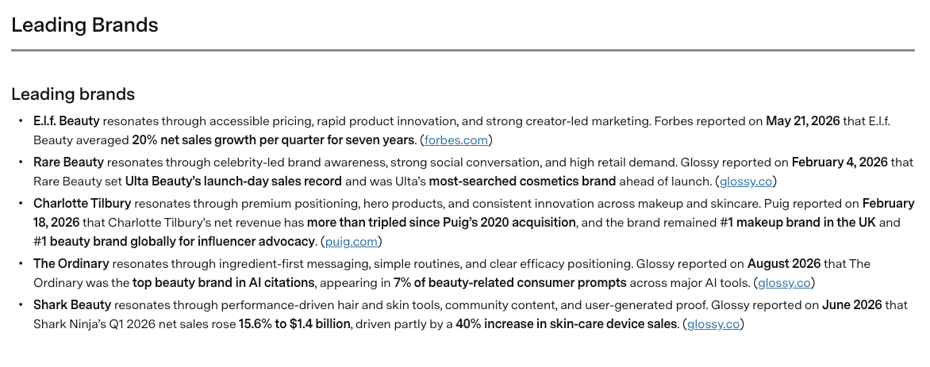
The Leading Brands section is not a simple ranking. It maps how the most prominent brands in the category are resonating and why, with sourced recent data. E.l.f. Beauty is highlighted for accessible pricing, rapid product innovation, and creator-led marketing, with Forbes reporting 20 percent net sales growth per quarter for seven years. Rare Beauty resonates through celebrity-led brand awareness and strong social conversation, with Glossy reporting it set Ulta's launch-day sales record. Charlotte Tilbury has more than tripled its revenue since Puig's 2020 acquisition and remains the number one makeup brand in the UK and number one beauty brand globally for influencer advocacy. The Ordinary is identified as the top beauty brand in AI citations, appearing in 7 percent of beauty-related consumer prompts across major AI tools. Shark Beauty's net sales rose 15.6 percent to $1.4 billion in Q1 2026, driven by a 40 percent increase in skin-care device sales.
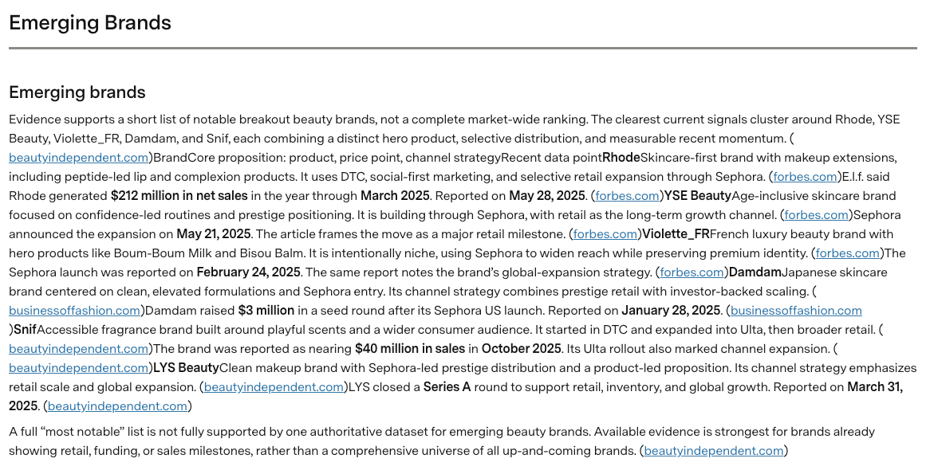
The Emerging Brands section surfaces the breakout players before they become obvious. Rhode, YSE Beauty, Violette FR, Damdam, and Snif are identified as brands with distinct hero products, selective distribution, and measurable recent momentum, each with specific funding or sales data attached. Rhode generated $212 million in net sales through March 2025. Damdam raised $3 million in a seed round after its Sephora US launch. Snif was nearing $40 million in sales in October 2025. These are the signals that tell a strategist or agency team which emerging players are worth tracking before the broader market catches up.
The brief closes with an Innovation and Technology section that maps the forces reshaping how the industry operates and competes. In beauty, that includes AI in design tools and product development, where McKinsey reports only 10 percent of beauty executives used AI regularly in 2025 while 60 percent were still exploratory, indicating early-stage but material adoption potential. Social commerce is identified as a core growth channel, with TikTok beauty sales growing at triple-digit rates since 2023 and NIQ projecting the social commerce channel could reach $4 billion in 2026. Supply chain automation and AI-enabled operations are becoming strategic levers, with L'Oréal's operations transformation built on data-at-scale and AI-enabled decision-making. Agentic commerce and AI-assisted shopping are emerging as a meaningful shift in how beauty buyers discover and purchase.
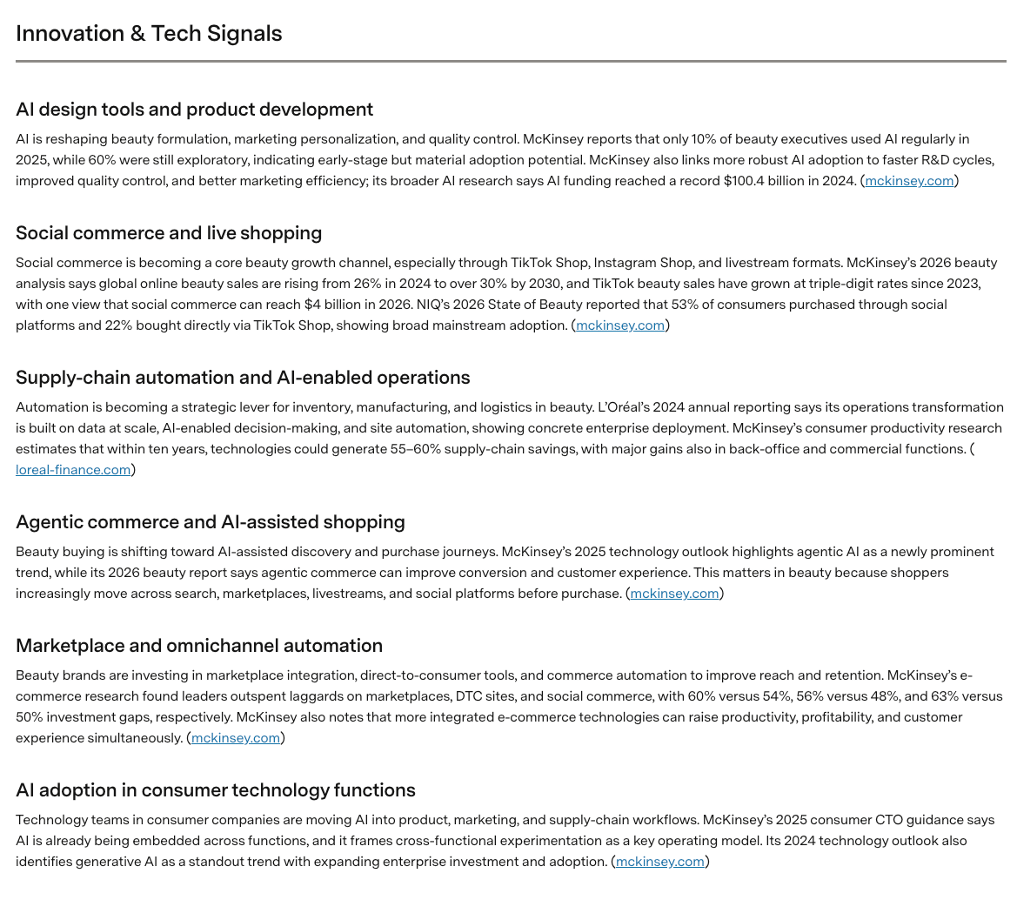
These signals matter not just for beauty brands but for anyone advising them. Knowing that agentic commerce is a named trend in the category, or that social commerce is projected at specific scale, is the kind of intelligence that belongs in a strategic recommendation before it belongs in a trade press headline.
The breadth of the Industry Profile brief makes it useful across a wide range of roles and contexts.
For agency teams onboarding a new client in an unfamiliar category, the brief provides a grounded starting point in minutes rather than days. Rather than beginning a client relationship with generic category knowledge, the team enters the first briefing with sourced trend data, a mapped competitive landscape, consumer perception intelligence, and identified growth opportunities already in hand.
For brand and marketing strategists building annual plans or entering new markets, the brief provides the macro context that strategic planning requires. Understanding that ingredient transparency is a dominant consumer concern in beauty, that China represents a specific and near-term growth opportunity, and that social commerce is scaling faster than in-store retail are not incidental facts. They are the inputs that shape where to invest and how to position.
For market research and insights teams, the combination of sourced trend data, named brand intelligence with recent sales and funding figures, and consumer perception mapping gives a defensible foundation for a market analysis that would otherwise require pulling from multiple separate research subscriptions and stitching together findings manually.
For anyone who needs to understand an industry quickly, accurately, and completely enough to make a consequential decision, the Industry Profile Agent does in minutes what research teams take days to produce.
You give the agent an industry. It pulls from Quid's compliant data network and surfaces a structured brief covering every dimension of the category. Sources are cited throughout, which means the intelligence is not just readable but usable in presentations, reports, and client-facing work. The brief is delivered to your inbox and inside Quid Terminal, where Ask Q is available to go deeper on any section, explore a specific brand or trend, or work through what the data implies for a particular strategic question.
The Industry Profile Agent is one of many Q Agents available inside Quid Terminal, each designed for a specific intelligence need. Whether the question is about a brand, a category, a sentiment, a trend, or an AI visibility gap, there is an agent built to answer it. The Industry Profile Agent is where many of those investigations should start, because understanding the landscape is the prerequisite to understanding everything else within it.
The Industry Profile Agent is available now inside Quid Terminal. Give it an industry and in minutes you have a complete market intelligence brief that is sourced, structured, and ready to work from.

Q Agent briefs are built on compliant, sourced data. Every insight is traceable and verifiable inside the platform.