


Cultural moments move fast. A single celebrity appearance, a streaming shake-up, or a viral runway look can shift consumer attention, create commerce spikes, and open or close brand opportunities within 24 to 72 hours. For brand and marketing teams, the challenge isn't that this information doesn't exist — it's that there's no fast, structured way to get it, assess what it means for strategy, and turn it into something actionable before the window closes.
The Media Category Trends Agent was built specifically for that problem. It runs a structured set of pre-curated research questions against your selected category, covering the areas that matter most to trend-forward teams: styles, colors, materials, products, brand and celebrity collaborations, viral moments, major events, and emerging cultural signals. Rather than open-ended exploration, it surfaces known interest areas filtered by your category and focus, pulls from a rolling week of top and mid-tier media coverage across online, print, and broadcast, and delivers a ready-to-use brief with curated insights, real sourced examples, and suggested actions in about 15 minutes.

The brief is structured around three main sections: Top News, Emerging Trends by Category, and Major Events. Each section covers the cultural signals most relevant to brand strategy within the selected category, with the analysis organized around what matters to teams making decisions about creative, partnerships, media investment, and messaging — not just what's generating the most volume.
A brief run on Pop Culture for the week of October 14 to 20, 2026, led with the headline: Culture Coalesces; Brands Seize Time-Boxed Spikes. The summary immediately identifies the strategic frame for the week: late-night political satire, auteur-led documentaries, and streaming pivots to live sports are creating high-reach, time-boxed windows. Fashion heats up through stylist-driven moments, Y2K lingerie nostalgia, and crystal-laden spectacle. The recommended posture: react within 24 to 72 hours, partner with credible creators, and reallocate to live and event inventory.
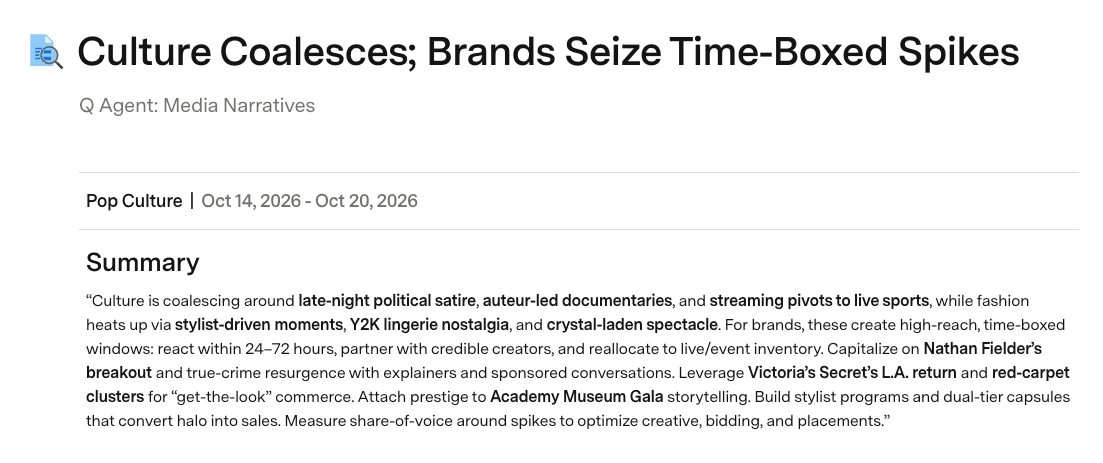
That level of strategic compression — from a week of media coverage to an actionable frame in a single paragraph — is what makes the brief useful for a senior leader or brand strategist who needs to orient quickly before briefing a team.
The Top News section surfaces the stories generating the most strategic relevance for brand teams, not just the ones with the highest coverage volume. Each trend comes with a summary of what's happening, why it matters for brand strategy, and three specific suggested actions with reasoning attached.
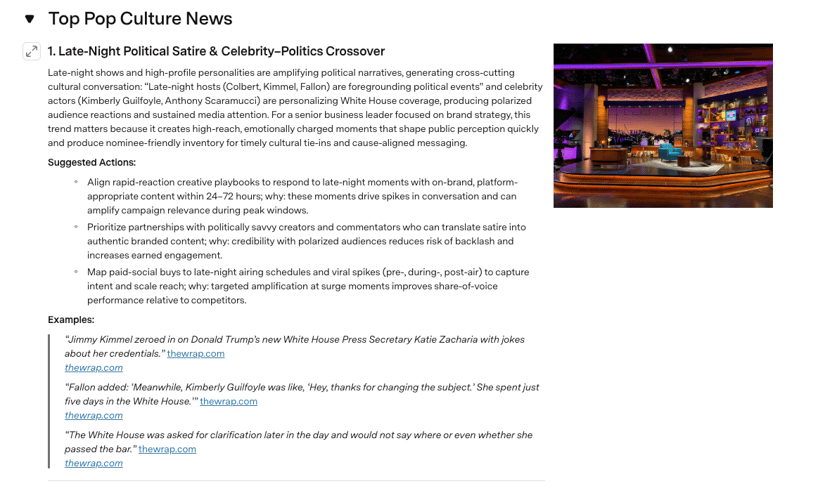
In the Pop Culture brief, Late-Night Political Satire and Celebrity-Politics Crossover led the news section. Late-night hosts including Colbert, Kimmel, and Fallon are foregrounding political events, and celebrity actors are personalizing White House coverage, producing polarized audience reactions and sustained media attention. The brief identifies this as creating high-reach, emotionally charged moments that shape public perception quickly and produce nominee-friendly inventory for timely cultural tie-ins. Suggested actions include aligning rapid-reaction creative playbooks to respond within 24 to 72 hours, prioritizing partnerships with politically savvy creators who can translate satire into authentic branded content, and mapping paid-social buys to late-night airing schedules and viral spikes to capture intent and amplify at surge moments.
Nathan Fielder's documentary breakout ranked second. His film "You Can See Everything" posted the largest opening weekend for a non-music documentary in over two decades, reactivating interest in adjacent scandal narratives including Elizabeth Holmes. The brief frames this as a strong signal of mainstream appetite for auteur-driven, tentpole documentary storytelling that converts cultural curiosity into measurable box-office and social conversation, and an attractive environment for branded sponsorships, long-form content partnerships, or creator collaborations that tap into investigative curiosity and memorable moments.
Streaming Leadership Shakeups and the Strategic Pivot Toward Live and Sports Content completed the top three, with Netflix executive exits signaling content strategy reassessment and broader coverage noting Netflix has not produced a game-changing hit recently, prompting the platform to invest in live sports momentum including roles tied to the LA 2028 Olympics. For brand leaders, the brief flags that these shifts matter because platform-level strategic moves change where cultural attention and large-scale audience engagement flow, altering the value of content partnerships, sponsorships, and where paid media will most efficiently move consumer behavior.
The Emerging Trends section is where the brief goes beyond news and into the specific aesthetic, product, and cultural signals that shape creative strategy. In the Pop Culture brief, this section covers fashion, beauty, and lifestyle trends drawing media attention during the same week, because pop culture and fashion are deeply intertwined and what dominates one tends to generate commerce signals in the other.
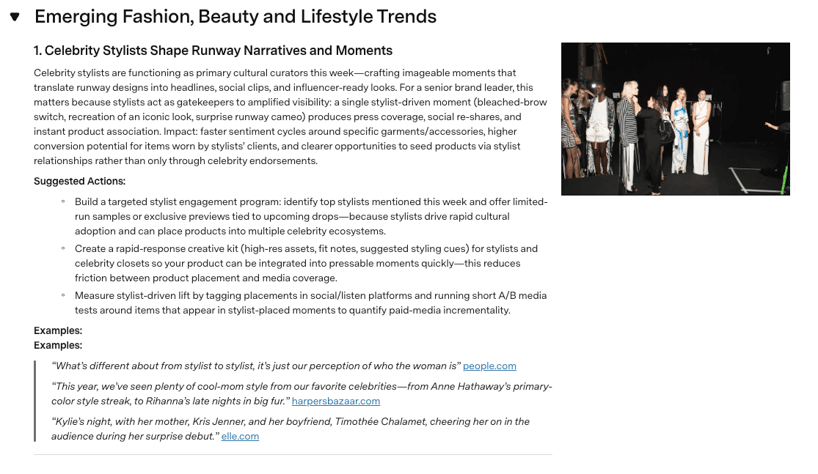
Celebrity Stylists Shape Runway Narratives and Moments led the emerging trends section. Celebrity stylists are functioning as primary cultural curators, translating runway designs into headlines, social clips, and influencer-ready looks. A single stylist-driven moment, including a bleached-brow switch, recreation of an iconic look, or surprise runway cameo, produces press coverage, social re-shares, and instant product association. The brief identifies faster sentiment cycles around specific garments and accessories, higher conversion potential for items worn by stylists' clients, and clearer opportunities to seed products via stylist relationships as the direct strategic impact.
Vintage Revival and Y2K Lingerie Nostalgia ranked second, with archival nods from vintage Yves Saint Laurent, Kate Moss, and Victoria's Secret creating a ripe moment for heritage storytelling, limited-edition archive drops, and Halloween-driven product tie-ins. Ultra-Luxury Crystal Embellishments surfaced third, exemplified by Kylie Jenner's $50 million Fantasy Bra at the Victoria's Secret Fashion Show, with the brief noting both the disproportionate PR multiplier of high-value, highly visual items and the halo effect on accessible price points when mass-market pieces are styled with crystal accents.
The Major Events section covers the specific events that generated the most significant cultural reach during the week, with brand strategy implications tied to each. In the Pop Culture brief, the Victoria's Secret Fashion Show Return to Los Angeles after 19 years led the events section. The show combined legacy supermodels, front-row celebrities, and theatrical moments including the Fantasy Bra and headline musical performances. The brief identifies a concentrated viral moment across fashion, entertainment, and social channels that generated content opportunities across runway clips, red-carpet fashion moments, influencer reactions, and earned media, and that can be activated quickly in paid and organic campaigns for brands targeting fashion-forward, mainstream, and Gen Z audiences.
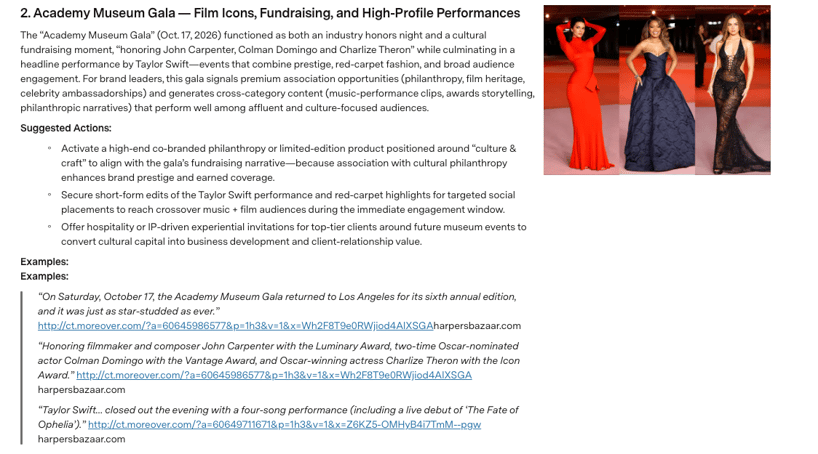
The Academy Museum Gala on October 17, 2026 ranked second, honoring John Carpenter, Colman Domingo, and Charlize Theron while culminating in a Taylor Swift headline performance. The brief frames this as an event that combines prestige, red-carpet fashion, and broad audience engagement, generating cross-category content including music performance clips, awards storytelling, celebrity ambassadorships, and philanthropic narratives that perform well among affluent and culture-focused audiences. Red-Carpet Premieres featuring Scarlett Johansson, Nicole Kidman, Kendall Jenner, Hailey Bieber, Simu Liu, and others completed the section, with the brief identifying repeated, platform-spanning opportunities to insert brand messaging, measure share-of-voice versus competitors, and identify emergent creative partnerships tied to talent and designers.
For brand and marketing teams, the brief answers the question that precedes every reactive creative and partnership decision: what is the cultural landscape right now, what's driving it, and what does it mean for us? Getting that answer in 15 minutes, with sourced examples and suggested actions already attached, changes what's operationally possible within a fast-moving news cycle.
For agencies building weekly trend intelligence for clients, the brief provides a consistent, structured read of the media landscape that is faster to produce and more specifically actionable than a manually assembled weekly roundup.
For content and creative teams planning campaigns or reacting to cultural moments, the suggested actions in the brief connect directly to what the data shows, with the reasoning attached so teams can evaluate fit rather than just execute a directive.
For media and partnerships teams evaluating where to invest, the events section and emerging trends section together show where attention is concentrated right now, which talent and platforms are driving it, and what the time window for activation looks like.
You select a category: Fashion, Beauty, Home, Toys, Entertainment, Pop Culture, or Food and Beverage. You can add a specific focus or topics to exclude. The agent runs a structured set of pre-curated research questions against that category, drawing from a rolling week of top and mid-tier media coverage across online, print, and broadcast sources. The brief is delivered to your inbox and inside Quid Terminal in about 15 minutes, organized by section with sourced examples and suggested actions throughout.
Ask Q is available alongside the brief inside Terminal for any follow-up. If a trend raises a question about a specific talent, brand, or opportunity, Ask Q works through it against the same sourced data that built the brief rather than generating answers from general knowledge.
The Media Category Trends Agent is available now inside Quid Terminal. Select your category, add any focus or exclusions, and in about 15 minutes you have a structured brief on what's driving the cultural conversation this week, with the brand strategy implications already surfaced.

The Quid Media Category Trends Agent is a Q Agent inside Quid Terminal that runs structured research questions against a selected media category and delivers a weekly brief covering the top news, emerging trends, and major events generating the most strategic relevance for brand teams. Categories include Fashion, Beauty, Home, Toys, Entertainment, Pop Culture, and Food and Beverage, each with pre-curated interest areas designed for trend-forward teams.
The Media Category Trends Agent draws from a rolling week of top and mid-tier media coverage across online, print, and broadcast sources. This coverage-first approach distinguishes it from social-listening tools, which primarily reflect social platform conversation, and ensures the intelligence reflects the media cycle that shapes broader consumer awareness and brand perception.
Social listening tracks conversation volume and sentiment across social platforms. The Media Category Trends Agent tracks what top and mid-tier media is covering, which is the layer that shapes broader public awareness, influences social conversation, and is most relevant to brand strategy decisions around partnerships, creative, media investment, and messaging. The two sources complement each other; the Media Category Trends Agent is specifically built for the media intelligence layer.
The Media Category Trends Agent brief is delivered to your inbox and inside Quid Terminal in about 15 minutes from when you submit your category and focus inputs.
The Media Category Trends Agent is run per category selection. Teams tracking multiple categories can run the agent separately for each, with each brief covering the pre-curated interest areas most relevant to that category. Categories available include Fashion, Beauty, Home, Toys, Entertainment, Pop Culture, and Food and Beverage.