

.png?width=1252&height=362&name=QUID_Logo_WHITE%20(2).png)
.png?width=1786&name=Q%20Agent%20Spotlight%20(22).png "Q Agent Spotlight (22)")
Patent data is one of the most underused sources of competitive intelligence available to brand, strategy, and innovation teams. It shows you not just what companies are selling, but what they are building toward: the directions they are investing in, the geographies they are protecting, the technology clusters they are defending. Reading a patent landscape accurately, however, requires more than searching a database. It requires knowing what the filing patterns mean, where the white space actually sits, and how to distinguish active innovation from the noise of fragmented, early-stage, or low-grant-rate filings.

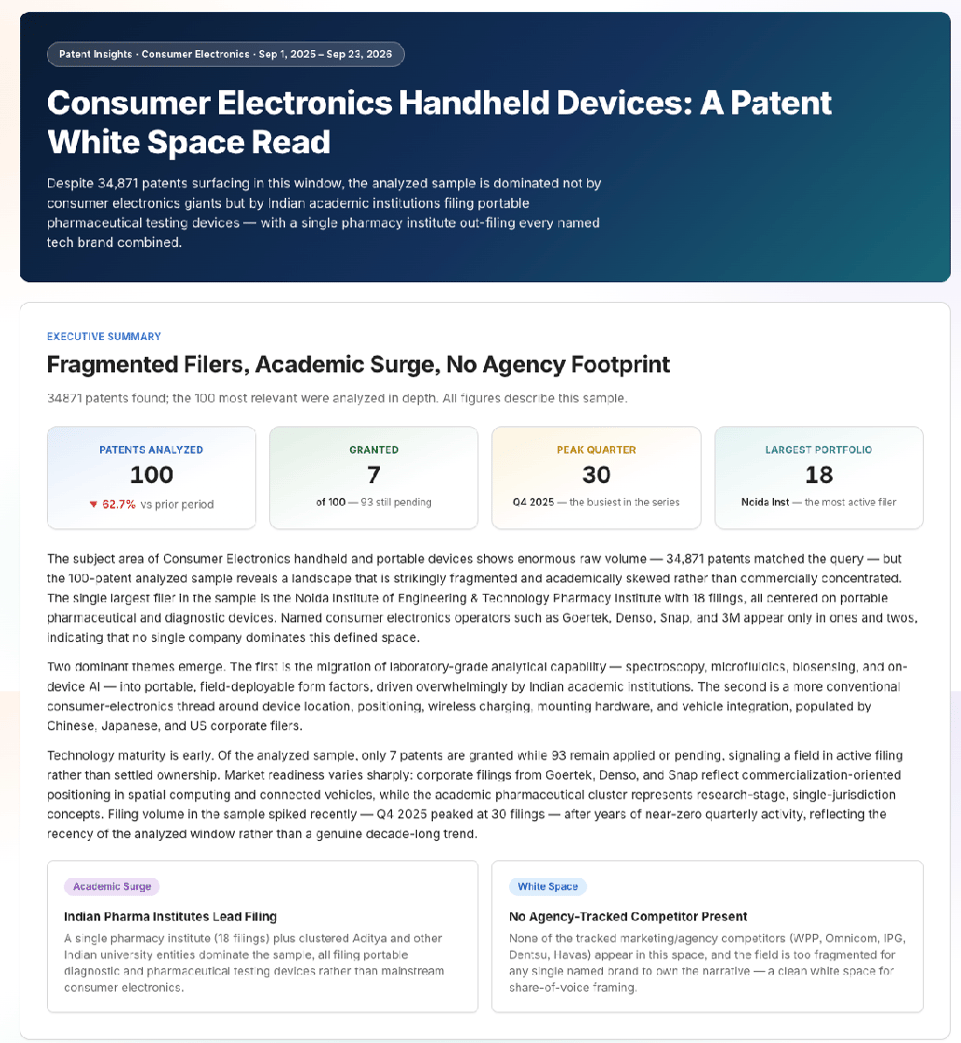
The Patent Insights Agent does that work. Enter a topic or company and a date range, and the agent retrieves relevant inventions from Quid's Patents dataset, covering more than 50 jurisdictions and filings dating back to the 1960s, interprets the trends running through the landscape, and generates a structured patent landscape report covering filing volume, top assignees, geographic activity, technology clusters, patent status, white-space opportunities, and competitive positioning. For any team that needs to understand where innovation is happening in a category before making a strategic decision, it's one of the most distinctive intelligence outputs in the Q Agent library.
The brief is structured to give a complete and interpretive picture of the patent landscape, not just a data export. Each section answers a different strategic question, and the brief is explicit about what the data does and doesn't show, which matters as much as the findings themselves.
A brief run on Consumer Electronics Handheld Devices, analyzed across a September 2025 to September 2026 collection window, surfaced 34,871 patents matching the query. The 100 most relevant were analyzed in depth. What the brief found was not what a surface-level assumption about the category would predict, and that interpretive gap is precisely what makes patent landscape intelligence valuable.
The executive summary headline: Fragmented Filers, Academic Surge, No Agency Footprint. The landscape is dominated not by consumer electronics giants but by Indian academic institutions filing portable pharmaceutical testing devices. A single pharmacy institute, the Noida Institute of Engineering and Technology Pharmacy Institute, holds 18 of the 100 analyzed filings, more than any named consumer electronics brand. Goertek, Denso, Snap, and 3M appear only in ones and twos. No single company dominates the defined space.
That finding alone is strategically significant. It tells a brand or agency team entering this category that the competitive narrative is unowned, the white space is unusually broad, and the field is too fragmented for any single player to credibly claim it — a fundamentally different strategic context than a landscape dominated by a few well-resourced corporate filers.
The Filing Volume section plots filings per quarter across the analyzed sample and surfaces a pattern that the brief is careful to interpret correctly rather than overstate.
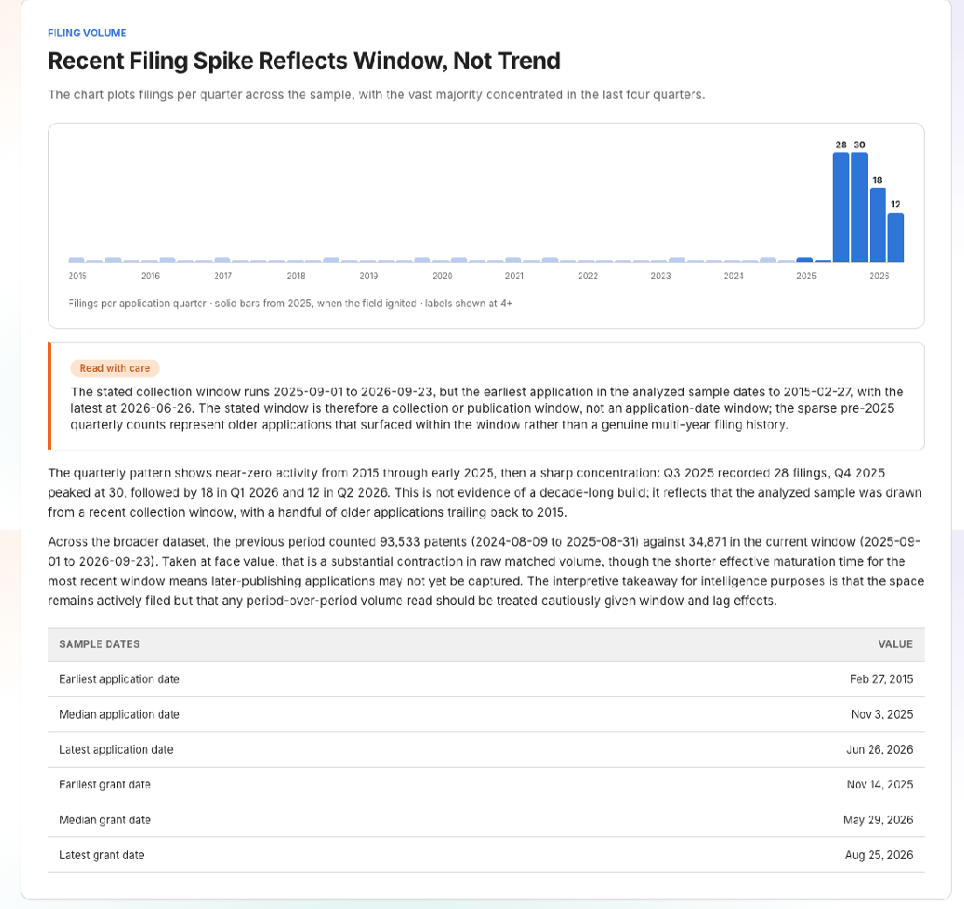
Filing activity was near-zero from 2015 through early 2025, then concentrated sharply in Q3 and Q4 2025, with 28 filings in Q3 and 30 in Q4, the busiest quarter in the series. This looks like a sudden surge, but the brief identifies it as a collection window effect rather than a genuine decade-long trend. The analyzed window runs September 2025 to September 2026, and earlier applications surface because they were published or collected within that window, not because they were filed then.
That interpretive precision matters. A team reading raw filing counts without that context would misread the trend as a recent innovation spike and make planning decisions accordingly. The brief prevents that by being explicit about what the numbers mean and where they require caution.
The assignee leaderboard is one of the most revealing sections of a patent brief because it tells you who is making the strategic decisions behind the filings, not just who the products belong to.
In the consumer electronics handheld devices brief, the leaderboard is topped by academic institutions, not manufacturers. The Noida Institute of Engineering and Technology Pharmacy Institute leads with 18 filings, followed by a cluster of affiliated Indian university entities that frequently co-assign the same inventions and effectively act as a single institutional bloc. Goertek Technology, Yupiteru, and Denso appear among the commercial filers, each with three filings.
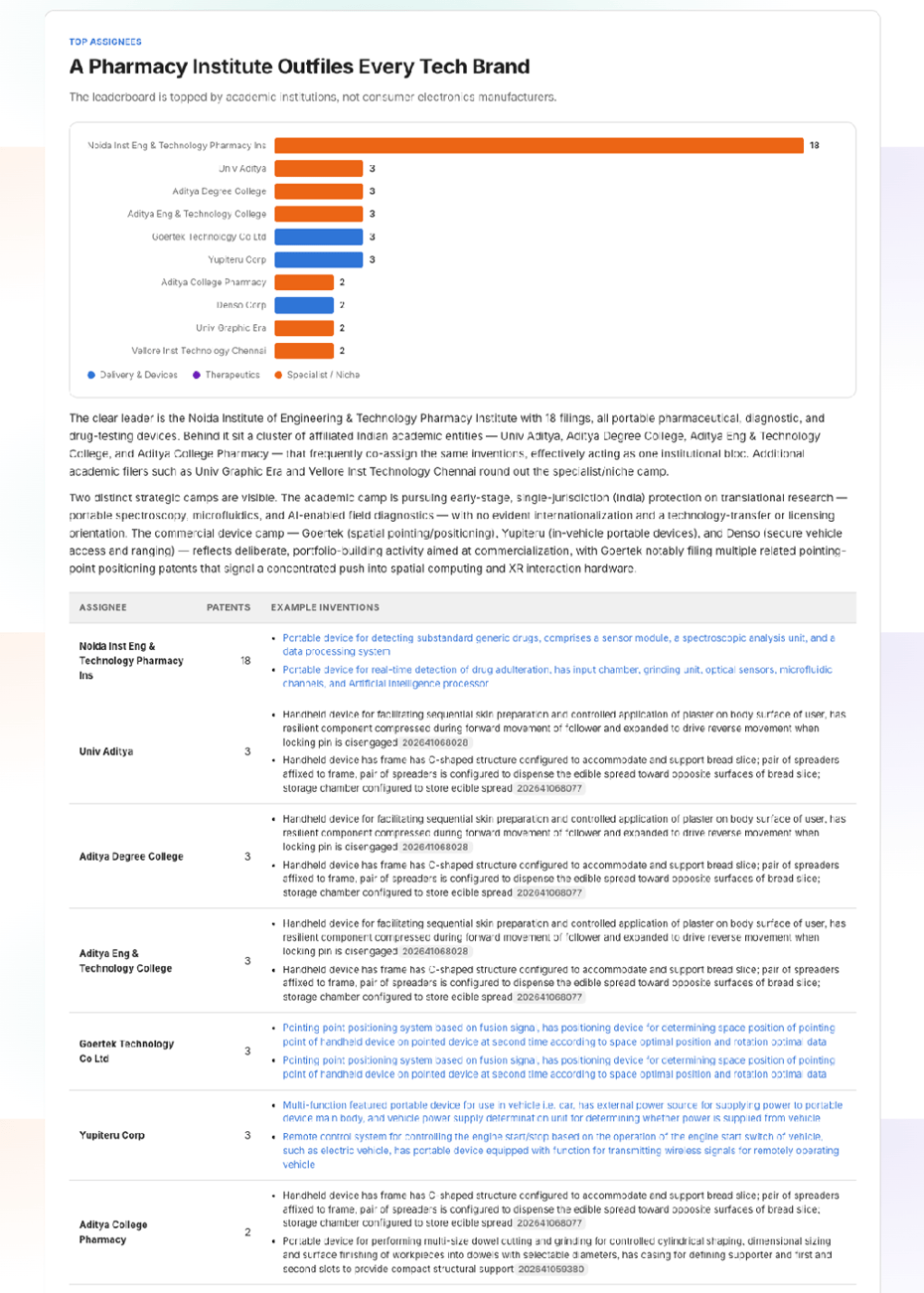
The brief identifies two distinct strategic camps. The academic camp is pursuing early-stage, single-jurisdiction protection on translational research in portable spectroscopy, microfluidics, and AI-enabled field diagnostics, with no evident commercialization pathway. The commercial camp reflects deliberate portfolio-building in spatial computing and XR interaction hardware, in-vehicle portable devices, and secure vehicle access. Reading those two camps together tells you where the field is being claimed from a research perspective and where the commercially meaningful patent positions are actually consolidating.
The geographic filing activity section maps where protection is being sought by jurisdiction, which is a different and more strategically useful read than where companies are headquartered.
India leads with 45 filings, driven almost entirely by the academic pharmaceutical cluster. China follows with 30, reflecting corporate filings in positioning, wireless charging, voice processing, and device security. The US contributes 21 and Japan 11, with more established corporate players including Snap, Denso, USPS, and 3M.
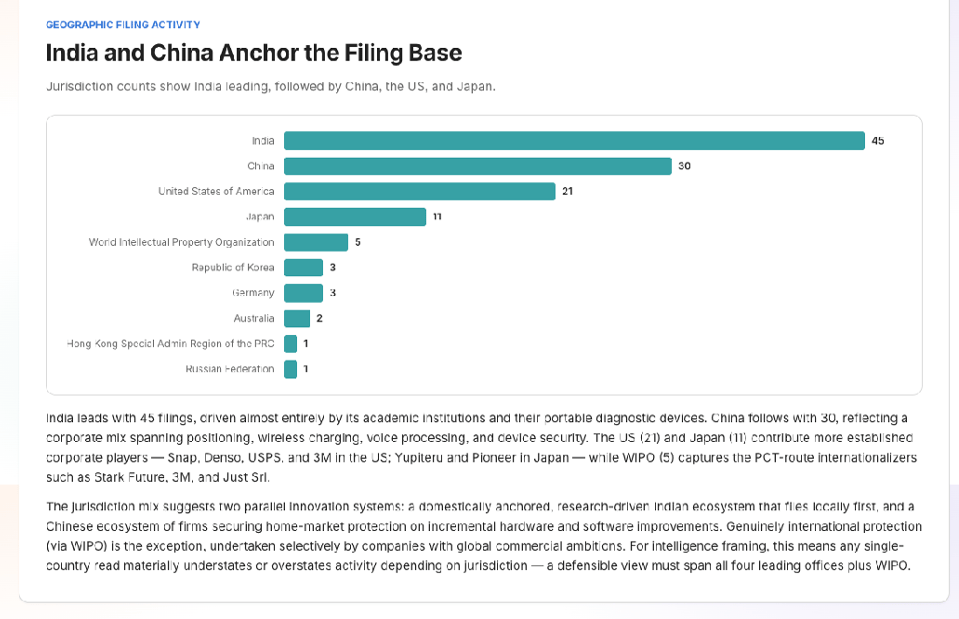
The brief identifies two parallel innovation systems running through this geography: a domestically anchored, research-driven Indian ecosystem that files locally first, and a Chinese ecosystem securing home-market protection on incremental hardware and software improvements. Genuine international protection via WIPO is the exception, undertaken by companies with global commercial ambitions. For intelligence purposes, a single-country read of this landscape materially understates or overstates the activity, and a defensible view requires spanning all four leading offices plus WIPO.
The Technology Clusters section groups the underlying IPC codes into recurring technology themes, making the conceptual structure of the landscape legible without requiring patent classification expertise.
Six clusters emerged in the consumer electronics brief: Portable Diagnostics and Lab-on-Chip, Wireless Location and Short-Range Communications, Spatial Interaction and Positioning, Power Management and Charging, Device Mounting and Mechanical Accessories, and AI-Enabled Sensing and Edge Compute. Each cluster maps to a distinct set of IPC codes, a description of what it covers, and the filers most active within it.
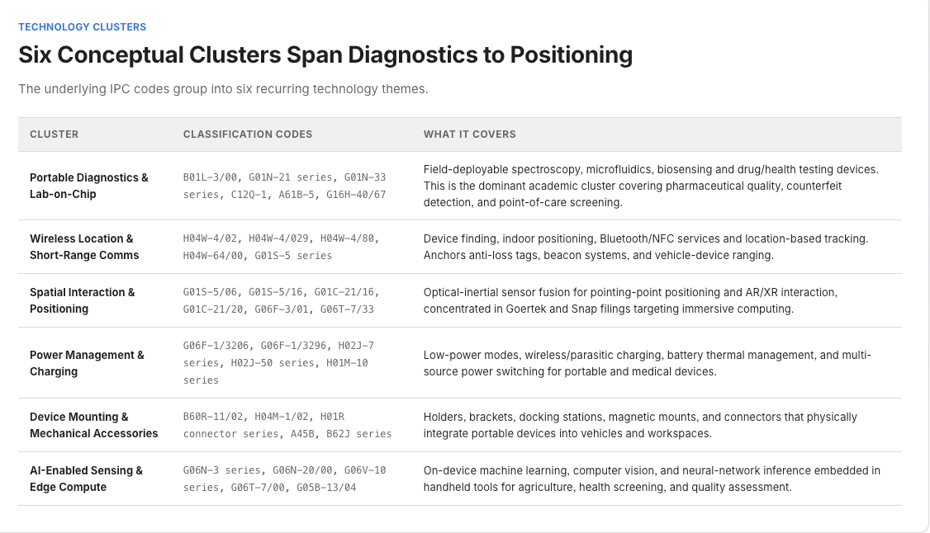
The cluster structure does significant interpretive work. It shows that Goertek is concentrated in Spatial Interaction and Positioning, pursuing sensor-fusion-based patents that signal a push into XR interaction hardware. The academic pharmaceutical bloc sits almost entirely within the Portable Diagnostics cluster. And the AI-Enabled Sensing and Edge Compute cluster is distributed across academic and corporate filers without a dominant player, which the brief flags as an emerging theme worth tracking.
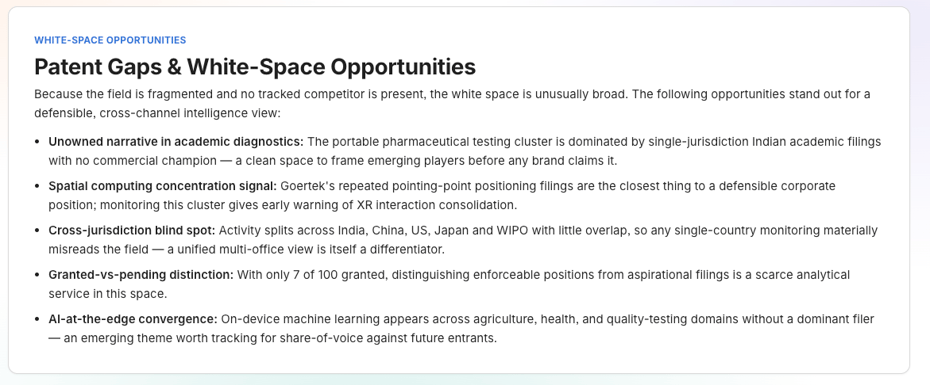
The White-Space Opportunities section is where the brief moves from describing the landscape to identifying where it's open.
Because this space is fragmented and no tracked competitor has an established footprint, the white space is unusually broad. The brief identifies five specific opportunities: the portable pharmaceutical testing cluster is dominated by single-jurisdiction academic filings with no commercial champion, leaving it open for a brand to establish narrative ownership. Goertek's repeated spatial computing concentration gives the clearest early warning of XR interaction consolidation. Activity splits across India, China, the US, and Japan with little overlap, so single-country monitoring materially misreads the field. With only 7 of 100 patents granted, distinguishing enforceable positions from aspirational filings is a scarce analytical service in this space. And on-device machine learning appears across agriculture, health, and quality-testing domains without a dominant filer.
The Competitive Landscape section closes the brief with a capability-layer analysis of where barriers actually sit. Sensor fusion and positioning algorithms represent high barriers requiring accumulated algorithmic expertise. Portable analytical chemistry held by the academic cluster has low-to-moderate barriers since most filers integrate off-the-shelf components. Secure wireless authentication requires deep security engineering and represents defensible positions. Mechanical mounting and connectors is an open space where protection is narrow and easily circumvented.
For R&D and innovation teams, the brief surfaces where a category is being claimed versus where it's genuinely open, which is the input that makes investment decisions defensible rather than directional.
For strategy and competitive intelligence teams, the assignee leaderboard, geographic spread, and technology cluster analysis together show which players are filing with commercial intent, which are filing for academic credit, and where the next consolidation is most likely to happen.
For brand and communications teams working in innovation-adjacent categories, the white-space analysis identifies narratives that are unclaimed in the patent record, which is a different and more durable kind of market positioning than content-based share of voice alone.
For agencies advising clients on category entry or investment, the brief provides a sourced, structured read of the innovation landscape that elevates the specificity of the recommendation beyond what market research and competitor tracking alone can provide.
You enter a topic or company and a date range. The agent retrieves relevant patents from Quid's dataset covering more than 50 jurisdictions and filings back to the 1960s, interprets the trends and patterns across filing volume, assignees, geography, technology clusters, and patent status, and delivers the complete brief to your inbox and inside Quid Terminal. The brief includes explicit methodology notes where the data requires careful interpretation, which is what makes it usable in high-stakes decisions rather than just interesting to read. Ask Q is available alongside the brief inside Terminal for any follow-up.
One note on timing: the agent works best with more than a year of data. A shorter window captures publication and collection activity rather than genuine multi-year filing trends, and the brief is transparent about that distinction when it applies.
The Patent Insights Agent is available now inside Quid Terminal. Enter a topic, a company, or a technology area alongside your date range, and the brief that comes back tells you who is filing, where, in what clusters, with what strategic intent, and where the space is genuinely open.
The Quid Patent Insights Agent is a Q Agent inside Quid Terminal that analyzes global patent data from more than 50 jurisdictions, dating back to the 1960s. It retrieves inventions relevant to any topic or company, interprets filing trends, and generates a structured patent landscape report covering assignees, geography, technology clusters, patent status, white-space opportunities, and competitive positioning.
Patent landscape analysis helps competitive strategy by showing where organizations are investing in innovation, which geographies they are protecting, and where white space exists before it becomes commercially contested. A patent landscape brief surfaces the competitive intent behind filings, distinguishing academic research from commercial portfolio-building and identifying which technology clusters are consolidating.
Patent white space refers to technology areas or application domains where no significant patent positions have been established, meaning the field is open for a new entrant to claim narrative and intellectual property ownership before competitors do. White space is most valuable when it aligns with emerging commercial demand.
The Quid Patents dataset covers more than 50 jurisdictions globally, including all four major patent offices — India, China, the United States, and Japan — as well as WIPO filings for international protection, and additional national and regional offices, with data extending back to the 1960s.
The Patent Insights Agent works best with more than a year of data. Shorter collection windows tend to reflect publication and collection activity rather than genuine long-term filing trends, and the agent's brief is transparent about this distinction when a shorter window is used, flagging where period-over-period volume comparisons should be treated with caution.
