

.png?width=1252&height=362&name=QUID_Logo_WHITE%20(2).png)
.png?width=1380&name=Q%20Agent%20Spotlight%20(7).png "<span id=\"hs_cos_wrapper_name\" class=\"hs_cos_wrapper hs_cos_wrapper_meta_field hs_cos_wrapper_type_text\" style=\"\" data-hs-cos-general-type=\"meta_field\" data-hs-cos-type=\"text\" >Q Agent Spotlight: The Subject Sentiment Agent</span>")
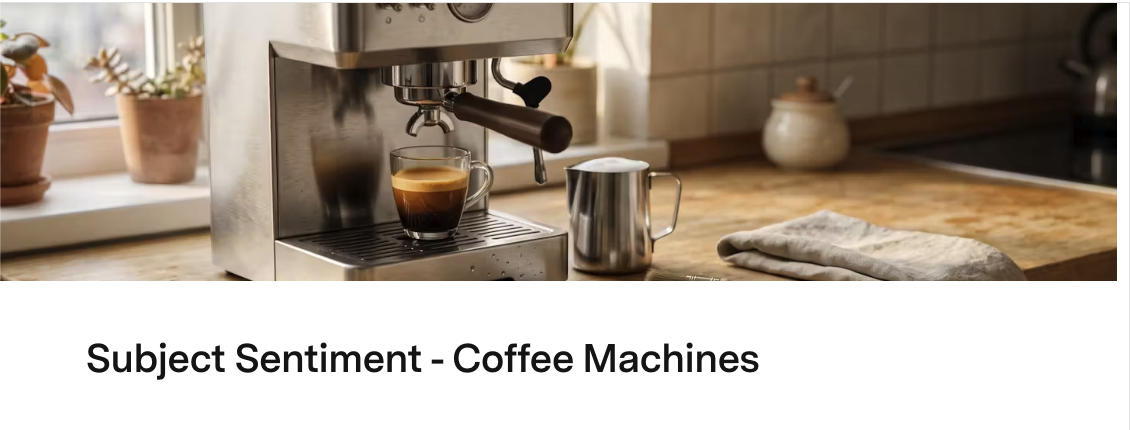
Before a brand builds a campaign around a category, enters a new market, or tries to understand why something is gaining or losing ground with consumers, it needs to know how people actually feel about the space. Not in surveys, but in the places where they are most honest. Reddit threads, TikTok comments, Facebook groups, Instagram captions. The unfiltered language people use when a product delights them, frustrates them, or lets them down at the worst possible moment.
The Subject Sentiment Q Agent was built to surface that intelligence at scale. Give it any subject or concept: a product category, a trend, an ingredient, a cultural moment. It analyzes sentiment across major social platforms, identifies the themes and emotions driving the conversation, maps the biggest complaints, and surfaces the meaningful differences in how each platform talks about that subject. The brief is ready in about 10 minutes.

The brief opens with a cross-platform overview before breaking into platform-specific analysis. That structure matters because the two layers answer different questions. The overview tells you the shape of sentiment in a category. The platform breakdown tells you where that sentiment is being formed, what is driving it on each channel, and how it differs, which is where the intelligence actually becomes actionable.
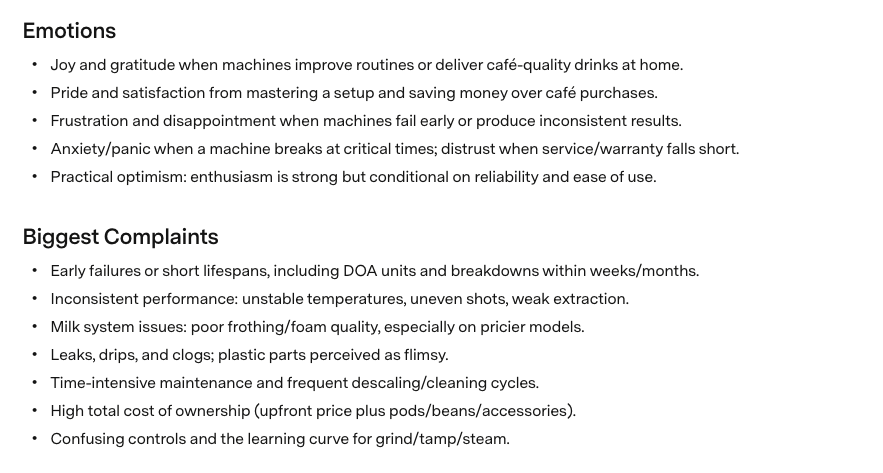
A brief run on coffee machines shows the range of what this looks like in practice. Across platforms, the agent identified that the category is viewed positively overall but with significant conditional trust: enthusiasm is strong when machines perform as promised, but reliability failures, maintenance burden, and cost concerns create enough friction to drive meaningful negative sentiment alongside the positive. That is not a simple "people like coffee machines" read. It is a map of where the category's credibility is strong, where it is fragile, and what specifically is threatening it.
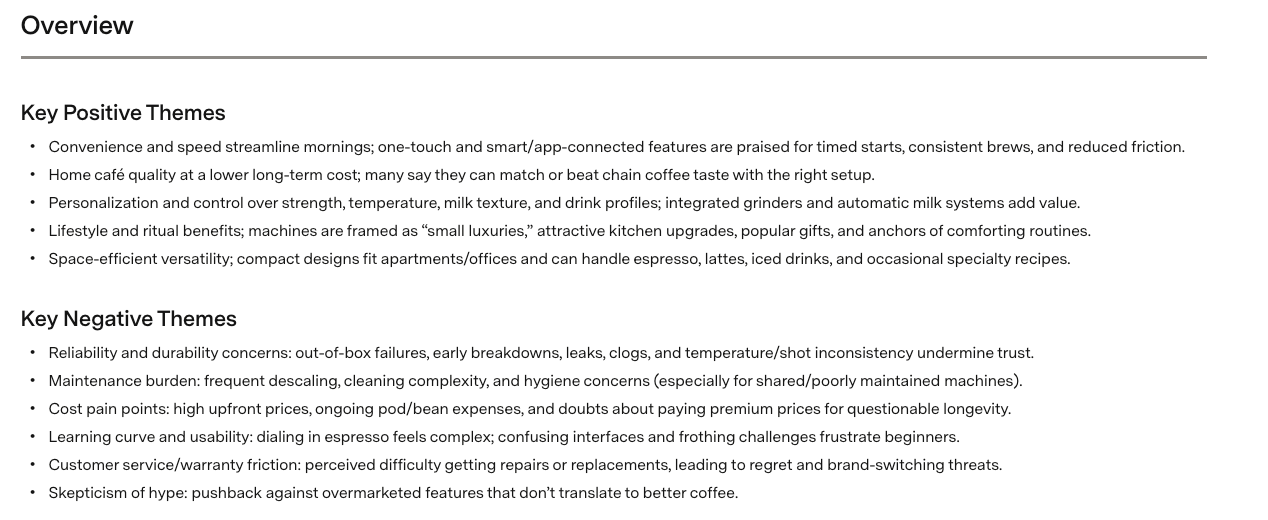
The emotions surfaced in the same brief (joy and gratitude when machines work, pride in mastering a setup, frustration and disappointment when machines fail early, anxiety when service falls short) give that picture a dimension that sentiment scores alone do not. Understanding the emotional register of a category is what separates intelligence that informs creative strategy from intelligence that just describes it.
Any tool can tell you aggregate sentiment. What makes the Subject Sentiment Q Agent distinct is the platform-level analysis, because the same subject looks and sounds fundamentally different depending on where people are discussing it, and those differences have direct strategic implications.
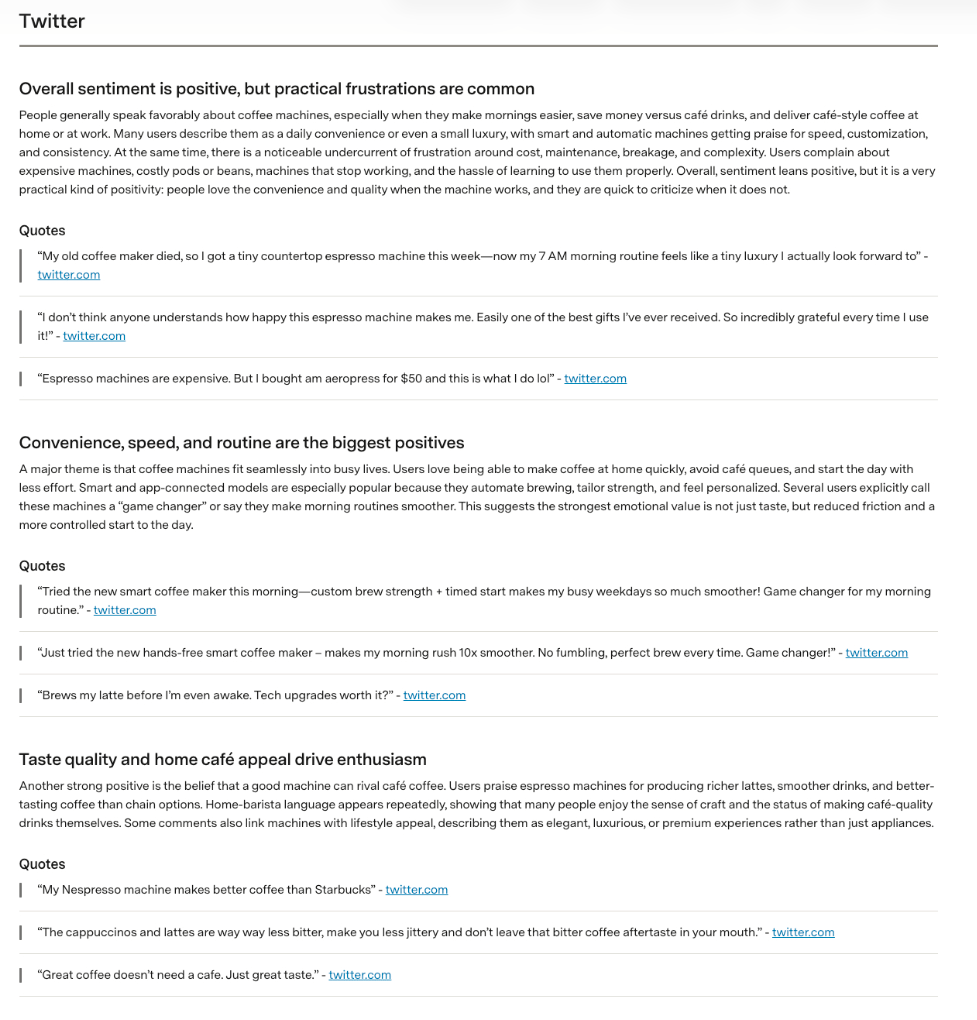
Twitter/X
Sentiment is positive overall, with convenience and morning routine as the dominant themes. Smart and app-connected machines are especially well-regarded, and users describe them as game changers for busy mornings. Criticism exists but stays measured, concentrated around cost, maintenance, and machines that stop working.
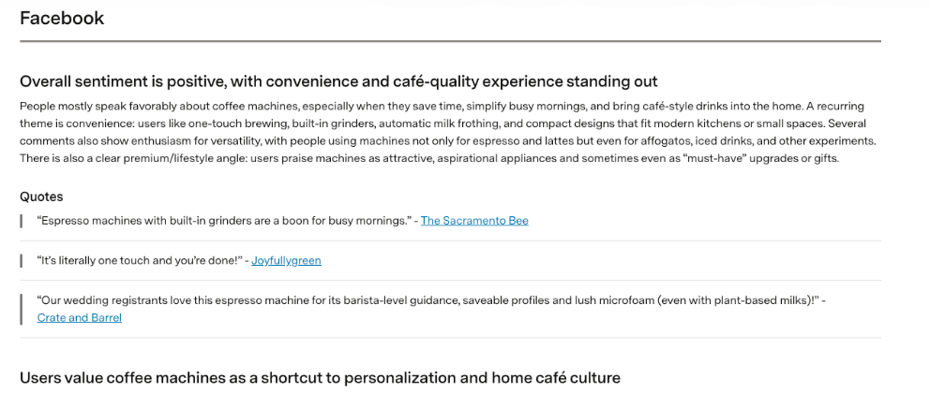
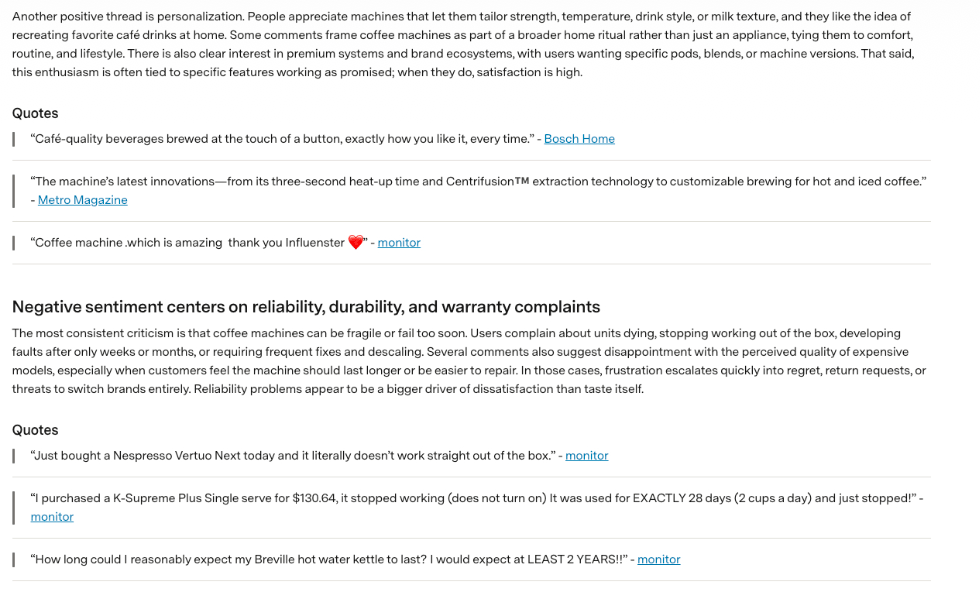
Facebook has the most split personality of any platform in the brief. Aspirational gifting content and feature enthusiasm sit alongside the strongest volume of warranty and durability complaints and buyer regret narratives in the entire dataset. Users who are happy talk about convenience and personalization. Users who are not talk about machines dying within weeks or months, expensive repairs, and brands that are difficult to deal with when things go wrong. This is the platform where category trust is most actively being built and broken simultaneously.
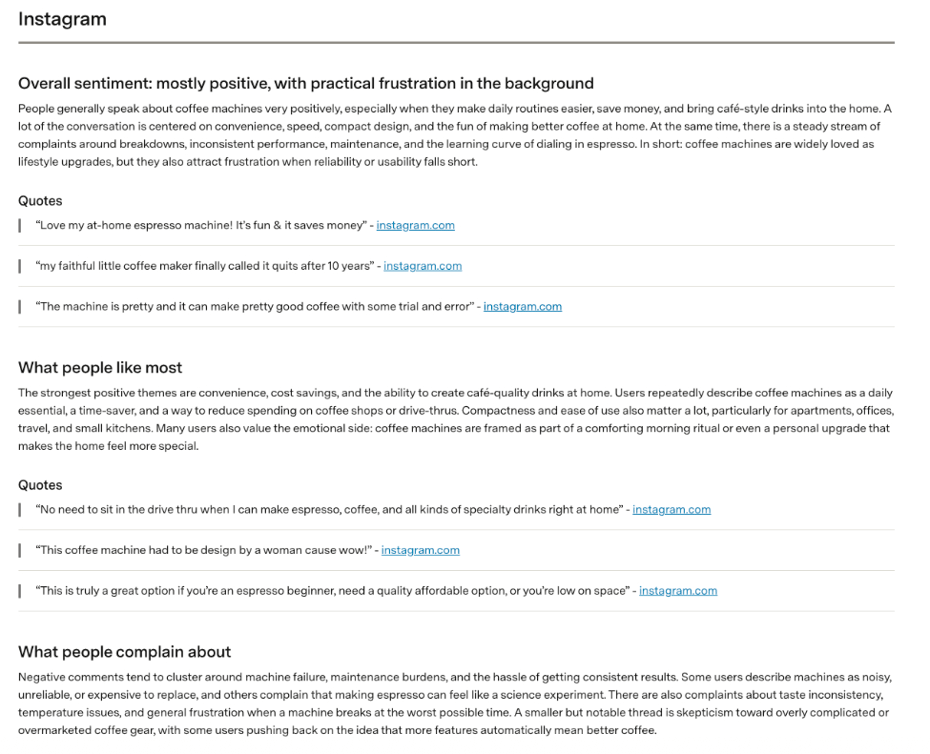
Instagram is lifestyle-first. Coffee machines appear as aesthetic objects, kitchen upgrades, and morning ritual anchors. The visual framing is compact, attractive, and money-saving at home. There is a steady undercurrent of frustration, particularly around the idea that making good espresso requires more science than marketing suggests, but the dominant voice is positive and aspirational.
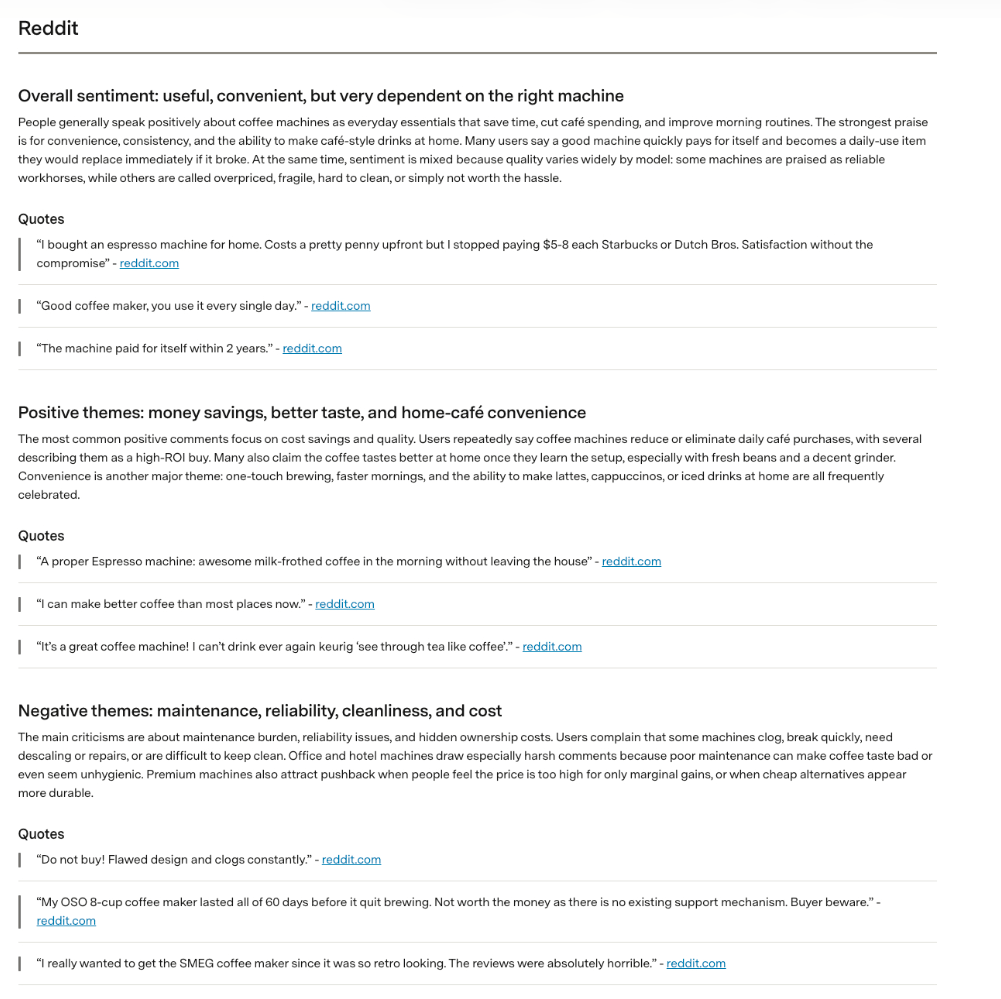
Reddit is the most analytical platform in the brief by a significant margin. Users here are doing ROI calculations, comparing machines model by model, deep-diving into maintenance and design flaws, and giving harsher takes on poorly maintained shared machines. The strongest positive themes are money savings, better taste, and home-café convenience, but the criticism is more pointed and more detailed than anywhere else. Reddit is where category skepticism is most developed and where the harshest brand-specific assessments appear.
TikTok leans positive and practical. Convenience, better-tasting coffee at home, and money savings versus daily café purchases are the main positive threads. Criticism is practical rather than emotional: milk frothing problems, shot inconsistency, leaking, and confusing settings are the common friction points. Price is acknowledged but generally framed as offset by reduced café spend. This is the platform where one-touch convenience and integrated grinder features get the most praise.
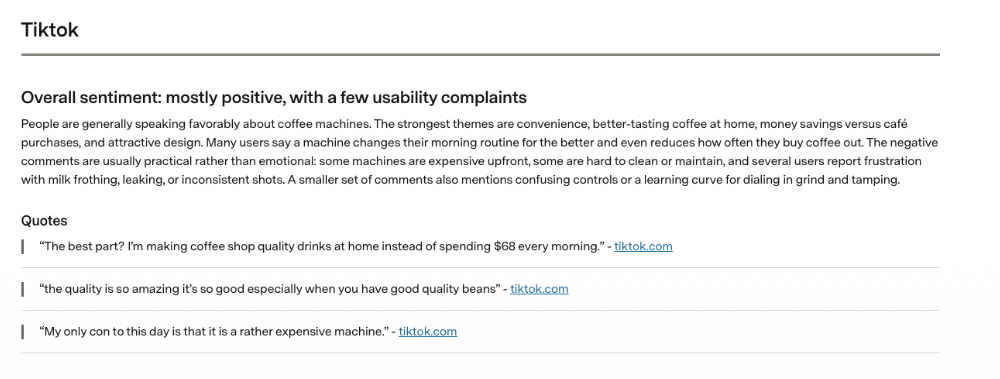
Knowing that warranty trust breaks down most visibly on Facebook while Reddit surfaces the most detailed category skepticism tells a brand team something specific about where to invest in reputation management and what format that investment should take. Knowing that TikTok is where convenience and integrated features get the most praise tells a content team something specific about what to make and what to emphasize. The brief does not just describe the conversation. It tells you which conversations are happening where, so the decisions downstream can match the platform rather than working against it.
The Subject Sentiment Q Agent brief closes with an Actionable Insights section that translates the findings into specific, prioritized recommendations tied directly back to the data. It does not end at diagnosis.
In the coffee machines brief, the recommendations follow directly from what the data showed. One focuses on share-of-voice tracking that separates paid and influencer-driven engagement from organic consumer sentiment, since the two tell very different stories in this category. Another maps content strategy to the platform differences the brief surfaced, rather than treating all channels the same. A third establishes crisis-detection triggers tied to the complaint patterns most likely to escalate: reliability failures, warranty friction, and maintenance burden. Each recommendation connects back to a specific finding, which is what makes them usable rather than general.
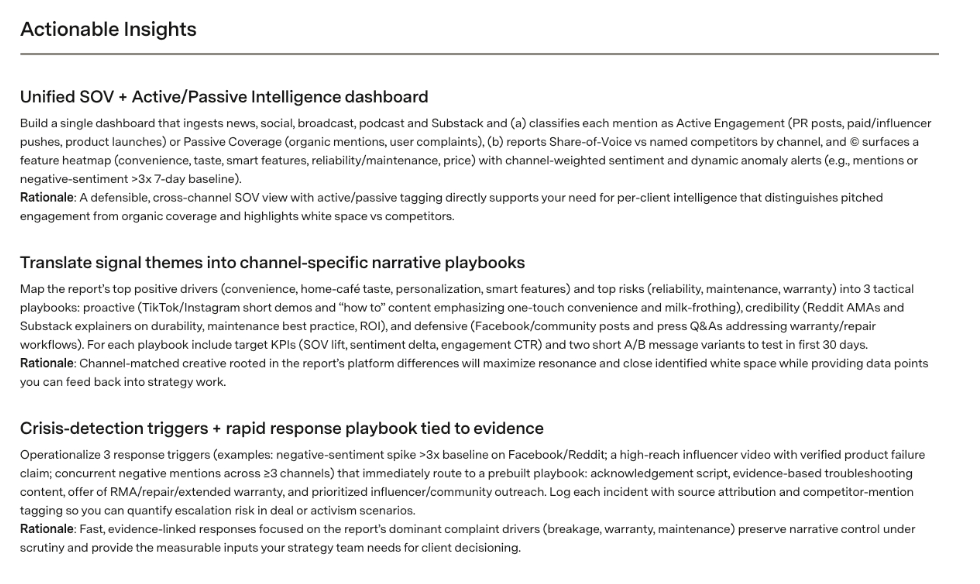
That connection between finding and recommendation is what makes the brief operationally useful rather than just informative. The data and the action point to the same thing.
The agent works for any subject you can define. Product categories, brand positioning, ingredients or technology claims, cultural trends, competitor categories, social movements. Anything where understanding how a topic is being discussed across social platforms, with sentiment mapped and platform differences surfaced, belongs in a decision.
For brand and marketing teams, the brief gives you an honest read on a category before you build a campaign around assumptions about how people feel about it. For agencies, it is the category intelligence that should inform a creative brief rather than follow from it. For product and insight teams, it surfaces the specific pain points, emotional triggers, and complaint patterns that shape what consumers actually want, grounded in what they say to each other rather than in structured survey responses designed to confirm a hypothesis.
Running the Subject Sentiment Q Agent requires one input: a subject. From there, the agent handles the analysis across platforms, surfaces the thematic patterns and platform differences, and delivers the complete brief to your inbox and inside Quid Terminal in about 10 minutes.
What is behind those 10 minutes matters. Every finding in the brief is grounded in Quid's compliant source network, which means the sentiment, the themes, and the platform-specific language all come from real posts and real conversations rather than from a model inferring what people probably say about a topic. That sourcing is what makes the brief verifiable and usable in high-stakes decisions, not just interesting to read.
Once the brief is in Terminal, Ask Q is available alongside it to go further. If the overview raises a question about a specific platform, if a complaint theme needs more context, or if you want to understand what the data implies about a particular positioning angle, Ask Q works through those questions against the same sourced data that built the brief. That grounding is what separates it from a general AI tool generating plausible-sounding answers from training data.
The Subject Sentiment Q Agent is available now inside Quid Terminal. Any subject, any category, any concept your team is trying to get ahead of. The brief that comes back in 10 minutes reflects what people are actually saying across the platforms that shape purchase decisions, brand perception, and category trust. That is not something a survey captures, and it is not something a general AI tool can produce from training data. It is sourced, current, and ready to act on.

Q Agent briefs are built on compliant, sourced data. Every insight is traceable and verifiable inside the platform.