

.png?width=1252&height=362&name=QUID_Logo_WHITE%20(2).png)
.png?width=1380&name=Q%20Agent%20Spotlight%20(23).png "<span id=\"hs_cos_wrapper_name\" class=\"hs_cos_wrapper hs_cos_wrapper_meta_field hs_cos_wrapper_type_text\" style=\"\" data-hs-cos-general-type=\"meta_field\" data-hs-cos-type=\"text\" >Q Agent Spotlight: The Theme Discovery Agent</span>")
A conversation is always happening around any topic that matters to your business. Knowing what's in that conversation at a surface level, that people are talking about automotive maintenance, or EVs, or luxury SUVs, is rarely enough to act on. What actually matters is how the conversation is structured: which themes are commanding attention, how much of the conversation each one owns, and where the key voices and sources are concentrated. The Theme Discovery Agent surfaces that picture for any subject area, drawing from the last 30 days of conversation across the open web.
Enter a subject and the agent identifies the dominant themes, ranks them by narrative share of voice, breaks each one into a detailed subtopic with sourced examples, maps how themes connect to one another, and surfaces who and what is driving coverage. The brief it returns is organized, ranked, and ready to work from.

The brief is structured around four sections: The Signal, Subtopic Network, Subtopic Breakdown, and Who Drove Coverage. They move logically from the headline read of what's dominating a conversation to the granular theme rankings, and finally to the sources and authors generating the most reach.
A brief run on the Automotive category across August 29 to September 28, 2026, generated 8.65 million posts, 100.31 million total engagements, and 2.66 trillion potential impressions. The Signal section framed the landscape in a single sentence: maintenance and repair anchor a broad automotive conversation, while EV debate and enthusiast content broaden the discussion into mobility choices and car culture. That framing is the starting point for everything that follows.
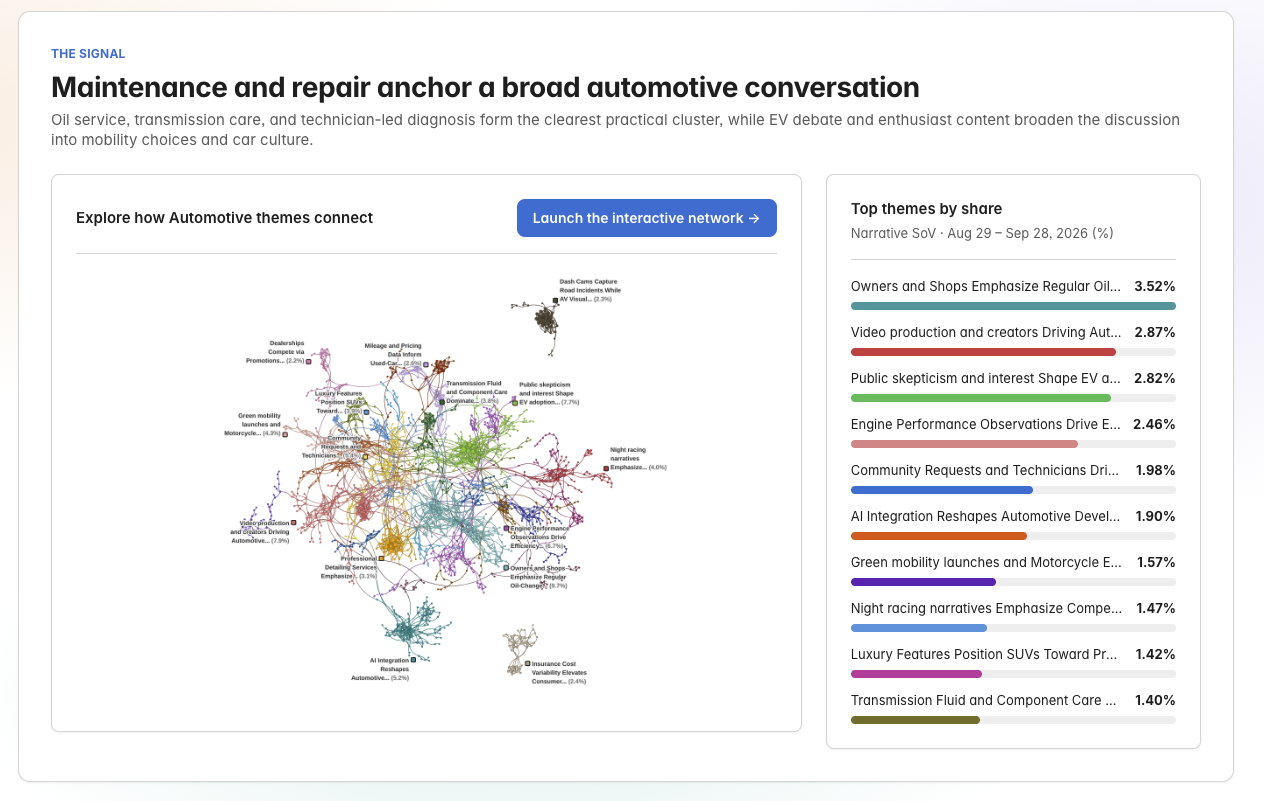
The Subtopic Breakdown is the core of the brief. Every theme is ranked by narrative share of voice and comes with a full description of what's driving it, sourced example posts from across the web, and a representative image from the conversation. It's a ranked accounting of how the conversation is actually divided; a meaningfully different starting point than a list of topics someone has guessed might be relevant.
In the automotive brief, ten subtopics emerged. Owners and Shops Emphasize Regular Oil-Change Maintenance led with 3.52% share of voice, driven by consistent messaging across forums, social posts, and local shop listings around regular oil and filter changes as a central maintenance task for engine longevity. User-reported intervals of 12,000 to 15,000 km, repeated reminders to change the oil, and service-center offers for scheduled checks all reinforce that oil service is viewed as a critical routine item across the ecosystem.
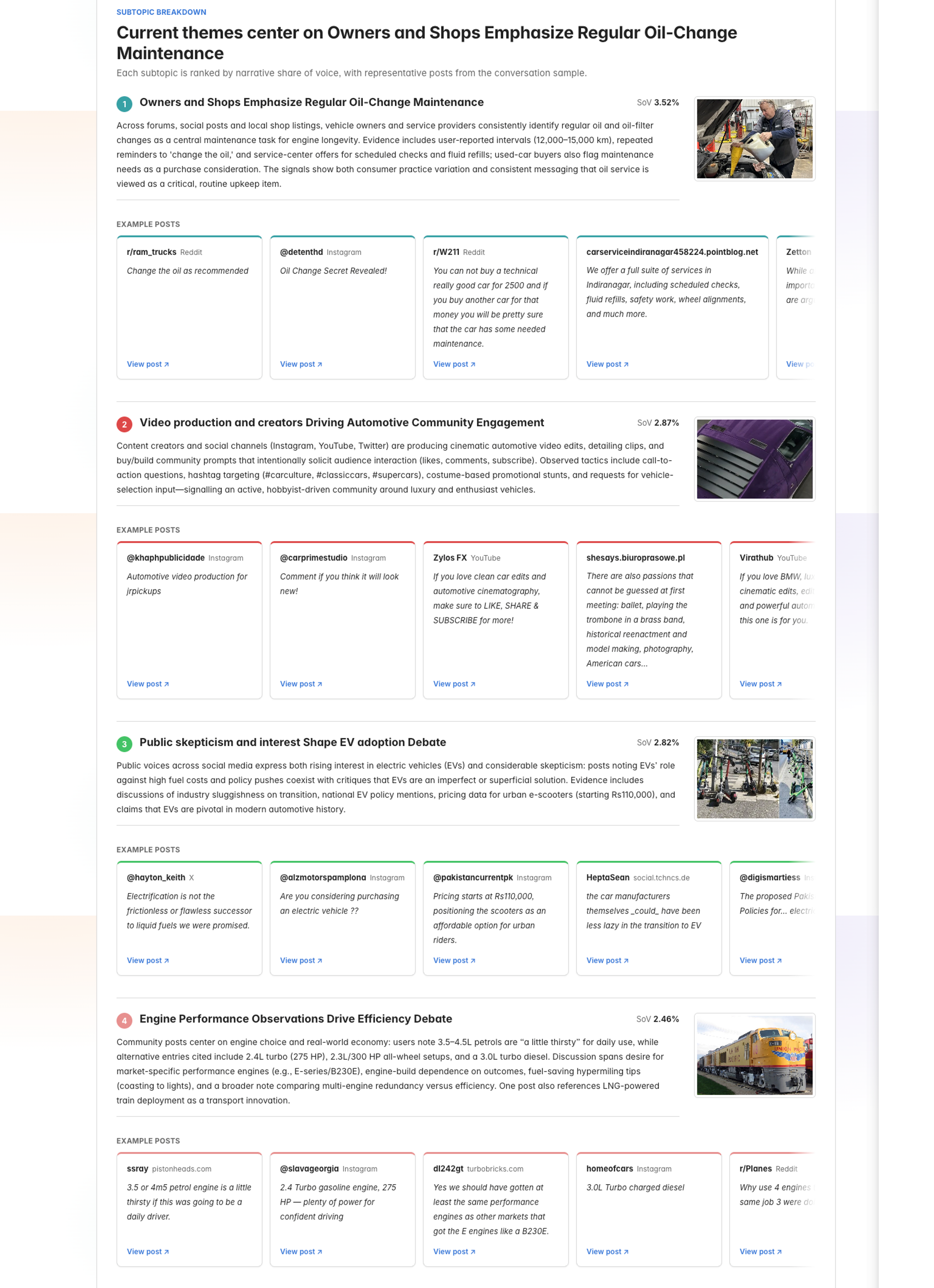
Video Production and Creators Driving Automotive Community Engagement ranked second at 2.87%, reflecting the significant role content creators are playing in shaping automotive culture. Creators across Instagram, YouTube, and Twitter are producing cinematic automotive video edits, detailing clips, and buy-build community prompts that deliberately solicit audience interaction, with call-to-action questions, hashtag targeting around carculture and supercars, and requests for vehicle-selection input all appearing as common tactics.
Public Skepticism and Interest Shape EV Adoption Debate came in at 2.82%, with rising interest in electric vehicles sitting alongside considerable skepticism. Posts framing EVs as a solution to high fuel costs and policy pressure coexist with critiques that the transition has been sluggish and the technology imperfect. The debate spans national EV policy mentions, pricing data for urban e-scooters, and claims that electrification is pivotal to automotive history.
Engine Performance Observations Drive Efficiency Debate ranked fourth at 2.46%, with community posts centering on engine choice and real-world economy. Users note that 3.5-to-4.5L petrols are "a little thirsty" for daily use, while the conversation also covers 2.4L turbo options, 3.0L turbo diesel, fuel-saving hypermiling tips, and a broader comparison of multi-engine redundancy versus efficiency.
Community Requests and Technicians Drive Repair Diagnosis Discussions at 1.98% centers professional mechanics in fault diagnosis. Posts solicit master-mechanic opinions, ask whether to repair immediately, and document frustration when shops reach for parts replacements instead of diagnosing the actual fault. Right-to-repair and consumer repairability appear as recurring themes, and multiple entries explicitly recommend consulting technicians for complex fixes.
AI Integration Reshapes Automotive Development and Logistics at 1.90% shows AI entering multiple automotive domains simultaneously: ByteDance's Doubao/Volcano Engine in-car assistant slated for an SAIC Motor model, an AI-ready engineering data platform for automotive verification, and data showing AI tools are now used by 36% of vehicle shoppers near automotive sites. Commentary also surfaces trust and capacity concerns, with analysts questioning implementation bandwidth and the robustness of AI-generated recommendations.
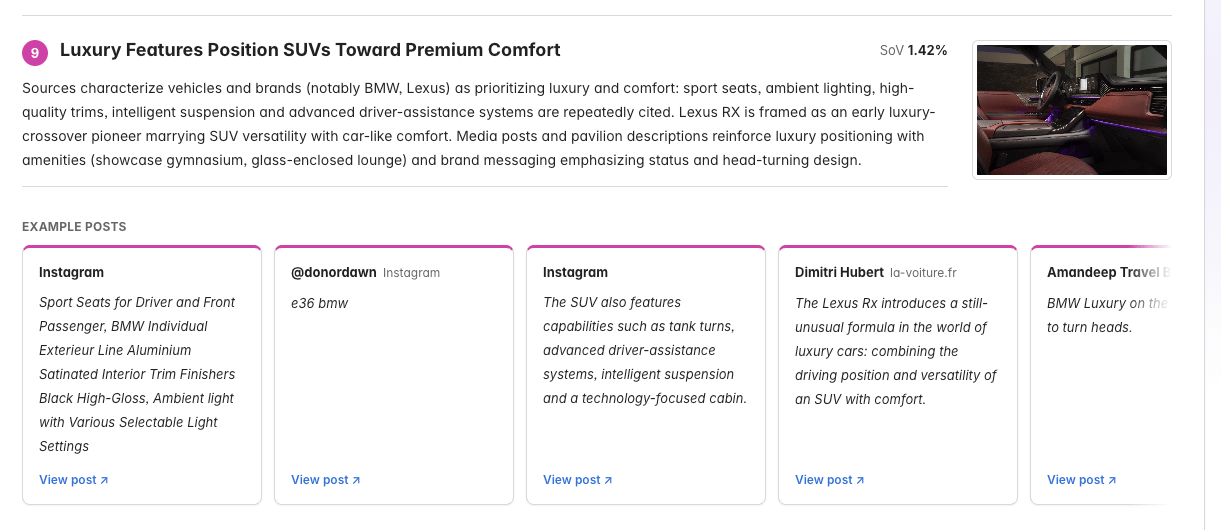
The remaining four subtopics cover Green Mobility Launches and Motorcycle Enthusiasts at 1.57%, Night Racing Narratives at 1.47%, Luxury Features Positioning SUVs Toward Premium Comfort at 1.42%, and Transmission Fluid and Component Care at 1.40%. Together the ten subtopics map the full terrain of where automotive attention is sitting across the period, from routine maintenance at the top to niche enthusiast culture and luxury positioning at the tail.
The Subtopic Network section visualizes how the themes in the brief relate to each other, showing which topics cluster together and where the conversation has structural connections across seemingly separate threads. In the automotive brief, the interactive network maps dozens of themes and their relationships, revealing that maintenance content, EV debate, and creator-driven enthusiast content form distinct but connected clusters within the broader conversation.
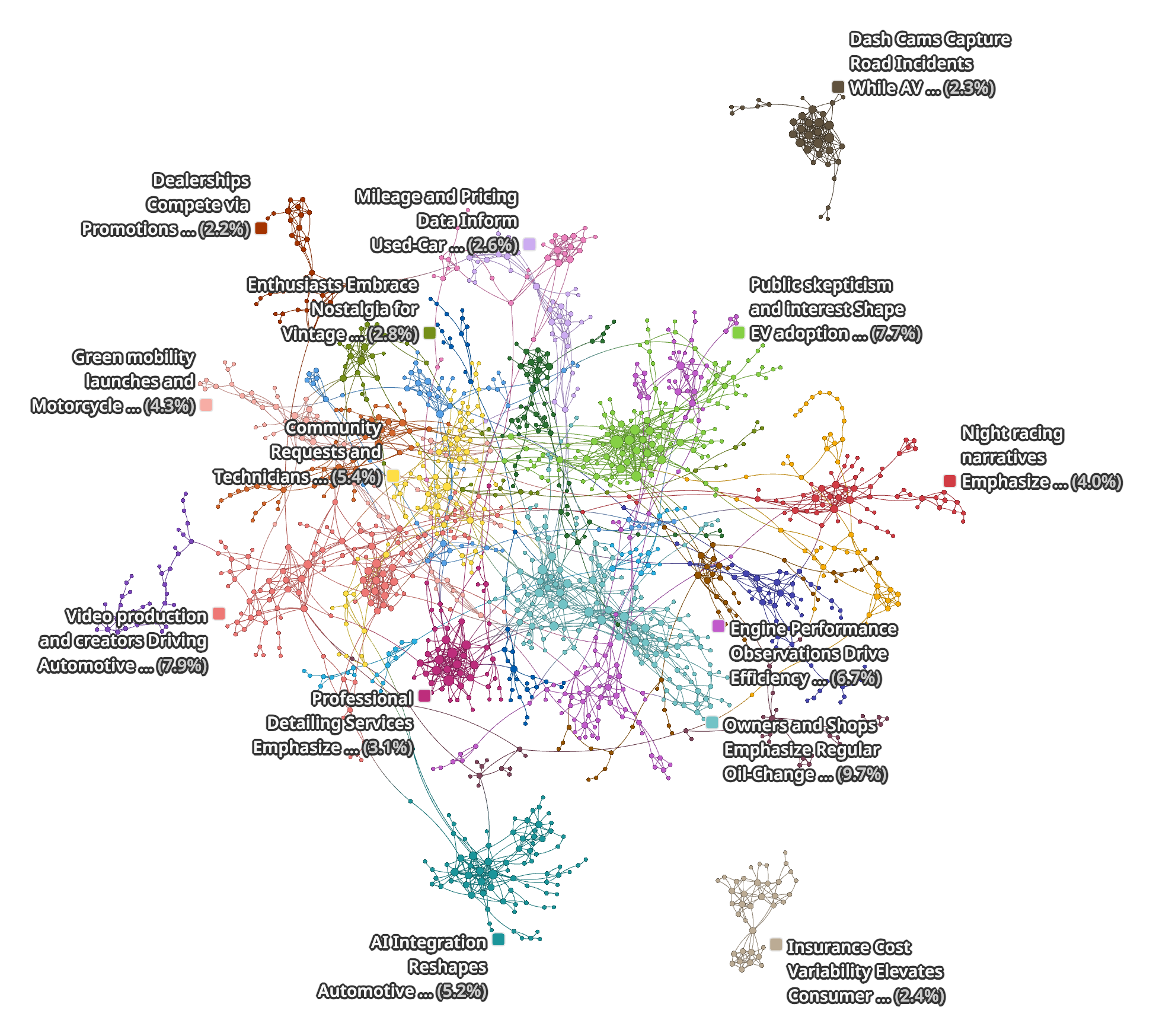
This layer of the brief is particularly useful for understanding how a topic you're tracking connects to adjacent conversations you might not have been monitoring. A brand or agency working in the EV space can see how EV debate connects to maintenance concerns, AI integration, and green mobility themes; all of which share audience overlap and narrative proximity in the data.
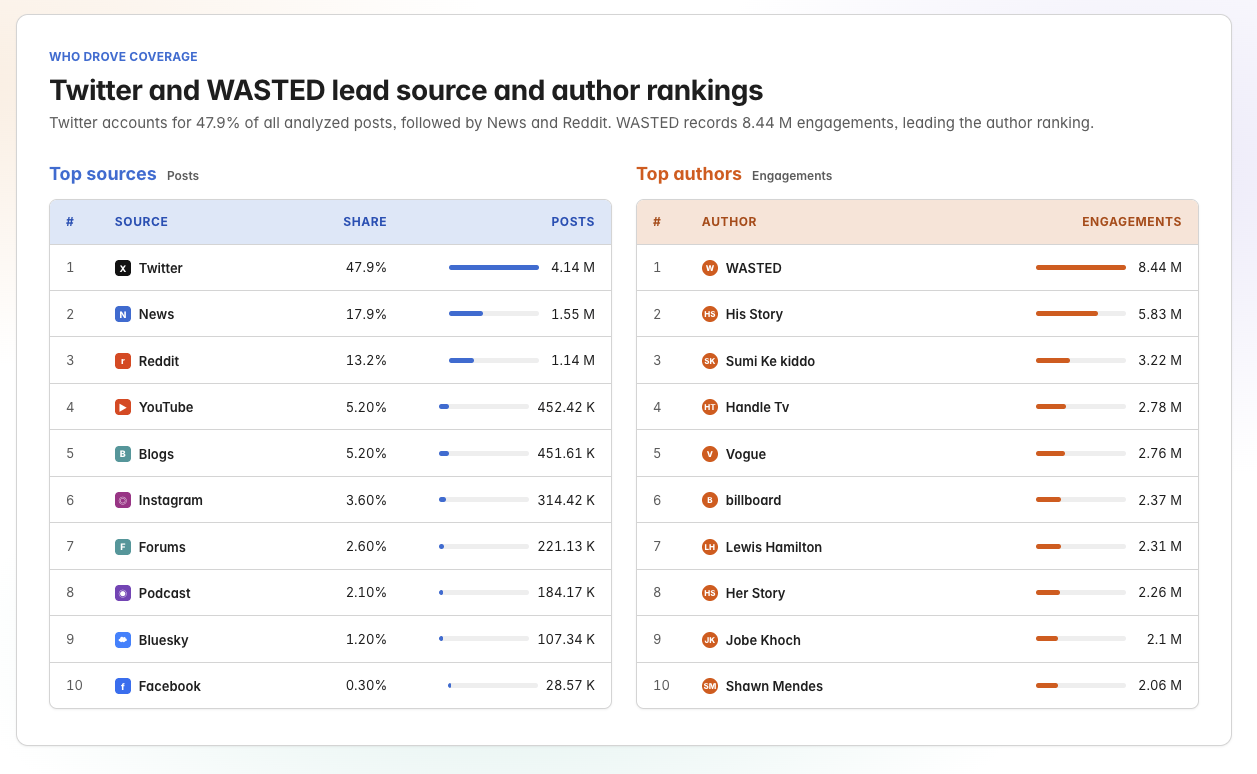
The Who Drove Coverage section surfaces the top sources by post volume and the top authors by engagement, giving a clear read on where the conversation is being generated and who is carrying the most reach within it.
In the automotive brief, Twitter accounts for 47.9% of all analyzed posts at 4.14 million, followed by News at 17.9% and Reddit at 13.2%. On the author side, WASTED leads with 8.44 million engagements, followed by His Story at 5.83 million and Sumi Ke Kiddo at 3.22 million. Lewis Hamilton and Vogue also appear in the top ten by engagement, reflecting the cross-cultural reach of automotive content into fashion, celebrity, and mainstream media.
For any team trying to understand where to build presence, identify partnership opportunities, or monitor how a narrative is forming, this section tells you where the conversation is being made rather than just where it exists.
For brand and marketing teams, the brief answers a foundational question before any content strategy decision: what is the conversation actually about right now, and how is attention divided within it? The subtopic rankings and share-of-voice data give that answer with enough specificity to make real allocation decisions.
For agencies building category intelligence for clients, the brief provides a sourced, ranked read of any topic in 30 days of conversation; the kind of foundational research that typically requires significant time to produce and still risks missing the themes that are genuinely commanding attention versus the ones that simply feel prominent.
For competitive intelligence and social listening teams, the Subtopic Network and Who Drove Coverage sections add dimensions that aggregate sentiment tools miss entirely: the structural relationships between themes, and the specific sources and authors shaping each one.
For product and innovation teams tracking how a category is evolving, running the agent on a consistent cadence creates a comparable record of how the conversation's theme distribution shifts over time, showing which themes are growing, which are fading, and which new ones are beginning to surface.
You enter a subject area and the agent analyzes the last 30 days of conversation across Quid's compliant data network, spanning social platforms, news, forums, blogs, podcasts, and more. It identifies the dominant themes, ranks them by narrative share of voice, and delivers the complete brief to your inbox and inside Quid Terminal.
Once the brief is in Terminal, Ask Q connects directly to the underlying data, not just a summary of the brief but the actual dataset behind it. That means you can ask specific follow-up questions, drill into a subtopic, request comparisons, or explore threads in the data that the brief surfaced but didn't fully develop, all grounded in the same sourced, verified data that built the report.
The Theme Discovery Agent is available now inside Quid Terminal. Enter any subject area and in minutes you have a ranked, sourced map of what's driving the conversation right now.

The Quid Theme Discovery Agent is a Q Agent inside Quid Terminal that analyzes the last 30 days of conversation for any subject area and surfaces the top themes driving that conversation, ranked by narrative share of voice. The brief covers subtopic breakdowns with sourced examples, a theme network showing how topics connect, and a source and author analysis showing who is driving coverage and reach.
Narrative share of voice in theme analysis refers to the percentage of the total conversation that a specific theme or subtopic accounts for. A theme with a higher share of voice is commanding more of the conversation than one with a lower share, making it a direct measure of which topics are generating the most attention within a broader subject area.
Theme Discovery differs from social listening by identifying and ranking the structural themes within a conversation rather than monitoring mentions or sentiment around a specific brand or keyword. Where social listening tracks what is being said about a named subject, Theme Discovery reveals how the broader conversation around a topic is organized, what themes are dominant, and which sources and voices are shaping it.
The Theme Discovery Agent draws from Quid's compliant data network spanning social platforms including Twitter, Instagram, Reddit, and Facebook, as well as news, blogs, forums, YouTube, podcasts, and Bluesky. This cross-channel coverage ensures the theme rankings reflect the full conversation rather than the subset visible on any single platform.
The Theme Discovery Agent is most valuable when run consistently over time. Running it on a set cadence creates a comparable record of how a conversation's theme distribution shifts: which themes are growing, which are declining, and which new ones are emerging. This longitudinal view turns the brief from a snapshot into a trend intelligence tool.