

.png?width=1252&height=362&name=QUID_Logo_WHITE%20(2).png)
The conversation around AI agents has shifted. Not long ago, most discussions focused on what agentic AI might do someday. Now the conversation is about what agents are already doing inside real products, enterprise platforms, and everyday workflows.
Companies are embedding agents into CRM systems, collaboration platforms, developer environments, and operational pipelines. Creators are experimenting with automated research assistants and marketing systems. Retailers are exploring agents capable of comparing products and executing purchases.
The result is a new phase in the AI cycle with less speculation and more implementation.
Our previous analysis explored how agentic AI represents the next leap from insight to intelligent action. This post examines what happens after that leap. Specifically, how people are actually using agentic AI today and how the conversation around it is evolving.
Using Quid data spanning the past two years, combined with media reporting and creator conversations across social platforms, several patterns emerge.
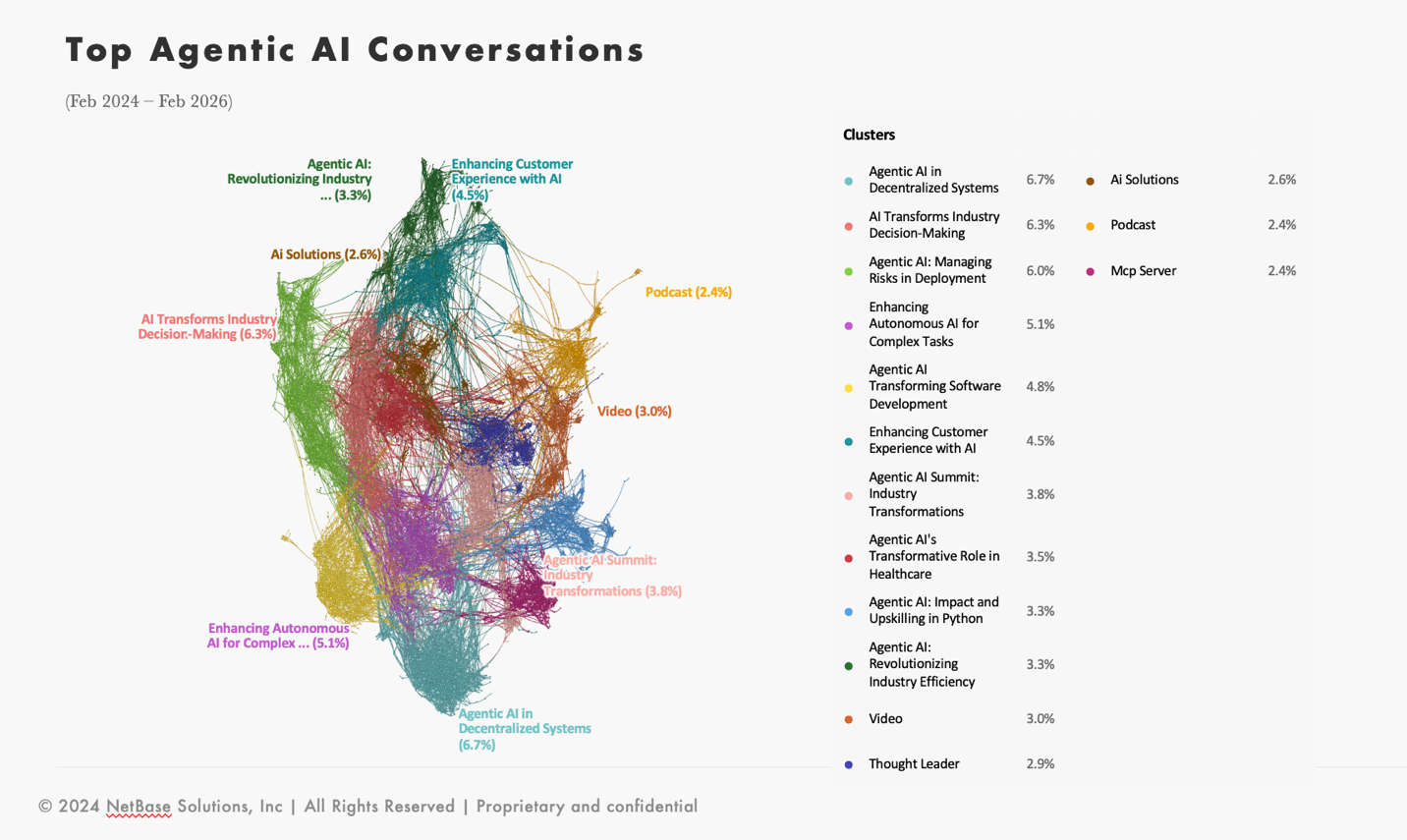
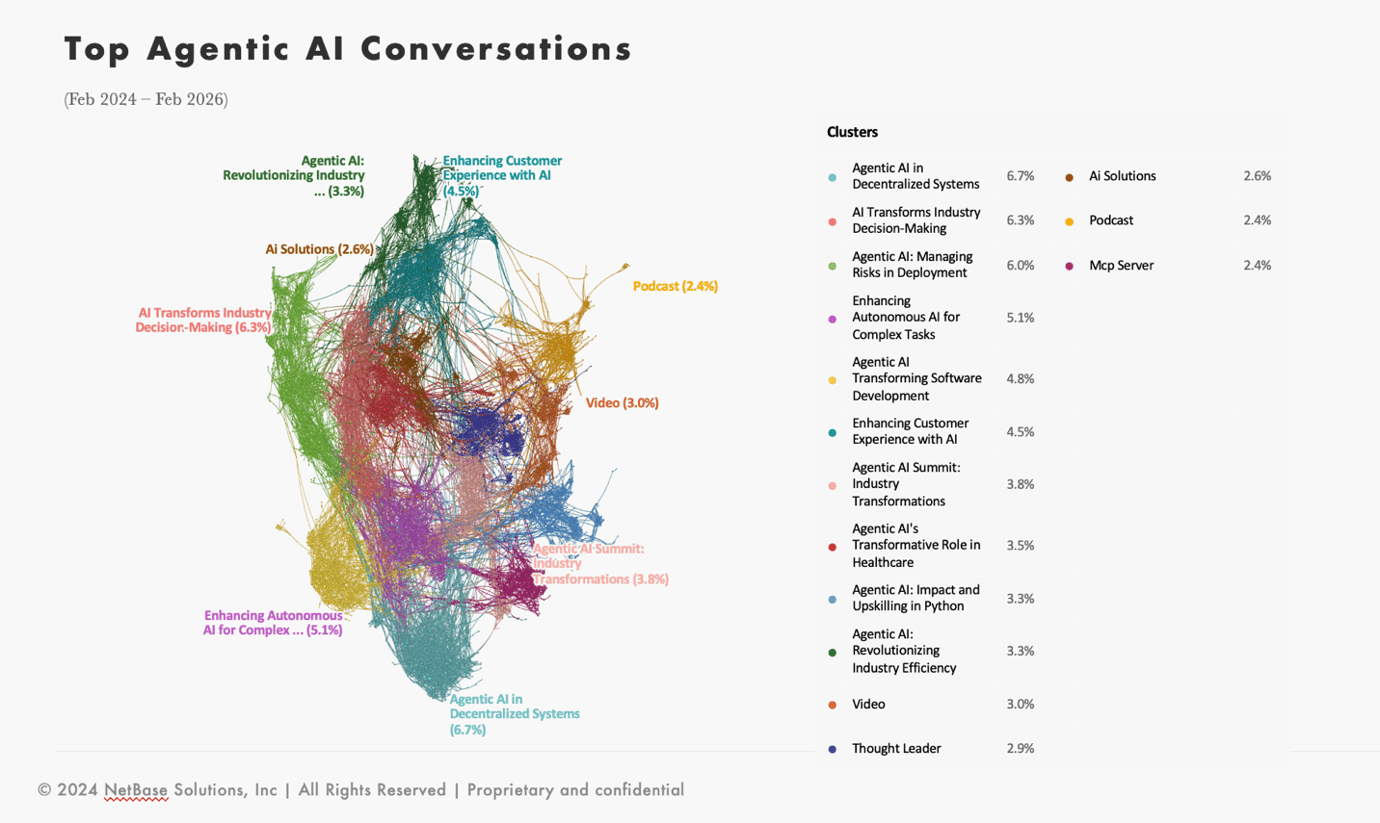
The network map shows how the discussion around agentic AI fragments into several conversation clusters. Instead of a single narrative about a technology breakthrough, the landscape reveals multiple overlapping discussions about infrastructure, workflows, governance, and consumer applications.
The largest clusters center on decentralized systems, enterprise decision-making, complex workflow automation, and customer experience applications.
Agentic AI in Decentralized Systems (~6.7%)
The largest conversation cluster centers on agents operating in decentralized environments. Discussions frequently connect agentic AI with:
In these conversations, agents are framed as software entities capable of coordinating activity across complex digital ecosystems. Rather than functioning within a single application, agents are envisioned as participants in broader distributed systems.
AI Transforming Industry Decision-Making (~6.3%)
The second-largest cluster focuses on how agentic AI could reshape operational decision-making across industries. Examples discussed include:
This narrative reflects a shift from AI as an analytical tool to AI as a decision coordination layer across organizations.
Autonomous Agents for Complex Workflows (~5.1%)
Another major cluster focuses on agents orchestrating multi-step workflows. These discussions highlight systems capable of:
The defining theme is orchestration. Instead of performing isolated tasks, agentic AI systems coordinate multiple tools and systems to complete complex objectives.
Customer Experience and Service Automation (~4.5%)
Customer-facing applications form another important conversation cluster. Organizations are exploring agents that can:
Customer experience environments offer an early proving ground for agentic AI because they combine repetitive tasks with large information repositories.
Conferences and Industry Narratives (~3–4%)
Another cluster centers on conferences, podcasts, and industry thought leadership. These discussions shape how businesses interpret agentic AI and often coincide with product announcements, governance frameworks, and developer ecosystem launches.
Industry events frequently amplify debates around security, standards, and enterprise readiness.

Sentiment around agentic AI remains largely neutral with pockets of excitement and skepticism.
Quid analysis shows:
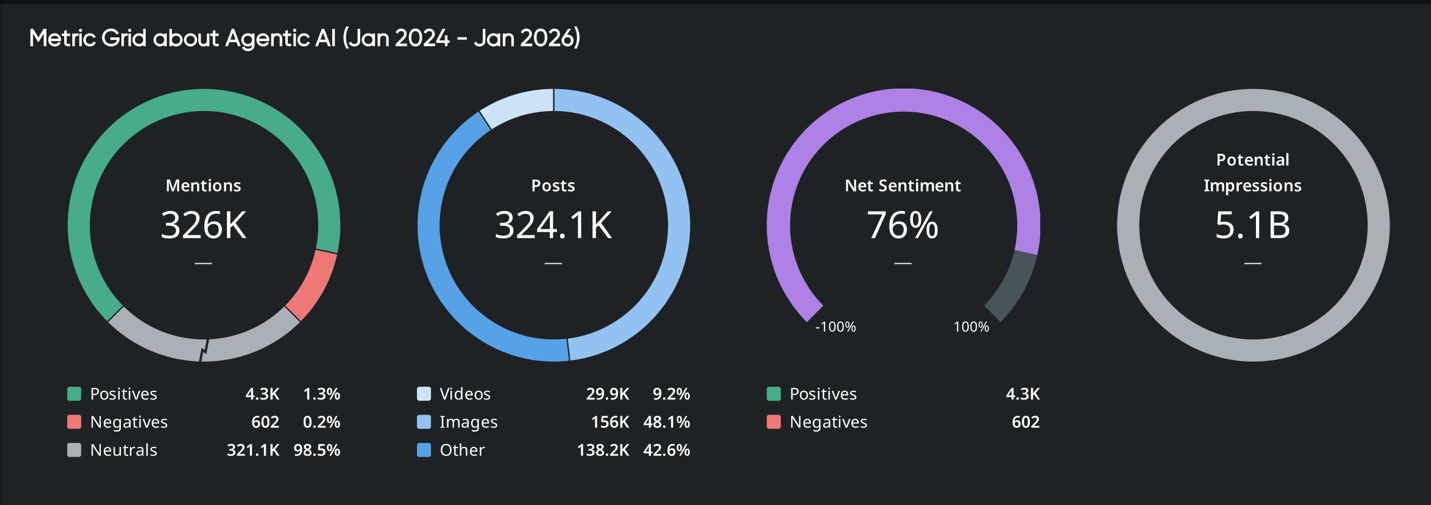
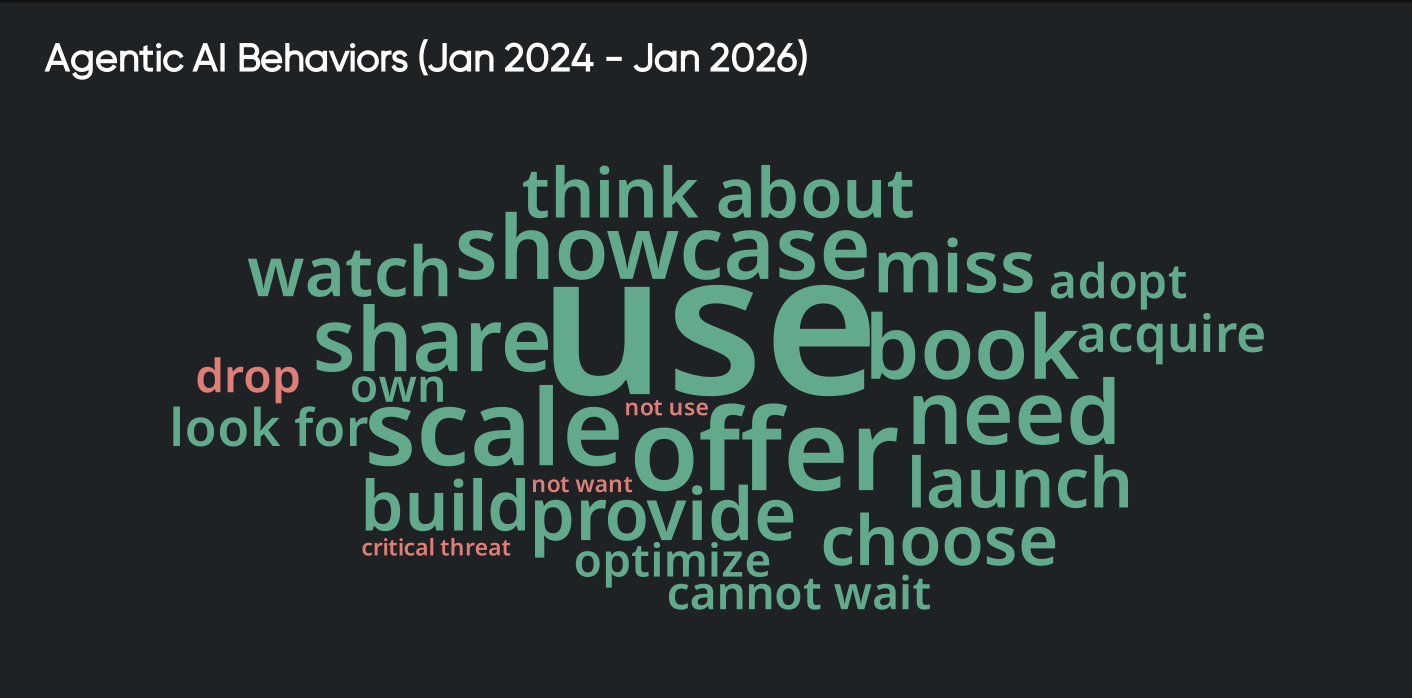
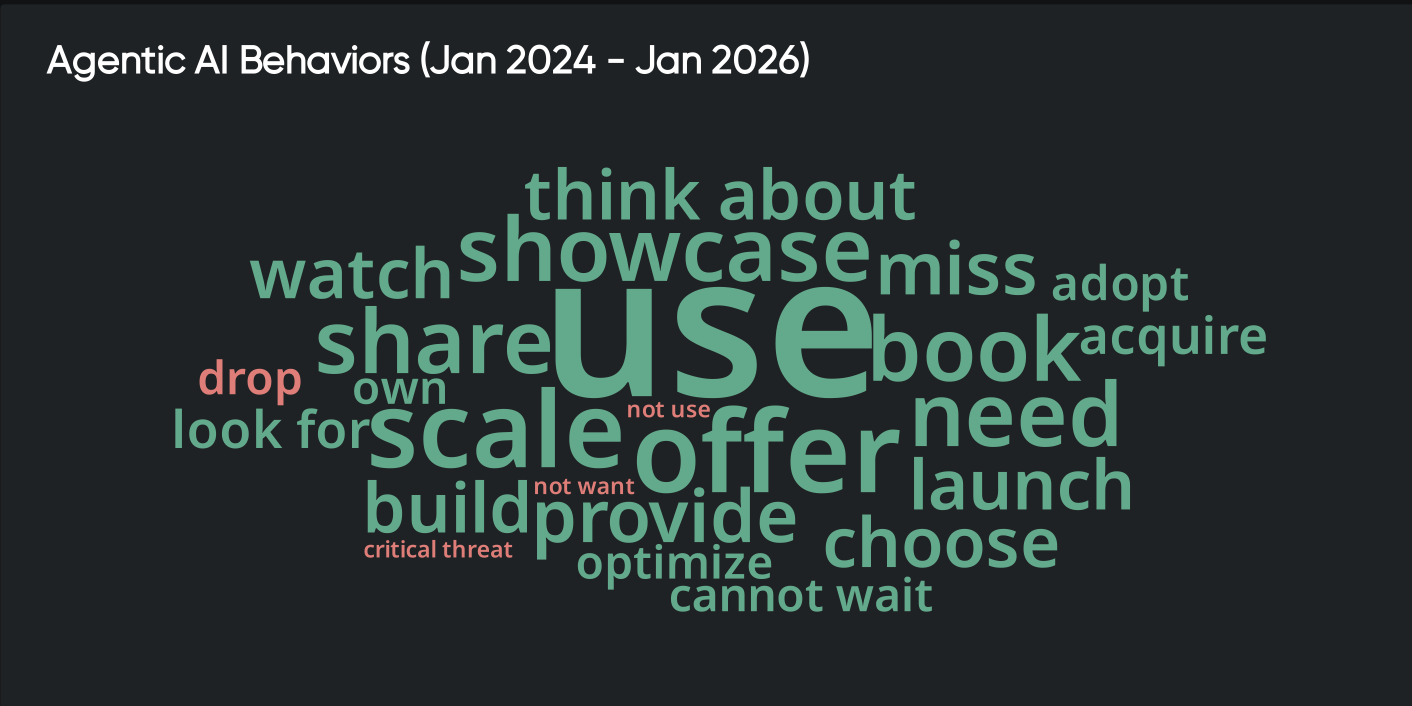
Neutral sentiment suggests normalization. Instead of debating whether the technology matters, most conversations now focus on how it is being implemented. Common verbs appearing in discussions include:
These words reflect operational activity rather than speculative curiosity.
The timeline reveals that attention around agentic AI grows in waves rather than steadily.
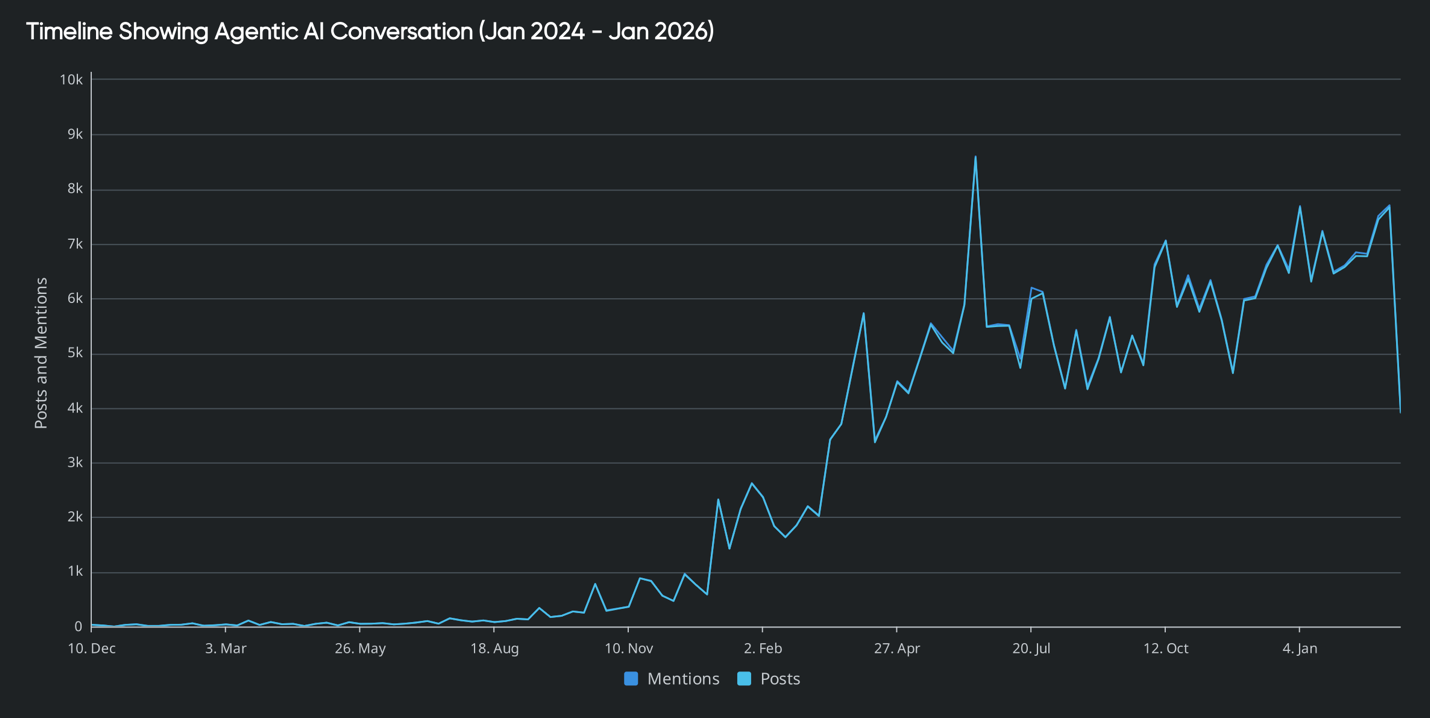
Spikes in conversation tend to align with three recurring triggers.
Major spikes frequently follow announcements from large technology vendors.
Companies such as OpenAI, Microsoft, Google, Salesforce, and NVIDIA regularly introduce new frameworks, developer tools, and agent platforms.
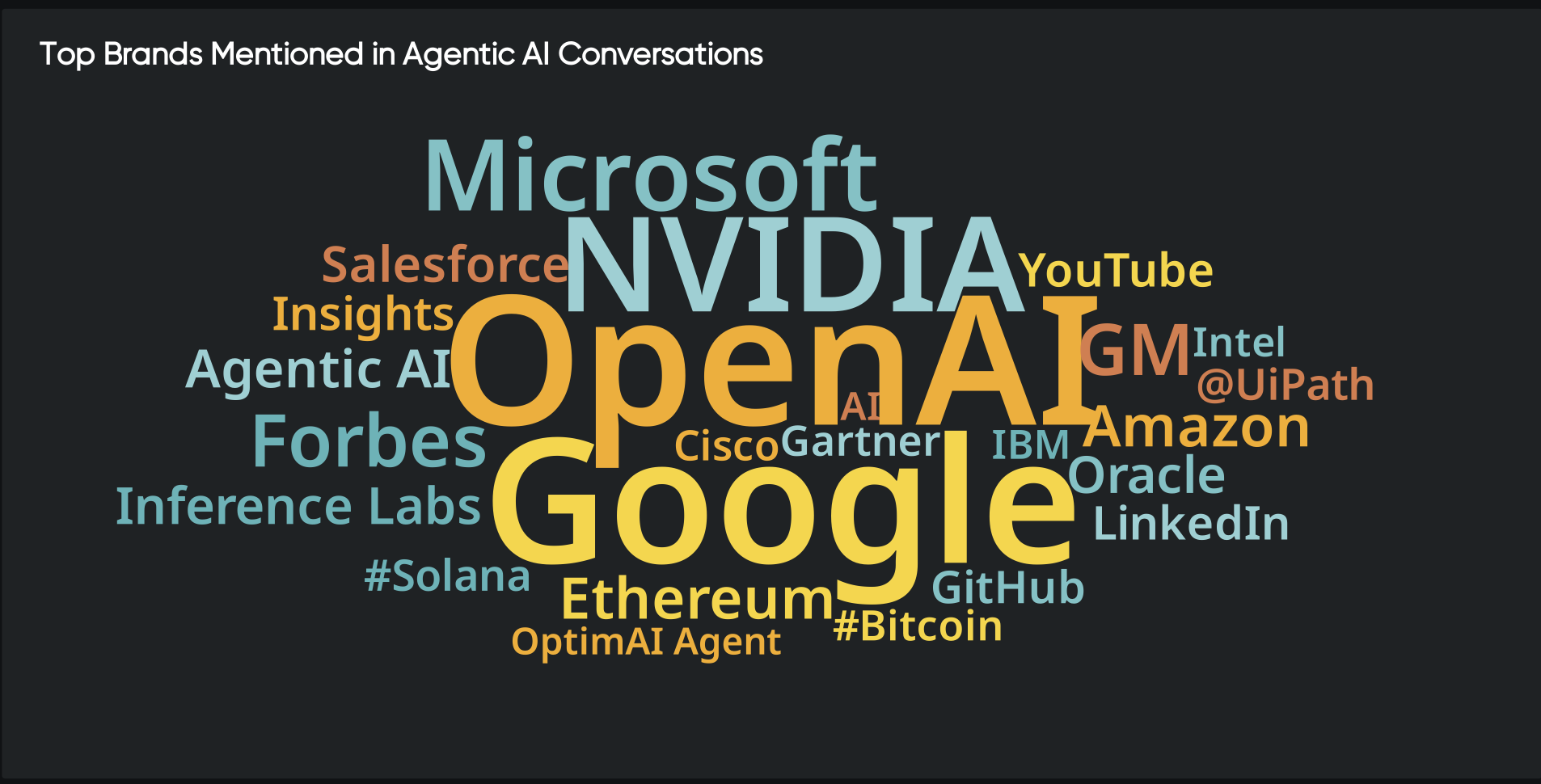
Each release expands the ecosystem and generates widespread discussion across both media coverage and developer communities.
Another major driver of conversation spikes is security research. Autonomous systems introduce new attack surfaces including:
Security research demonstrating these vulnerabilities often triggers intense industry discussion.
Spikes also align with launches of new developer platforms and no-code agent builders.
Low-code tools promising rapid agent development generate significant attention, particularly among creators demonstrating automated workflows.
These demonstrations often circulate widely across social platforms because they show visible results quickly.
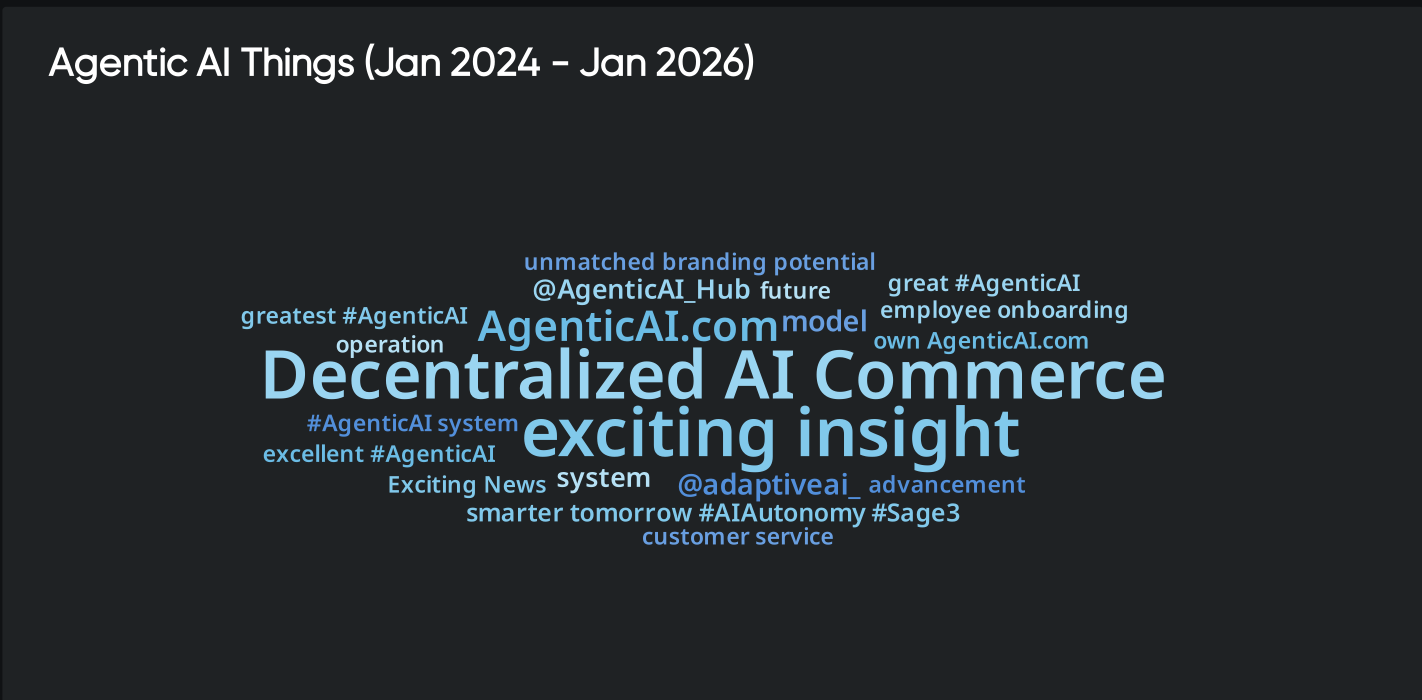
Across media coverage and social conversations, several practical use cases appear repeatedly.
Organizations are embedding agents into enterprise platforms including:
Vendors increasingly position agentic AI as an ecosystem combining orchestration layers, identity controls, connectors, and governance frameworks. Enterprise discussions emphasize reliability and security rather than novelty.
Developers and creators frequently showcase agents functioning as personal assistants. Examples include agents that:
Some agents operate locally on desktops, providing direct access to files and system functions.
Agentic AI is widely used to automate marketing and creator workflows. Examples include agents capable of:
These demonstrations often combine multiple AI models and automation tools into unified workflows.
Retail and commerce platforms are experimenting with agents that act as purchasing intermediaries. These systems can:
Some demonstrations show purchases occurring directly inside AI interfaces. Industry analysts increasingly expect AI agents to influence product discovery and purchasing decisions across digital commerce platforms.
Security remains one of the dominant themes surrounding agentic AI. Autonomous systems introduce new attack surfaces including prompt injection, tool chaining, and credential exposure.
These risks are prompting organizations to develop new governance frameworks focused on:
Governance is rapidly becoming a central component of enterprise AI deployment strategies.

Looking at both the conversation clusters and the timeline reveals an important pattern. Agentic AI is evolving across three interconnected fronts.
Together, these forces explain why the conversation around agentic AI continues to expand across industries. The technology is simultaneously a research frontier, a commercial platform, and a governance challenge.
Conversations around emerging technologies move quickly. Quid's AI Agents, Q Agents, helps organizations track how narratives form, where adoption signals appear, and what those signals mean for real-world strategy. Reach out today to learn how we can help you uncover this insight, too!
What is agentic AI?
Agentic AI refers to artificial intelligence systems capable of independently planning and executing tasks to achieve goals while interacting with tools, data sources, or applications.
How are companies using agentic AI today?
Organizations are integrating agents into enterprise platforms, productivity tools, marketing systems, and digital commerce experiences.
Why is security a major concern?
Agents can interact with multiple systems autonomously, creating new risks such as prompt injection attacks and credential misuse.
Are consumers comfortable interacting with AI agents?
Consumer sentiment remains cautious. Many users are willing to interact with agents if systems demonstrate reliability, transparency, and strong privacy protections.
Which industries are adopting agentic AI fastest?
Early adoption is visible in software development, enterprise automation platforms, marketing technology, and digital commerce ecosystems.