

.png?width=1252&height=362&name=QUID_Logo_WHITE%20(2).png)
One $400 blind-box plush at a time, adults are buying comfort, nostalgia and identity. Whether it’s a sealed trading card locked in acrylic, or a LEGO set that never gets built because it is meant to be displayed, this isn’t about toys. Adults are investing in identity, stability and emotional control.
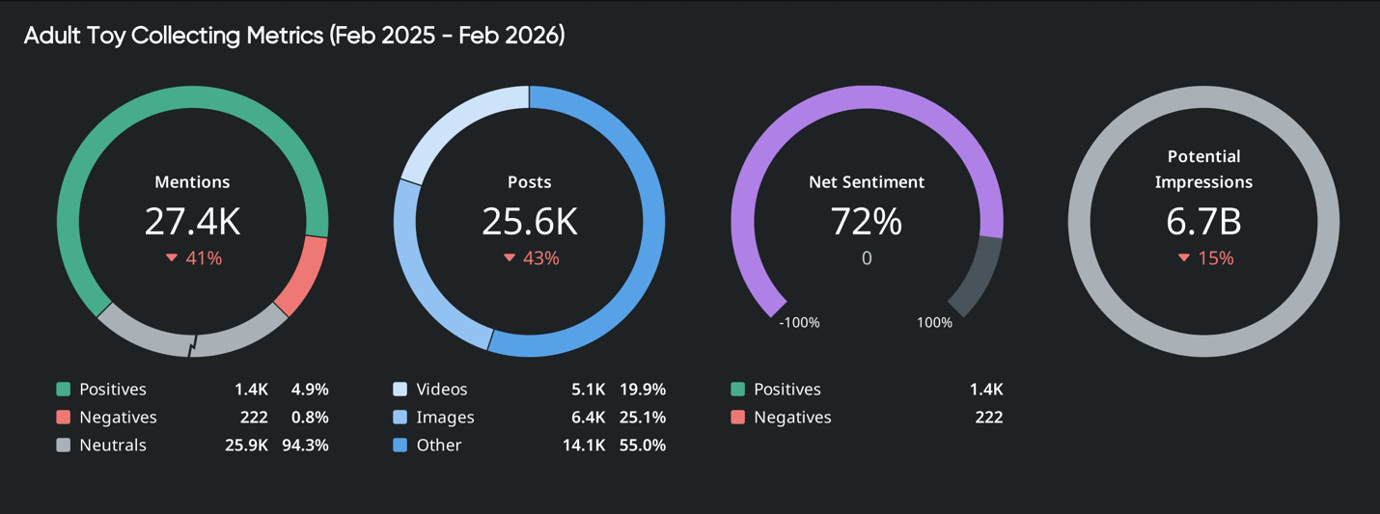
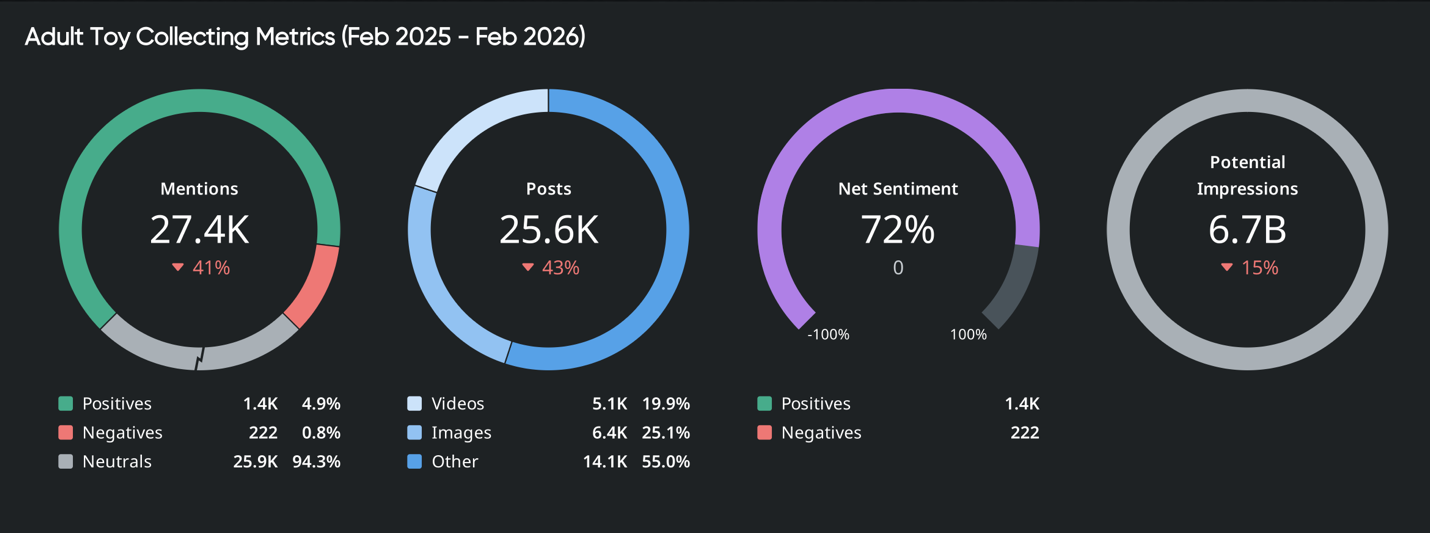
Between February 2025 and February 2026, adult toy collecting generated 27.4K mentions, 25.6K posts, 6.7B potential impressions, and a 72% net sentiment score:
The “kidult” economy is now structured, global, and commercially significant.
Key Takeaways
Now let’s look at the structure beneath the headlines.
Quid’s network map aggregates the conversation into 30 distinct conversations:
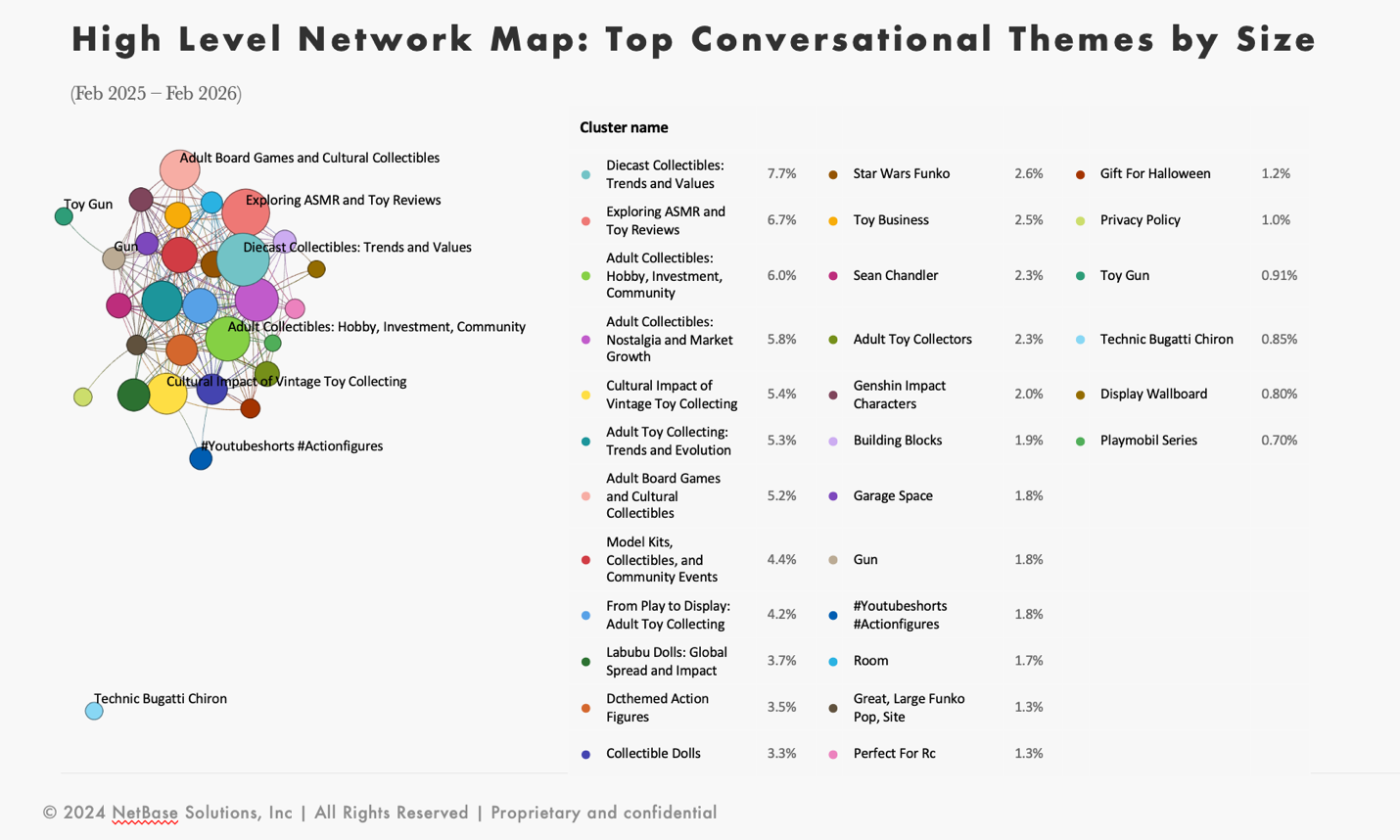
The largest clusters include:
Some segments operate like alternative assets, with others functioning as emotional preservation. Board games anchor social rituals and vintage toys preserve generational memory.
The network density shows several connections across themes. This “play” is really anything but, touching investment, entertainment, social identity and resale economics simultaneously.
The timeline reveals predictable spikes aligned with spring trading card releases, convention season reveals, fall franchise drops, and holiday retail cycles.
Collectors do not stumble into purchases. They track release calendars and return at cultural inflection points.
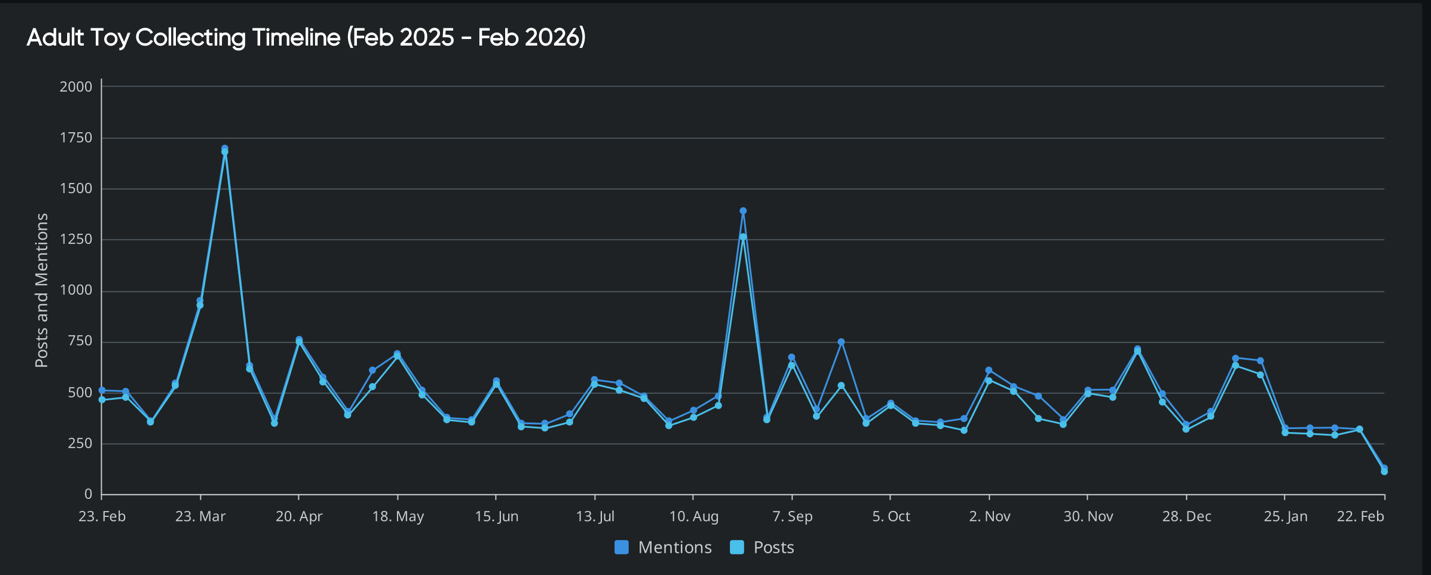
This pattern signals the habit of collectors’ return. They monitor drops and anticipate events. Adult collecting is cyclical. It’s consumption driven by emotion, and nostalgia is its anchor.
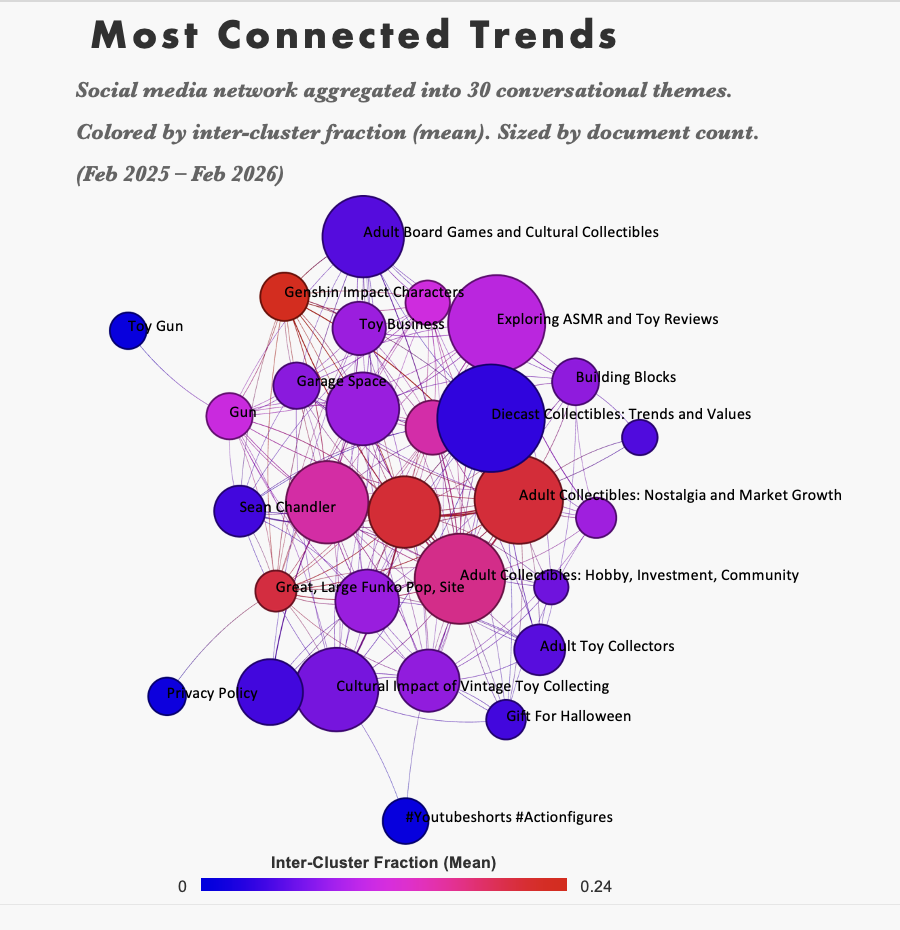
This network map aggregates the conversation into 30 conversational themes. Node size reflects volume. Color intensity reflects inter-cluster connectivity. What stands out is not just the presence of nostalgia — it is its position.
Clusters like “Adult Collectibles: Nostalgia and Market Growth,” “Adult Collectibles: Hobby, Investment, Community,” and “Cultural Impact of Vintage Toy Collecting” sit near the center of the network, connected to adjacent themes including diecast collectibles, ASMR toy reviews, board games, building blocks and influencer-driven content.
Nostalgia bridges investment behavior, community interaction, content creation and retail activity. That central positioning matters. It signals that adult collecting is not a narrow niche category. It is an interconnected marketplace where emotional attachment drives adjacent behaviors.
Collectors who enter through nostalgia often expand into display culture, resale activity, and social amplification. The emotional anchor becomes the economic gateway.
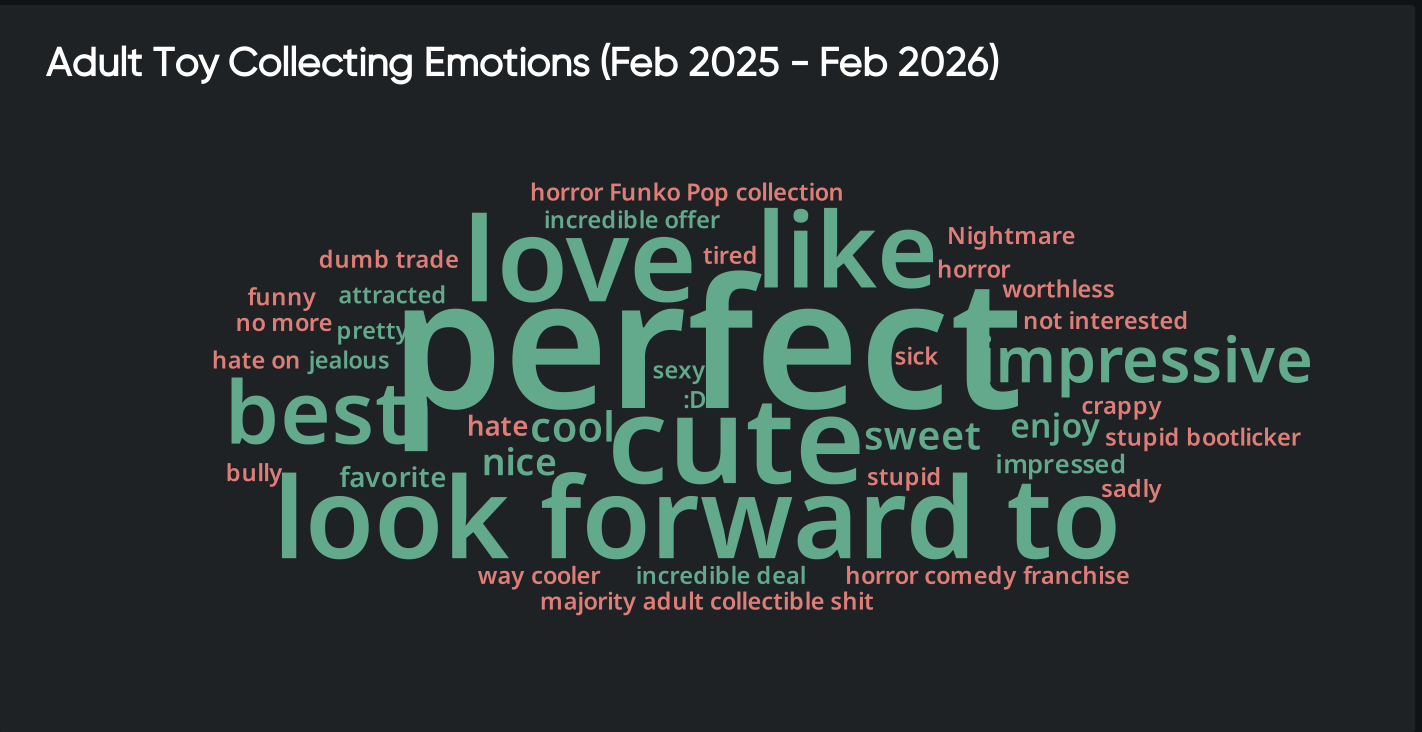
The emotional data reinforces this structural view.
The dominant language includes “perfect,” “best,” “love,” “favorite,” “look forward to,” reflecting attachment, not volatility. The tone is steady.
Even negative language clusters around friction points like pricing or counterfeits. It does not overwhelm the category. At scale, neutrality dominates as collecting is integrated into daily life.
When attachment-based language dominates a category that also exhibits strong cross-cluster connectivity, it suggests consistent demand.
Adults are revisiting franchises tied to their formative years and embedding them into their present-day identity. In uncertain environments, familiarity reduces cognitive friction. It feels safe.
And safety supports repeat purchase cycles.
The network map also shows strong connections among nostalgia clusters and themes such as ASMR toy reviews, influencer content, and board games. This is where emotion becomes amplification.
Collectors are preserving memory and they are also displaying it. Unboxings, shelf tours, and collection showcases turn personal attachment into public identity. What begins as nostalgia evolves into visible signaling.
The collectible becomes social shorthand. Ownership is physical and identity is broadcast. It is emotional, performative, and commercial all at once.
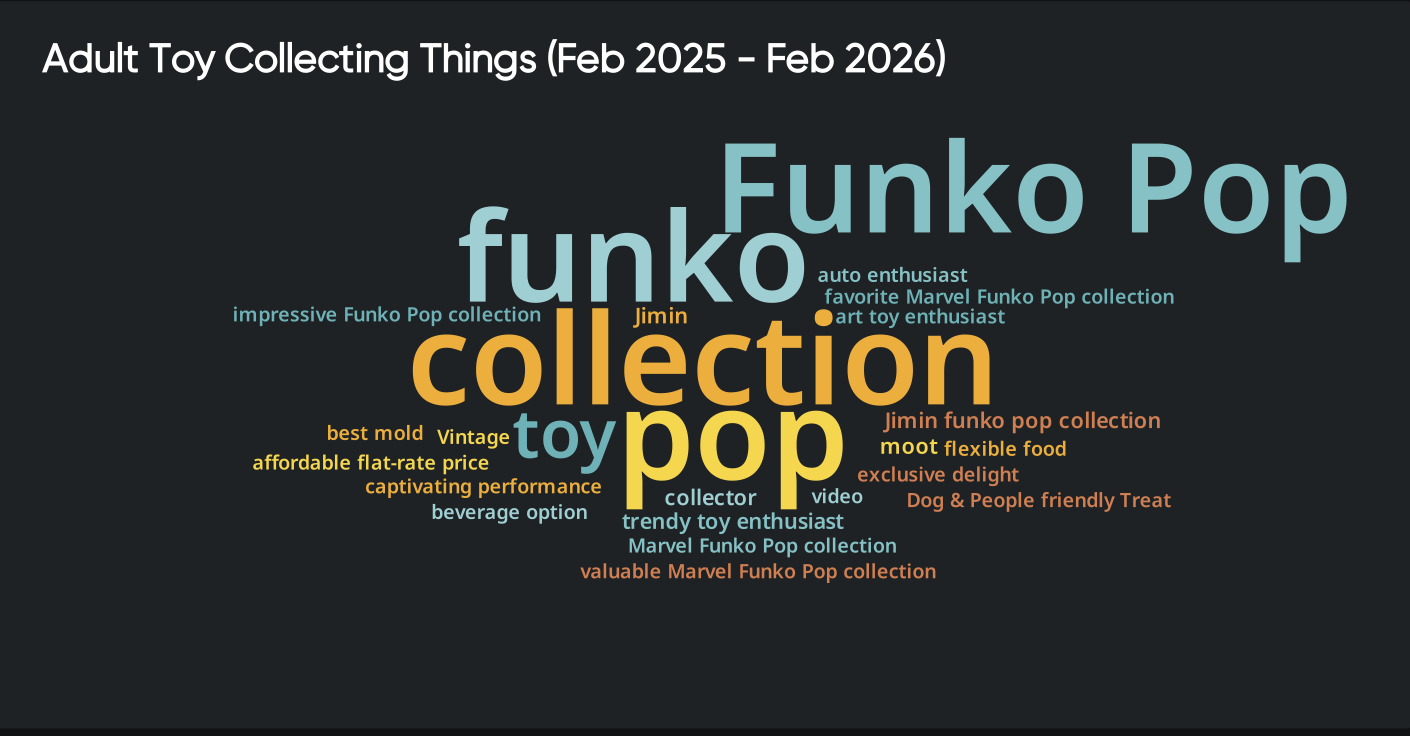
The “Things” analysis is dominated by language such as “Funko Pop,” “collection,” “collector,” “Marvel variants,” and “vintage.” These are not one-off purchases. They are curated inventories.
Behavior language adds another layer. Words like “show,” “show off,” “unbox,” “upgrade,” and “stick to collect” signal intentional visibility.
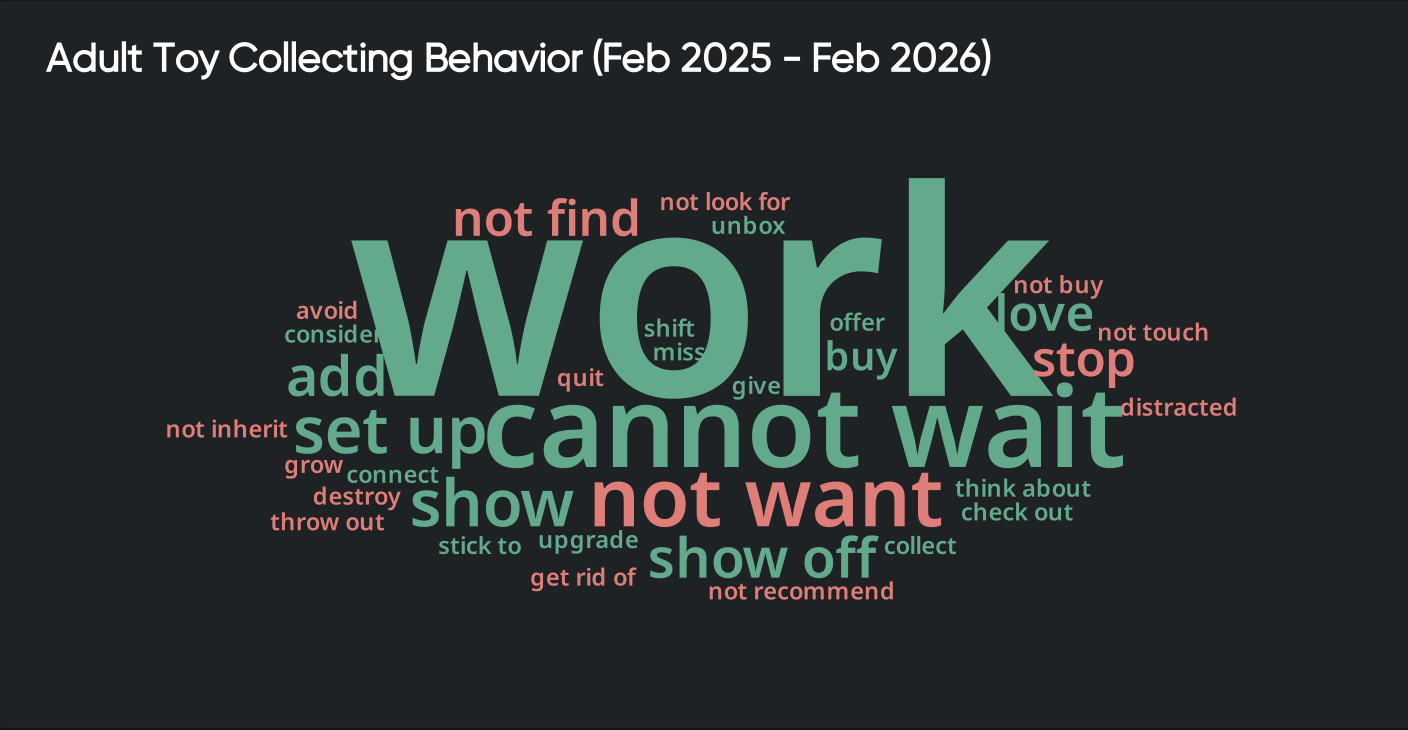
Collectibles are not hidden in drawers. They sit on shelves behind cameras. They anchor TikTok backdrops. They appear in unboxing videos and livestreams. They function as visual shorthand for taste, nostalgia, and fandom.
Ownership is physical. Identity is broadcast.
What begins as emotional continuity evolves into social positioning.
This is where adult collecting moves beyond personal reassurance. It becomes spatial branding where the shelf is a stage.
The same network that shows emotional attachment also reveals strong ties to investment-oriented clusters. Adults are now one of the fastest-growing buyer segments in the toy industry. Trading cards, blind boxes, and limited releases are generating resale premiums and secondary-market speculation.
Scarcity mechanics are central to this dynamic. Limited drops, mystery formats, exclusive retailer partnerships, and signed editions create controlled supply.
When supply tightens, attention intensifies.
The behavior patterns resemble those seen in sneakers and luxury goods. Products are evaluated for display value and resale value simultaneously. The collectible operates as both emotional artifact and alternative asset.
But the financial layer does not replace nostalgia. It builds on it. Emotional attachment fuels willingness to pay. Scarcity just amplifies the urgency. Together, they create that durable commercial momentum brands crave.
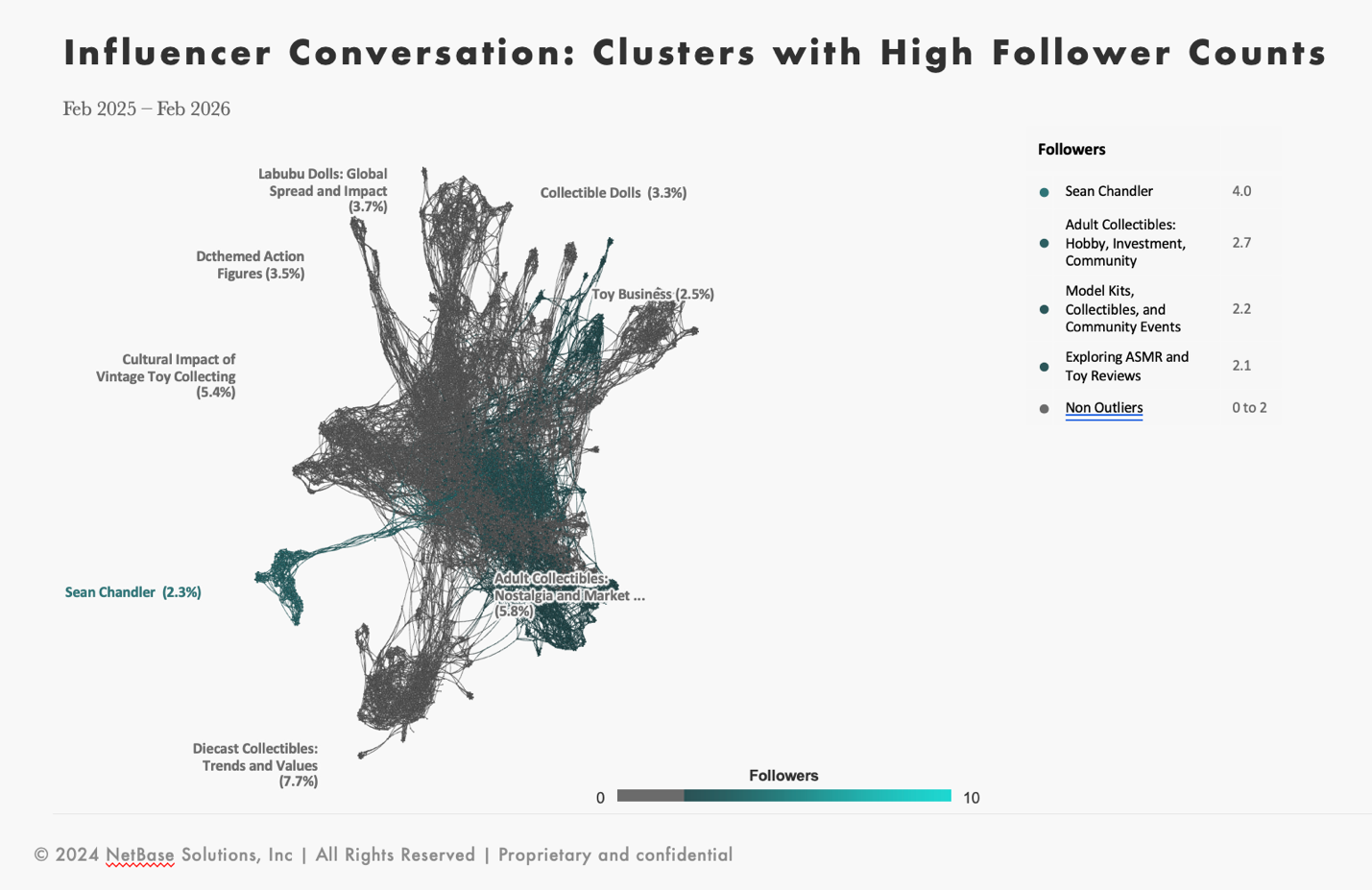
Follower-weighted analysis shows strong engagement across fandom niches, vintage collectors, and influencer ecosystems.
The product launch is rarely the peak moment. Unboxings create anticipation. Reddit threads validate purchases. YouTube Shorts and TikTok reviews amplify visibility. Conversations extend product lifespan beyond the initial drop.
Collecting becomes collaborative. Community turns private attachment into shared validation. It reduces buyer friction and strengthens repeat behavior.
In this marketplace, the conversation is not secondary to the product. It is part of the product.
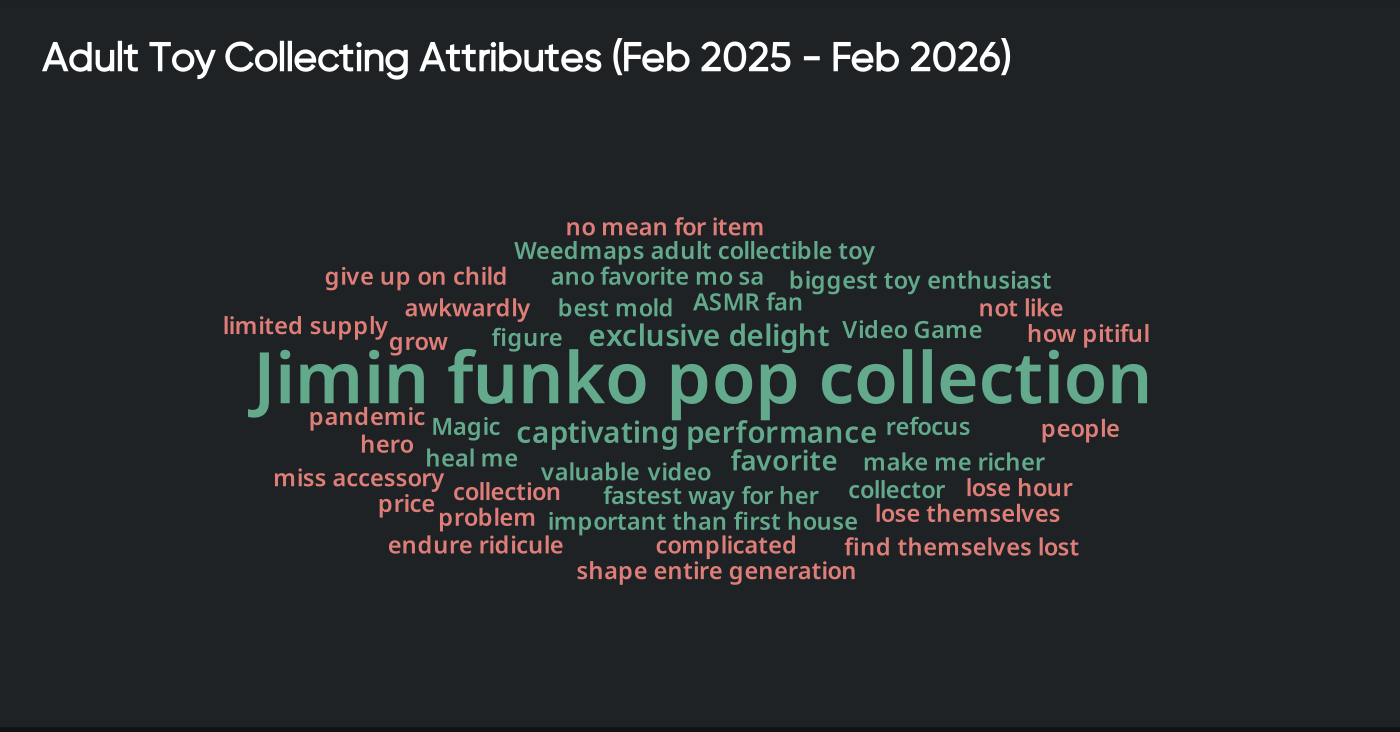
Attribute language includes phrases such as “lose themselves,” “look forward to,” “important,” “heal,” and “favorite.”
The emotional tone returns us to the beginning.
Adult collecting provides contained environments in an unpredictable landscape. It offers tangible ownership in a digital economy. It creates continuity across life stages.
Adults are not retreating from complexity, they are curating manageable worlds within it.
The data shows attachment at the center, visibility at the surface, and scarcity at the edges. That layered structure is what makes this category resilient.
This is a design and positioning story. Brands that want to compete in the adult play economy must understand the emotional architecture driving it.
Scarcity must feel intentional, not exploitative. Limited access drives urgency, but alienation erodes loyalty. Products must be designed for display as much as for use. Packaging, colorways, and form factor should anticipate camera visibility and shelf longevity.
Community activation should be strategic. Mapping niche fandom clusters and seeding credible creators converts interest into ritual.
Secondary-market monitoring is no longer optional. Resale spikes, counterfeit chatter, and price volatility are leading indicators of demand intensity and reputational risk.
Most importantly, brands should track emotional signals alongside sales metrics. Attachment-based language signals stability. Positive spikes indicate cultural moments. Emerging negative chatter often flags friction before it impacts revenue.
The adult collectibles segment now intersects retail, resale economics, licensing, influencer culture, and emerging interactive technology.
It produces billions of potential impressions annually. It spans dozens of interconnected conversational clusters.
Brands that treat collectibles as emotional ecosystems rather than impulse toys will capture long-term loyalty. Those who reduce it to trend merchandising will miss the structural shift.
Quid surfaces the structure beneath cultural momentum. We help brands detect demand shifts before they peak, map interconnected conversation clusters, monitor resale and reputational risk in real time, and translate emotional signals into actionable product and marketing strategy.
If adult play is reshaping retail, Quid reveals the data architecture behind it.
Connect with Quid to transform cultural insight into competitive advantage.