

.png?width=1252&height=362&name=QUID_Logo_WHITE%20(2).png)
New Year’s resolutions are easy to say out loud, but hard to commit to and even harder to fund. That is why the resolution purchase conversation is such a useful retail signal. It shows where people’s true commitment lies and what they’re likely to purchase more of in the near future. For retailers, this is an early read on where follow-through spending is headed.
Two points matter most here for retailers:
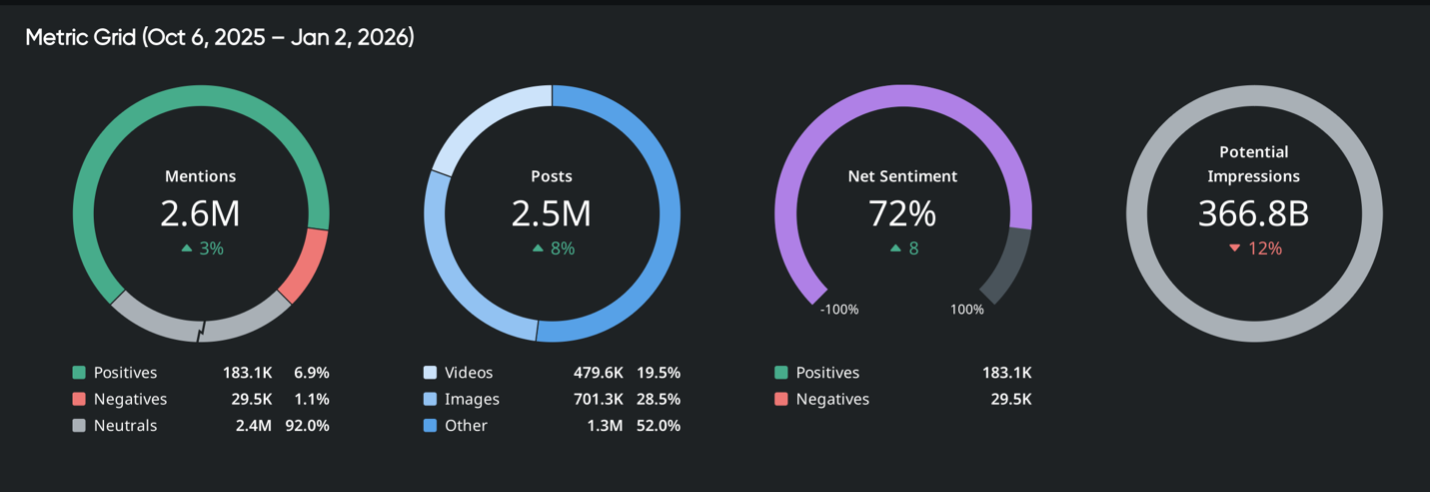
That usually signals evaluation behavior. People are comparing, considering, and sharing options more than they are celebrating or complaining.
The panel above sets the overall scale and tone. It also shows what formats carried the conversation.
That media format split suggests that proof-and-demonstration content (images and video) is a meaningful driver of engagement. In other words, people are not just talking about what they want. They are showing it. Retailers should not assume resolution purchase conversation is purely text-based recommendation chatter.
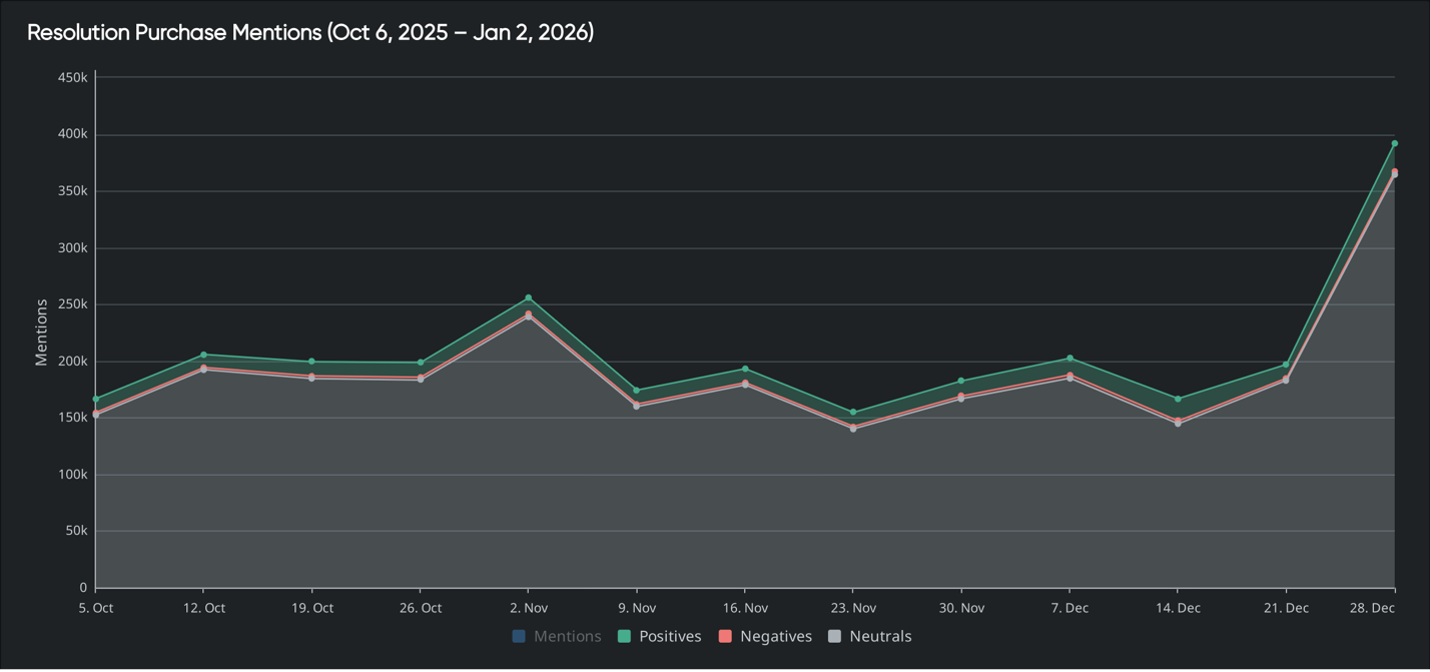
Throughout most of the period, resolution purchase mentions hover roughly between 150K to 210K mentions from early October through mid-December. There’s one visible lift in early November that peaks around the 250K mark. Then the line drops back into baseline activity.
The real story hits in the final week shown where mentions surge sharply to just under 400K at the end of December in a late, decisive spike.
Retailers should read this as a behavioral pattern. Consumers talk about change for months, but they more toward making actual purchases when year-end becomes unavoidable.
The last week of December is a peak attention and conversion window for buying. It’s after most gifting decisions and before January routines settle into place.
This word cloud shows behavioral language, and it leans heavily toward intent and evaluation. It reads like shopping, not daydreaming.
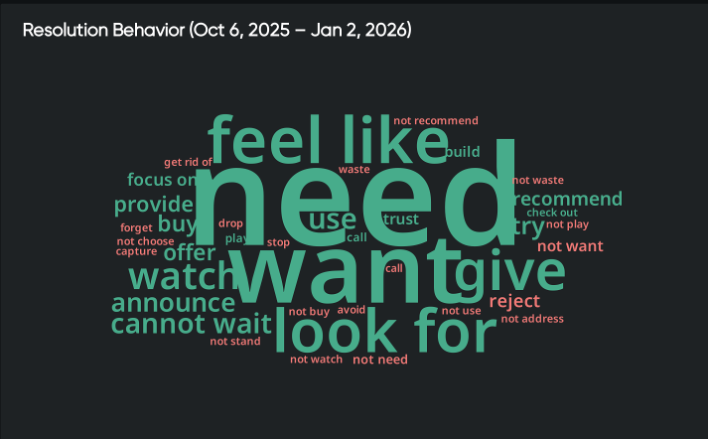
The green terms tell us that consumers need, want, look for, offer, provide, buy, use, trust, recommend and try items to support upcoming resolutions. It’s purchase language. People search, compare, decide and commit.
The red terms show the refusal side of the same decision-making process, with phrases such as "not recommend," "not buy," "not use," "avoid," and "not waste."
The emotional language adds another layer:
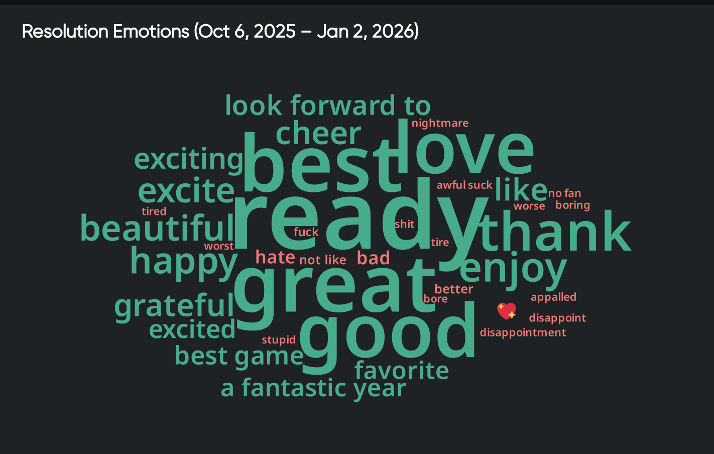
The dominant emotion terms speak to forward motion and approval. Visible positives include ready, love, great, good, best, enjoy, happy, grateful, and excited.
The negative terms are blunt and practical, with awful, worst, bad, hate, tired and boring.
This matters for purchase behavior. The emotional story here reveals people trying to set themselves up for a year they expect to be demanding.
The emotional picture is a mix of readiness and fatigue. It’s a combination that supports a common resolution purchase mindset. People want change, and they also expect it to be hard.
This is where retailers can misread the moment, and it’s crucial that they don’t.
If messaging leans only toward inspiration, it ignores the “tired” and “do not waste my money” layers visible in the data.
And what kinds of things are these New Year Resolvers interested in this year?
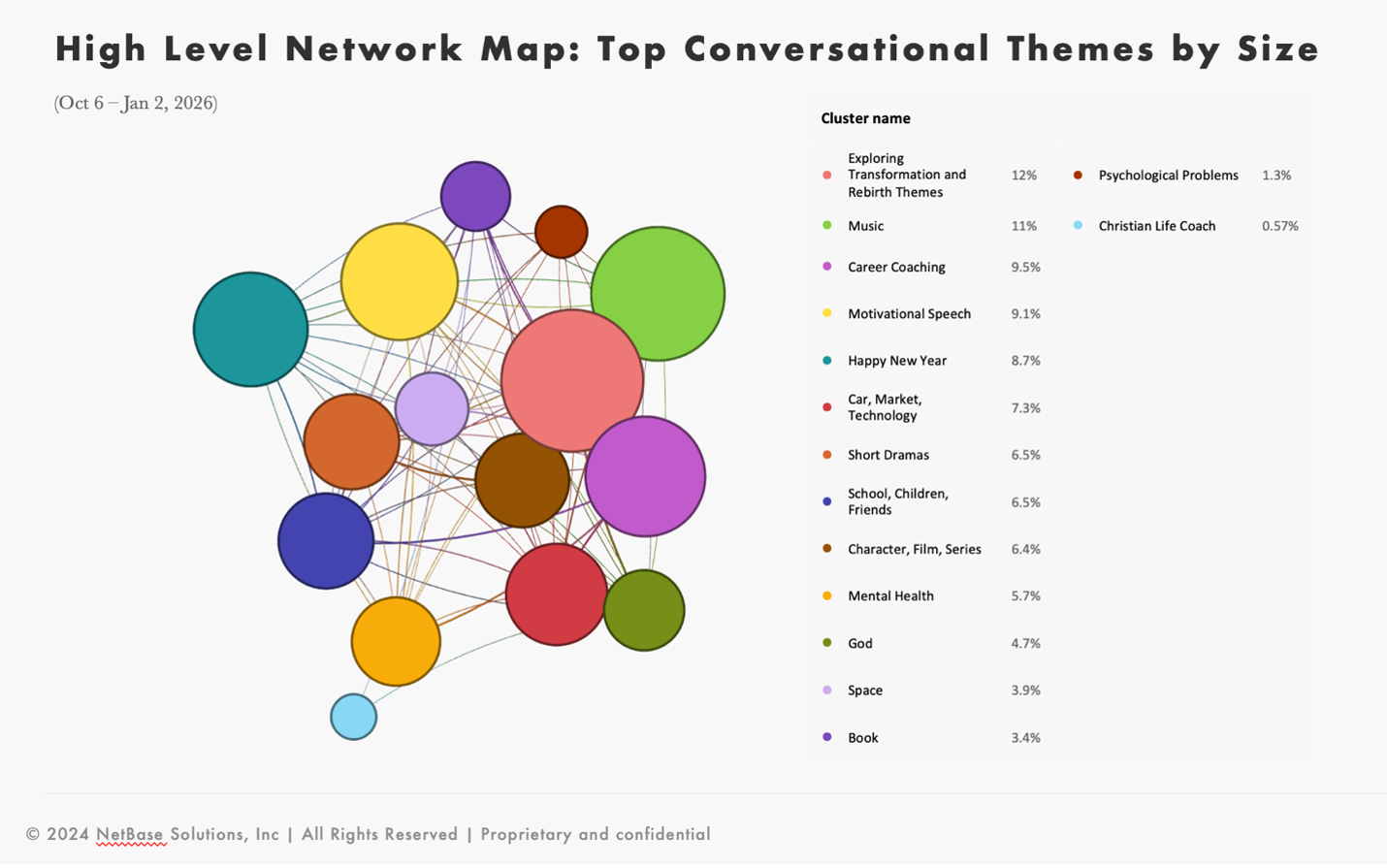
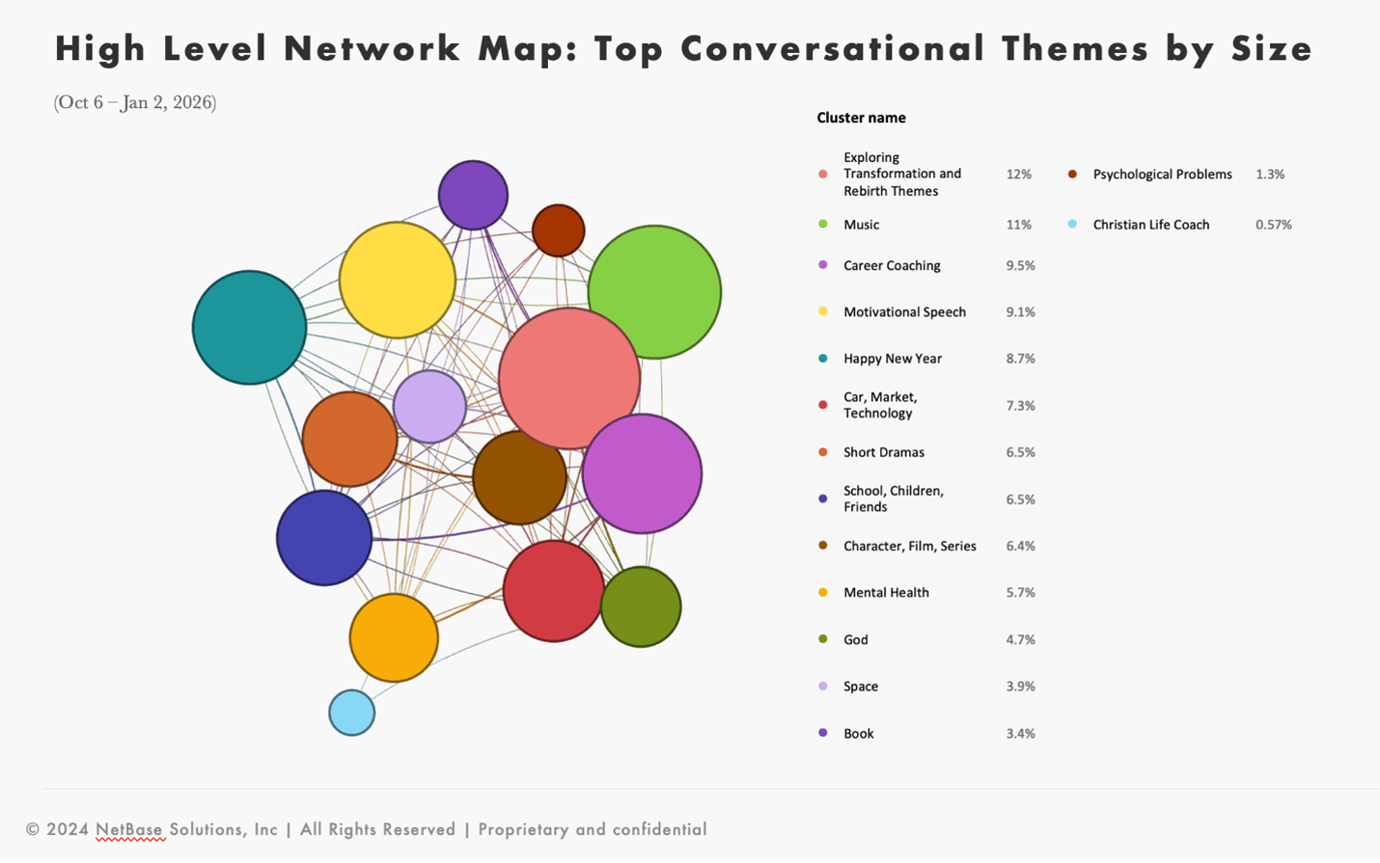
The image above shows the conversation organized into a handful of large themes.
The biggest bubbles are Exploring Transformation and Rebirth Themes (12%) and Music (11%), followed by Career Coaching (9.5%), Motivational Speech (9.1%), and Happy New Year (8.7%). Smaller but still meaningful themes include Car, Market, Technology (7.3%), Short Dramas (6.5%), School, Children, Friends (6.5%), Character, Film, Series (6.4%), and Mental Health (5.7%).
Several conversations are not about “shopping,” but they influence what people buy, specifically mental health, books and God. These clusters act like emotional scaffolding, shaping motivation, identity and attention, which shape purchasing decisions.
Zooming out, the narratives underneath these themes are consistent:
AI Summary: Key Narratives
Transformation and Rebirth Across Contexts (35%)
The theme of transformation and rebirth is a recurring motif across various domains, including personal growth, cultural shifts, and spiritual renewal. This is evident in the Japanese philosophy of 'Kaikaku,' which advocates for radical transformation, and the rebirth novels genre, where characters rectify past mistakes through new lives. Additionally, spiritual and cultural reflections, such as those found in the Bhagavad Gita and the symbolism of the butterfly, emphasize the cyclical nature of life and the potential for renewal. These narratives collectively highlight the universal appeal of transformation as a means of achieving personal and collective growth.
New Beginnings and Fresh Starts
The concept of new beginnings and fresh starts is prominently featured in discussions about personal and professional life changes, as well as societal and political transformations. January is highlighted as a time for setting new goals and making resolutions, with the 'fresh-start' effect encouraging individuals to pursue virtuous habits. In the political realm, the election of Zohran Mamdani as New York City's first Muslim mayor signifies a significant shift, while community-driven initiatives and calls for systemic change reflect a broader desire for renewal. These narratives underscore the importance of embracing new opportunities and the potential for positive change.
Technology and Personal Development
The intersection of technology and personal development is a key narrative, with AI and digital platforms playing a significant role in career growth and personal coaching. Consiliari AI, an AI-powered career coaching platform, exemplifies this trend by offering data-driven insights and personalized strategies to democratize career growth. Similarly, intuitive life coaching and the use of digital tools for academic planning and goal setting highlight the growing influence of technology in facilitating personal and professional development. These narratives illustrate the transformative impact of technology on individual growth and the accessibility of personal development resources.
And we can’t forget productivity, planning and habit tools to accompany everything “new year, new me.”
AI Summary: Productivity, Planning & Habit Tools
Resolution shoppers also buy organizers and habit-supporting accessories (calendars, planners, gel pens) to build routines and accountability—often from niche brands that position physical tools as behavior-change levers.
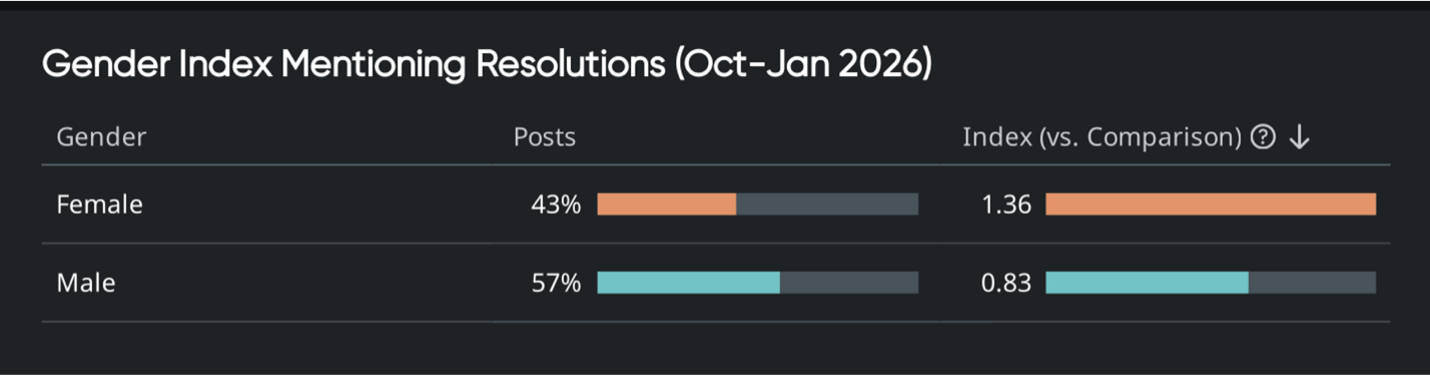
Gender splits inside the top themes, with the conversation over-indexing female:
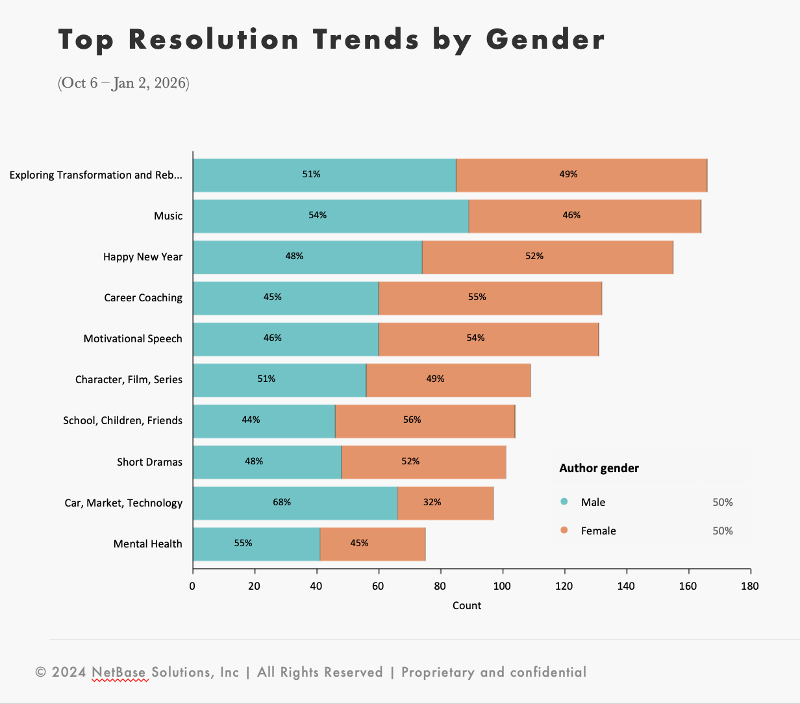
This chart shows theme-level gender balance, and it is not uniform. Notable splits visible in the bars:
Some “resolution purchase” themes behave like consumer categories, while others behave like culture and content clusters.
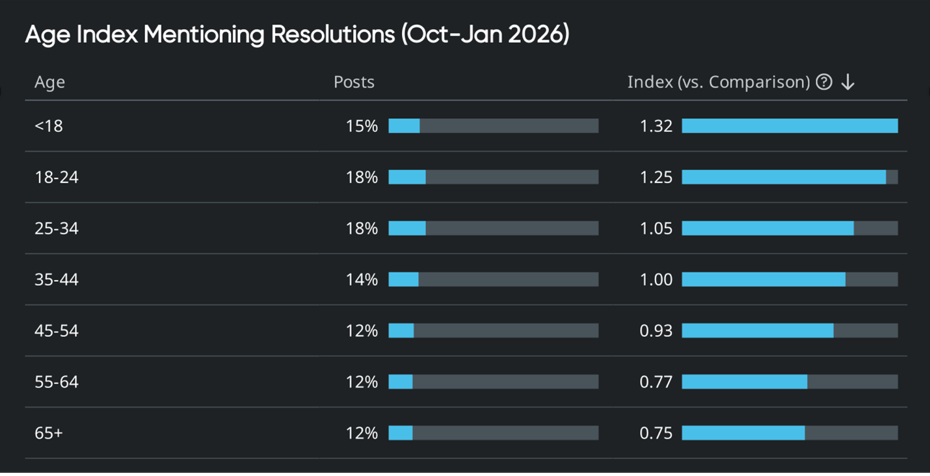
Age shows a clear skew younger:
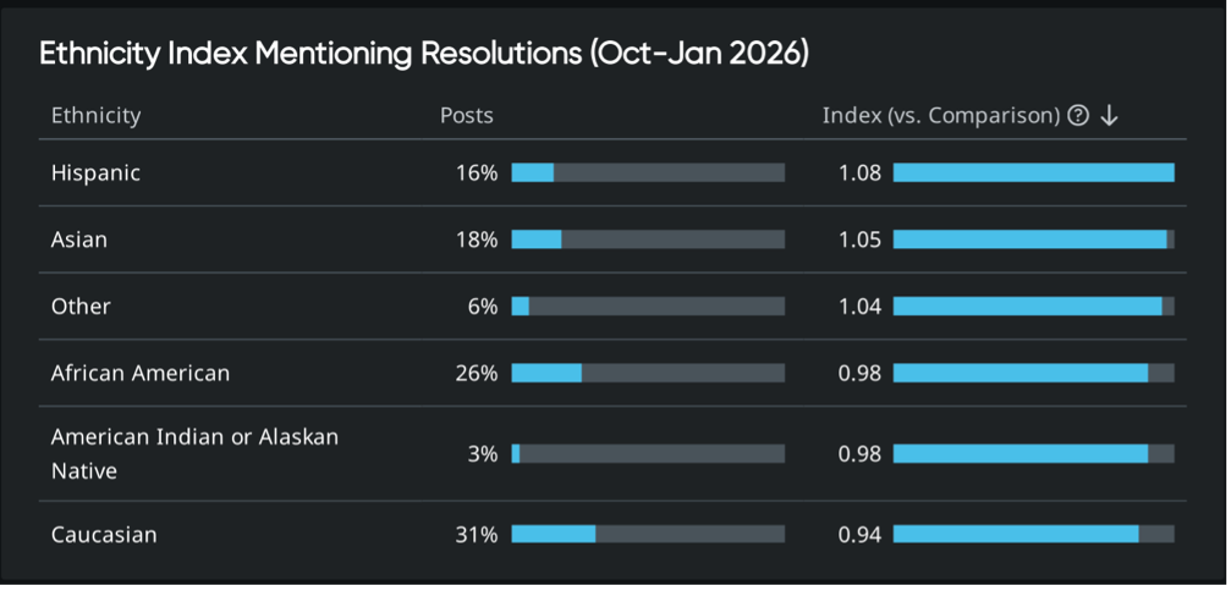
If you want to reach the most over-indexed groups by ethnicity, this image tells you where to aim:
What interests and professions show the strongest lift?
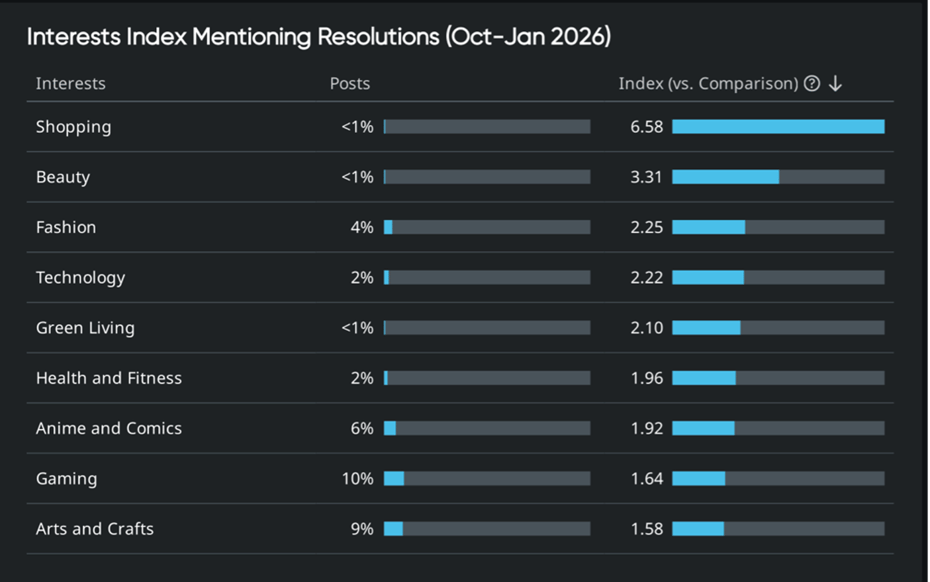
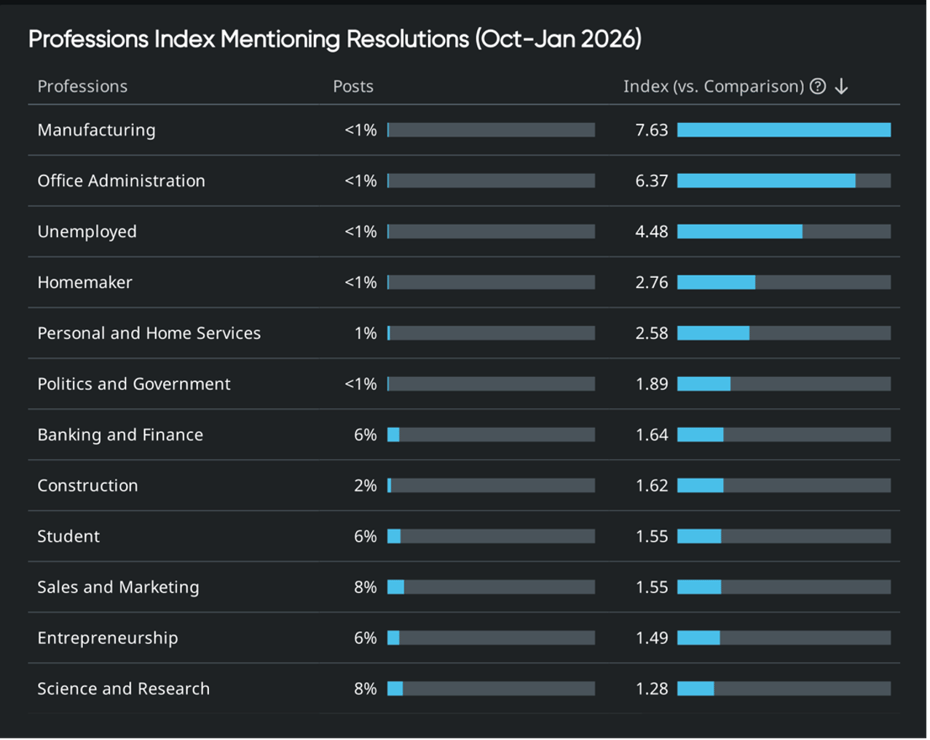
The indices show where this conversation over-indexes most strongly.
Interests
Professions
Resolution purchase talk clusters around stability, capability, and practical life management.
Consumers make a late December jump into January. Retail strategy should match that tempo. Taken together, the imagery points to a coherent story.
Resolution purchase conversation is:
There are a few practical implications to act on from the insight:
If you want consumers to stick around and buy more, reduce their uncertainty. Show them what works, and make the choice feel safe. And get all of this done by the end of the year going forward!
Reach out, and we’ll help you hit upcoming holiday deadlines ahead of competitors.