

.png?width=1252&height=362&name=QUID_Logo_WHITE%20(2).png)
.png?width=1380&name=template%20even%20text%20(3).png "<span id=\"hs_cos_wrapper_name\" class=\"hs_cos_wrapper hs_cos_wrapper_meta_field hs_cos_wrapper_type_text\" style=\"\" data-hs-cos-general-type=\"meta_field\" data-hs-cos-type=\"text\" >The Top Platforms For Market Trends & Consumer Insights</span>")
Market trends and consumer insights shape countless strategic decisions, from where to spend ad dollars to which product features to prioritize next quarter. Understand your market and audience well, and you're building campaigns, products, and strategies around what your customers actually want. Get it wrong, and you're pouring resources into guesswork.
But "market trends and consumer insights" covers a lot of ground. Figuring out which media channels your audience spends time on is one task; tracking the pain points they're voicing in online reviews and forums is another. Similarly, understanding where a market is headed quantitatively in terms of size and growth calls for different data than spotting the product trends slowly gaining traction.
That's why the platforms built to answer these questions vary so widely. Some specialize in social listening and sentiment. Some focus on survey-based consumer panels. Others center on transactional or behavioral data. The right one depends on what you're trying to learn.
Below, we break down the leading platforms for market and consumer intelligence, what each one does best, and how to think about which fits your use case.
Countless platforms promise to help you make sense of your market and customers. Here are ten worth knowing, each with its own angle on the problem. And since we're the ones writing this, we'll start with us!
For: Brand Monitoring, Competitive Analysis, Consumer Insights, Market Intelligence, Predictive Analytics, Product Innovation
Industries: Agencies & Consulting, Consumer Brands, Consumer Packaged Goods (CPG), Financial Services, Retail, Media & Entertainment, Pharmaceuticals, Travel & Hospitality, Government
Quid is an AI-powered consumer and market intelligence platform that helps you make sense of what’s happening in your market, from emerging consumer trends to shifting sentiment to competitor activity.

Quid draws from more than 2 petabytes of data through direct partnerships across social, search, news, broadcast, patents, and investment sources. That includes over 200 million daily social posts, 10 million daily news articles, a database covering 6 million public and private companies, and more. You can also layer in your own data, like customer feedback, CRM records, or search trends, to ground insights in your specific business context.
That data is organized into AI-ready datasets you can explore directly through visualizations and charts, or query in plain language through tools like Ask Q. Ask a question about changes in brand sentiment, customer feedback, or campaign performance, and Ask Q returns a grounded answer sourced from the live dataset.
For business leaders who need fast, confident answers rather than a full dive into the underlying data, Q Agents draw on Quid's full breadth of data to quickly conduct the multi-step analyses that teams find themselves running again and again.
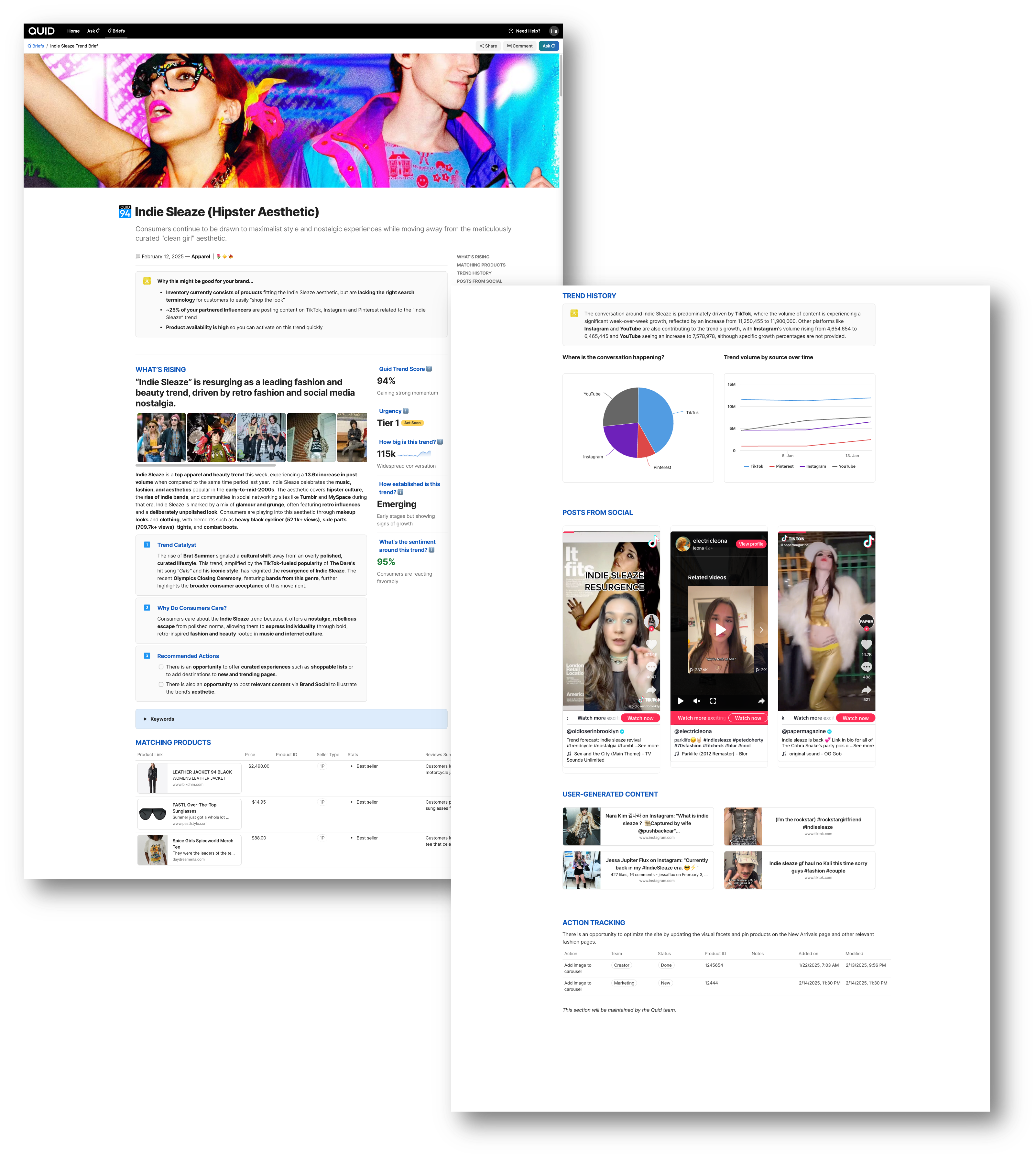
With more than 100 available, each Q agent is built around a specific business need, from SWOT analysis to patent insights. Define the topic or question you want explored, and an agent runs the analysis and returns a tailored brief, delivered straight to your Terminal and inbox. Instead of sifting through raw data, you get the signal without the noise: key takeaways, relevant trends, and the reasoning behind them, packaged in a format that’s easy to read, share, and act on.
Every dataset and AI agent adapts to your specific context, so the output reflects your goals rather than generic industry benchmarks. Quid also integrates with the tools your team already works in, so insights are accessible in the tools you use each day, from LLMs, messaging tools, BI platforms, and more.
For: Social Media Management, Consumer Intelligence, Influencer Marketing
Industries: Agencies, CPG, Financial Services, Media & Entertainment, Retail, Technology, Pharma & Healthcare, Education
Brandwatch is a social media management and consumer intelligence platform built around understanding what people are saying online and helping teams act on it. Its Consumer Intelligence product lets teams search millions of posts, comments, and conversations, then categorize them by feedback, complaints, opinions, and more.
Within that, Brandwatch Consumer Research applies AI to surface insights from more than 100 million online sources, helping teams answer specific questions.
Because Brandwatch is also a social media management and influencer marketing platform, insights can lead directly to execution. Brands can spot trends, then move into planning campaigns or identifying influencers to reach their audience from the same platform.
Platform limitations: Coverage centers on social and online conversation, so it does not extend to purchase behavior or market sizing, and advanced query building and dashboard customization carry a learning curve
For: Voice Of The Customer, Brand Monitoring, Crisis Management, Competitor Insights
Industries: CPG, Government, Financial Services, Retail, Technology, Communications, Travel & Hospitality
Sprinklr Insights is the consumer intelligence product within Sprinklr's broader Unified Customer Experience Management platform. It pulls real-time consumer, competitor, and market intelligence from more than 30 social and digital channels, plus over 400,000 media sources and a billion websites and review sites, and combines that with a brand's own owned data for a fuller view of customer feedback.
Built as part of a larger customer experience suite, Sprinklr Insights is best for teams that want consumer intelligence to feed directly into functions like crisis management or customer service. It's a fit for organizations managing customer experience across multiple channels and looking for a single platform to unify that data with real-time market and competitor insight.
Platform limitations: Insights is one module within a broader customer experience suite, and users describe setup and integration as complex and time-consuming
For: Shopper Behavior Analysis, Sales Measurement, Growth Planning, Retail Forecasting
Industries: CPG, Beauty, Beverage Alcohol, Packaging, Pet, Financial Services, Media, Public Sector, Retail, Small & Medium Business, Technology & Durables
NielsenIQ (NIQ) focuses on shopper and purchasing behavior, drawing on trillions of transactions to help brands understand how consumers actually buy. Its platform combines data, technology, and a team of analysts to turn that transaction volume into insights on buying patterns and where growth opportunities exist.
NIQ is geared toward understanding what's already happening in the market, like sales trends and category performance, rather than toward tracking online sentiment or conversation. This makes it a good option for CPG and retail brands that need a transaction-level view of their category.
Platform Limitations: Retail measurement depends on retailer participation, and exclusive data agreements mean every syndicator has coverage gaps.
For: Audience Profiling, Campaign Planning, Market Sizing, Consumer Segmentation
Industries: Agencies, Media, Sports, Gaming, Retail, Finance
GWI describes itself as a “flexible human insights” platform, built on survey responses from millions of consumers worldwide rather than scraped social or web data. It gives teams access to more than 250,000 profiling points, from interests and attitudes to buying habits, which can be used to build out a detailed picture of a target audience.
That survey-based approach makes GWI useful to teams building or refining audience personas for campaign targeting, especially when they need attitudinal or behavioral detail that's harder to infer from passive listening alone.
Platform limitations: Data is survey-based, so it reflects stated preferences rather than observed behavior, and Core is collected quarterly.
For: Audience Targeting, Identity Resolution, Privacy-Forward Data Sourcing, Marketing Activation
Industries: Alternative Financial Services, Advertising & Media, Automotive, Banks, Commercial Institutions, Credit Unions, Energy & Utilities, Fintech, Healthcare, Insurance, Mortgage, Public Sector, Rental Property, Telecommunications
Experian's consumer intelligence offering has two connected parts:
Together, these tools bridge the gap between who your audience is and how you reach them. This makes Experian ideal for companies that need that link between audience data and campaign execution, especially in regulated industries like financial services and healthcare, where data privacy and responsible sourcing are especially important.
Platform limitations: Oriented toward audience targeting and activation, and some attributes are inferred through statistical modeling rather than directly observed.
For: Survey-Based Market Research, Audience Profiling, Brand Sentiment Tracking
Industries: Agencies, Economy & Business, Entertainment, Arts, & Media, Health & Pharma, Policies & Current Affairs, Retail & Consumer, Society & Academia, Sports & Esports, Technology, Travel, Transport, & Automotive
YouGov centers on a panel of millions of registered members across 64 markets. It gathers data directly from people via surveys, revealing attitudes and opinions that might not surface in public conversation. It also draws on behavioral data like search activity, streaming habits, and shopping trips across roughly 18 million shopper journeys, connecting what people say to what they actually do.
That approach makes YouGov a strong option for teams that want survey-verified data, with consumer insights pulled from direct responses over time.
Platform limitations: The panel is opt-in and not itself representative, so results depend on sample matching and weighting.
For: Market Sizing, Industry Statistics, Data-Backed Research
Industries: Technology & Telecommunications, E-Commerce, Internet, Economy & Politics, Consumer Goods & MFCG, Transportation & Logistics, Society, Media, Finance & Insurance, Health, Pharma, & Medtech
Statista is a data-as-a-service company built around a massive library of statistics, reports, and insights spanning more than 80,000 topics and 50,000 sources across 170 industries. In addition to its own proprietary data, Statista aggregates and organizes existing research and figures, which makes it a helpful reference for market size, growth forecasts, and industry benchmarks.
Its platform includes Research AI, which combines LLM technology with Statista's data library, along with dedicated Consumer Insights and Market Insights tools covering consumer behavior and market forecasts across more than 150 countries. Statista is a good option for teams that need fast, citable statistics on market trends.
Platform limitations: Primarily aggregates third-party research, so verifying the original source falls to the user
For: Product Launch Tracking, Consumer Behavior Research, Market Trend Forecasting
Industries: Advertising & Marketing, Beauty & Personal Care, Education & Libraries, Financial Services, Food & Drink, Government, Household, Ingredients, Flavours, & Fragrances, Insurance, Media & Content Producers, Packaging, Retail, Sports, Gaming, & Entertainment, Technology, Travel & Tourism, TV, Phone, & Internet
Mintel has spent more than 50 years tracking consumer behavior and product launches, giving it a deep historical view of how markets evolve. Covering more than 270 consumer goods subcategories, it tracks 40,000 product launches a month across 86 economies and speaks with more than a million consumers across four continents.
That data is paired with a team of nearly 200 analysts and consultants who bring expert analysis and forward-looking perspectives. This makes Mintel a strong fit for those looking for expert-informed forecasting on where consumer behavior and product categories are headed.
Platform limitations: Reports follow a publishing cycle, and syndicated category research is typically updated annually or biannually.
For: Cross-Platform Media Measurement, Audience Analytics, Ad Planning & Evaluation
Industries: Automotive, CPG, Digital Media, Financial Services, Gaming, Local Media, Pharmaceutical, Political, Retail, Technology, Travel
Comscore helps brands and media companies plan, buy, and measure media across platforms. It's known as a third-party source for cross-platform measurement, verifying how many people actually saw or engaged with something, which can help teams decide where to spend ad dollars or verify that a campaign worked.
The platform combines viewership data from digital, linear TV, and streaming with audience insights, so media buyers and sellers can see how people behave across screens instead of looking at each channel on its own. Tracked over time, that data also reveals shifting habits, such as audiences migrating from cable to streaming. For anyone trying to understand audience behavior on media channels at scale, particularly for ad planning and measurement, Comscore provides a useful piece of the picture.
Platform limitations: Focused on media exposure rather than consumer opinion, and privacy changes can affect deterministic linking and panel completeness.
Now that we’ve covered some of the leading platforms, how do you decide which one is actually right for your team? There’s no single best platform for every business, so the right choice depends on what you want to understand, what data you need, and how easily your team can turn those insights into action.
Ultimately, the platform you choose should fit the way your team actually makes decisions. Once you know what you need to learn, what data you need to get there, and how your team will use the insights, the right choice becomes much easier.
Understanding market trends and consumer insights is less about having more data and more about being able to make sense of what’s happening across it. With the right platform, you can connect the dots between consumer conversations, emerging trends, competitive moves, and other signals that might otherwise be difficult to piece together.
If you’re looking for a consumer and market intelligence platform that brings a broad range of data together and helps you get from question to actionable insight faster, Quid is built for that. With AI-powered analysis tools and outputs that surface the trends and recommendations that matter, Quid helps turn complex market intelligence into something your team can actually use.
A market trends and consumer insights platform aggregates data that helps businesses understand markets, customers, competitors, and changing consumer behavior.
Market trends platforms may use social media, surveys, transactions, search data, news, reviews, media data, and other market sources.
Consumer insights platforms can help businesses understand customer attitudes, behaviors, needs, preferences, sentiment, and how they change over time.
A business should consider its research goals, data needs, industry, audience, analytics skills, and how easily insights can be shared and used.
Market intelligence looks at the broader market, including competitors, trends, and growth. Consumer insights focus more closely on what customers think, want, and do.