

.png?width=1252&height=362&name=QUID_Logo_WHITE%20(2).png)
.png?width=1380&name=minimalism%20fatigue%20(1).png "<span id=\"hs_cos_wrapper_name\" class=\"hs_cos_wrapper hs_cos_wrapper_meta_field hs_cos_wrapper_type_text\" style=\"\" data-hs-cos-general-type=\"meta_field\" data-hs-cos-type=\"text\" >What 537 Million Conversations Are Actually Telling You About Pride 2026</span>")
Pride 2026 Is Fragmented, Commercialized, and Still Deeply Community-Driven
Pride Month 2026 is generating massive engagement before June has even fully begun. But the conversation is no longer operating as a single cultural moment. It is splitting across celebration, commerce, politics, local activism, creator culture, and backlash at the same time.
That fragmentation means brands trying to approach Pride with a single universal message are increasingly colliding with audiences that expect specificity, consistency, and measurable action.
Quid’s analysis shows a conversation environment that is highly visible, emotionally layered, commercially active, and politically contested all at once. A standard search can surface headlines. Quid maps how those narratives connect, where they diverge, and which tensions are driving engagement underneath the surface.
The sentiment breakdown is one of the clearest indicators in the dataset.
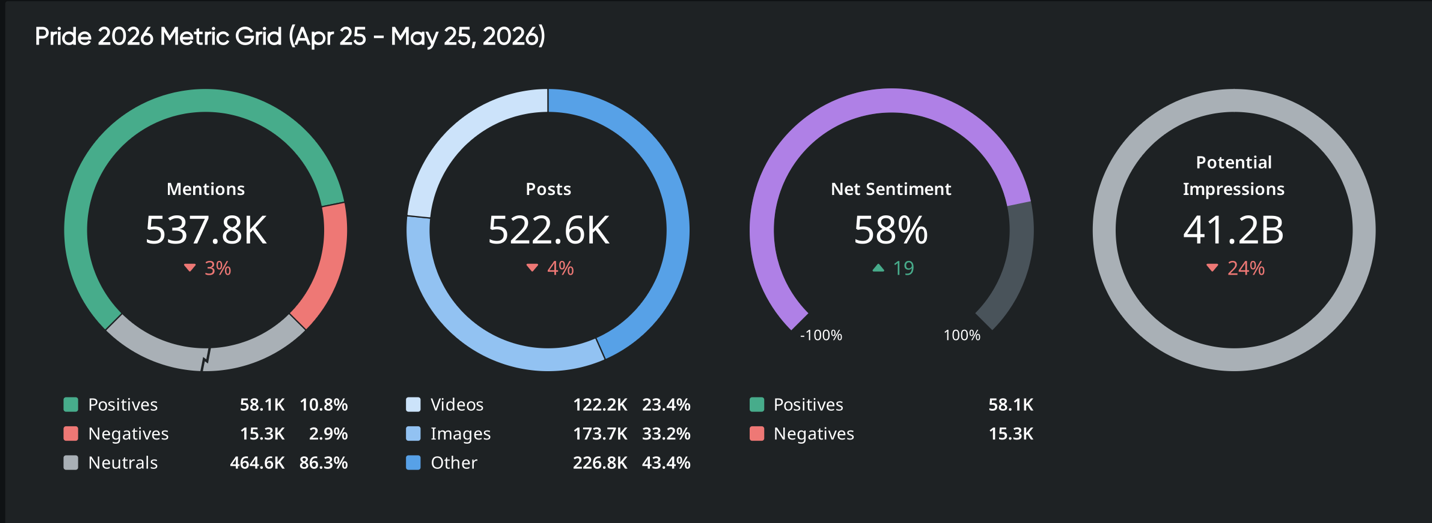
Positive sentiment accounts for 10.8% of conversation. Negative sentiment sits at just 2.9%. But the dominant category by a massive margin is neutral conversation at 86.3%.
That changes how Pride should be interpreted strategically.
The conversation is no longer functioning primarily as a reactive cultural flashpoint. It is behaving more like an established seasonal ecosystem woven into entertainment, local events, commerce, creator content, and consumer routines. That normalization also explains why brands are facing more scrutiny, not less.
Once something becomes structurally mainstream, audiences stop reacting to mere participation. They start evaluating execution.
One of the clearest narrative splits in the Quid data involves corporate Pride visibility.
Some companies are increasing activations through products, events, and branded experiences. Others are scaling back visible symbolism while still attempting to maintain support messaging behind the scenes.
Philz Coffee's removal (and then return) of Pride flags while maintaining Pride programming became a flashpoint. Apple’s Pride Collection rollout generated mainstream consumer coverage. Brands like Bombas tied products to measurable donations.
The distinction is important, as consumers increasingly separate:
Those are no longer treated as interchangeable.
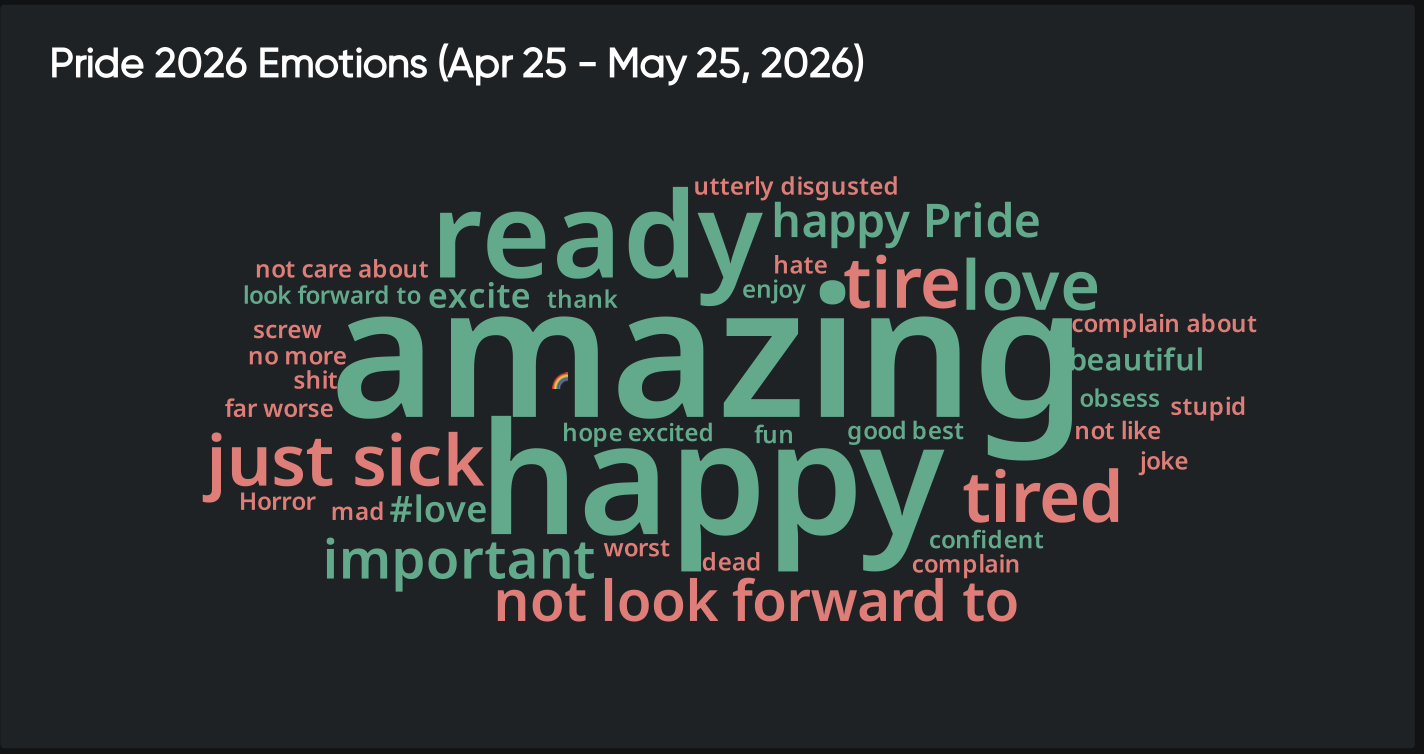
The emotional dataset itself reflects this tension. Positive emotional terms like “happy,” “love,” “excited,” and “beautiful” coexist beside “tired,” “complain,” “hate,” “utterly disgusted,” and “not look forward to.”
That overlap is important because it demonstrates how Pride conversation now contains multiple parallel realities operating simultaneously depending on audience cluster, geography, platform, and political context.
That coexistence is exactly why Pride campaigns now carry higher reputational complexity. Celebration, community support, political backlash, corporate marketing, and cultural debate are all operating within the same conversation environment, often at the same time and around the same brands.
The strongest positive engagement patterns are increasingly tied to community-rooted participation rather than large-scale brand messaging.
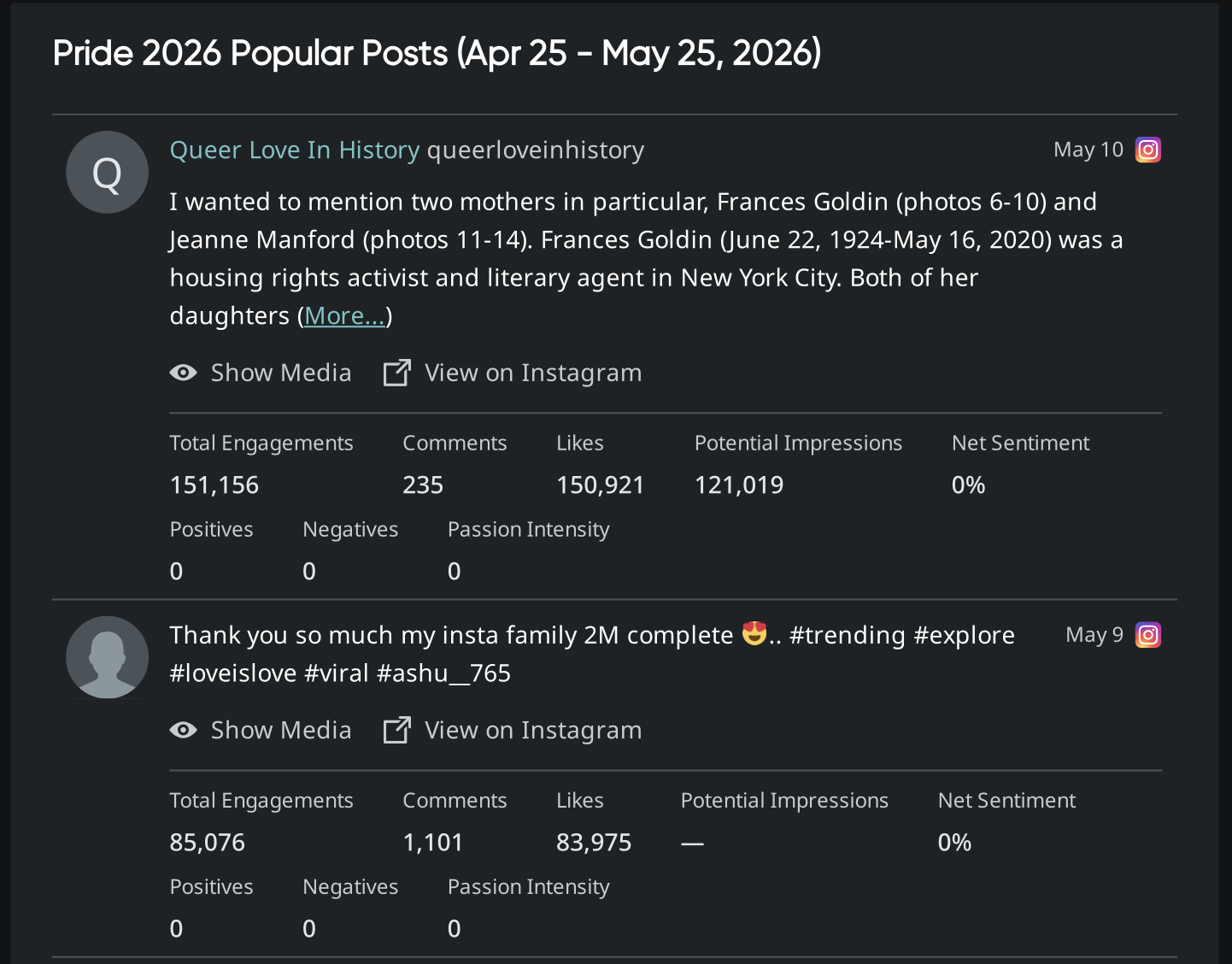
The Quid dataset highlights strong engagement around:
TikTok conversation especially reinforces this pattern. Many of the highest-engagement conversations involve:
This reveals where trust is concentrating. Large campaigns may generate visibility. Smaller community activations increasingly generate credibility.
One of the most important strategic insights in the Quid analysis is the level of ecosystem fragmentation. The conversation now spans:
That fragmentation changes how brands should evaluate risk.
Messaging that performs well in one audience cluster may fail entirely in another. A Pride activation tied to entertainment or creator culture behaves very differently than one tied to workplace policy or regional politics.
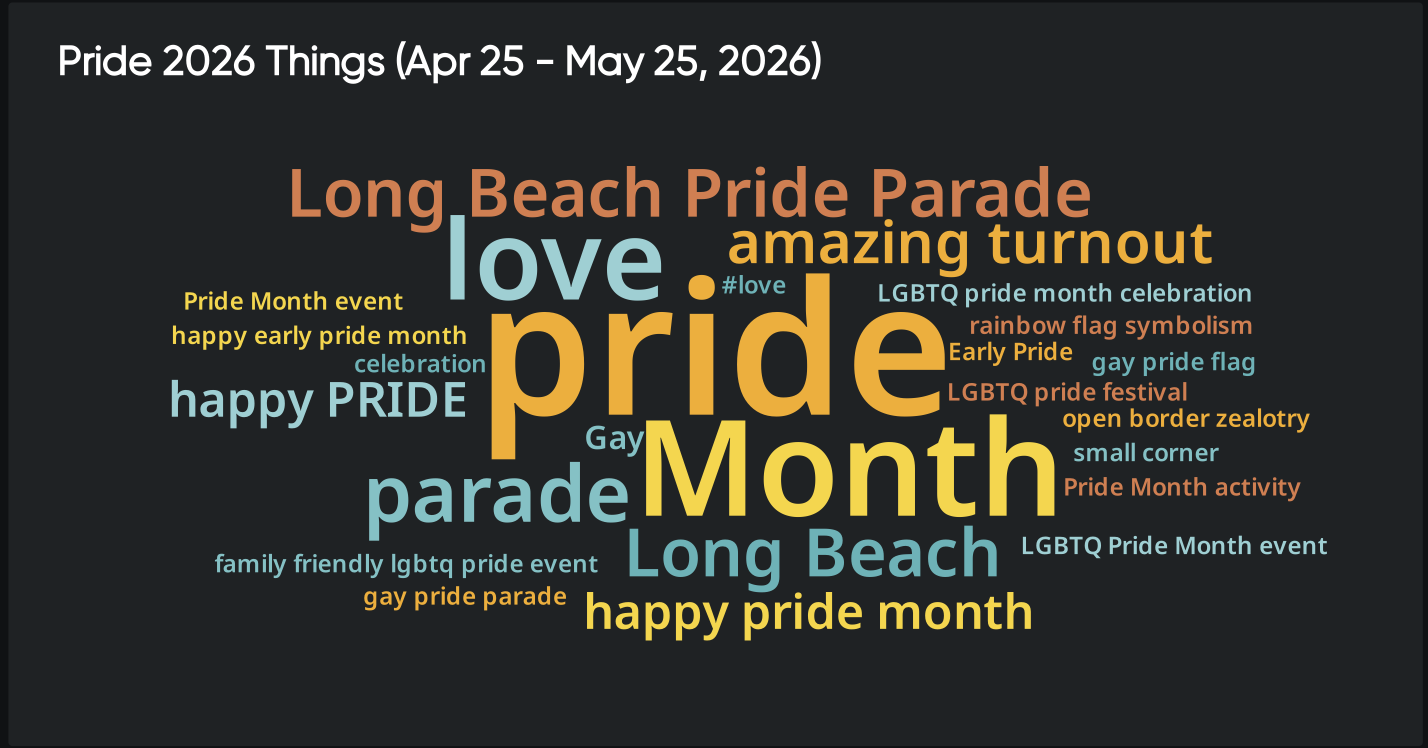
Our “Pride 2026 Things” word cloud image demonstrates how the conversation spans celebrations, parades, symbolism, family-friendly events, and political language simultaneously. Terms like “celebration,” “parade,” “happy pride month,” and “family-friendly LGBTQ pride event” coexist beside “rainbow flag symbolism” and “open border zealotry.”
That coexistence is exactly why regional context matters more in 2026 than broad national messaging.
The conversation surrounding Pride is increasingly driven by adjacent cultural ecosystems.
Sports controversies involving athletes’ comments and teams’ responses are creating major moments of amplification. Entertainment releases, Pride-themed events, TV representation, and fandom discussions are extending visibility beyond traditional Pride marketing windows.
TikTok discussion around:
This is especially important because younger audiences increasingly encounter Pride conversation through creators, fandoms, and entertainment first, not corporate campaigns.
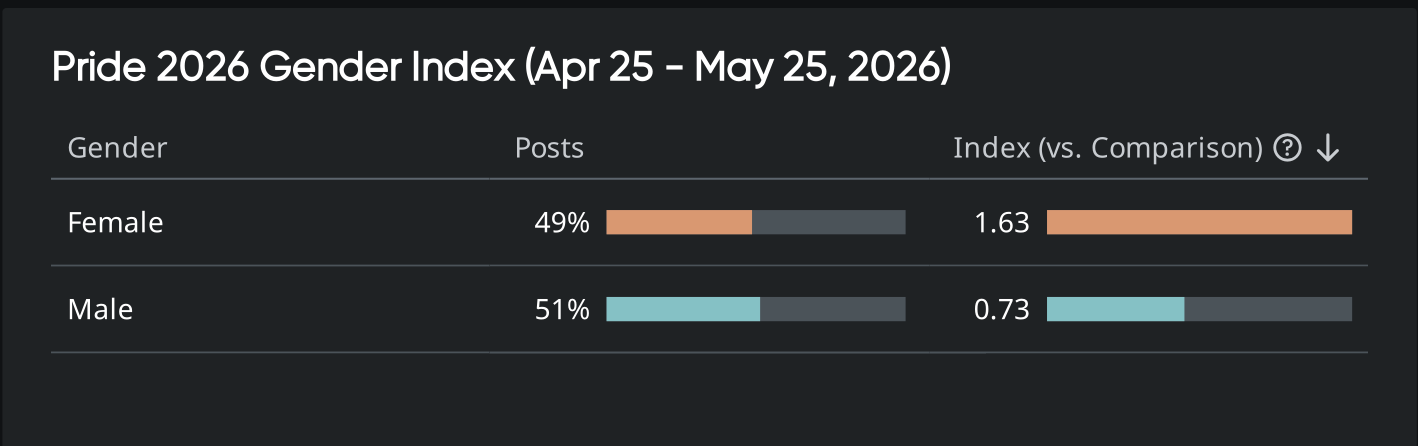
The audience distribution reinforces how mainstream the conversation has become.
The gender split is nearly even at 49% female and 51% male participation.
Age participation is also distributed broadly across groups rather than concentrated entirely among younger users. While younger demographics over-index slightly, the conversation spans multiple age ranges consistently.
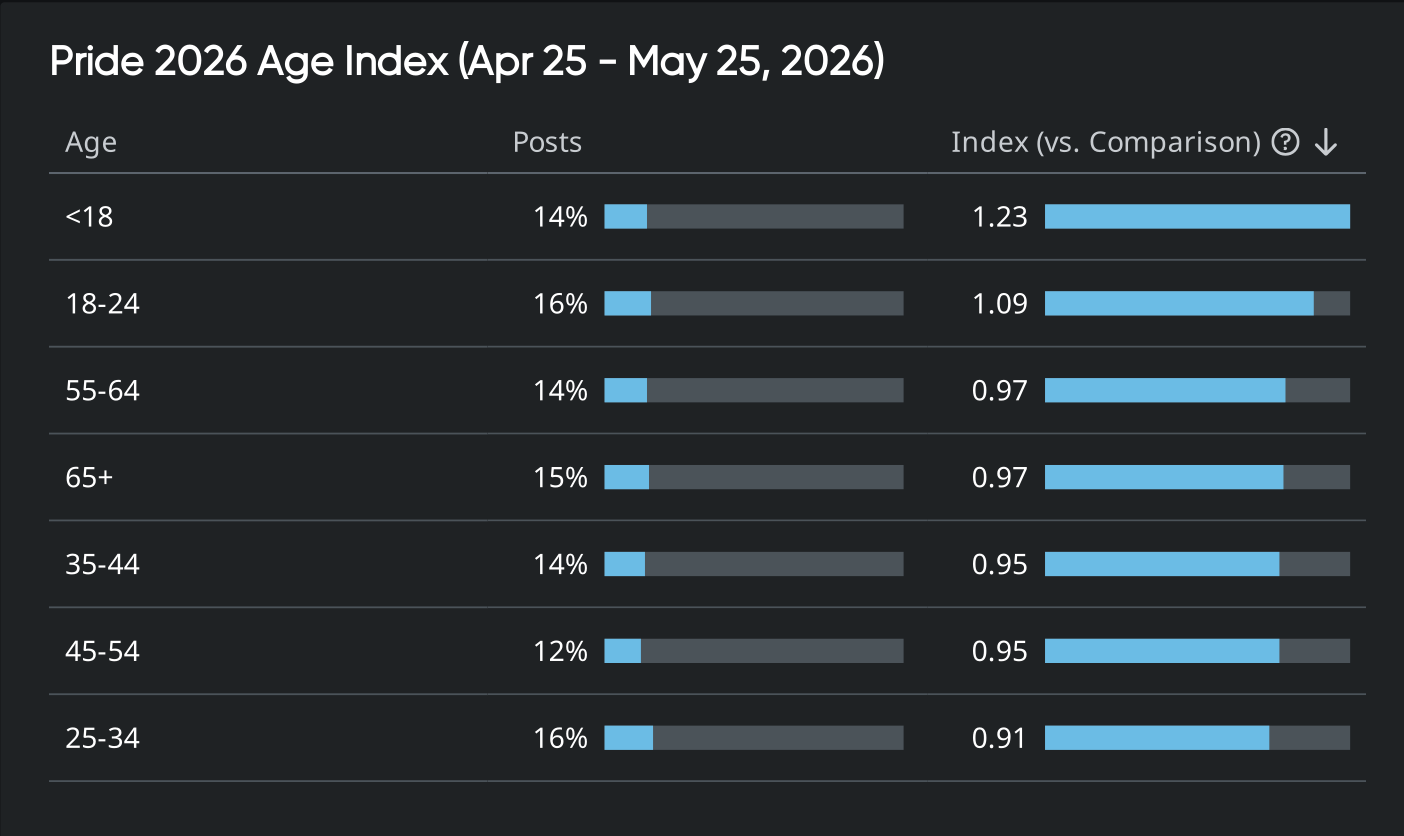
That broad participation helps explain why Pride now behaves less like a niche campaign period and more like a major seasonal cultural environment with national visibility.
The biggest strategic mistake brands can make in 2026 is assuming visibility alone creates trust. The data points somewhere more nuanced:
Quid reveals something traditional searches often miss. The conversation is not moving in one direction. It is splitting into interconnected narrative systems operating simultaneously across politics, commerce, identity, entertainment, activism, and creator culture. Understanding where those systems overlap is what allows brands to respond strategically instead of reactively.
Because by the time backlash trends publicly, the underlying audience shifts usually started much earlier. The internet loves pretending outrage appears out of nowhere. In reality, most reputation shifts leak slowly before they explode loudly. Quid simply lets brands see the pressure building before the pipe bursts. Reach out today, and we’ll help you stay ahead of the conversation, wherever it leads!