

.png?width=1252&height=362&name=QUID_Logo_WHITE%20(2).png)
.png?width=1380&name=template%20even%20text%20(19).png "<span id=\"hs_cos_wrapper_name\" class=\"hs_cos_wrapper hs_cos_wrapper_meta_field hs_cos_wrapper_type_text\" style=\"\" data-hs-cos-general-type=\"meta_field\" data-hs-cos-type=\"text\" >What Halloween Reveals About Brands' Cultural Relevance</span>")
Halloween gives consumers permission to borrow, remix and recreate culture.
A recognizable character can become a costume and a popular product can end up in a treat bag. Retailers can become part of the annual hunt for decorations, and entertainment franchises can move from screens into parties, attractions, and Halloween experiences.
For brands, those appearances can look like evidence of cultural relevance. But Quid's analysis of Halloween conversation shows why marketers should look beyond mentions before drawing that conclusion.
The first answer is often the easiest one to find. Cultural intelligence requires going beneath it to understand what created the signal, how widely the behavior appears and whether consumers or brands are driving it.
How much Halloween conversation did Quid analyze?
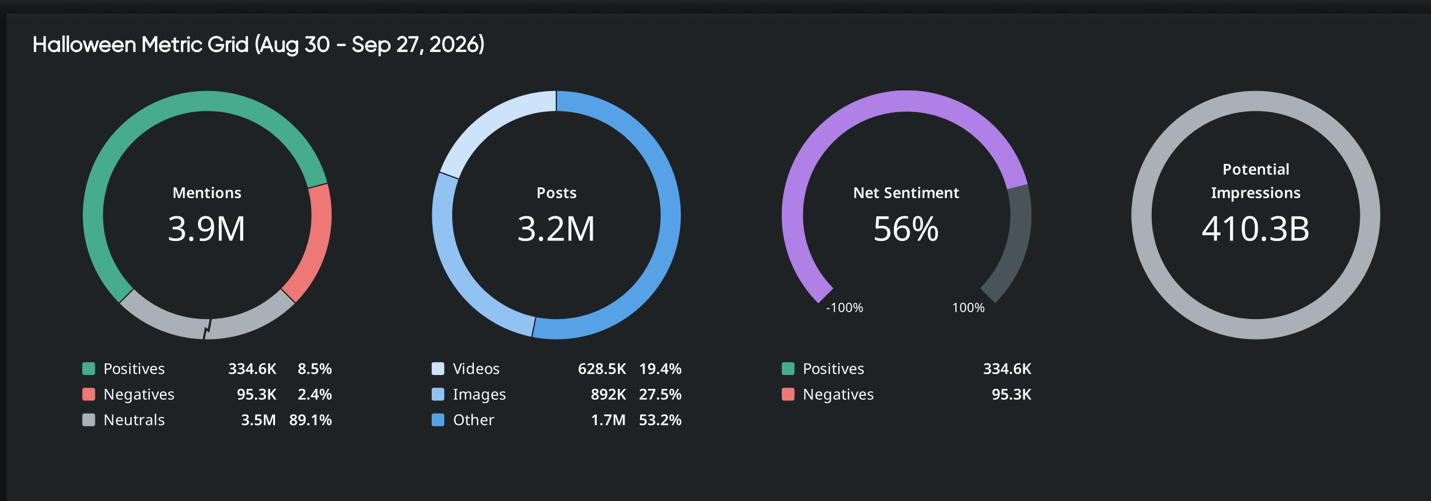
Between August 30 and September 27, 2026, Quid identified 3.9 million mentions across 3.2 million posts in the analyzed Halloween conversation.
Which brands and properties appear in Halloween conversation?
The brand analysis surfaces names including Disney, Walmart, Amazon, Etsy, Universal Studios Hollywood, Disneyland, Wayfair, Fortnite, Target, Roblox, Five Nights at Freddy's and Resident Evil.
Does a high number of mentions prove cultural relevance?
No. A brand can appear because of advertising, retail listings, news coverage, branded events, consumer posts or other activity. The underlying context determines what the mention means.
What is a stronger signal of consumer participation?
Posts showing consumers actively wearing, making, using, gifting or incorporating branded products or intellectual property into Halloween provide more direct evidence of participation than brand mentions alone.
Why should marketers distinguish the two?
Without examining context, high-volume conversation can make promotional visibility and consumer-led adoption look like the same behavior.
The Halloween DIY conversation generated 410.3 billion potential impressions:
Within that enormous conversation, brands, retailers, entertainment properties and platforms appear everywhere. The more important question is how they got there.
The brand landscape is broad. Quid's brand word cloud includes major retailers such as Walmart, Amazon, Etsy, Wayfair and Target alongside Disney, Disneyland, Universal Studios Hollywood, Universal Orlando, Fortnite, Roblox, Five Nights at Freddy's and Resident Evil. Social and media platforms also appear prominently.
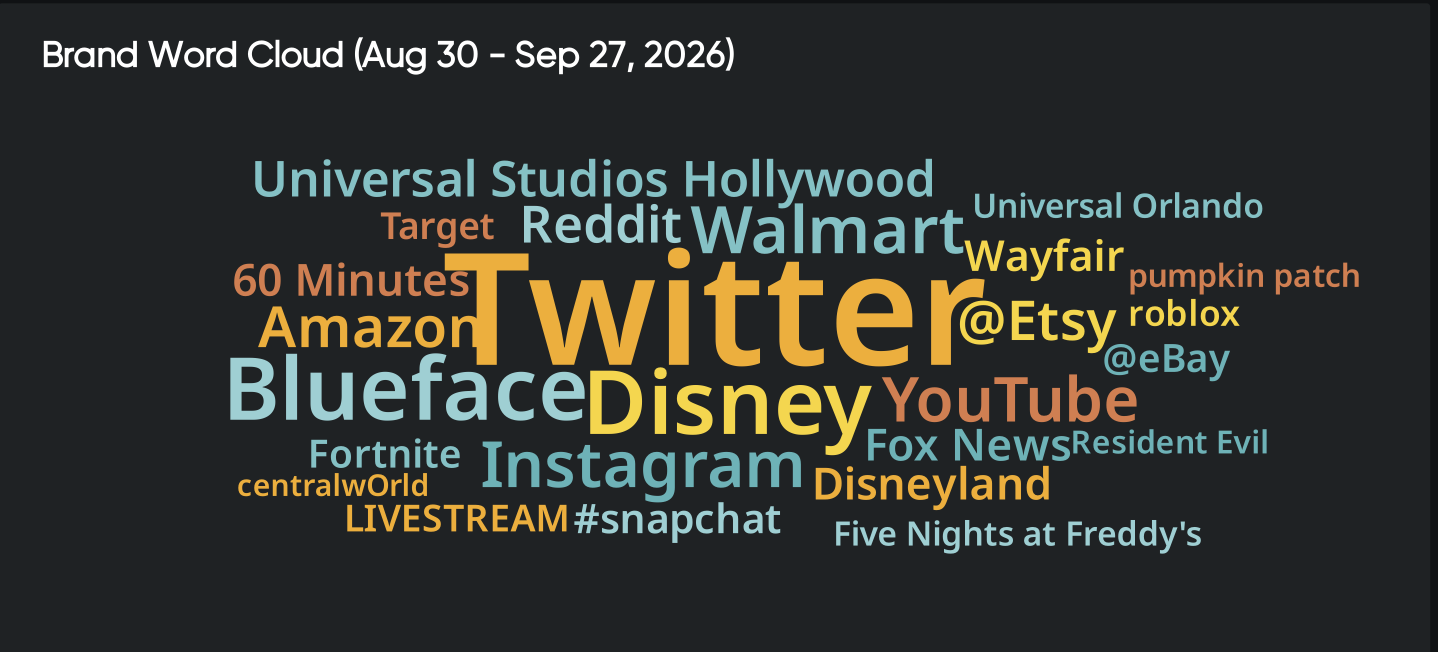
That variety is useful because it immediately exposes a problem with using brand mentions as a proxy for relevance. A retailer selling Halloween products, an entertainment property appearing in costume conversation and a consumer incorporating a product into a homemade Halloween creation can all generate brand mentions. Those mentions represent very different relationships with the season, though.
For marketers, the useful signal comes from understanding the behavior behind the name. This is where large-scale cultural intelligence becomes valuable.
Quid allows analysts to move from millions of conversations to the clusters, entities and underlying posts producing a signal, then examine those sources in context. A surface-level summary can identify that a brand is appearing. The deeper analysis reveals why.
Some of the clearest examples in the underlying conversation involve consumers incorporating branded products or intellectual property into Halloween activities.
One consumer described purchasing Lowe's glow-in-the-dark Halloween buckets while talking about trick-or-treating. Another Halloween Boo Bag included Ghost Face Fanta and Alani Nu Witches Brew alongside other treats and merchandise.
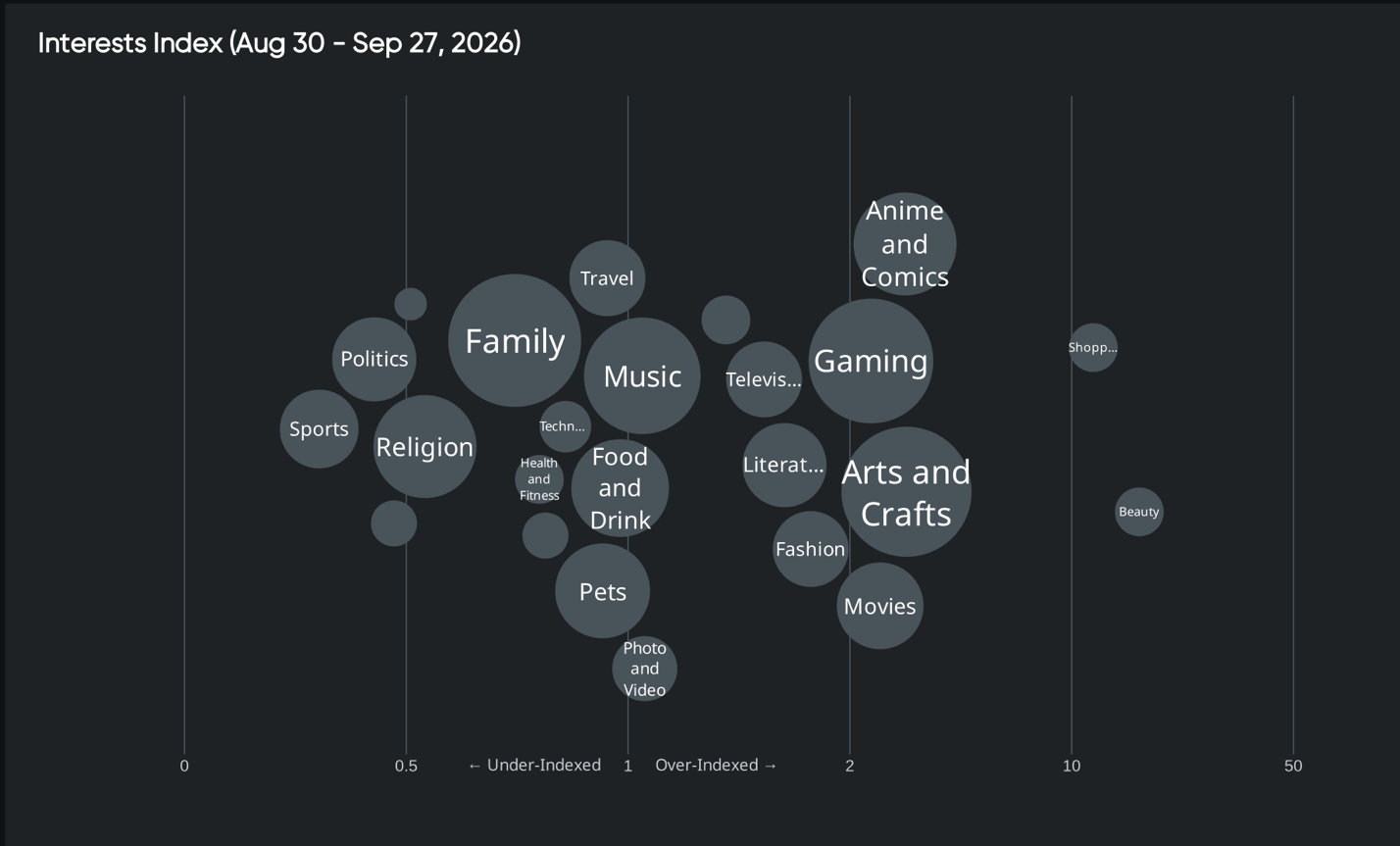
Craft content provides another form of participation. One post described creating Halloween treat bags using Tim Holtz seasonal Halloween prints. Audience context adds another layer, with arts and crafts among the interests that over-index in this Halloween conversation.
These are small qualitative examples rather than evidence of broad trends. But they demonstrate the type of behavior marketers should look for, because the product has become part of what the consumer is doing:
Costumes seem like an obvious way to identify brands with cultural relevance, but raw social volume can be misleading.
Quid surfaced a large cluster around the Pink Power Ranger, with 8,890 posts from 5,779 authors. At first glance, that could look like strong evidence of a costume trend. Closer examination changed the interpretation.
The available example came from a widely circulated political anecdote in which a parent recalled wearing a Pink Power Ranger costume while trick-or-treating with her children. The surrounding conversation amplified that story rather than providing clear evidence of thousands of consumers independently choosing Pink Power Ranger costumes.
That distinction is the difference between valuable marketing intel and wildly misleading data. High conversation volume can originate from one story spreading across a network. Before marketers interpret a character, product or brand as a consumer trend, they need to understand what generated the cluster.
This is also where relying on generative AI alone can create problems. An AI tool asked to summarize a dataset may accurately report that the Pink Power Ranger appeared in 8,890 posts. Given only that aggregate result, however, it lacks the evidence needed to determine what produced those posts. Quid provides the ability to investigate the conversation beneath the metric, examine the source material and test whether an apparent trend survives closer scrutiny.
In this case, that additional investigation changed the finding. What initially looked like thousands of costume signals traced back, in the available evidence, to amplification around a specific story. The more useful insight came from challenging the obvious answer.
Halloween experiences create another important distinction. Disney appears in the broader brand conversation, and one consumer post described attending Mickey's Not-So-Scary Halloween Party, including seeing characters in costume, watching the parade and fireworks, trick-or-treating, buying merchandise and attending the Hocus Pocus show.
That is real consumer participation. But it takes place inside a Disney-created experience.
The same issue applies to entertainment properties incorporated into branded attractions. A franchise appearing in a licensed haunted maze demonstrates visibility and partnership activity. It does not, on its own, demonstrate that consumers are independently recreating that franchise in their own Halloween celebrations.
For brands trying to measure cultural relevance, separating brand-created participation from consumer-created participation gives the data much more meaning.
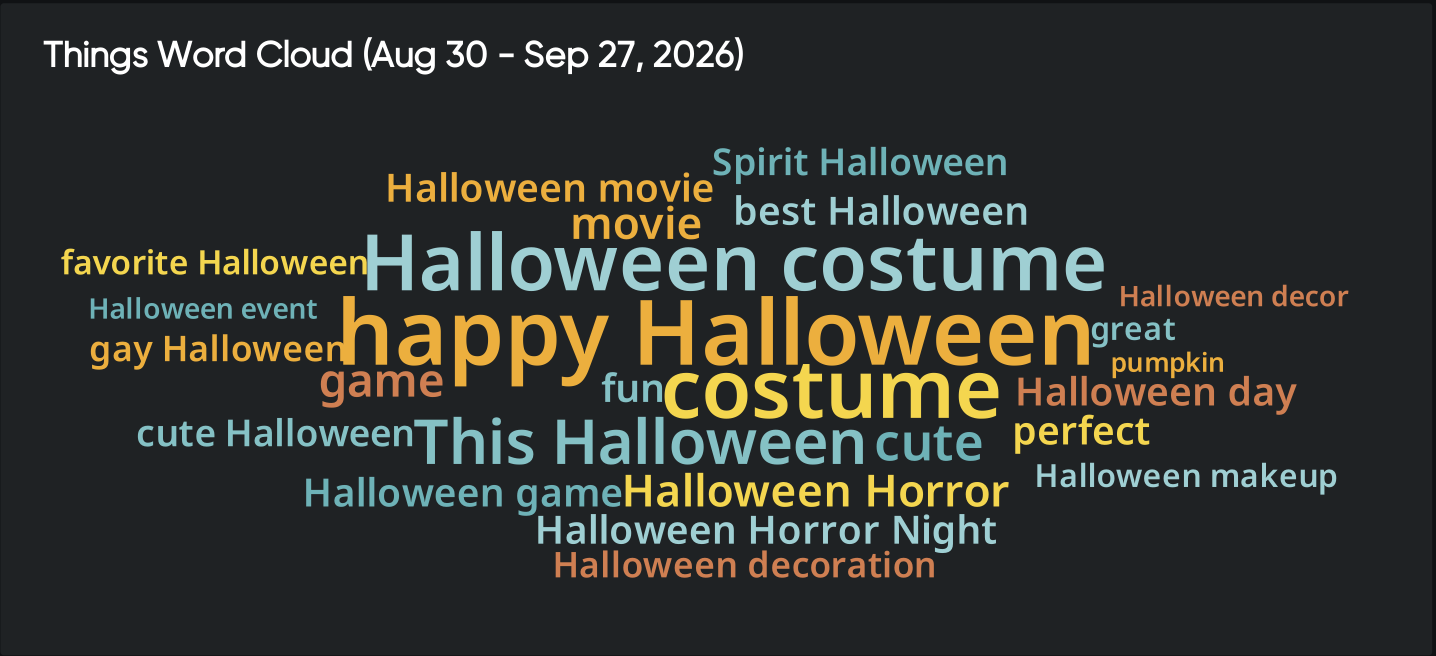
The broader conversation reinforces just how many forms Halloween participation can take. Costume, Halloween costume, Halloween movie, Halloween Horror Night, Spirit Halloween, Halloween decoration, Halloween makeup, Halloween events and Halloween decor all emerge in Quid's analysis.
The strongest Halloween signal is not simply whether a brand appears. Brands should examine how consumers interact with it. A useful framework is to separate Halloween visibility into progressively more participatory behaviors:
The last two categories can provide particularly useful evidence because the consumer has made the brand part of their own Halloween behavior.
They also require closer analysis. A word cloud, mention count or AI-generated summary cannot establish that distinction by itself. Analysts need access to the underlying conversation so they can move between macro patterns and individual evidence, separate amplification from independent behavior and test whether a seemingly important signal holds up under examination.
Quid makes that movement between scale and context possible. Instead of stopping at what appears most often, teams can investigate the structure beneath the conversation and determine what the data supports.
Halloween provides an unusually visible example of a larger challenge in cultural intelligence. Brands can measure enormous quantities of conversation. The harder and more valuable task is determining what those conversations represent.
Generative AI makes it faster than ever to summarize information, identify themes and ask questions of data. Those capabilities are valuable, but the quality of the answer still depends on the evidence available to the model.
When marketers need to know whether millions of posts represent thousands of independent consumer behaviors, one amplified story or brand-generated activity, they need visibility into the underlying conversation.
The Halloween data includes 892,000 image posts and 628,500 video posts during the analyzed period. That makes visual and contextual analysis especially important when consumers communicate through costumes, decorations, crafts and experiences that may reveal more than the accompanying caption.
Cultural relevance emerges through context. For marketers, the opportunity is to move beyond asking “Are people talking about us?” and start examining “What are people doing with us?”
Quid gives teams the ability to ask that second question at scale, trace the answer back to the conversations producing it and challenge apparent trends before they become marketing assumptions. That is where social conversation becomes cultural intelligence.
Contact Quid today to uncover how consumers are incorporating brands, products and cultural properties into the moments that matter.
What does cultural relevance mean in Halloween social data?
For this analysis, the strongest evidence comes from the context in which brands appear, particularly when consumers actively incorporate brands, products or intellectual property into Halloween activities.
Can brand mentions measure cultural relevance?
Mentions measure visibility. Additional analysis is necessary to determine whether those mentions come from advertising, news, branded experiences, retail activity or consumer-led participation.
Can generative AI identify cultural trends from social data?
Generative AI can help summarize data, identify themes and surface potential patterns, but its conclusions depend on the evidence available to it. Cultural intelligence requires access to the underlying conversation to determine what produced a signal, distinguish independent behavior from amplification and test whether an apparent trend holds up in context.
Why are DIY costumes useful to marketers?
DIY and consumer-created costumes can show that people recognize and reinterpret a brand, character or cultural property. Individual examples should not be treated as broad trends without supporting volume and independent examples.
What can brands learn from trick-or-treat and party content?
These conversations can reveal products consumers incorporate into activities such as treat bags, gifting, decorations and celebrations. They also help distinguish product use from general brand discussion.
How can brands identify stronger Halloween signals?
Look beyond total mentions to the underlying posts. Separate brand-led promotion from consumer use and consumer creation, then examine whether the behavior appears repeatedly across independent consumers and activities.