

.png?width=1252&height=362&name=QUID_Logo_WHITE%20(2).png)
Search doesn't work the way it used to. More often than not, consumers are getting their answer directly from ChatGPT or an AI Overview and never click through to a website at all. That shift is why AEO, or answer engine optimization, has become so important.

AEO is the practice of optimizing your content so LLMs and AI-powered search tools mention or cite you as a source when they generate those answers. That's a meaningfully different goal than ranking on a search results page. Ranking gets you in front of someone willing to click. Citation gets you mentioned in the answer itself, whether or not anyone clicks anywhere at all.
For brands, that distinction matters. If you're not being mentioned in those answers, your visibility probably isn't what you think it is. And unlike SEO, where you can check your keyword rankings and know exactly where you stand, AEO success is harder to assess.
So what does drive AEO success? And how is it different from what you're already doing for SEO? Let’s get into it.
While you don't need a study to feel the shift in search behavior, the numbers make it concrete. According to McKinsey, half of Google searches already surface an AI-generated summary, and that share is projected to climb past 75% by 2028. Zoom out further, and AI tools are now generating an estimated 45 billion monthly sessions worldwide, or roughly 56% of global search engine volume.
Most of that activity seems to be happening inside Google itself. According to a study conducted by Previsible, Google’s AI Overviews and AI Mode drive more AI-influenced traffic than every standalone LLM assistant combined. Among the assistants people query directly, ChatGPT dominates, accounting for over 92% of trackable referral traffic, with Gemini as the second most visible model.
The good news is you're not starting from zero. Google and ChatGPT dominate the way you'd probably expect, so you're not learning a whole new set of platforms from scratch. But familiar platforms don't mean familiar rules; showing up in an AI-generated answer takes a different approach than ranking on a results page.
SEO is centered around search terms, with keyword and phrase matching being a major factor in how engines rank content. On the other hand, AEO is built around answers. LLMs are trying to construct the right answer, and they favor claims that show up consistently across multiple sources over ones that only appear in a single place. Consensus matters more than any one source being loud about itself.
That leads to some meaningful implications:
Together, these differences mean the tactics that earned you rankings won't automatically earn you citations. So what actually moves the needle for citations?
While there’s no confirmed formula for earning a citation in AI-generated answers, enough patterns have emerged to point to a few factors worth focusing your AEO strategy on:
That said, this isn't a foolproof science. The logic underlying AI search tools isn't public, so most of what we know about how LLMs like ChatGPT, Gemini, Mistral, and Deepseek cite sources comes from observation, not confirmed rules.
From what's been observed, different AI platforms don't all do it the same way. A page cited constantly on one might barely register on another. That means there’s no single, universal AEO strategy, which is why keeping an eye on where you actually stand, platform by platform, matters so much.
Knowing what drives citations is one thing. Knowing whether it's actually working for your brand is another challenge entirely.
With SEO, you can check your ranking for a given keyword and get a clear answer. But AEO doesn't offer that kind of single source of truth. Your positioning might look completely different depending on which LLM someone asks. Checking one platform only gives you a fragment of the big picture, and that fragment might not represent how you're showing up everywhere else.
That's the gap Quid's AEO Agent is built for. Given a brand or product and its category context, the agent surfaces how that brand is actually being described across LLMs, social media, and search, all at once. In other words, it gives you a consolidated view of a brand or product’s visibility, along with how it stacks up against competitors and where the gaps sit.
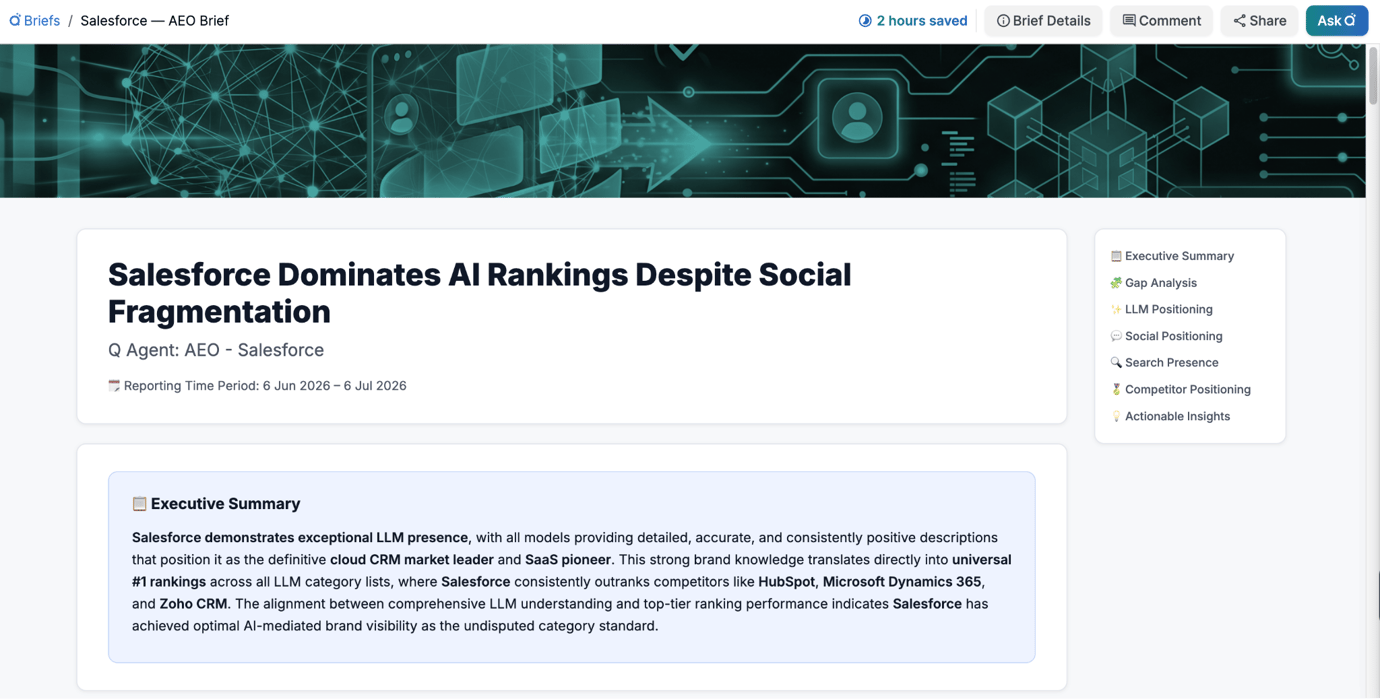
Here's what that looks like in practice. Take this sample brief on Salesforce. The executive summary gives you the headline finding first — in this case, that Salesforce demonstrates exceptional LLM presence across all models. That's the kind of answer you'd otherwise have to piece together yourself, one platform at a time.
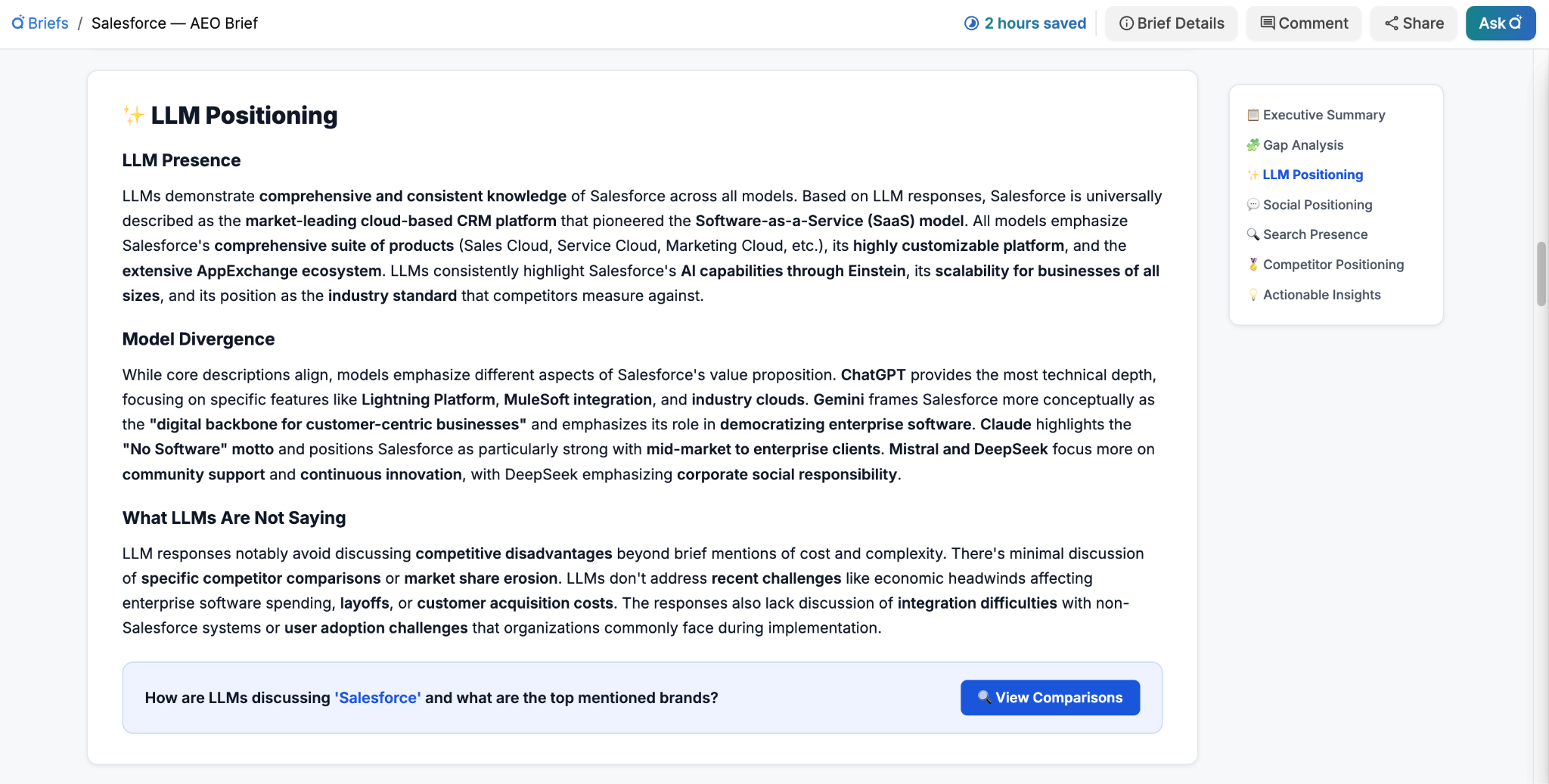
The brief also breaks down how Salesforce is actually being described in LLM responses, including where models agree, where they diverge, and what they leave out. With these insights, you can quickly identify whether your intended positioning is actually coming through and where the gaps are.
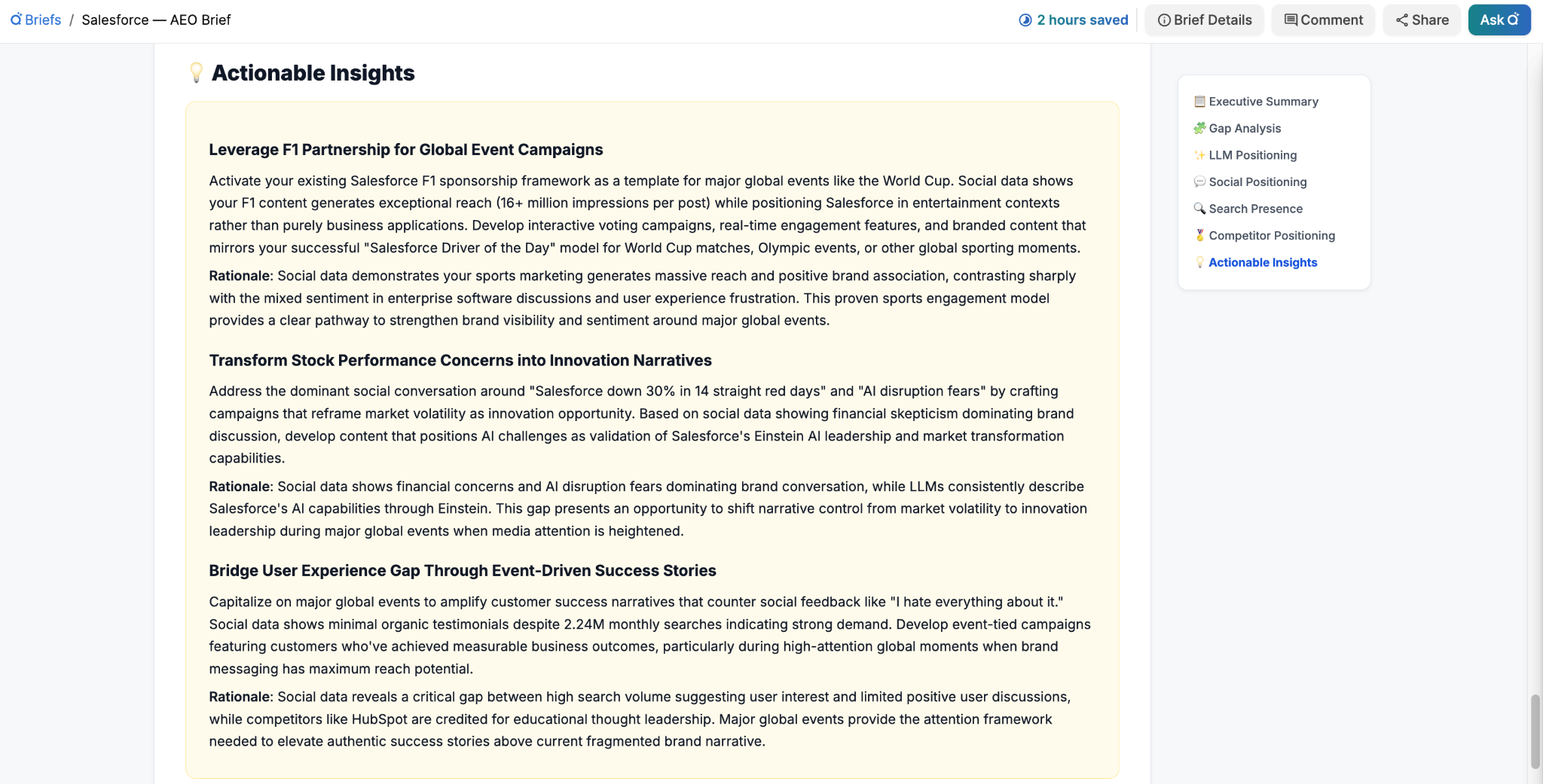
After covering social, search, and how the brand stacks up against competitors, the brief closes with actionable insights grounded in everything the data turned up. In other words, rather than leaving you to figure out what to do with the analysis, Quid’s AEO Agent gives you a concrete jumping-off point for ideas, so you're not left wondering what comes next.
Want to see the full picture? Check out the complete Salesforce AEO brief here.
The rules of AEO are still being written, and they'll likely keep changing as these platforms mature and consumer behavior shifts alongside them. That's not a reason to wait on the sidelines, though. The brands paying attention now, watching how they're actually described and closing the gaps they find, will be the ones building the foundation to stay visible as AEO matures.
AEO stands for answer engine optimization and refers to the practice of optimizing content so AI systems mention or cite your brand when generating answers to a query.
SEO is centered on ranking in search results, largely through keyword and phrase matching. AEO is centered on getting cited inside an AI-generated answer, which depends more on entity recognition and third-party validation than on keywords alone. Ranking well in SEO doesn't guarantee getting cited in AI-generated answers.
Not exactly. SEO and AEO serve different goals, and many brands need both. Ranking well can still drive traditional search traffic, while citation is what gets you mentioned in AI-generated answers, whether or not someone clicks through.
You could manually check each LLM yourself, such as by asking ChatGPT, Mistral, Deepseek, and Gemini the kinds of questions your customers might ask. However, since each platform cites sources differently, any one check only gives you a partial picture, and it's not something you can realistically keep up with over time.
Tools like Quid's AEO Agent are built to monitor this across platforms at once, so you get a fuller picture of your positioning across LLMs, social, and search.