

.png?width=1252&height=362&name=QUID_Logo_WHITE%20(2).png)
This year’s Mother’s Day conversation was split across multiple emotional realities at once. Consumers were shopping, booking brunches, posting tributes, discussing weather forecasts, while sharing grief, and debating family dynamics, all inside the same conversational ecosystem.
Overall, people seemed committed to emotional multitasking while holding a mimosa and doomscrolling.
Quid network analysis shows Mother’s Day behaving less like a single holiday conversation and more like multiple overlapping consumer states happening simultaneously
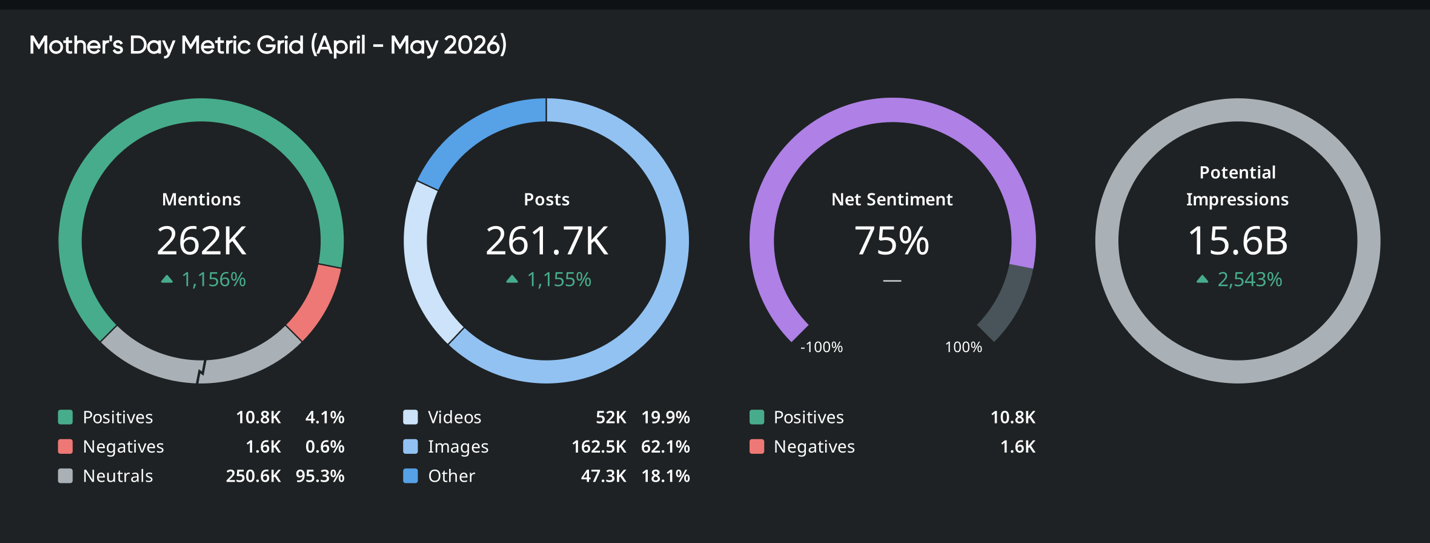
The first thing Quid reveals is that Mother’s Day 2026 was extraordinarily broad but emotionally restrained at scale.
Conversation volume exceeded 262K mentions with more than 15.6 billion potential impressions. Yet despite the emotional nature of the holiday, sentiment remained overwhelmingly neutral at 95.3%.
A traditional Google search might surface “top Mother’s Day gifts” or trending brunch stories. A generative AI summary might tell you people were “celebrating moms online.” Neither explains the actual behavioral structure underneath the conversation.
Quid does.
The dominance of neutral sentiment signals that Mother’s Day has become operationalized consumer behavior. Participation, posting, shopping and making reservations are all expected. The holiday functions almost like a recurring behavioral infrastructure layer now, especially online.
The visual breakdown also shows that image-driven content dominated distribution, accounting for 62.1% of posts. Videos accounted for 19.9%. That shift reinforces that Mother’s Day is increasingly consumed visually before it is consumed emotionally.
Consumers were discussing Mother’s Day and displaying it.
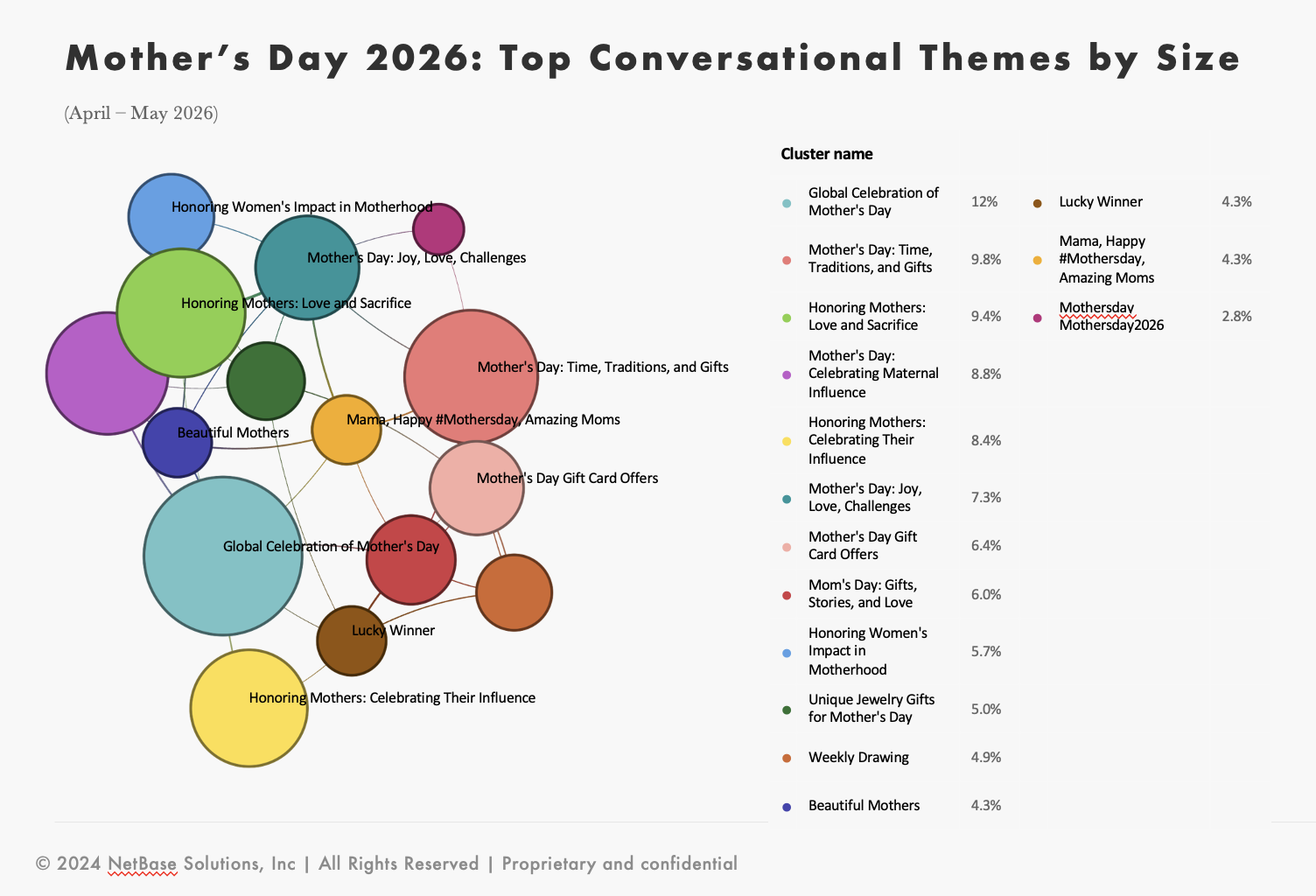
The Quid conversations map shows that no single emotional narrative controlled Mother’s Day conversation. The largest cluster, “Global Celebration of Mother’s Day,” represented just 12% of the conversation. Other major clusters included:
This was not a monolithic “happy Mother’s Day” environment. Consumers were entering the holiday from entirely different emotional and practical positions.
Modern commerce has achieved poetry somehow. Quid’s clustering makes those parallel realities visible in a way keyword search alone cannot.
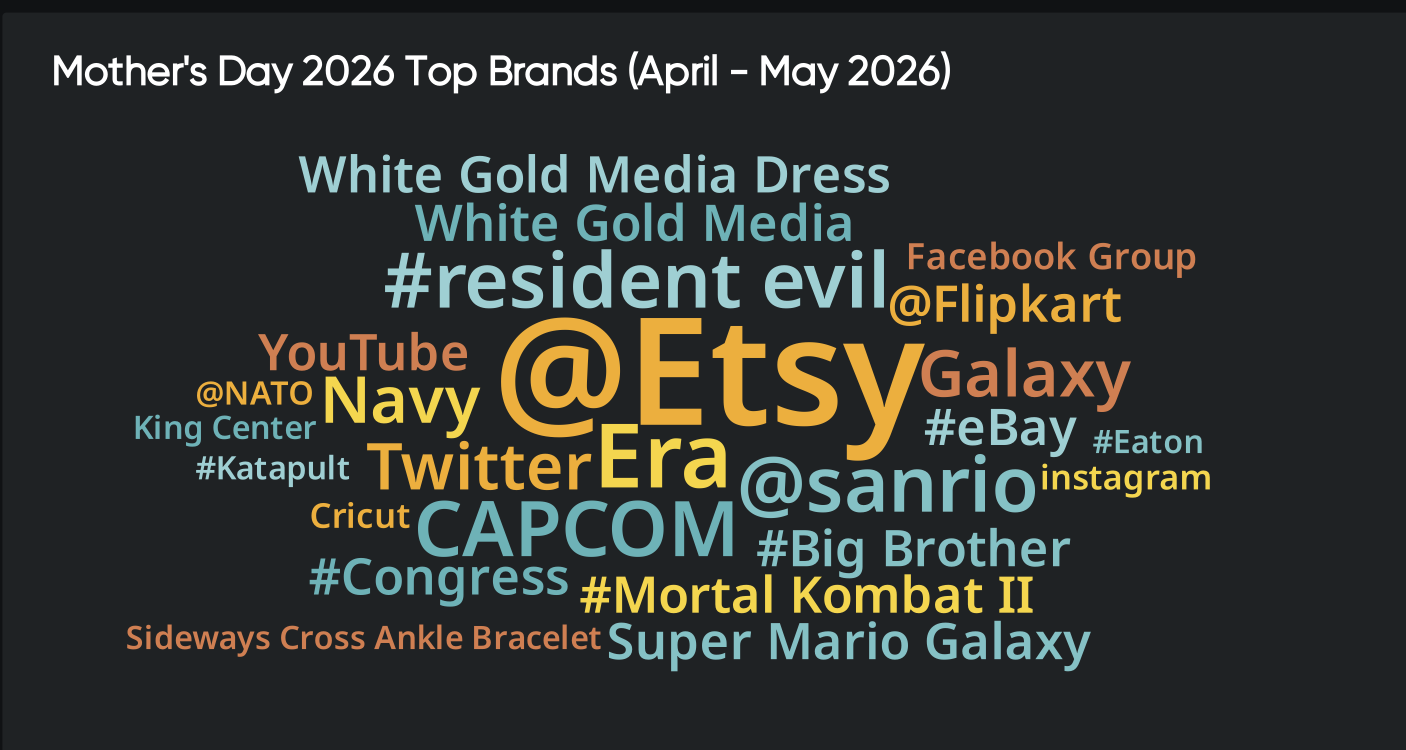
TikTok conversation around Mother’s Day leaned heavily into transactional discovery behavior. Creators repeatedly framed Mother’s Day as a shopping problem that needed solving quickly. The language patterns centered around:
Guided journals and memory books became especially important because they merged commerce with emotional permanence.
Quotes like: “Mom, I want to hear your story...” and “This is the kind of gift that we get to say all the little things we forget to say out loud” performed differently from standard product promotions because they positioned products as emotional preservation tools rather than simple purchases.
Consumers were buying emotional documentation. This is where Quid becomes far more useful than a standard AI summary.
A language model may identify “journals were trending.” Quid surfaces the surrounding emotional architecture and behavioral relationships that explain why those products gained traction in the first place.
Weather conversation and brunch planning emerged as one of the clearest examples of practical intent shaping consumer behavior. Forecast discussion was everywhere:
This was not filler conversation, as it directly affected foot traffic, booking behavior, and last-minute purchasing decisions.
At the same time, local publishers and restaurants aggressively positioned Mother’s Day as a major revenue event through:
The overlap between weather discussion and restaurant promotion is particularly valuable for brands because it reveals a real-time decision environment. Consumers were actively recalculating plans based on changing local conditions.
Quid helps brands identify these shifting behavioral windows while they are happening, not afterward when the conversion opportunity is already gone.
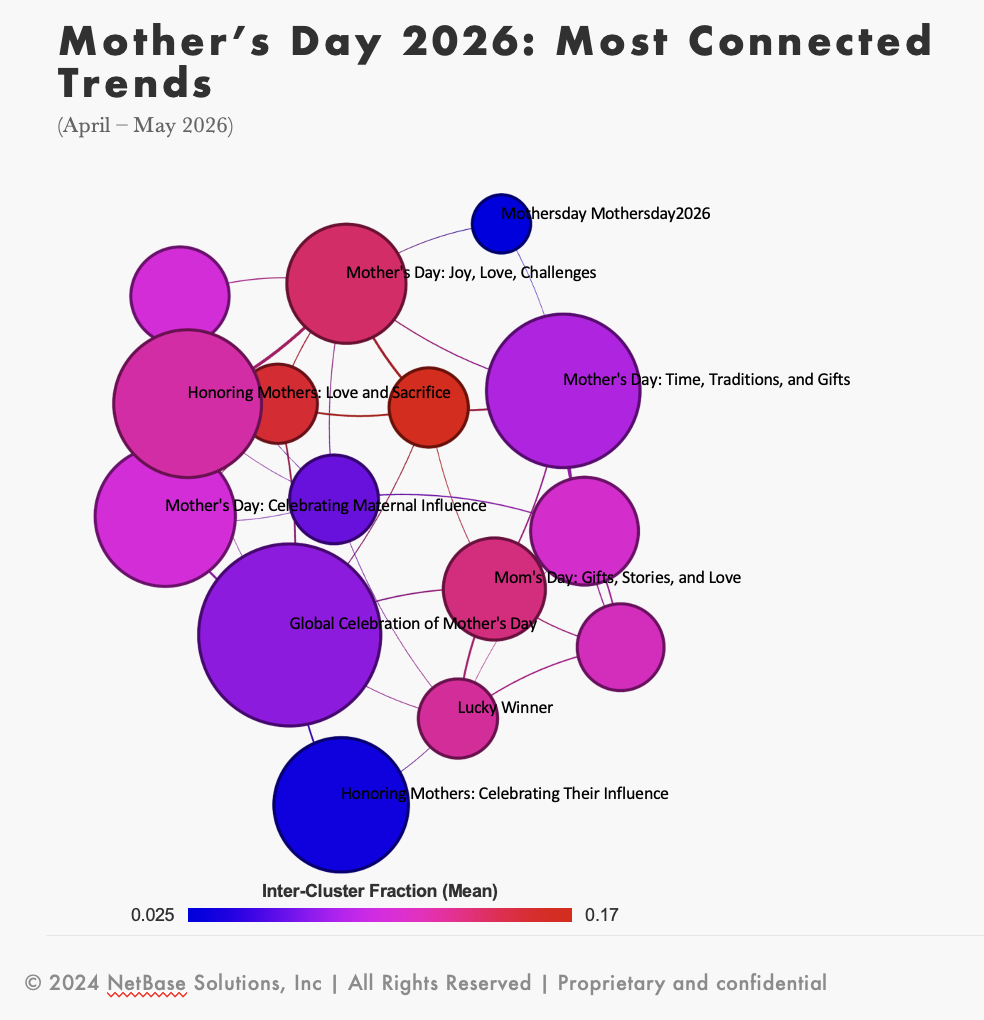
One of the most important findings from the broader news analysis was the coexistence of celebration and mourning.
Coverage connected to Gaza, missing persons, family loss, and human-rights reporting became a major parallel narrative during the holiday period.
Stories included:
One of the highest-engagement social posts in the dataset centered entirely on visiting a mother’s grave for Mother’s Day.
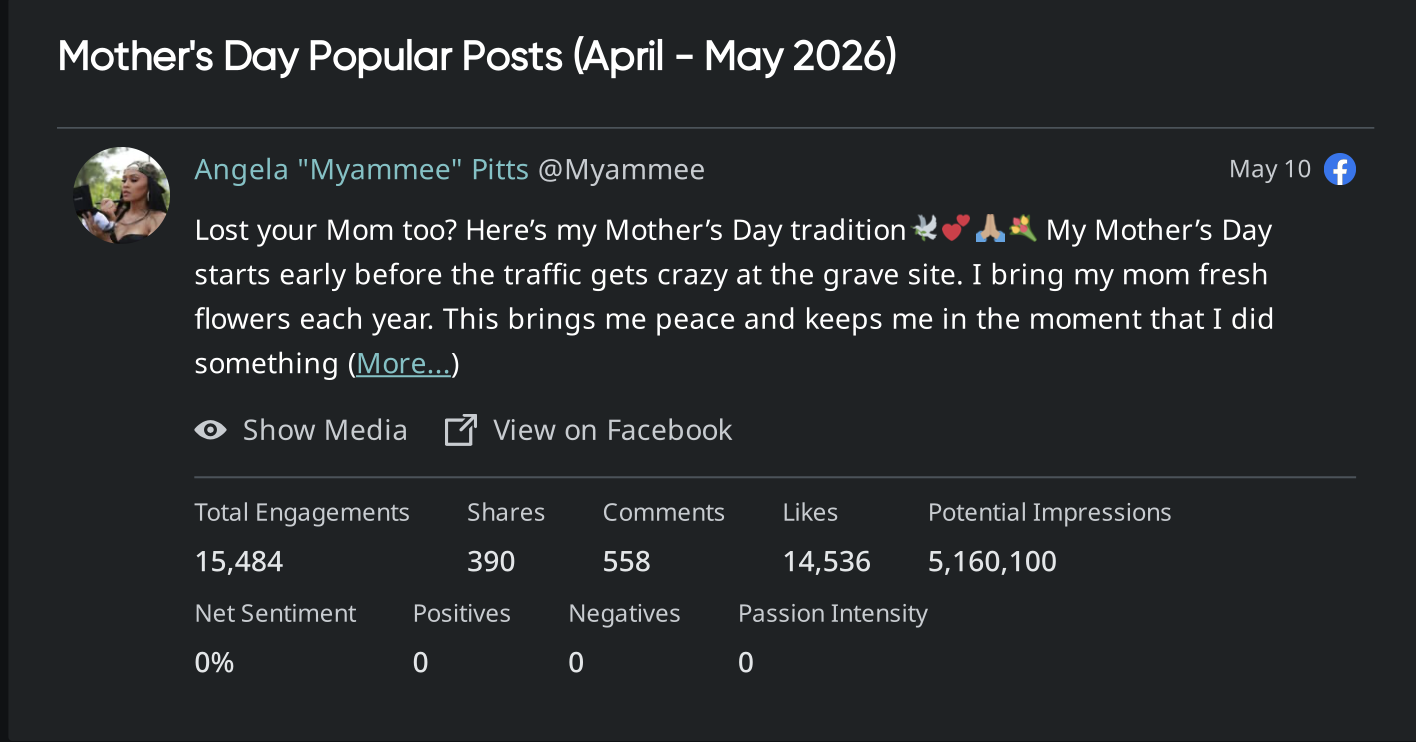
That is important because it complicates simplistic brand assumptions about seasonal positivity.
Mother’s Day is no longer a universally celebratory environment online. It is emotionally fragmented. Brands relying exclusively on cheerful promotion risk missing the broader emotional conditions consumers are actually navigating.
Quid exposes those overlaps structurally.
A standard search might surface isolated articles. Quid reveals how those conversations connect, cluster, and scale against commercial and celebratory behavior simultaneously.
The deeper insight is this: Mother’s Day conversation is increasingly organized around emotional negotiation.
Consumers are balancing:
That is why experience-based gifts, “time-off” requests, and self-care narratives performed so strongly on TikTok.
Many mothers explicitly asked for:
That shift reflects something larger than a seasonal shopping trend. It reflects changing expectations around caregiving, emotional labor, and visibility.
The strongest Mother’s Day strategies moving forward will likely combine:
But the larger takeaway is methodological. Quid does not simply show what people posted. It shows:
That is the difference between trend observation and behavioral intelligence. Google can show you content and AI can summarize content, but Quid shows where consumer decisions are actually forming.
Mother’s Day 2026 showed how quickly consumer behavior fragments across emotion, commerce, culture, and real-world conditions at the same time. Consumers were not participating in one unified holiday narrative, rather, they were navigating celebration, grief, gifting, exhaustion, weather disruptions, family dynamics, creator commerce, and social expectations simultaneously.
Quid makes those overlapping behavioral patterns visible in a way traditional search and AI summaries cannot.
Instead of simply surfacing trending content, Quid reveals how narratives connect, where emotional and commercial signals intersect, and how consumer decisions evolve in real time. That level of connected insight helps brands move beyond reactive marketing and toward strategies grounded in actual behavioral intelligence.
Reach out to Quid to uncover the deeper behavioral patterns shaping your audience before they become obvious to the rest of the market.