


Black Friday 2026 is approaching, and retailers face a familiar challenge as they prepare employees, stores and systems for increased holiday shopping demand. This year, however, seasonal hiring strategies are changing.
Some retailers are relying more heavily on existing employees, flexible scheduling and part-time workers. Others are expanding recruitment to support fulfillment operations. Meanwhile, retail employees are discussing reduced hours, scheduling conflicts and holiday workloads.
Consumer expectations add another layer of complexity. Shoppers expect efficient service during busy periods, while holiday operating hours raise questions about employees' ability to spend time with their families.
Can retailers meet these competing expectations without compromising employee well-being or the shopping experience?
Quid's analysis of Black Friday staffing and holiday shopping conversations between August and November 2026 provides insight into the challenges surrounding retail readiness.
Quick Facts
How are retailers preparing for Black Friday 2026? Retailers are combining seasonal recruitment, existing employee coverage and flexible scheduling. The National Retail Federation expects retailers to hire between 325,000 and 375,000 seasonal workers in 2026.
What concerns are retail employees discussing? Recent employee conversations include reduced working hours despite ongoing recruitment, scheduling changes during Thanksgiving week and questions about staffing coverage.
What concerns shoppers during busy retail periods? According to Logile's 2026 Peak Hour Penalty Report, long checkout lines are the leading frustration among shoppers when stores are understaffed.
What does Quid's Black Friday Staffing analysis reveal? Quid’s Black Friday Staffing analysis identified approximately 2,500 mentions across 2,300 posts between August and November 2026, generating approximately 1 billion potential impressions.
Quid's Black Friday staffing analysis shows conversation volume, potential impressions and sentiment distribution between August and November 2026. The analysis identified approximately 2,500 mentions across 2,300 posts, with a net sentiment score of 74%.
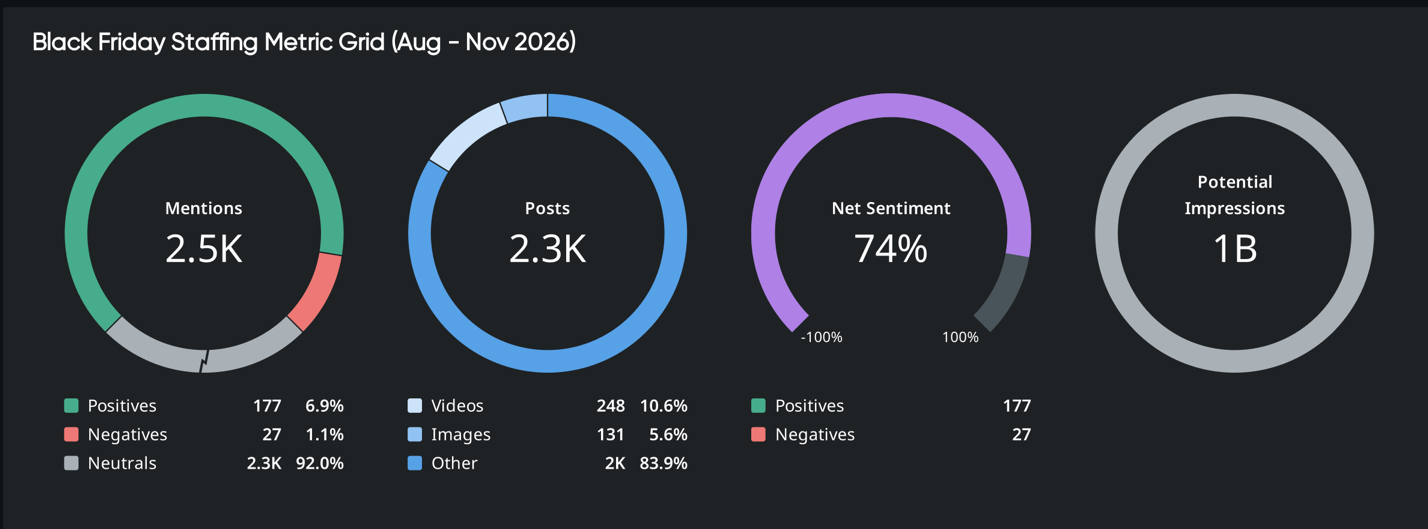
Sentiment was predominantly neutral:
The high proportion of neutral conversation reinforces the importance of examining underlying themes rather than relying exclusively on sentiment classifications.
Unsurprisingly, Black Friday staffing conversations generally increased as the holiday shopping period approached. Quid's timeline shows activity fluctuating during August and September before generally increasing through October and early November.
Although the increase suggests growing visibility for the topics captured, it does not independently establish whether staffing problems are becoming more widespread. Understanding who participates in these conversations provides additional context.
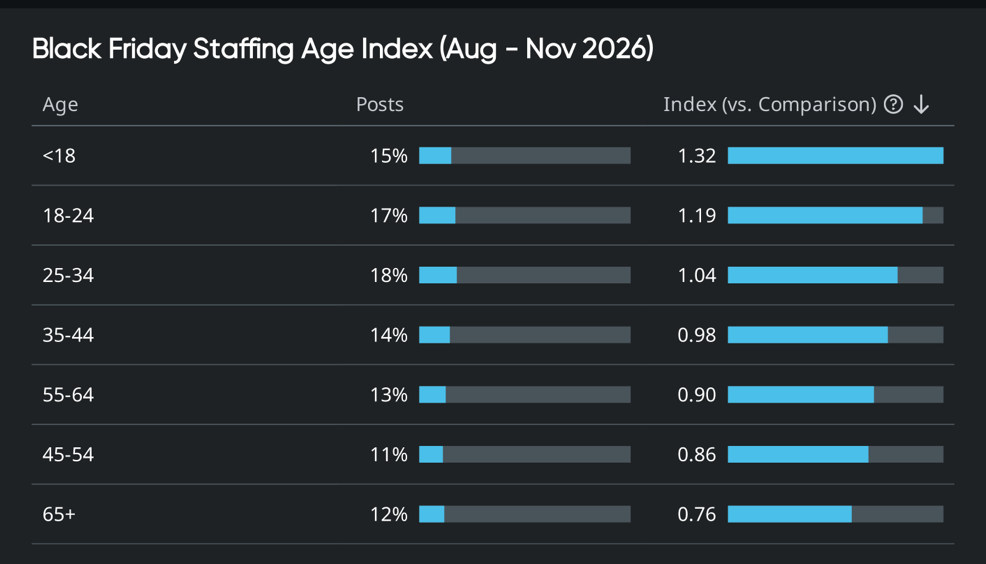
Quid's audience analysis reveals that younger audiences are disproportionately represented in the Black Friday staffing conversation. People under 18 accounted for 15% of classified posts and indexed at 1.32 relative to the comparison population. Those ages 18–24 represented 17% of posts and indexed at 1.19.
The professional breakdown reveals another distinction. Sales and marketing accounted for 26% of classified posts and indexed at 4.98, while students represented 12% and indexed at 4.00. Entrepreneurship also showed above-average representation, accounting for 19% of posts with an index of 2.98.
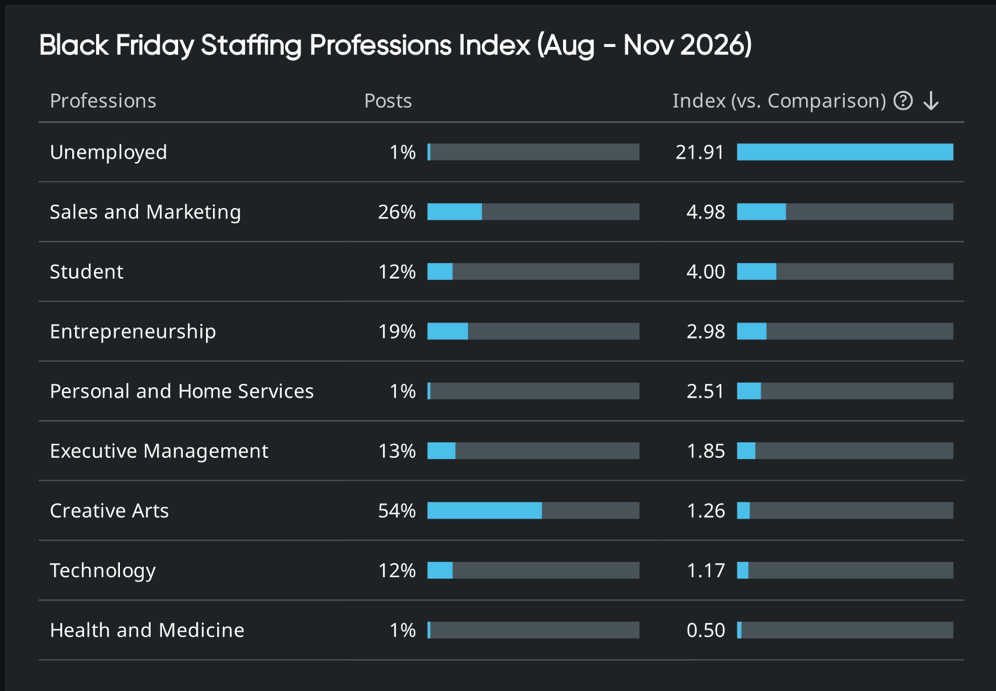
For brands, these findings provide important context. The conversation includes audiences associated with marketing, business and education, alongside discussions of retail employment and shopping.
These classifications do not establish whether participants are retail workers or shoppers. However, they reinforce the importance of examining who is contributing to a conversation before interpreting its implications for workforce conditions.
According to November 2026 reporting from Retail Dive, some major retailers are relying more heavily on existing employees and part-time workers rather than announcing large seasonal hiring campaigns. Among large employers, part-time positions increased year over year, while seasonal positions declined.
Target illustrates this approach. The retailer plans to offer additional hours to existing employees and use its On Demand workforce of approximately 43,000 store employees who can select available shifts. Other retailers are pursuing different strategies. Kohl's is recruiting across stores and fulfillment operations, while other retailers are adjusting their hiring strategies to accommodate different operational requirements.
These differences highlight why recruitment totals alone provide an incomplete picture of holiday readiness. Retailers must also consider employee availability, training and the operational requirements of individual locations.
Employee discussions provide another perspective on holiday preparation.
In a November 6 Reddit discussion, a Target employee described continued seasonal recruitment despite reduced working hours for existing staff. Other participants questioned how experienced employees could train new hires when their scheduled hours were declining.
Walmart employees raised different concerns. In November discussions, workers described Thanksgiving-week scheduling changes, including assignments outside their usual availability and conflicts with personal commitments.
These anonymous, self-reported accounts do not establish company-wide conditions. However, they illustrate practical challenges involving employee availability, training and workforce coverage. The concerns become particularly relevant when retailers extend operating hours or concentrate promotional activity around major holidays.
Quid's extracted conversation terms reveal a mixture of holiday shopping experiences, promotional activity and employee-related discussion. The analysis identifies phrases including "holiday shopping," "shopping experience" and "first Black Friday shift." Other prominent phrases reference curated, festive and unique shopping experiences.
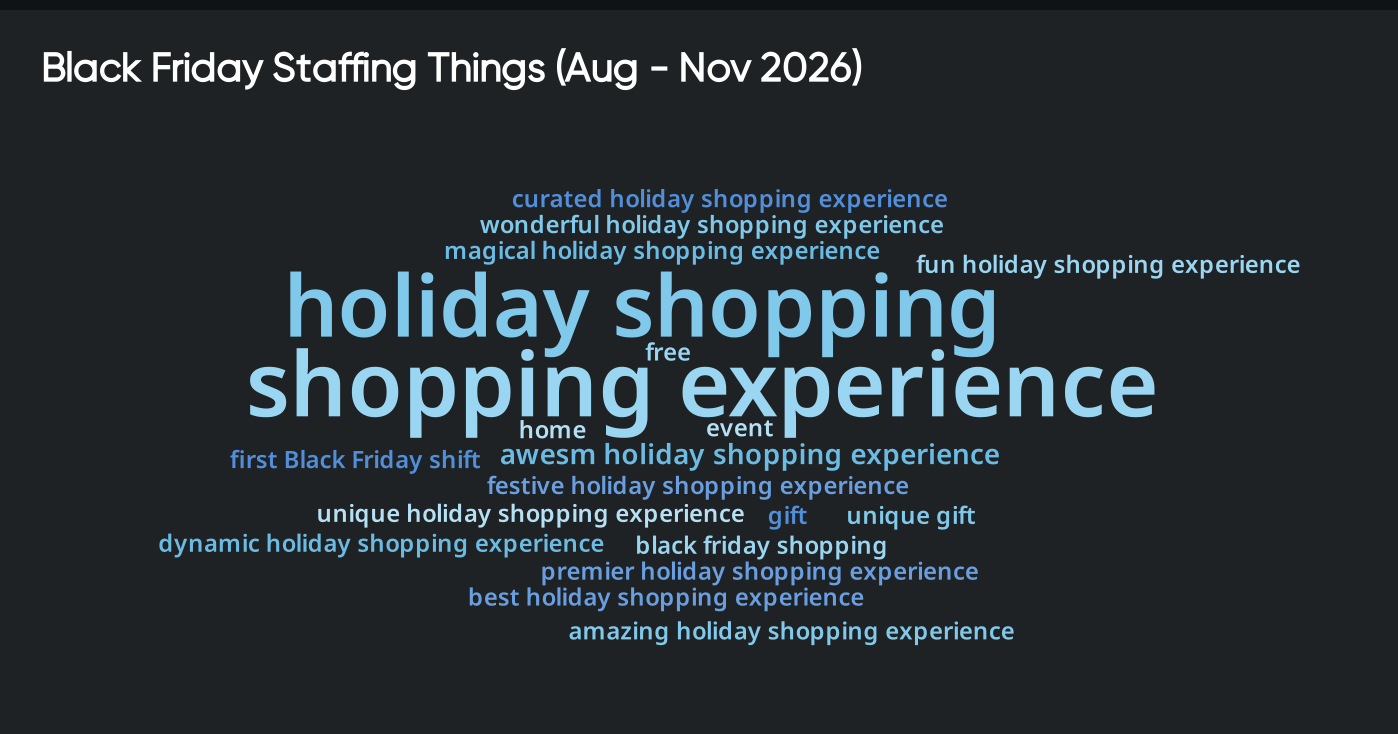
References to shopping experiences may reflect promotional messaging or consumer expectations, while discussions of individual shifts can provide more direct context about employee preparation.
The word cloud does not establish the relative prevalence of staffing complaints or service problems. However, it illustrates why brands need to examine the underlying posts before drawing conclusions from broad conversation trends.
Holiday staffing introduces another challenge: meeting consumer demand while respecting employees' personal commitments. According to the National Retail Federation's October 2026 holiday survey, 64% of consumers expect to complete most of their holiday shopping during Thanksgiving weekend.
Retailers must prepare for that concentrated demand while making decisions about holiday operating hours.
Target, for example, will close its stores on Thanksgiving Day, November 26, before reopening at 6 a.m. on Black Friday. The retailer also plans extended operating hours during portions of the holiday season. This approach accommodates a major holiday closure while providing additional shopping opportunities on surrounding dates.
However, holiday closures do not eliminate scheduling challenges. Employees may still be needed to prepare inventory, manage fulfillment and support increased customer traffic before and after the holiday.
For retailers, the challenge is coordinating customer demand, operating hours and employee availability without creating unnecessary scheduling conflicts.
The available evidence does not establish how many consumers oppose holiday staffing requirements. That question would require additional research into attitudes toward holiday work.
Consumer research demonstrates why staffing decisions matter beyond the workforce. According to Logile's November 2026 Peak Hour Penalty Report, 78% of surveyed shoppers reported leaving a store without purchasing anything during the preceding six months because of problems associated with busy shopping periods.
Among respondents who recalled their intended spending, the average abandoned shopping trip was worth approximately $113. Long checkout lines were the leading frustration when stores were understaffed, cited by 42% of respondents. Other findings included:
The survey also found that 59% blamed management or corporate leadership for problems associated with understaffing, compared with 8% who blamed frontline employees. Additionally, 74% agreed that understaffing during predictable busy periods reflects a planning failure.
These findings demonstrate that shoppers evaluate retailers on their ability to prepare for increased demand. They also reinforce the importance of examining staffing decisions alongside checkout capacity, employee training and customer service requirements. The survey covered shopping experiences during the preceding six months and should not be interpreted as measured Black Friday 2026 outcomes.
The findings reveal several considerations for retailers preparing for Black Friday. Employee discussions identify scheduling conflicts, reduced hours and questions about workforce coverage. Consumer research highlights checkout delays and expectations that retailers will prepare for predictable demand.
Holiday operating policies introduce additional considerations involving employee availability and customer access. For brands, these conversations provide opportunities to investigate potential operational gaps before Black Friday.
Retailers should monitor:
Comparing these conversation themes with internal workforce and performance data can help retailers prioritize preparation efforts.
Quid provides visibility into emerging discussions, while employee accounts and consumer research add context about the conditions retailers are preparing to manage. The central question is whether retailers can deliver the shopping experience consumers expect while maintaining practical, sustainable working conditions for employees.
As Black Friday approaches, understanding both perspectives can help brands make more informed decisions about staffing, operations and customer experience.
Can employee conversations predict Black Friday service problems?
Employee discussions can identify potential concerns involving staffing, scheduling and training. However, confirming operational risks requires additional evidence from workforce and performance data.
How can retailers evaluate whether holiday staffing strategies are effective?
Retailers can compare staffing coverage, employee availability, training completion and checkout performance against anticipated customer demand. Post-event analysis can help identify areas for improvement.
How can social listening support future holiday planning?
Comparing pre-event conversations with post-event employee experiences and customer feedback can help retailers identify recurring concerns and evaluate the effectiveness of their preparation strategies.