

.png?width=1252&height=362&name=QUID_Logo_WHITE%20(2).png)
.png?width=1380&name=template%20even%20text%20(20).png "<span id=\"hs_cos_wrapper_name\" class=\"hs_cos_wrapper hs_cos_wrapper_meta_field hs_cos_wrapper_type_text\" style=\"\" data-hs-cos-general-type=\"meta_field\" data-hs-cos-type=\"text\" >How Can Agentic AI Improve Market Intelligence?</span>")
Key takeaways:
Market intelligence has traditionally been a process you initiate when you have a question. You have a question, commission or conduct research, analyze the findings, and turn them into a report that helps inform a decision. Once the report is delivered, the process largely ends until the next question comes up.
But the market itself doesn’t work that way. Consumer preferences shift, competitors move on their own schedules, and new trends emerge each day. By the time a study’s complete, some of the signals it captured may have already changed.
Agentic AI changes the model by making market intelligence continuous. Instead of gathering information and analyzing findings as needed, AI agents can work through defined research and analysis workflows on an ongoing basis, drawing from a layer of current market data and returning intelligence briefs in a fraction of the time. Questions that once took days or weeks to answer can potentially be addressed in hours or even minutes.
In other words, agentic market intelligence ushers in a shift from producing intelligence periodically to maintaining an ongoing view of what is happening in the market.
Here’s what that shift looks like, and where real people still fit into the process.
Agentic AI enables continuous market intelligence by taking on much of the manual work involved in producing intelligence. AI can automate tasks like monitoring, gathering, synthesizing, and reporting on market data, giving teams more time for higher-value analysis and strategy.
That efficiency matters because traditional intelligence workflows often rely on a variety of tools, resources, and approaches to develop a single set of insights. You might use one platform for social listening, another source for web data, and internal data for additional context. You then have to extract the relevant information, identify connections across sources, analyze the findings, and bring it all together into a coherent presentation that can inform decisions.
With agentic AI, you can compress that scattered workflow into a single process handled by a dedicated agent. Rather than someone manually extracting information from separate platforms and sources, the agent would sit on a comprehensive data layer and pull from designated sources. For example, Quid's Q Agents draw on more than two petabytes of data, including information from social, investment, patents, search, broadcast, and news sources.
Agents then work through defined research and analysis tasks, whether that's conducting a brand sentiment analysis or building a SWOT analysis, before synthesizing the findings into a brief. By reducing the manual work involved in moving between sources and piecing together findings, agentic AI gives analysts more time to focus on what those findings mean and how they can inform strategy.
The potential efficiency gains are reflected in Forrester’s Total Economic Impact™ study of Quid, which found:
These figures illustrate the potential efficiency and economic impact of moving from fragmented research workflows to a more integrated approach.
While AI can automate parts of the intelligence workflow, it’s not a substitute for human curiosity, judgment, and strategic thinking.
Agents are well suited to repetitive tasks, including processing large volumes of data, organizing information, and identifying trends. Human analysts, however, still need to stay in the loop to determine what the intelligence means and how it should inform the business. This includes:
In other words, the human role doesn't disappear. It transforms into a position where analysts are able to ask better questions, bring deeper context to the findings, and focus their expertise where it can have the most strategic value.
All of that sounds useful in theory, but what does it actually look like in practice? Let's walk through a simple example.
Quid offers a comprehensive library of AI Agents, each designed around a specific business need. For instance, the TikTok Leaderboard Agent can provide a daily-updated, category-filtered view of what's gaining traction on TikTok, while the Brand & Product AEO Agent can generate a comprehensive brief on how your brand or product appears in AI-generated answers.
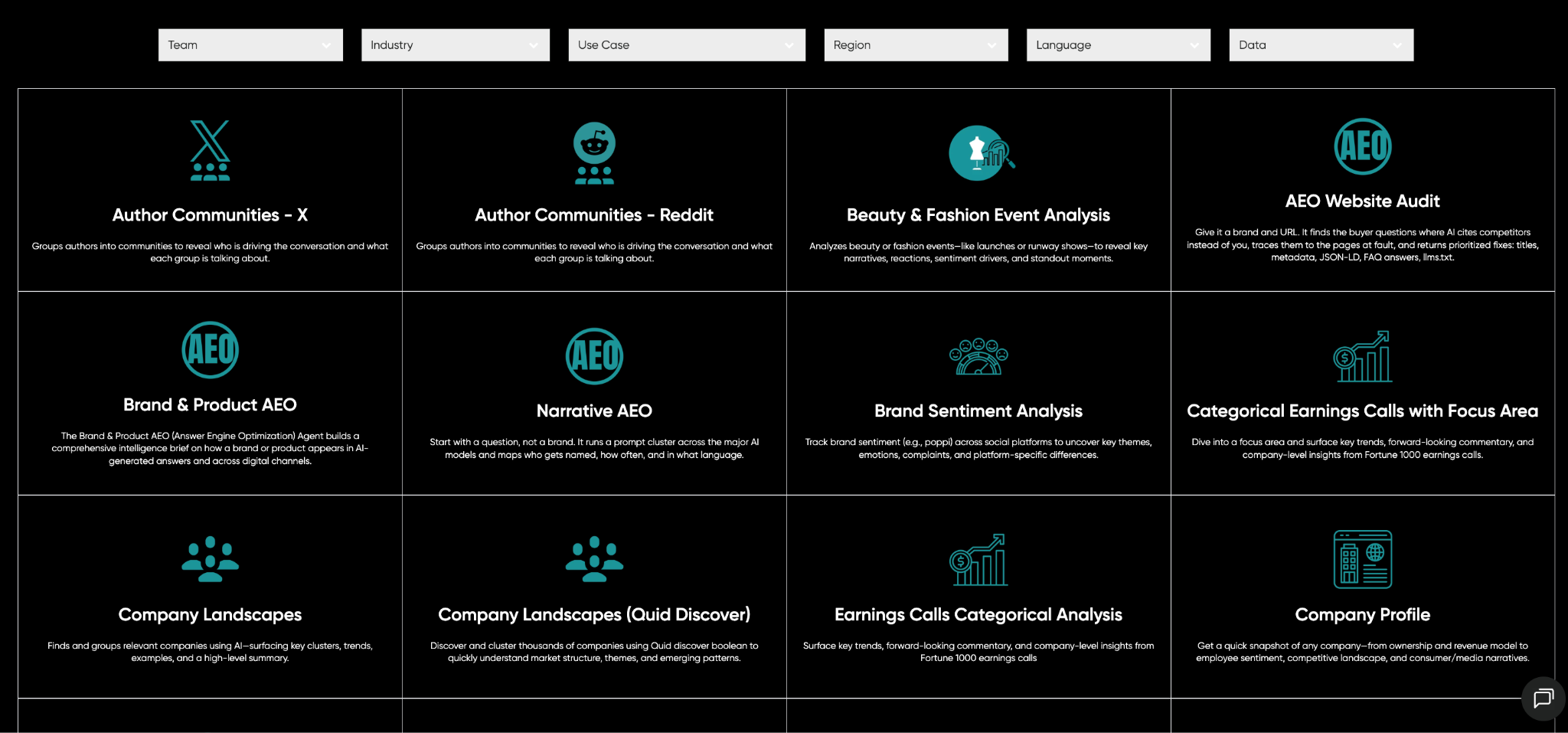
Now, let’s say you're a beverage brand preparing to launch a new prebiotic drink. You want to determine how to position the product and develop messaging that appeals to customers while differentiating it from competitors. One place to start is understanding how consumers currently feel about the category. Social media can provide a rich source of that information, but analyzing sentiment across a large volume of posts can quickly become a time-consuming task.
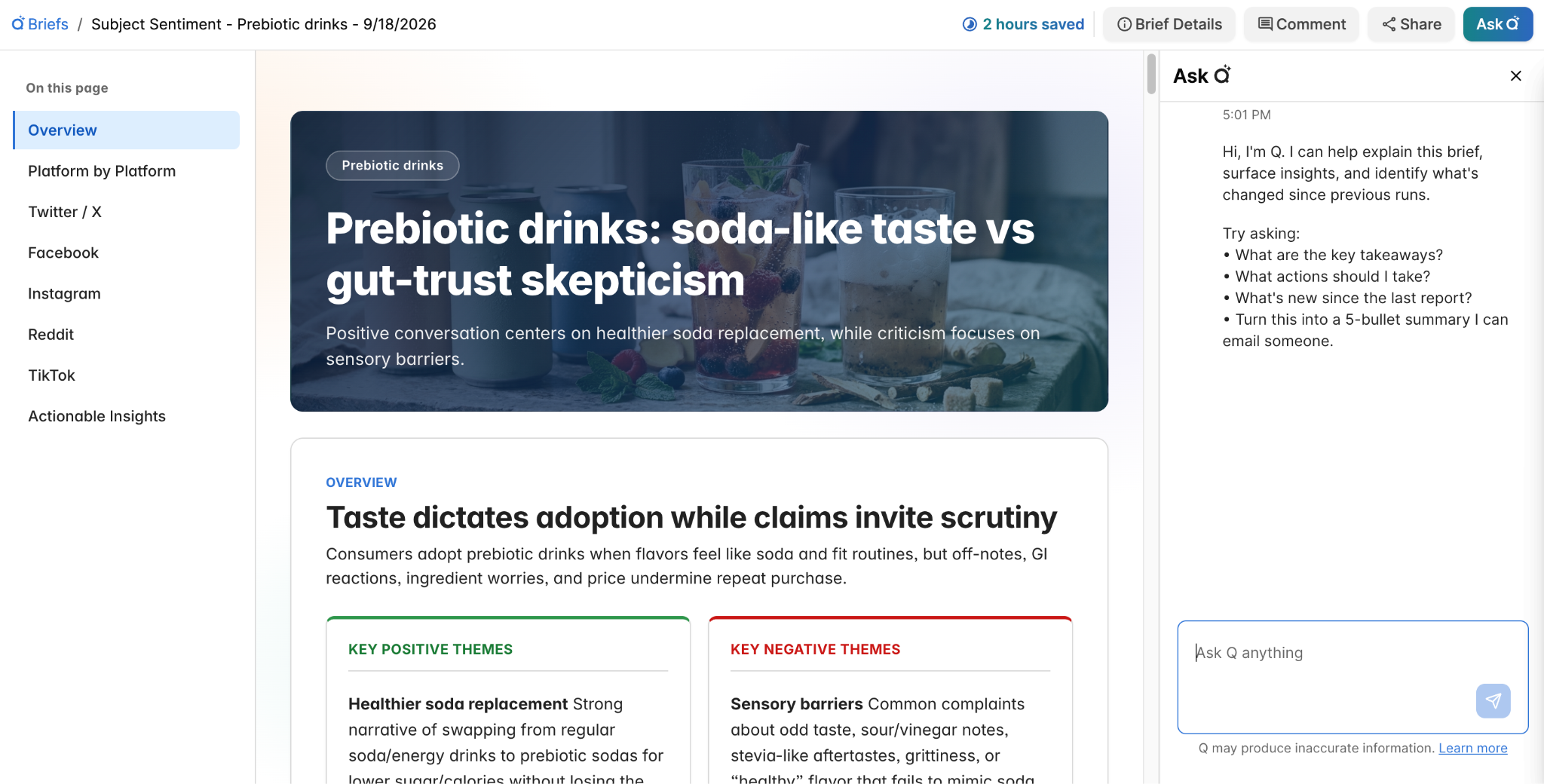
This is where the Subject Sentiment Analysis Agent can take over. You define the topic you want to investigate, such as "prebiotic drinks," and trigger the workflow. The agent analyzes the relevant data and delivers an Insight Brief directly to Quid Terminal and your inbox.
Instead of handing you a collection of posts to sort through, the brief provides an executive-ready view of the conversation, including key positive and negative themes, common complaints, and differences in sentiment across platforms.
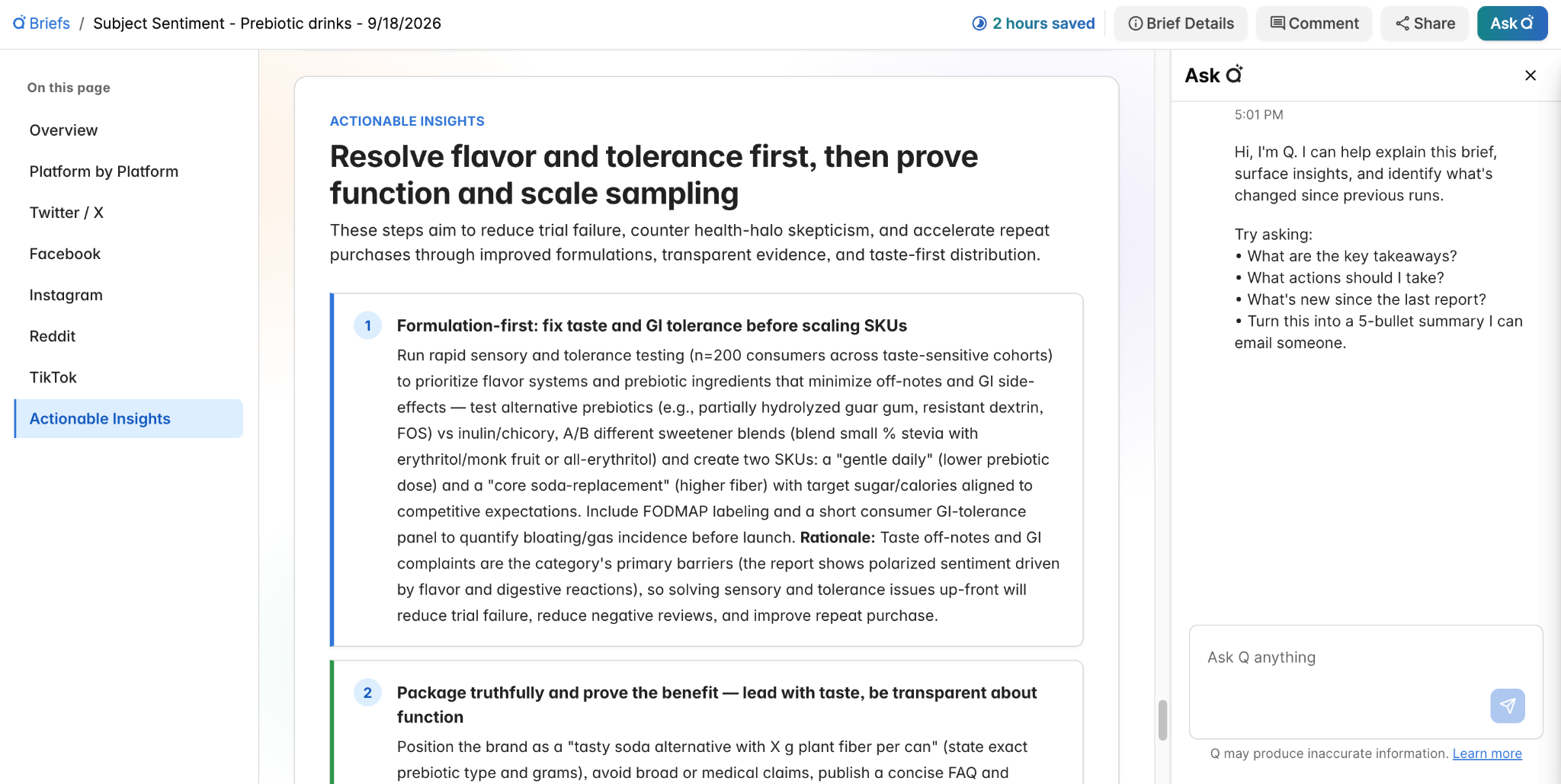
The brief even surfaces actionable insights tailored to your business, giving your team a starting point for deciding what to investigate or do next.
At the same time, Ask Q, our AI chatbot, is available within the brief, so you can ask follow-up questions, clarify a finding, or summarize the analysis for sharing with other stakeholders.
This is how agentic market intelligence is different from simply using automation to speed up research. Beyond helping you find information faster, Q Agents can carry a defined research task through to a usable piece of intelligence, so you and your team can spend more time determining what the findings mean and what to do with them.
Agentic AI gives your team a way to make market intelligence a more continuous part of the decision-making process. Instead of spending days or weeks gathering information, pulling together different sources, and working through the analysis, your team can trigger an agent and get to useful insights much faster.
That means answering more questions in less time and receiving the intelligence you need to make smarter decisions, uncover new opportunities, and fuel growth.
Request a free trial and see what your team could uncover.
Agentic AI in market intelligence refers to using AI agents to work through defined research and analysis tasks. Rather than simply helping with an individual step, an agent can gather relevant information, analyze findings, identify trends, and synthesize the results into a usable intelligence brief.
Traditional AI tools typically help with individual tasks, such as summarizing information or answering one particular question. Agentic AI connects multiple steps into a defined workflow, which means an agent could gather information, conduct analysis, and synthesize the results into a finished output with one click.
AI agents can help teams reduce manual research work and get answers faster by quickly analyzing large volumes of information across multiple data sources. This gives analysts more time to focus on interpreting findings, applying business context, and turning intelligence into decisions.
AI agents can automate parts of the market intelligence process, but they don't replace the need for human judgment. Analysts still need to decide which questions are worth asking, add business context, challenge findings, validate outputs, and determine how insights should influence strategy.
Agentic AI can help with competitive intelligence by quickly working through defined questions about competitors, markets, or emerging developments. An agent can gather relevant information, analyze the signals, and report the findings, giving teams a faster starting point for understanding what’s changed and what may deserve a closer look.