

.png?width=1252&height=362&name=QUID_Logo_WHITE%20(2).png)
You might think March Madness is just another sports event, but it isn’t. It is a layered marketplace where media rights, athlete brands, betting ecosystems, and social content collide in real time.
What used to be bracket predictions is now behavioral data at scale. And if you are still treating this as a media buy instead of a dynamic signal environment, you are already behind.
This analysis breaks down how March Madness operates as a market intelligence system and where brands are winning attention.
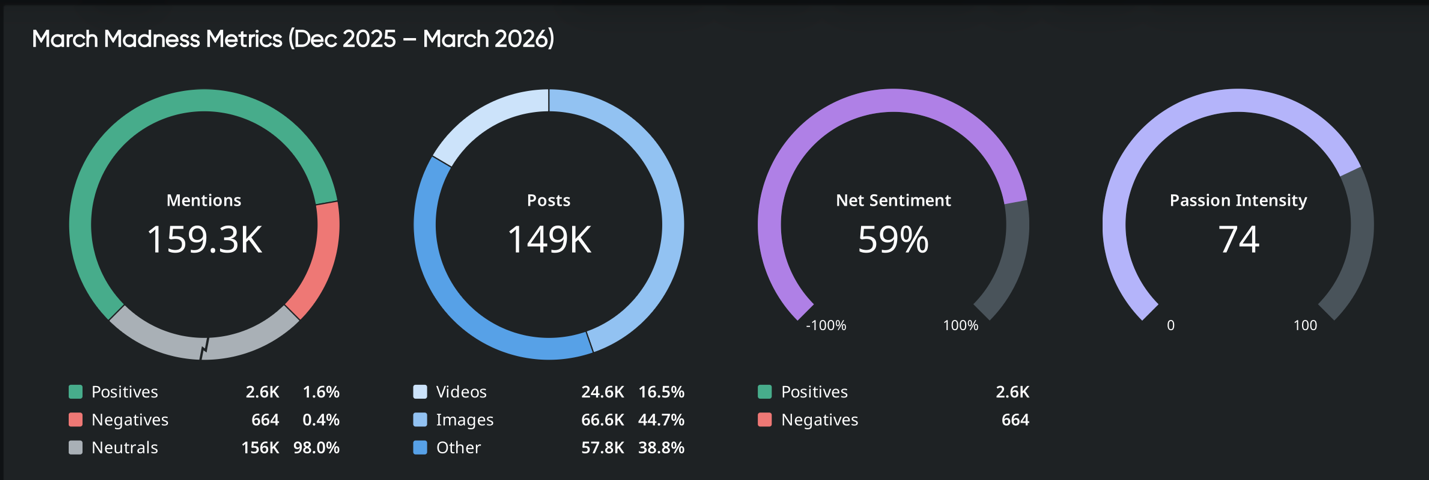
The March Madness dataset shows 159.3K mentions and 149K posts, with 98% neutral sentiment. That neutrality means:
Even with 451.6K total engagements and high passion intensity (74), the emotional profile does not spike dramatically.
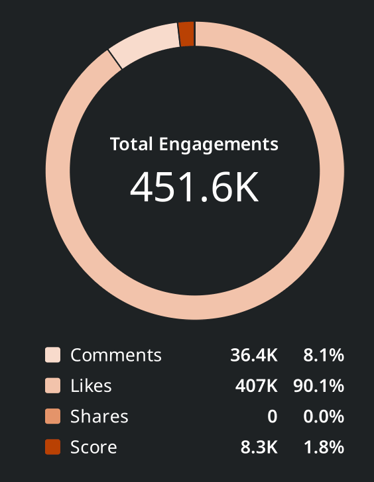
People care, and this is a stable environment where brands can operate predictably, but it also means attention is harder to differentiate.
Understanding what, specifically, is driving behavior helps.
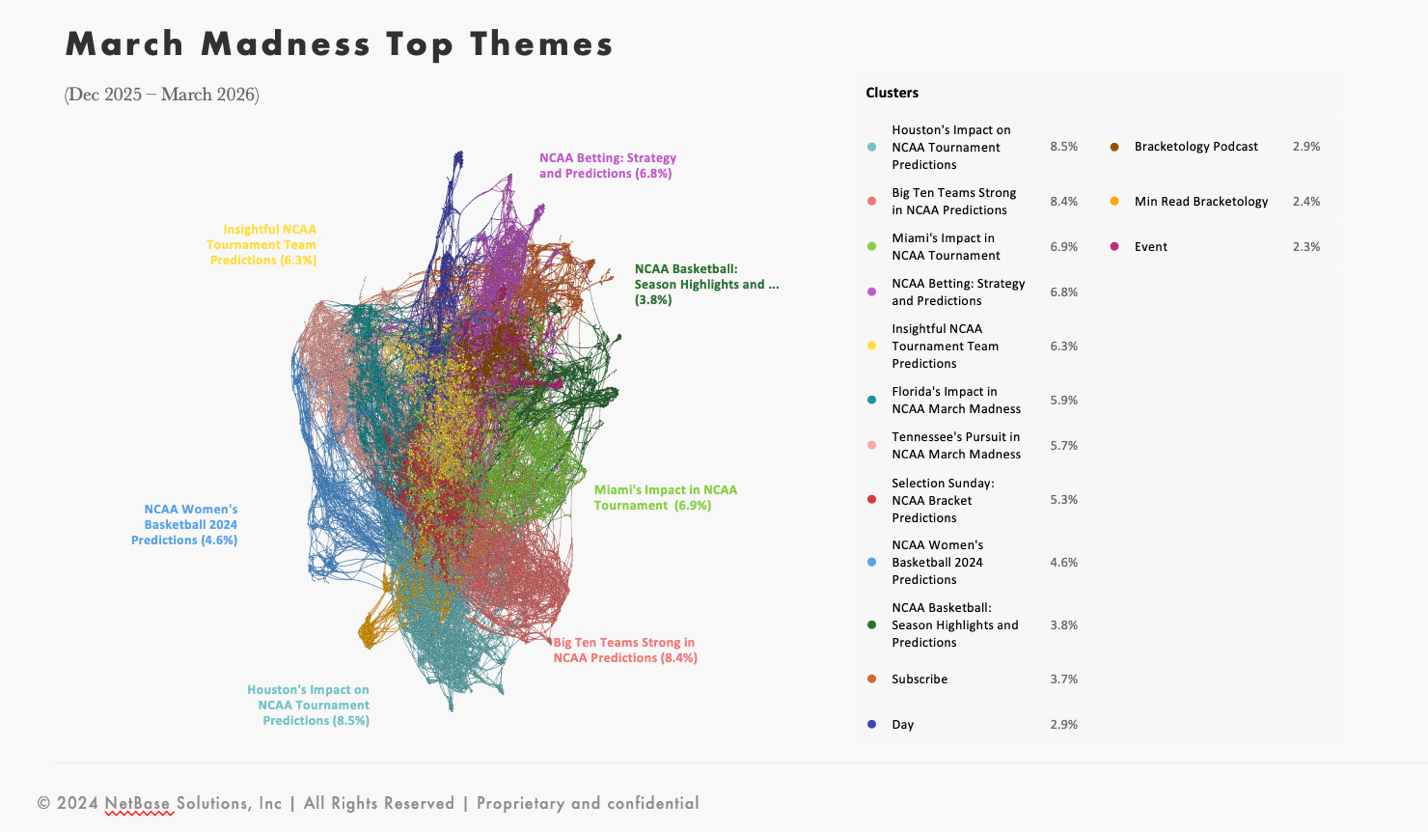
Top themes include:
This is not casual fandom, it’s decision-based engagement. People are filling out brackets, tracking predictions, comparing models, and placing bets
The behavior language reinforces this: “pick,” “watch,” “fill out,” “best bet,” “analysis.”
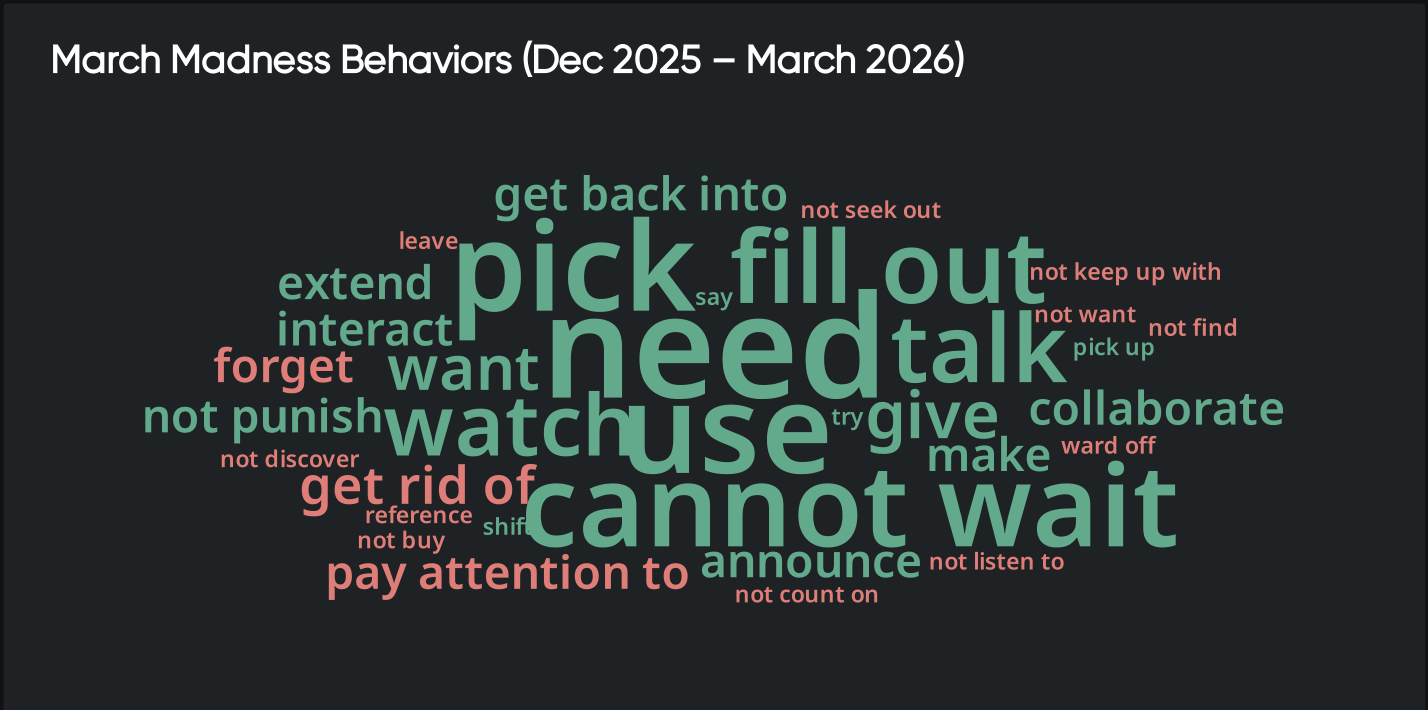
March Madness has effectively become a prediction economy, and savvy brands are taking note.
Brand sponsorships are everywhere, especially:
But the actual driver of engagement is not the logo, it’s the athlete. Athlete-led activations like Flau’jae Johnson’s campaigns show how brands are shifting toward lifestyle integration (music, fashion, recovery), story-driven content, and cross-platform visibility.
Even coach-driven moments, like Kim Mulkey’s viral fashion, are being turned into participation campaigns. Sponsorship creates presence, and storytelling creates reach. NIL is big business.
The Name, Image, Likeness (NIL) conversation dominates volume, with 3,490 posts in top-tier media alone.
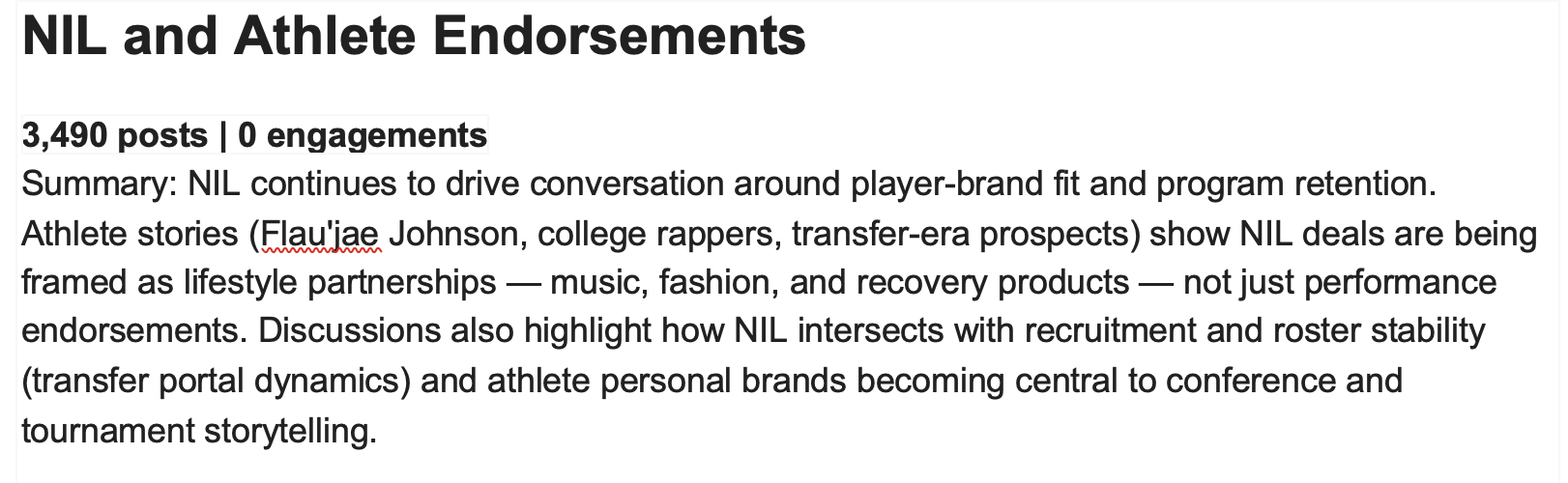
Athletes are no longer just endorsers. They are content creators, brand ecosystems, and cultural entry points.
TikTok insight reinforces this:
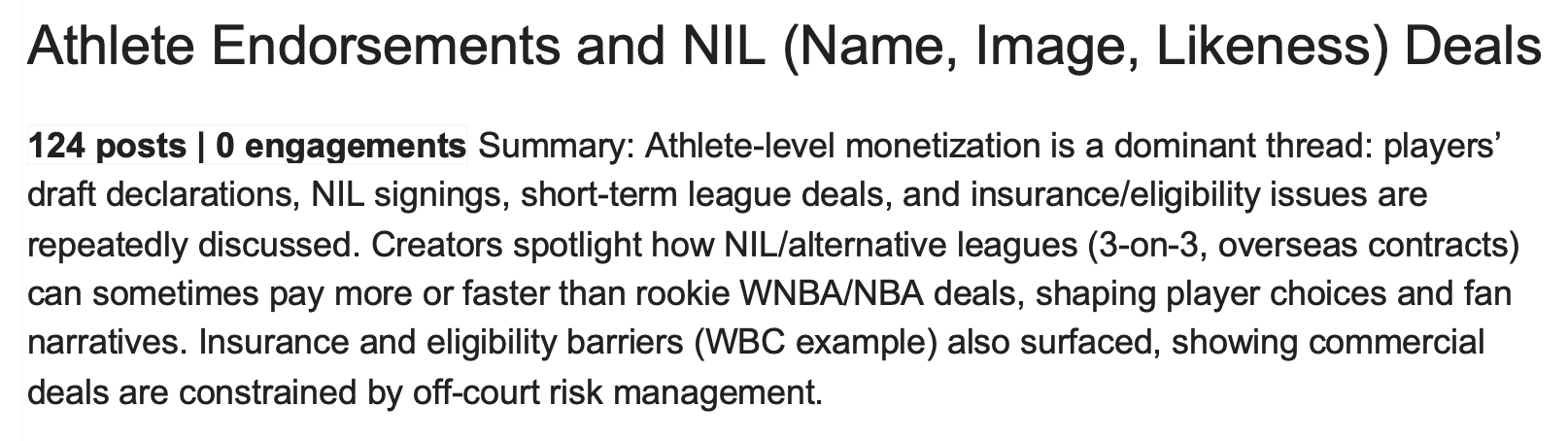
This changes everything for brands. You are no longer buying access to an audience.
You are partnering with someone who already owns one. And that audience comes complete with its own sentiment profile.
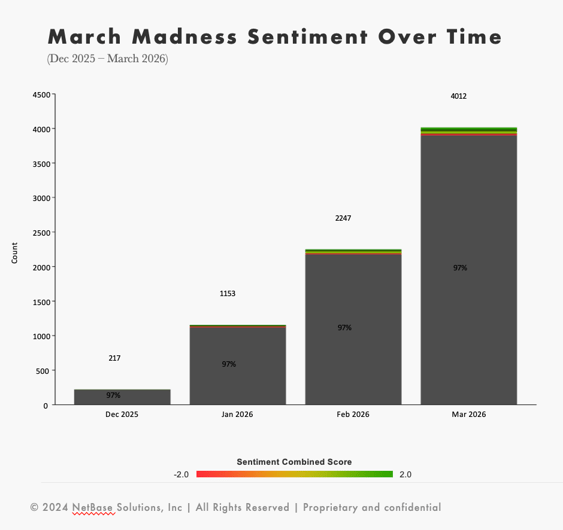
The sentiment timeline holds almost perfectly steady from December through March.
Roughly 97 percent of conversations remain neutral across every month, even as volume builds toward the tournament. That level of consistency shows that March Madness is not driven by emotional spikes. It is driven by repeated, normalized behavior. People do not show up once. They show up continuously, tracking teams, updating brackets, revisiting predictions, and reacting in cycles.
This is a stable engagement environment. And stability changes how brands should operate. You are not trying to capture a moment. You are inserting yourself into a pattern that already exists.
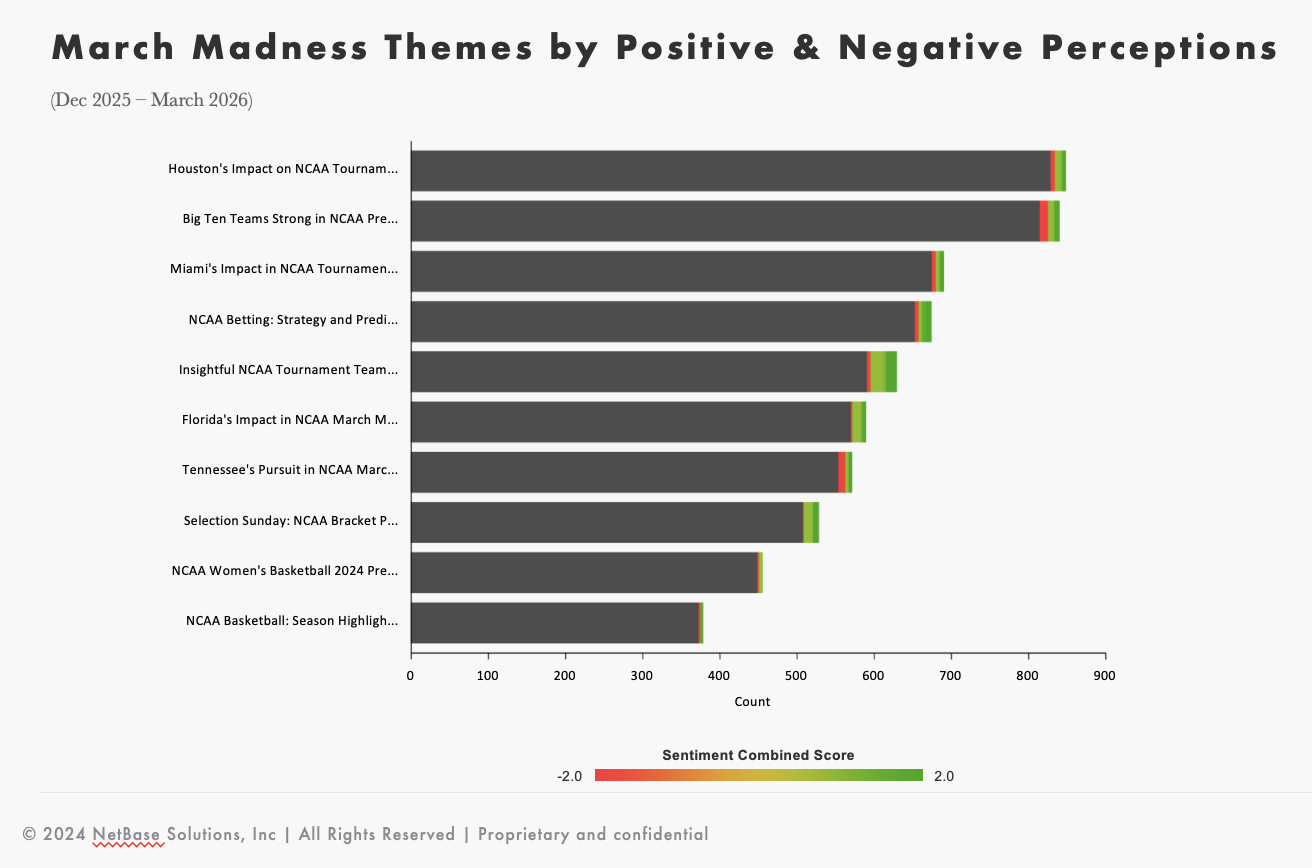
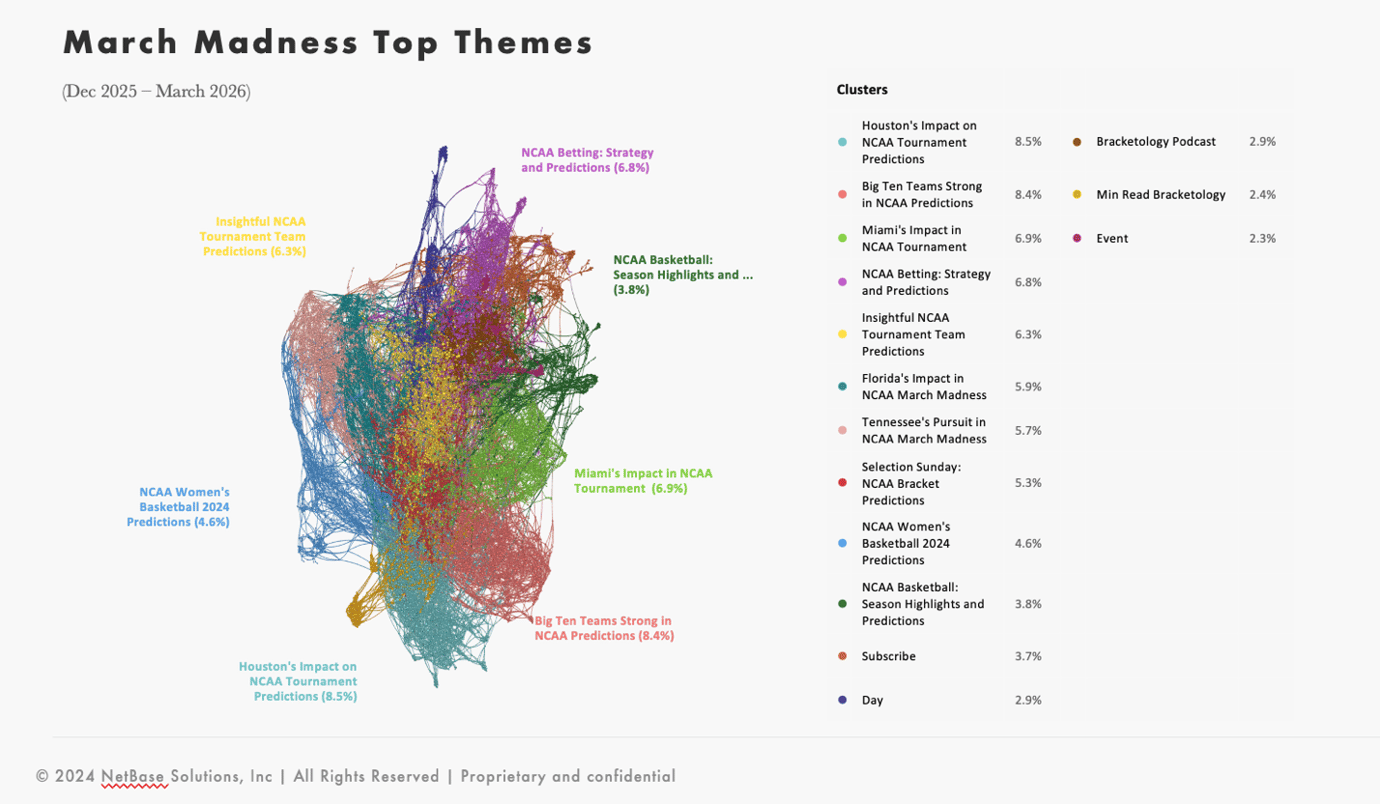
A small number of themes carry a disproportionate share of the conversation.
Houston’s impact on predictions leads, with Big Ten performance and betting strategy and prediction frameworks sitting right behind them. This is concentrated attention.
People are not talking about everything. They are talking about a few things repeatedly, through different angles. Team performance, prediction accuracy, and betting logic dominate. That concentration creates clarity.
If your messaging does not connect to one of these narrative lanes, it is competing against noise without a foothold.
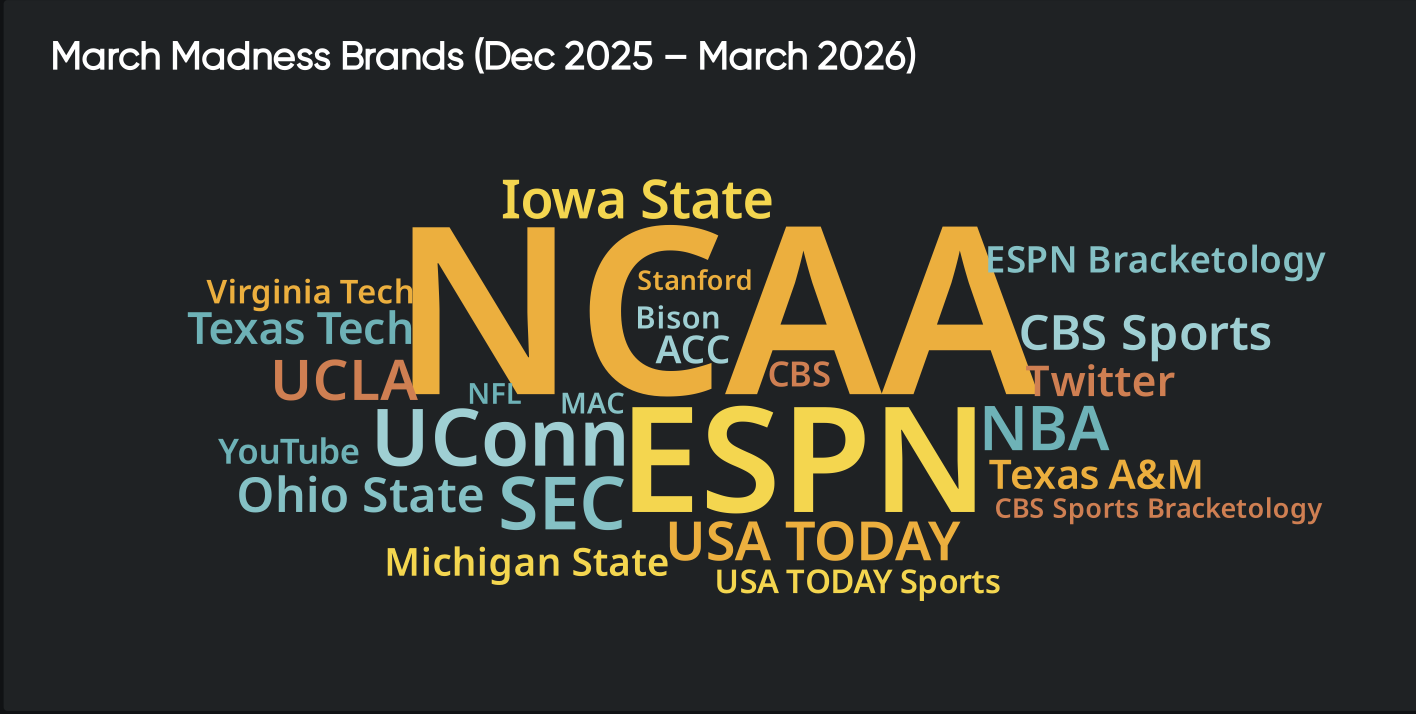
The brand landscape does not center on consumer brands, it centers on media.
NCAA, ESPN, CBS Sports, and USA Today dominate the conversation space, with bracketology tied directly to those publishers. The largest entities are not selling products. They are shaping interpretation.
That matters more than it looks like. Because in this environment, whoever controls the prediction layer controls attention. ESPN Bracketology is not just content. It is a decision framework that millions of people reference, react to, and recalibrate against.
Consumer brands show up. But they are operating inside a system defined by media authority. That shifts the role of sponsorship.
You are not just buying visibility. You are competing against the platforms that define what people believe is likely to happen.
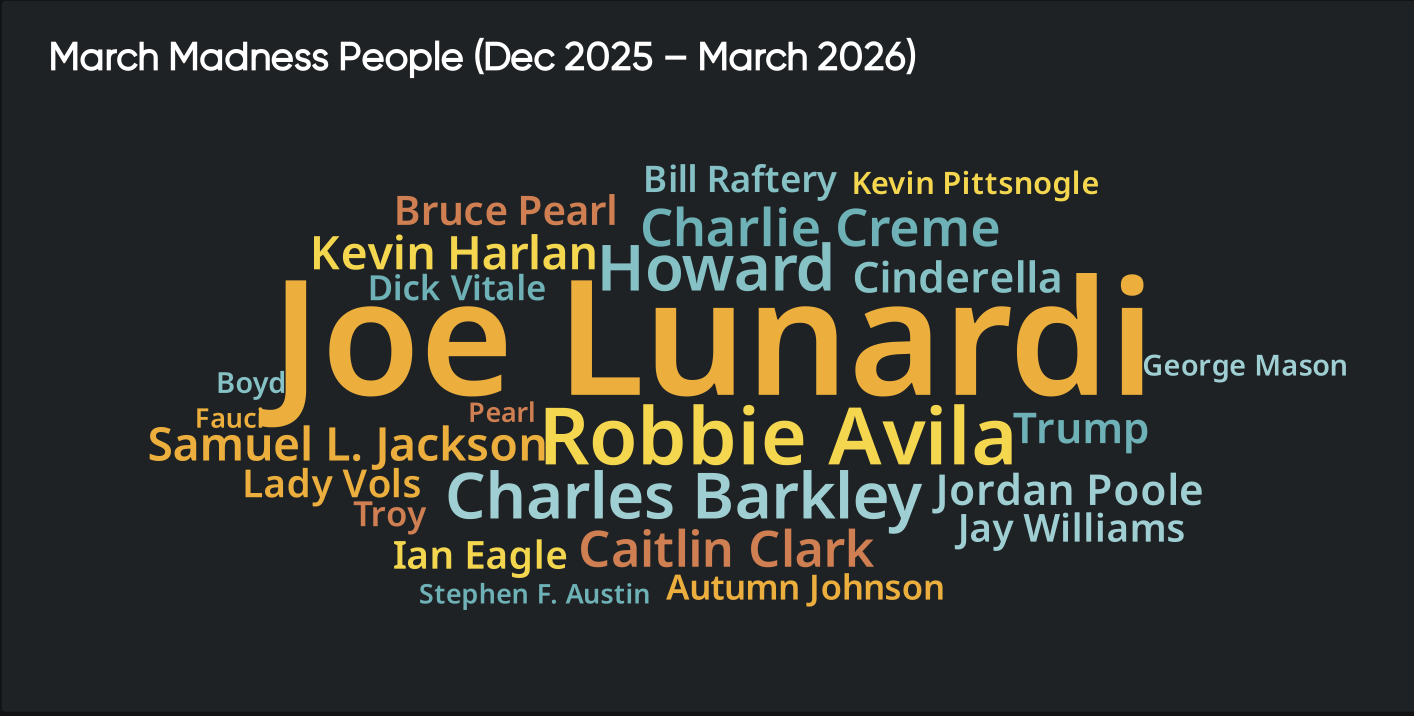
Joe Lunardi dominates the people conversation. Not a team. Not a brand. A person. He sits alongside Charles Barkley, Caitlin Clark, and Robbie Avila, creating a mix of analysts, athletes, and personalities driving engagement.
Bracketology has a face, commentary has a voice, and prediction has ownership. That creates trust concentration.
When people engage with March Madness, they are not just following teams. They are following interpreters, analysts who tell them what matters, players who give them a reason to care, and personalities who make the experience legible.
For brands, this is uncomfortable but obvious. Institutional messaging flattens, but personality-driven content travels.
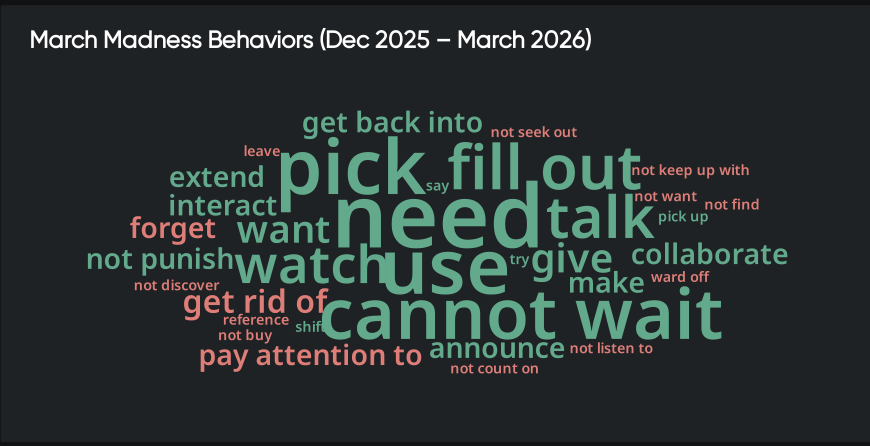
The dominant behavior terms are direct and action-oriented. “Pick,” “fill out,” “watch,” “use,” “talk,” and “give.”
Even the negative language reflects decision friction. “Cannot wait,” “get rid of,” “forget,” “not want.”
This is an instructional environment where people are not just expressing excitement. They are telling each other what to do, what to choose, and how to participate. That aligns with everything else in the dataset.
March Madness is a participation system and the conversation teaches behavior in real time:
Brands that rely on passive messaging get ignored here. If you are not helping someone do something, you are background noise.
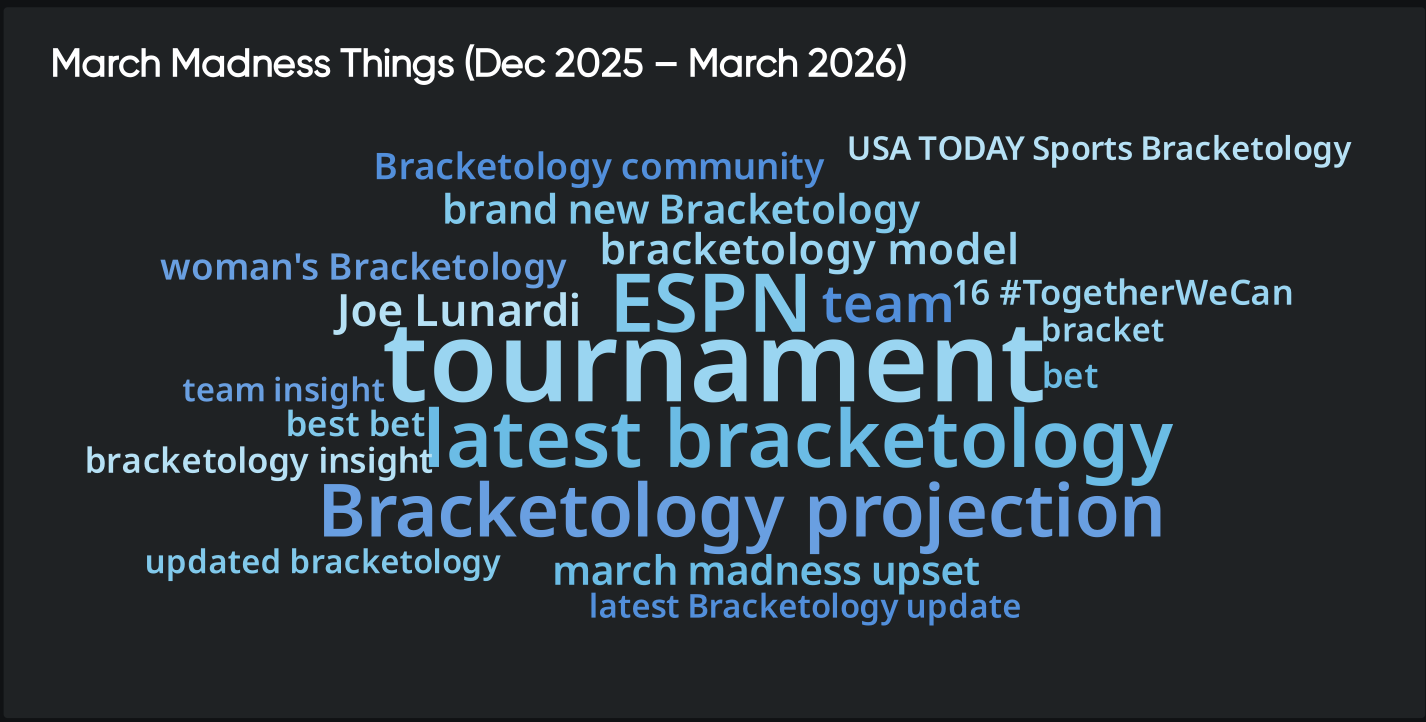
Nothing dominates the object-level conversation like bracketology.
“Bracketology projection.”
“Latest bracketology.”
“Bracketology model.”
“Best bet.”
“Bracket.”
Even “tournament” sits behind it in prominence, because that is the interface. Bracketology is how people interact with the tournament before, during, and after games. It is how they translate uncertainty into structure. And it is constantly updated.
This means engagement is not tied to static content. It is tied to refresh cycles, updates, revisions, and new projections. And that creates repeat entry points. People do not check once, they check repeatedly. And every update is an opportunity to capture attention again.
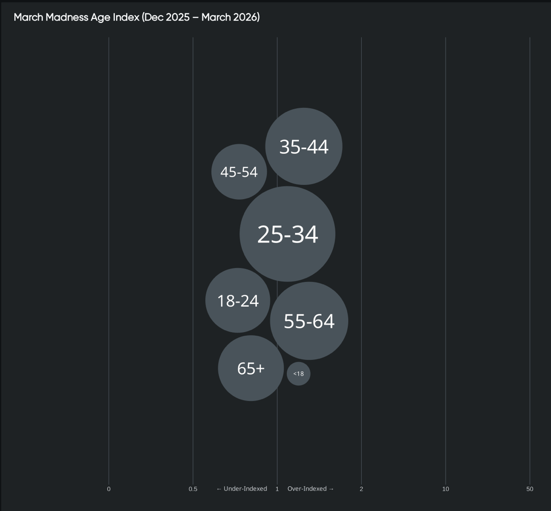
The age distribution centers around 25–44, with strong presence in 35–44 and 45–54. Younger audiences (18–24) are present but not dominant. Older segments (55–64, 65+) still participate meaningfully.
This is a decision-capable audience. These are people with disposable income who are comfortable making bets, purchases, and real-time decisions. People who understand the stakes of outcomes and engage accordingly.
That aligns directly with the behavior and language patterns.
This is active participation from an audience that can convert, not casual scrolling.
Put all of this together and the pattern gets very clear.
This is not a content ecosystem. It is an operating system for decision-making at scale, and brands are plugging into it mid-process. Here’s what brands must do:
1. Compete at the interpretation layer, not just visibility
If media and analysts shape decisions, brands need to attach to those frameworks, not just run alongside them.
2. Partner with personalities who influence decisions
Athletes and coaches matter, but analysts matter more than most brands want to admit.
3. Build tools, not just campaigns
Brackets, projections, comparisons, and updates outperform static content because they match how people engage. They want to feel involved.
4. Design for repeat entry, not one-time exposure
Bracketology proves people come back constantly. Give them a reason to return.
5. Treat this as a decision economy, not an awareness play
Everything in this dataset points to action. Brands that stay in awareness mode are missing the entire point.
Need help turning this into an action plan?
Quid shows you where decisions are forming, not just where conversations are happening. That is where strategy gets sharper, timing gets clearer, and campaigns actually convert. Reach out today to start building against real signals.