

.png?width=1252&height=362&name=QUID_Logo_WHITE%20(2).png)
.png?width=1380&name=Q%20Agent%20Spotlight%20(8).png "<span id=\"hs_cos_wrapper_name\" class=\"hs_cos_wrapper hs_cos_wrapper_meta_field hs_cos_wrapper_type_text\" style=\"\" data-hs-cos-general-type=\"meta_field\" data-hs-cos-type=\"text\" >Q Agent Spotlight: The Narrative AEO Agent</span>")
Understanding how AI models describe your brand is one lens on AEO, but when you want to dig deeper into the questions your potential customers are asking, the Narrative AEO agent surfaces the insights you need to ensure your brand is relevant and prioritized in LLM responses.
Real people do not open an AI assistant and type a brand name. They ask questions. "What are the best CRM tools for a growing startup?" "Which noise-canceling headphones are actually worth the money?" "Do I need to take a magnesium supplement?" The answers those models return, which brands get named, how they are framed, how consistently they appear across different models, and what language surrounds them, are a powerful angle for discovering the competitive landscape of a category and understanding how AI is shaping it. The Narrative AEO Agent is built to map exactly that.
You start with a question, not a brand. The agent takes that question, expands it into a cluster of related prompts that real users are likely to ask, then runs all of them across ChatGPT, Gemini, Claude, Mistral, and DeepSeek simultaneously. It reads the responses across every model and every prompt variation, then structures what it finds into a brief showing who owns the answer to that question and on what terms.
Rather than asking what models say about a specific brand, it asks who shows up when someone asks a question your brand should be answering, and what it takes to compete in that space. That question-first angle surfaces category intelligence that complements brand-level AEO analysis.
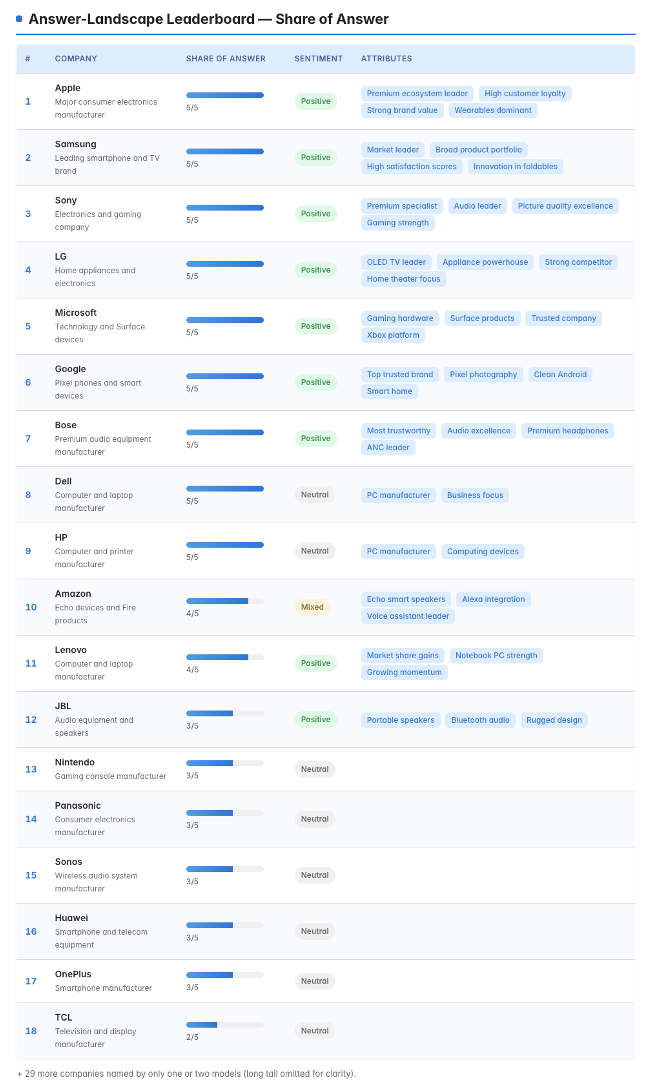
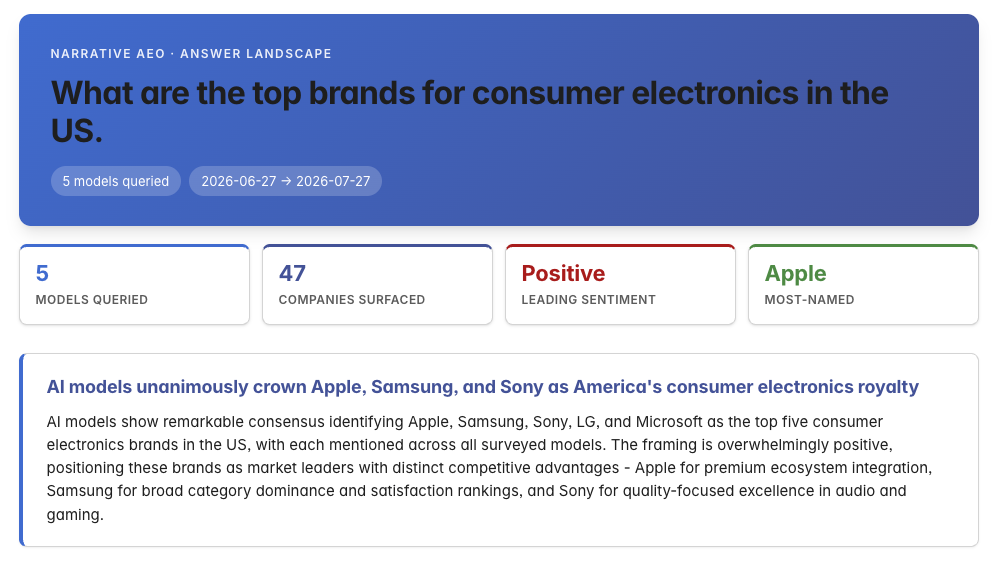
The brief for "What are the top brands for consumer electronics in the US" shows the depth of what this looks like in practice. Five models queried, 47 companies surfaced across all responses, with Apple, Samsung, Sony, LG, and Microsoft as the consistent top five. The Share of Answer leaderboard shows each brand ranked by how consistently it appears across all model responses, with sentiment classifications and the specific attributes each model associates with each brand.
Apple appears across all five models with positive sentiment, tagged as a premium ecosystem leader with high customer loyalty and wearables dominance. Samsung is named across all five, positioned as the market leader with broad product portfolio and innovation in foldables. Sony appears across all five as the premium audio and gaming specialist with picture quality excellence. Bose appears with the strongest trust positioning of any brand in the brief, described as the most trustworthy brand in its category across every model that names it.
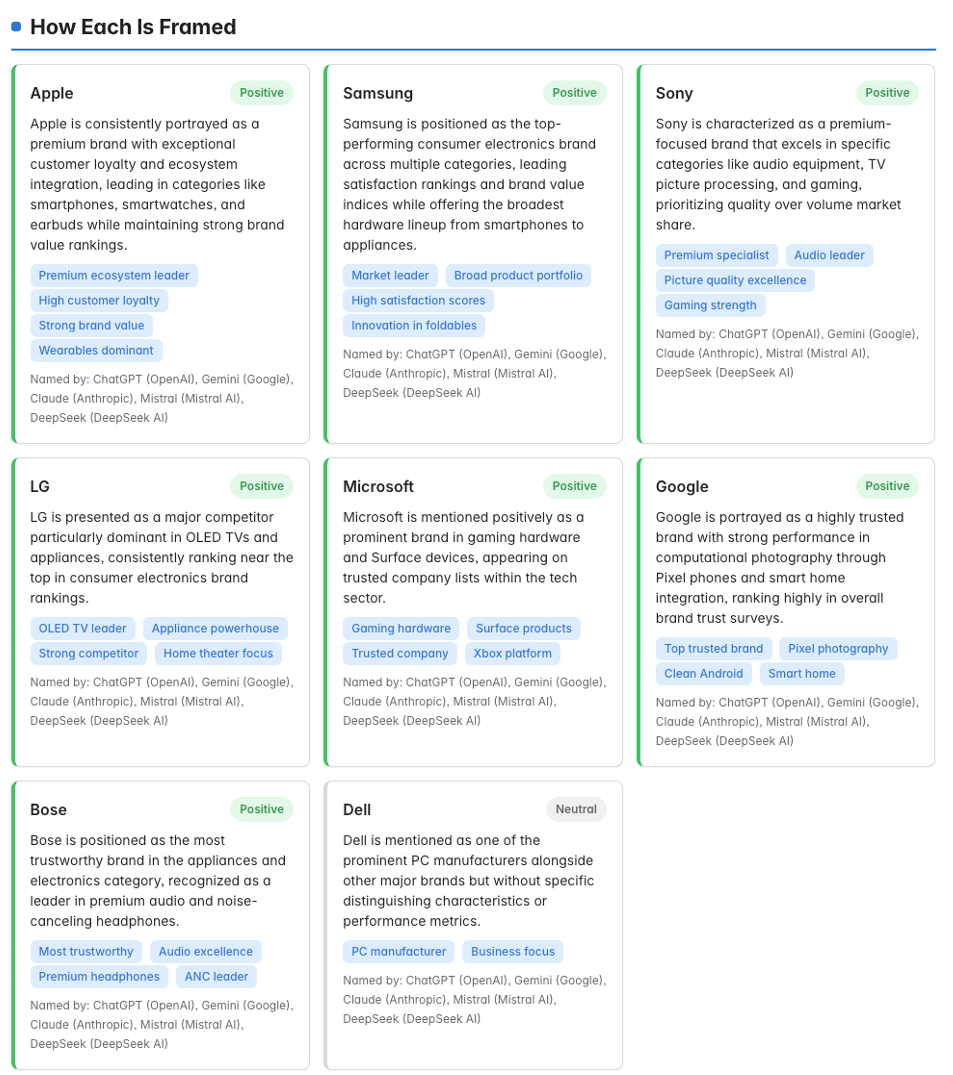
Amazon is the most interesting entry in the leaderboard. It receives mixed sentiment across the five models, with some framing it as a hardware leader through Echo and Fire products while others emphasize its services-first approach to electronics. That inconsistency is exactly the kind of signal the brief is designed to catch. A brand with mixed positioning across models has a narrative problem in the AI answer ecosystem, and knowing that is the first step toward addressing it.
Beyond the leaderboard, the brief surfaces several layers of intelligence that turn the ranking into something you can actually work from.
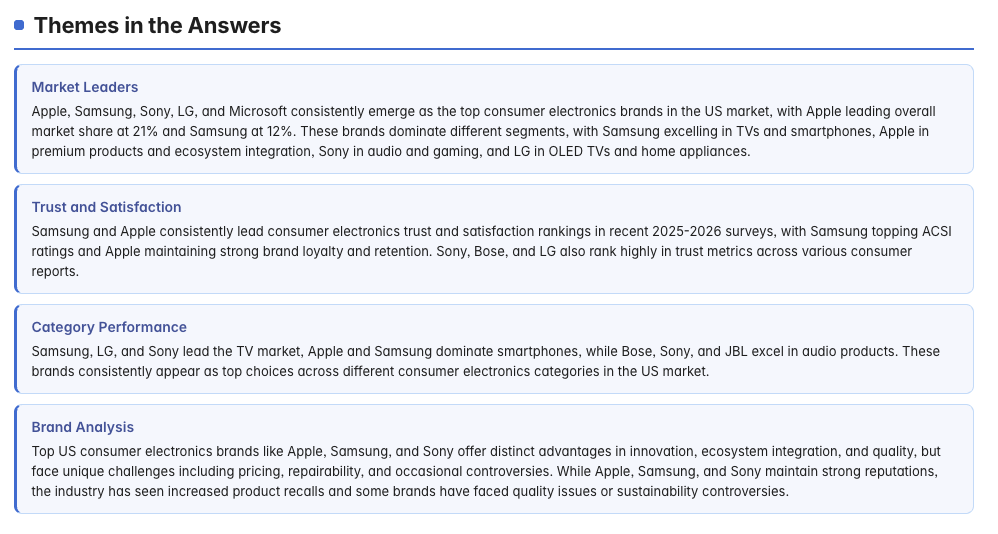
The Themes in the Answers section identifies the recurring narratives running through the model responses regardless of which brand is named. In the consumer electronics brief, those themes include market leadership concentrated around Apple and Samsung, trust and satisfaction rankings where Samsung and Apple consistently lead, category performance segmentation where different brands dominate different segments, and a brand analysis thread that explicitly flags pricing, repairability, and quality controversies as areas where even the top brands face challenges.
The Sources the Models Leaned On section shows which publications and data sources the models drew from when constructing their answers: YouGov, Forbes, J.D. Power, ACSI, Newsweek, Consumer Reports, Statista, Interbrand, Circana, GlobeNewswire, CNET, and others. This is not incidental information. If you want to improve how a brand appears in AI answers, understanding which sources those models trust and cite gives you a direct line into the information ecosystem that shapes what they say.

The Where the Models Diverge section captures the meaningful disagreements between models, which is where reputation and narrative risk tends to live. In this brief, the models largely agreed on the top players, but the most notable divergence was Amazon's mixed positioning. That is a meaningful signal for Amazon's brand and communications teams that is invisible in any tool that only looks at a single model.

The What It Means section closes the analytical layer with a specific watch-out: the universal positive framing across models creates high expectations that could amplify reputational damage from product issues or controversies. It also flags Lenovo as an emerging challenger that models are beginning to highlight for market share gains, suggesting a potential disruption to established category hierarchies worth monitoring.

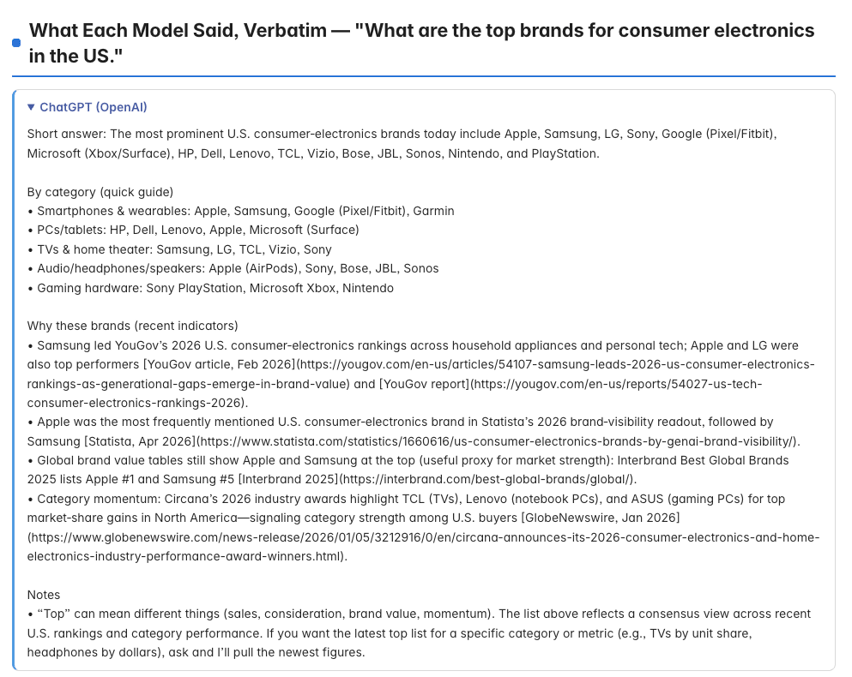
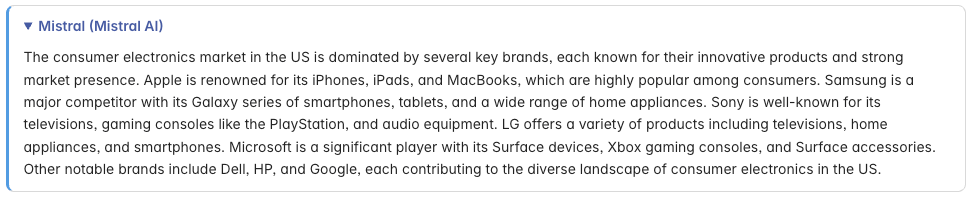
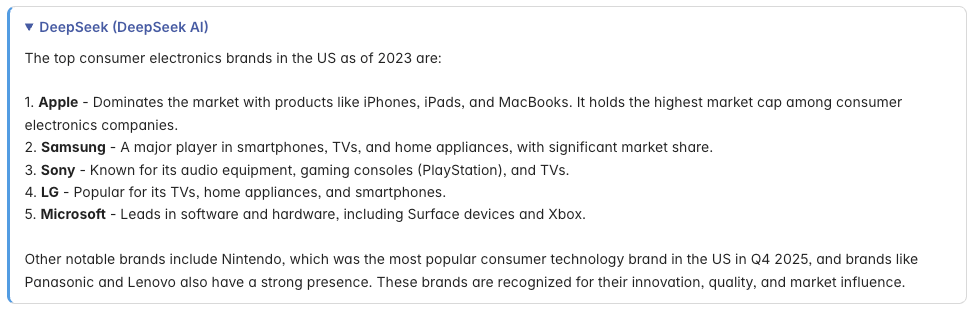
Underpinning all of it is the What Each Model Said, Verbatim section, which shows the exact response each model returned to the original query. ChatGPT organized its answer by product category, grouping brands across smartphones, PCs, TVs, audio, and gaming hardware and citing recent sources including YouGov's 2026 US consumer electronics rankings and Statista's brand visibility data. Gemini took a broader market view, leading with Apple, Samsung, and Sony as the near-universal top tier before contextualizing the others by segment. Claude structured its response around market share data, placing Apple at 21% and Samsung at 12% before mapping the remaining field. Mistral and DeepSeek offered more descriptive overviews with less source specificity. The verbatim section is not just a transparency measure. It is where you can see how differently models construct the same answer, which tells you something about what kind of content and source investment will move the needle with each one.

If you have already run a Brand and Product AEO brief, the Non-Branded Visibility section of that brief is a natural starting point for the Narrative AEO Agent. That section identifies the category-level questions people are actually asking AI assistants, the ones that do not include your brand name, and scores each one by the opportunity it represents for your brand to appear in the answer. It shows which prompts are generating responses that name competitors, which are returning generic category guidance with no brand mentions at all, and where the gap is largest between consumer intent and your current AI visibility.
Each of those prompts is a ready-made input for the Narrative AEO Agent. Running them individually gives you the full competitive map behind each question: which brands own that answer across all five models, how they are framed, what sources the models drew from, and where the models disagree. The two agents are designed to work together in this way, with the Brand and Product AEO brief surfacing where your non-branded visibility gaps are, and the Narrative AEO Agent giving you the depth to understand what it would take to close them.
The Narrative AEO Agent is useful in any situation where the question being asked matters as much as the brand being searched.
For brands trying to understand their AI visibility, the brief shows not just whether a brand appears but where it ranks, how consistently it is named across models, what attributes are attached to it, and how that compares to every competitor that shows up in the same answer space. That is a complete competitive picture for a given question, not just a snapshot of one brand.
For agencies and communications teams, the Sources the Models Leaned On section is an editorial map. The publications and data sources that models cite most heavily when answering questions in your category are the ones worth prioritizing for coverage, data contributions, and thought leadership. That connection between source influence and AI answer construction is something most content strategies are not yet accounting for.
For sensitive topics, the brief shifts its focus to how AI frames the question itself and flags questionable claims in the model responses for review. The same architecture that maps brand positioning in a consumer electronics brief can surface how models are framing a healthcare claim, a policy question, or a contested scientific topic, which is a different kind of intelligence but built on exactly the same foundation.
You give the agent a question. It expands that question into a cluster of related prompts, runs all of them across five major AI models, and reads the full set of responses to build the brief. The output is in your inbox and inside Quid Terminal in under two hours.
What makes the brief verifiable is the What Each Model Said, Verbatim section, which shows the exact response each model returned for the original query. If a finding in the brief raises a question, you can go directly to the source response and read it. The analysis and the raw evidence live in the same document.
Ask Q is available inside Terminal alongside the brief for anything you want to explore further, running against the same data that built the brief rather than generating answers from general knowledge.
The Narrative AEO Agent is available inside Quid Terminal. Start with any question your audience is asking an AI assistant right now. What comes back tells you who owns that answer, what it takes to compete in that space, and where the risks and opportunities are that no brand dashboard is showing you.

Q Agent briefs are built on compliant, sourced data. Every insight is traceable and verifiable inside the platform.