

.png?width=1252&height=362&name=QUID_Logo_WHITE%20(2).png)
.png?width=752&name=template%20big%20title%20(2).png "template big title (2)")
Most brands approach Mother's Day and Father's Day as variations of the same marketing moment. They launch a gift guide, run some promotions with emotional creative and wait for consumers to convert.
But the data suggests they are actually very different consumer events.
While Mother's Day conversation in 2026 centered on storytelling, caregiving, family relationships, and emotional experiences, Father's Day (as of this writing) operated much more like a decision-making environment. Consumers were actively evaluating products, planning activities, comparing gift options, and searching for practical ways to celebrate.
The difference becomes obvious when you look beyond surface-level mentions and examine how the conversations evolved. This is insight that brings us well beyond a Gen AI search.
This comparison dashboard immediately challenges some common assumptions.
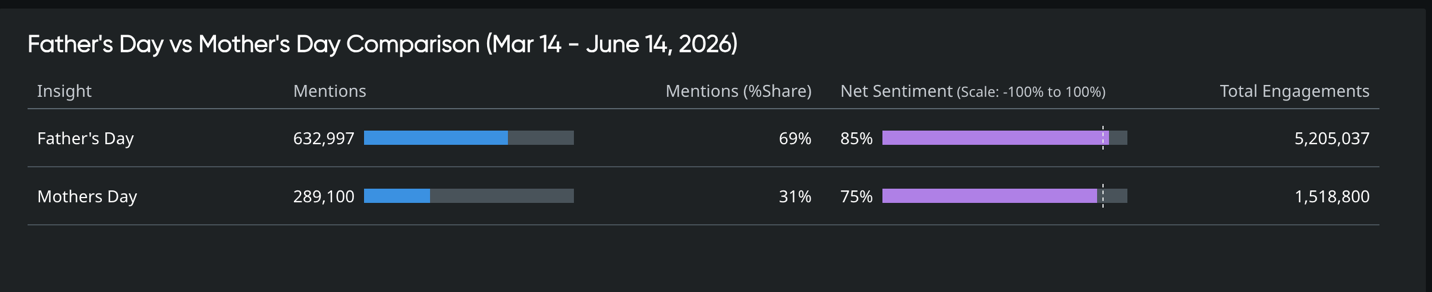
Father's Day generated more than 633,000 mentions compared to approximately 289,000 for Mother's Day. It also drove significantly higher engagement and stronger net sentiment. On the surface, that seems surprising given the amount of cultural attention typically devoted to Mother's Day.
The explanation becomes clearer when we examine how people actually talked about each holiday.
One of the strongest differences between the two holidays appears in the surrounding content ecosystem.
Mother's Day coverage was dominated by:
Father's Day coverage looked very different. The conversation centered on:
The distinction reveals different consumer mindsets. Mother's Day encouraged reflection and Father's Day encouraged action.
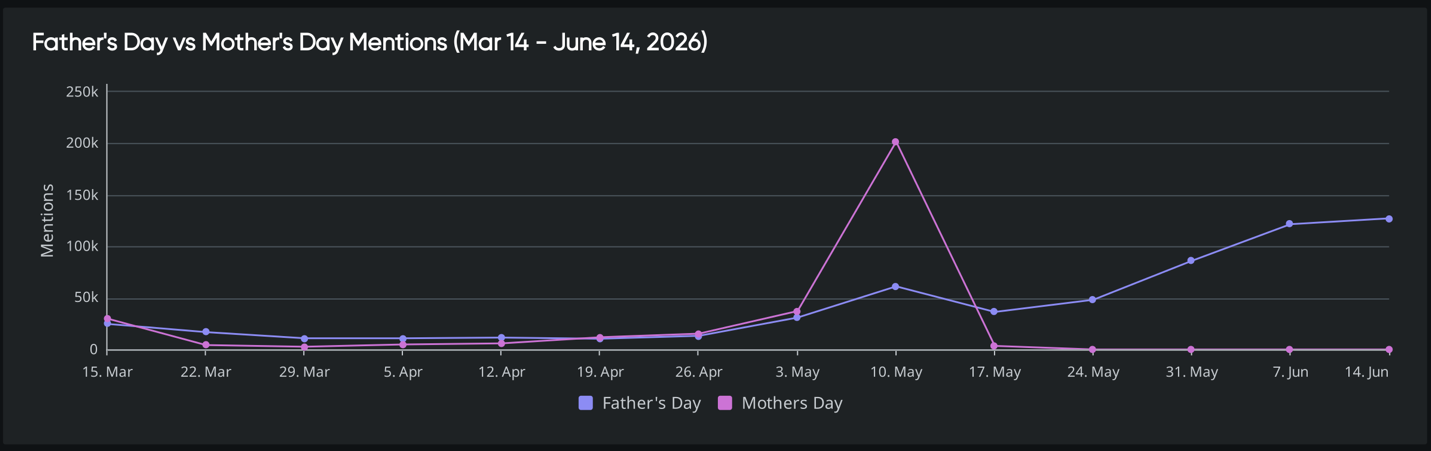
The mentions timeline reinforces this behavioral difference.
Mother's Day behaves like a traditional event. Conversation surges sharply around the holiday itself before quickly declining.
Father's Day behaves more like a shopping season. Discussion builds gradually over multiple weeks as consumers evaluate options, compare ideas, and make purchasing decisions.
For marketers, that creates a longer activation window and more opportunities to influence behavior before the holiday arrives. Also, it seems we’re putting less thought into grabbing a quick gift for mom, versus that “so hard to buy for” Dad.
It would be easy to assume Mother's Day dominates emotional conversation, but the data tells a more nuanced story.
Both holidays generated strong expressions of appreciation, gratitude, and affection. Both holidays also triggered significant grief and loss narratives. What differed was how those emotions were expressed.
Mother's Day conversations focused heavily on caregiving, family relationships, and emotional labor.
Father's Day conversations centered on appreciation for guidance, protection, dependability, mentorship, and quiet sacrifice.
Across platforms, one phrase appeared repeatedly: "Presence over presents."
Consumers consistently emphasized quality time, shared experiences, meals, and simple recognition over expensive gifts.
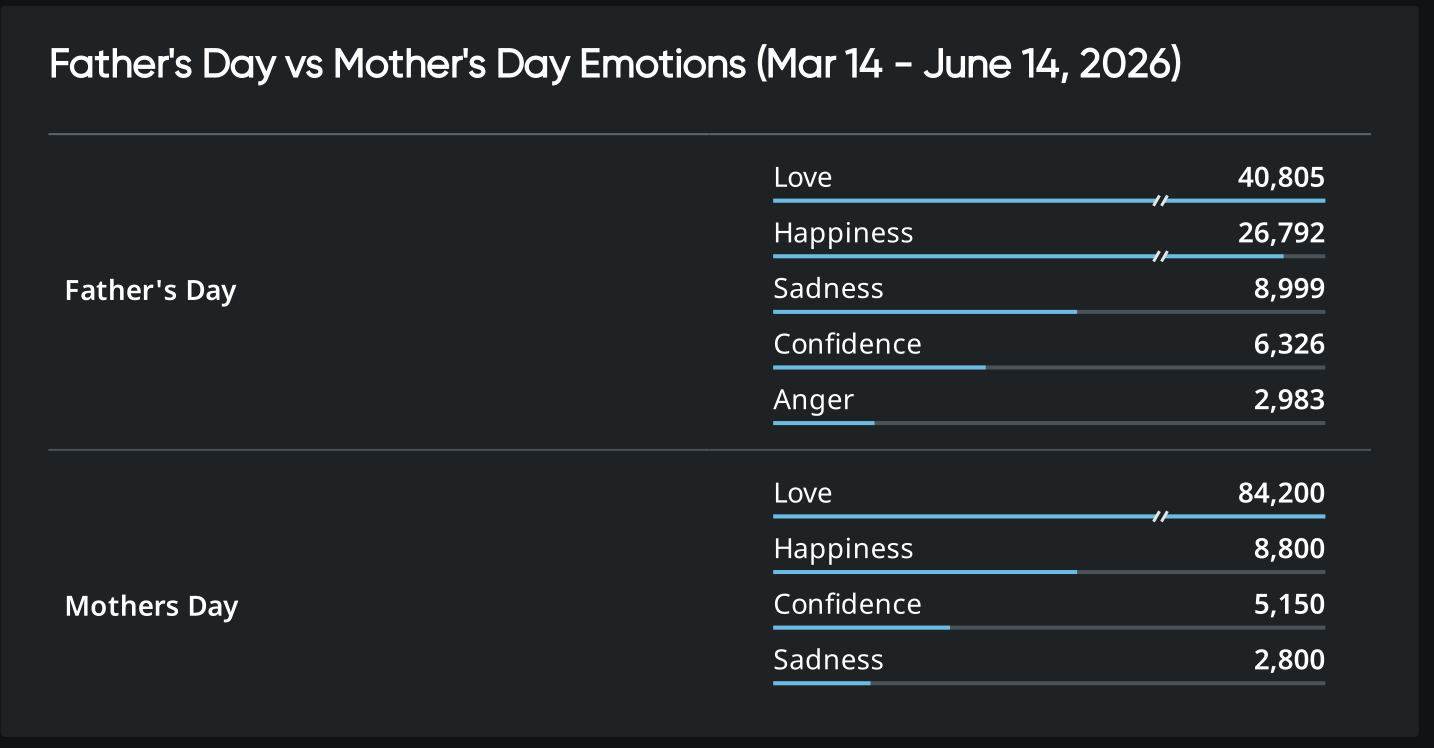
The emotional breakdown reveals something particularly interesting. Mother's Day generated substantially more expressions of love. Father's Day generated more happiness, more sadness, and slightly higher expressions of confidence.
That combination reflects the unique position Father's Day occupies online.
Consumers are celebrating fathers while simultaneously discussing loss, absence, difficult family histories, and unresolved relationships.
The conversation is less sentimental than Mother's Day, but it is not less emotional. It is simply emotionally different.
One of the strongest signals across Twitter, Reddit, TikTok, Facebook, and Instagram was grief. People discussed:
At the same time, another recurring theme emerged. Many consumers argued that Father's Day receives less attention than Mother's Day.
Whether accurate or not, the perception appeared repeatedly across platforms.
Consumers expressed frustration that Father's Day receives less promotion, fewer celebrations, and less cultural recognition despite the importance they place on fatherhood.
This creates an unusual emotional mixture.
All occurring simultaneously.
One of the clearest examples of why Quid matters appears in the platform analysis. While a traditional search result might conclude that Father's Day conversation is broadly positive, Quid shows entirely different audience behaviors depending on where consumers are participating.
Facebook centered on family stories and gratitude.
Instagram focused on celebration and gift inspiration.
TikTok blended gift discovery, practical recommendations, and humor.
Reddit consistently favored low-pressure celebrations built around the father's actual preferences.
Twitter carried some of the strongest grief narratives alongside debates about whether Father's Day receives enough attention.
Those seemingly small differences represent entirely different consumer motivations hiding beneath the same holiday.
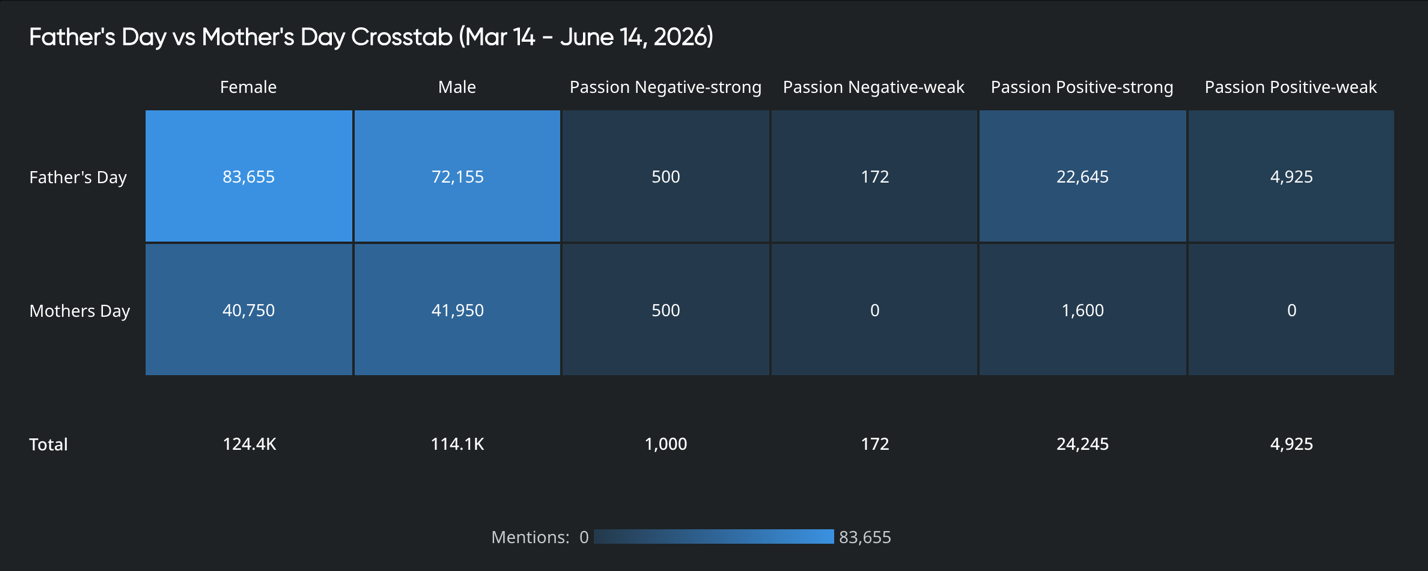
The crosstab visualization highlights just how differently consumers engaged with the two holidays.
Father's Day generated significantly stronger positive-passion engagement while also attracting larger overall audience participation. The result is a holiday that appears more commercially active while still carrying substantial emotional complexity.
The biggest lesson is about understanding how consumers participate in seemingly similar events for very different reasons.
Mother's Day functioned primarily as a storytelling environment. Consumers discussed relationships, caregiving, family dynamics, personal experiences, and emotional milestones.
Father's Day functioned more like a decision environment. Consumers evaluated products, experiences, activities, and practical ways to demonstrate appreciation.
That difference affects everything from creative strategy to promotional timing. Brands that treat both holidays identically risk missing the behaviors actually driving engagement and conversion.
Most importantly, this analysis demonstrates the difference between seeing conversation and understanding it.
That is where meaningful consumer intelligence lives.
Mother's Day and Father's Day may appear similar on the surface, but the behaviors driving them are fundamentally different. Quid helps brands uncover those hidden distinctions across holidays, audiences, categories, and markets, revealing not just what consumers are discussing, but how those conversations influence decisions, loyalty, and spending.
Reach out to see how Quid can help uncover the signals shaping your audience today and the trends shaping your business tomorrow.
Why did Father's Day generate more engagement than Mother's Day?
The conversation was significantly more commerce-oriented, creating more opportunities for consumers to engage with products, experiences, promotions, and recommendations.
What was the biggest difference between the holidays?
Mother's Day centered on storytelling and caregiving. Father's Day centered on decision-making, experiences, and purchasing behavior.
Did both holidays include grief-related conversation?
Yes. Both contained substantial grief narratives, although Father's Day discussions were more likely to include themes of absence, estrangement, and perceived cultural underrecognition.
Why are platform differences important?
Different platforms revealed different audience motivations. Understanding those differences helps brands tailor messaging, creative, and promotions more effectively.
Reach out to Quid to uncover the behavioral patterns shaping your audience before they become visible to the broader market.