

.png?width=1252&height=362&name=QUID_Logo_WHITE%20(2).png)
Consumers announce their brand breakups on social media every day, with statements and testimonies about how they’ll “never buy from X again" or "switched from Y to Z.”
If you're the brand being mentioned in that post, you want to know about it. A defection announcement is a customer telling you exactly what went wrong, in their own words. Even how consumers talk about your competitors or your industry as a whole can be as useful, giving you a heads up to fix potential pain points before your customers start churning.
Social listening, or the practice of tracking and analyzing what people say about your brand, competitors, and category across social platforms, gives us a systematic way to see this in real time, giving you a clear picture of what's actually driving consumer defection in 2026.
In this article, we’re looking at what that social listening data reveals, from how people phrase these breakups to which brand categories face the highest risk of a public defection.
To understand what drives consumers to publicly break up with brands, we analyzed social conversations with Quid, drawing on a dataset that captures a vast array of online conversations across multiple platforms, such as Reddit, YouTube, and Instagram.

While some posts are simple, clear-cut declarations, a large share of the content includes concrete reasons and evidence for quitting a brand. That level of detail is what makes these conversations so valuable. It tells you precisely where you're falling short, or where a gap has opened up between what you say and what you do.
There's also a consistent pattern of values-based reasoning. These online, public “breakups” don’t often involve casual buyers. They typically come from loyal customers who feel betrayed, maybe because the brand acted against the customer’s values or because it stopped rewarding their years of loyalty. Either way, they're posting out of anger and disappointment, not indifference.
This values-based reasoning also explains why some conversations become far more coordinated than others. While a poor experience might cause someone to quietly switch brands, perceived betrayals of trust or values are much more likely to trigger public campaigns, like boycotts or petitions. Rather than simply expressing disappointment, these consumers are trying to influence the behavior of both the brand and other customers.
Social listening also reveals that a brand breakup doesn't look the same for everyone. The reasons customers leave may be similar across generations, but the channels they choose, the language they use, and the response they want from brands can look very different.

For instance, younger consumers tend to frame their breakup as discovery: "Here's what happened. Be aware." It's addressed to peers and designed to spread the word. An older consumer's post often reads more like a formal grievance. It’s addressed to the brand itself, aimed at getting a response or a fix, and willing to go into far more detail to make the case.
|
Younger consumers |
Older consumers |
|
|
Format |
Short, visual, built to spread; TikTok clips, quick videos |
Long-form content, such as forum posts, detailed social posts, & repeat reviews across sites |
|
Framing |
A discovery, packaged as a warning to others |
A grievance, told with context and specifics |
|
What they emphasize |
Ethics, social impact, how the brand behaves on the platform |
Value erosion, transparency, quality of after-sale support |
|
What they’re after |
Persuading peers, social pressure on brands |
Getting the issue fixed, sometimes referencing policy or legal standing |
The distinction between how generations publicly denounce a brand matters for how you monitor and respond. A brand only watching long-form reviews and forums will miss the trending TikTok, while a brand only watching short-form video will miss the detailed, evidence-heavy complaints that could carry real weight with press or regulators.
So which brands are most likely to become the subject of these public defections? Social listening data suggests it’s actually the ones that have cultivated the strongest emotional relationships.
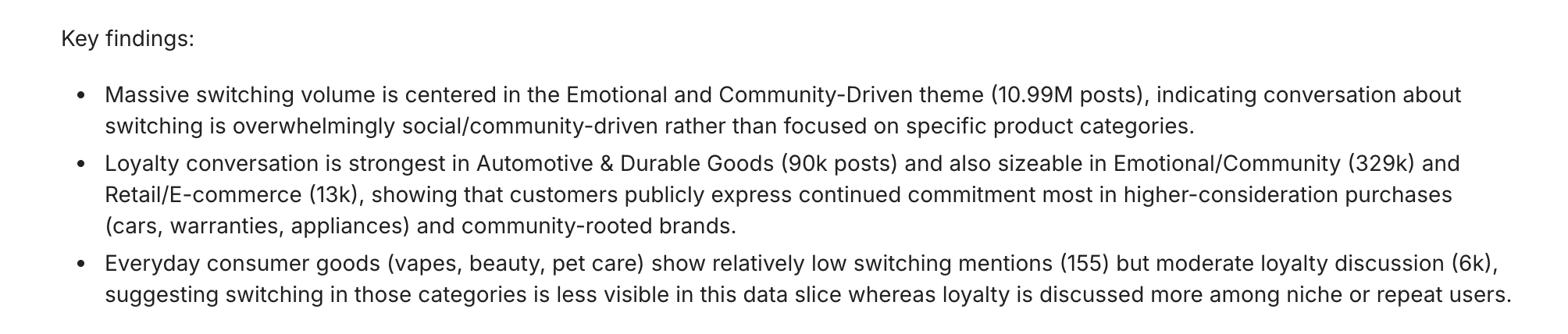
Brands built on emotions and community generate more public "breakup" conversations than categories where switching is largely transactional. For instance, everyday consumer goods don't generate much switching conversation. That’s likely because switching is low-effort, so people just do it quietly instead of announcing it.
High-consideration purchases like cars and appliances also don't generate as much switching conversation. These are decisions people research heavily before committing, and that research seems to make them less willing to publicly denounce it afterward. When these categories do show up in social listening data, it's more often in conversations about loyalty than in conversations about switching brands.
Loyalty and community-driven brands, however, are the opposite. This makes sense considering consumers would only talk about "switching" because they were loyal in the first place. They invested time, money, and trust into a brand, and when that stops paying off, they want to air the grievance publicly. People also post when they know there's a community of others who may be feeling the same thing.
Hotel loyalty programmes, subscription services, and other businesses built around repeat engagement illustrate this dynamic well. Their biggest strength is the deep relationship they build with customers, but that relationship also raises expectations. The stronger the emotional investment, the more likely customers are to publicly react when they feel the brand has broken its side of the bargain.
The data doesn't point to one universal reason why customers publicly leave a brand. Across social media, consumers cite everything from poor customer service and rising prices to declining product quality and value misalignment. The reasons vary widely depending on the brand, industry, and customer, making it difficult to draw meaningful conclusions from the broader conversation alone.
It’s more useful to narrow the focus to your own brand and category. Social listening tools let you track mentions, complaints, and public "breakup" posts as they happen, helping you identify the specific issues driving customers away. Instead of guessing why loyalty is slipping, you can see recurring themes emerge directly from customer conversations and directly address them.
But reacting to complaints is only part of the picture. The strongest brands also monitor sentiment over time. Keeping an eye on how customers' expectations, perceptions, and emotions change helps you spot when your brand is falling short of what people expect. It also makes it easier to see loyalty risks early, check whether your changes are working, and fix problems before they lead to public defections.
Public brand breakups may represent only a small slice of online conversations, but they're often some of the richest sources of customer feedback. The challenge is that these signals are scattered across thousands of posts, reviews, videos, and comments. Finding meaningful patterns manually isn't realistic.
Quid helps brands turn that volume of unstructured data into actionable insights. Rather than having teams manually sift through endless social posts, reviews, and online discussions, Quid connects to a wide range of social, search, market, and internal sources, with purpose-built Q Agents surfacing the insights that matter most.
For example, the Brand Sentiment Analysis Q Agent tracks how people feel about your brand across social platforms, reporting on key themes, emotions, complaints, and platform-specific differences. The Subject Sentiment Analysis Q Agent applies the same approach to broader topics, such as your product category or an emerging industry trend. Those are just two examples from a library of more than 40 specialized Q Agents designed to answer common business questions faster.
Those are just two of more than 30 specialized Q Agents built around common business questions. Rather than simply presenting dashboards full of raw data, our AI Agents summarize key findings, highlight actionable insights, and help teams quickly move from understanding customer conversations to making informed decisions.
Social listening is the process of monitoring and analyzing online conversations about your brand, competitors, and industry across social platforms.
Social listening data can help brands understand customer sentiment, identify recurring complaints, and spot changes in expectations before they impact loyalty.
Brands built around loyalty, community, and repeat engagement are often the most exposed, since stronger reactions occur when customers have invested more time, money, and trust into the relationship. Brands with subscription models and loyalty programmes are good examples of this.
Social listening helps brands identify patterns across customer conversations, such as growing frustration with pricing, service issues, or changing expectations. These insights allow brands to address problems earlier, before dissatisfaction turns into widespread negative sentiment or public criticism.
AI-powered social listening tools can analyze large volumes of conversations, identify themes, and surface sentiment trends faster than manual monitoring. Solutions like Quid use AI-powered workflows to help brands investigate specific questions, such as changes in brand sentiment or consumer reactions to emerging topics.
