

.png?width=1252&height=362&name=QUID_Logo_WHITE%20(2).png)
Brooklyn Rosenhan
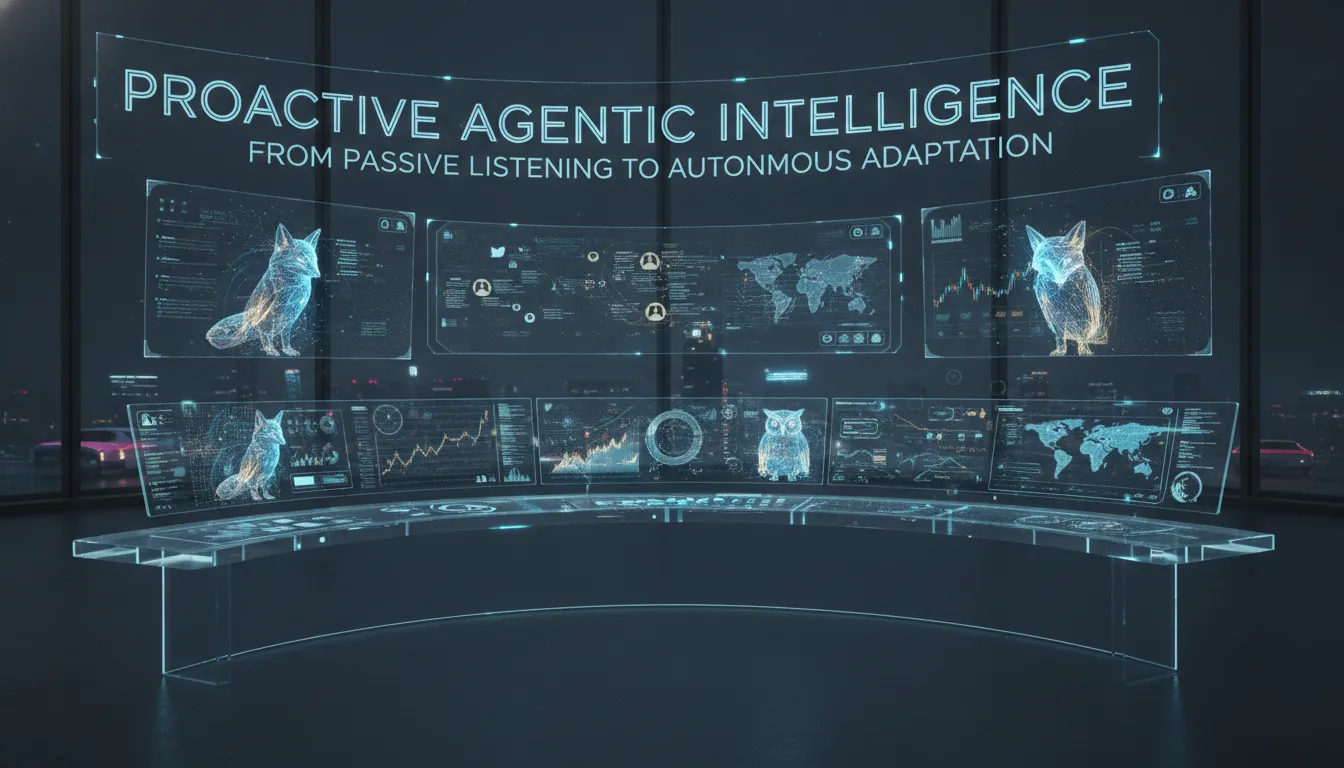
Billions of daily social media posts have turned traditional social monitoring into a structural challenge for global brands. Most teams are drowning in data but starving for actionable outcomes. The era of the passive dashboard is ending as agentic AI takes over. Explore how Q Agents can transform your market intelligence today.
Enterprise social listening tools were designed for a slower, less complex digital ecosystem. They surfaced charts and keyword counts but left the analytical burden on human teams. Modern agentic AI platforms reverse this equation by deploying autonomous agents that reason across billions of signals. Deliver prescriptive business outcomes, and close the gap between observation and strategy. According to Gartner, 40% of enterprise applications will embed task-specific AI agents by 2026, signaling an industry-wide pivot from passive analytics to proactive intelligence.
Understanding why legacy dashboards fail at enterprise scale is the first step toward building a more responsive market intelligence capability.
Traditional social listening platforms were architected for volume tracking, not strategic analysis. They generate static dashboards that require manual interpretation, leaving enterprise teams with raw data and no clear path to action.
Across industries, organizations are confronting four structural limitations that make legacy tools insufficient for modern demands:
Agentic social intelligence represents an architectural departure from passive listening. Instead of presenting data for human interpretation, autonomous AI agents ingest, reason about, and act upon social signals in real time, delivering business outcomes rather than dashboards.
Whereas legacy tools surface what happened, agentic systems answer why it happened and what to do next. This shift is grounded in three capabilities:
According to Salesforce, 75% of marketers are now experimenting with AI in their workflows. However, the gap between experimental use and enterprise-grade deployment remains wide. Agentic intelligence bridges this gap by embedding autonomous analysis directly into market intelligence workflows.
Agentic AI restructures the intelligence pipeline from manual collection-and-review to automated analysis-and-recommendation, collapsing weeks of research into near real-time insights.
The transformation affects every stage of the market intelligence lifecycle:
In the public health sector, researchers use similar AI-driven social listening frameworks to identify and combat health misinformation at scale. For enterprise teams, the same methodology applies to brand protection, market trend detection, and competitive strategy. Organizations that adopt agentic workflows move beyond legacy social listening into a model where intelligence generation is continuous and autonomous.
The most consequential shift in market intelligence is the transition from data display to outcome delivery. Agentic platforms measure success by business results, not dashboard views.
This outcome-engineering model changes how organizations evaluate their intelligence investments. Instead of asking "how many mentions did we track," leaders ask "what business value did the intelligence generate?" The metrics shift accordingly:
The Quid market intelligence platform operationalizes this model through Outcome Engineering, a framework that maps every intelligence activity to a measurable business objective. Teams no longer receive raw data streams and interpret them independently. Instead, they receive synthesized, decision-ready intelligence that connects directly to revenue, brand equity, and competitive positioning.
The limitations of dashboard-centric intelligence are not theoretical for Fortune 500 teams navigating global markets. They face data volumes, visual blind spots, and response-time pressures that legacy architectures cannot address.
Three converging forces are driving enterprise adoption of agentic intelligence:
AI agents serve as the operational middle layer that turns raw social signals into strategic intelligence. They absorb the analytical burden that previously required entire teams of junior analysts, freeing senior leaders to focus on execution and strategy.
The operational difference between traditional social listening and Quid's agentic approach can be illustrated across every dimension of the intelligence workflow.
| Capability | Traditional Platforms | Quid (Agentic AI) |
|---|---|---|
| Intelligence delivery | Static dashboards and charts | Autonomous AI agents with prescriptive output |
| Analysis method | Manual query, filter, and interpretation | AI-driven pattern discovery and reasoning |
| AI capability | Reactive keyword matching | Proactive outcome engineering |
| Time to insight | Days or weeks of analyst research | Near real-time synthesized answers |
| ROI model | Value per login or seat license | Value per measurable business outcome |
| Scalability | Constrained by staff headcount | Infinite signal processing via agent orchestration |
| Multi-modal coverage | Text-only keyword tracking | Text, image, video, and conversational analysis |
Traditional platforms require organizations to invest heavily in analyst headcount to extract value from their data subscriptions. In contrast, Quid's Q Agents perform the analytical work autonomously, allowing enterprises to scale intelligence without scaling headcount linearly. Gartner's projection that 40% of enterprise apps will embed AI agents by 2026 underscores how fundamental this architectural shift has become. Organizations that maintain dashboard-only intelligence risk competitive disadvantage as peers adopt agentic workflows that deliver faster, deeper, and more actionable market intelligence.
Generative AI produces content text, images, or code from prompts. Agentic AI goes further: it reasons, plans, and executes multi-step tasks autonomously. While generative tools respond to instructions, agentic agents pursue objectives, use external tools, and adapt their approach based on outcomes. In a market intelligence context, generative AI can draft a summary of a trend report, but agentic AI can discover the trend. Validate it against multiple data sources, assess its business impact, and recommend a response strategy without step-by-step human direction.
Dashboards present data but leave interpretation to humans. At enterprise scale, this creates a bottleneck where analysts spend more time filtering noise than generating insight. Agentic platforms solve this by deploying autonomous agents that perform the analytical work continuously, surfacing only the highest-value signals with contextual recommendations already attached. The shift is from passive data display to active intelligence delivery.
A commissioned Forrester study found that Quid customers achieve a 314% return on investment and surface insights 50% faster than with traditional tools. The returns come from reduced manual labor, faster strategic decision-making, improved campaign effectiveness, and higher-quality competitive intelligence. These gains compound as agents learn from previous outcomes and refine their analytical models over time.
Quid's platform offers over 36 pre-built Q Agents that activate immediately without custom development. Teams can select agents for brand monitoring, competitive intelligence, trend detection, campaign optimization, and other use cases on day one. Deployment involves selecting the relevant agents and configuring their monitoring parameters, not building models or training systems from scratch.
Yes. Unlike legacy tools that rely on text-based keyword matching, agentic platforms process images, videos, and conversational data alongside text. This multi-modal capability is critical because approximately 80% of brand images on social media contain no text-based brand mention. Agentic platforms capture this visual brand conversation that text-only tools systematically miss.
The gap between dashboard-based social listening and agentic market intelligence is not incremental. It is structural. Legacy tools inform you what happened yesterday. Agentic platforms tell you what is happening now, why it matters, and what to do about it. For enterprise teams competing on speed and insight quality, the choice between passive data and active intelligence determines market position.
Schedule a free consultation to see Q Agents in action and discover how agentic intelligence can transform your market intelligence workflow.
Disclaimer: This blog post is for informational purposes only and does not constitute legal advice. Reading this content does not create an attorney-client relationship. For legal advice specific to your situation, please consult with a qualified attorney.