


On October 19, quinoa looked like it might be having a moment.
The hashtag #quinoa had just entered TikTok's top 200 food and beverage trends in the US, with views climbing 201% in a single week. For a food brand searching for its next product opportunity, those numbers could easily earn a spot in a trend report, spark a conversation in a product development meeting, or inspire a new campaign.
But look a little closer, and the story takes an unexpected turn.
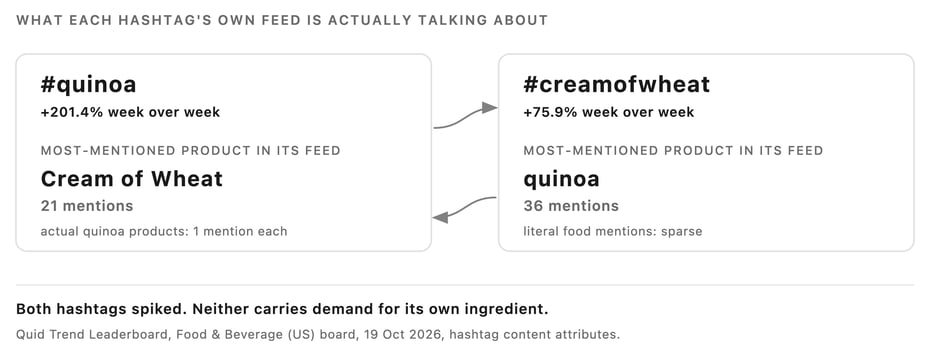
The most-mentioned product in posts using #quinoa wasn't quinoa at all. It was Cream of Wheat, appearing 21 times in the content attributes. The same pattern appeared in reverse, with quinoa mentioned 36 times under #creamofwheat. It turns out the two hashtags were connected by a meme, and much of the sudden attention had little to do with consumers actually wanting either product.
Imagine making a product investment based on that 201% increase, only to discover that the consumer trend you thought you'd identified was essentially a running joke.
It's an amusing example, but the underlying problem is a serious one for brands. Consumer conversations are moving faster than ever, and the sheer volume of available data can create the illusion that we're getting better at understanding them. Yet a dashboard full of rising numbers can still leave a pretty important question unanswered: What, exactly, is driving all this attention?
For businesses trying to anticipate shifts in consumer behavior, that distinction matters. Identifying an emerging trend early can influence everything from product innovation and merchandising to marketing investment and competitive positioning. But getting there requires more than knowing which topics are popular. It requires understanding how interest is changing, what people are actually discussing, and whether those conversations point to something worth pursuing.
To explore that challenge, Quid examined 400 ranked hashtag entries across two US TikTok Trend Leaderboard categories, using data captured October 19, 2026. We wanted to understand which signals were most useful for identifying emerging consumer trends, where commonly used metrics fell short, and how brands could separate meaningful opportunities from misleading spikes.
The findings were revealing. Some of the biggest hashtags were already losing momentum, some of the strongest emerging signals were barely visible in the rankings, and half of the accelerating food hashtags we examined were being driven by conversations unrelated to food.
Taken together, the analysis points toward a more useful approach to consumer trend detection, one that combines the numbers with an understanding of the people and behaviors behind them.

Consumer trends are changes in people's interests, preferences, values, and behaviors that influence what they buy, how they use products, and what they expect from brands. These changes can develop gradually over years or emerge rapidly within specific categories, offering valuable clues about where a market may be heading.
Consider how consumer interest in convenience has evolved over time. What began as a preference for products and services that saved time has influenced everything from ready-to-eat meals and subscription services to delivery expectations and digital shopping experiences. That kind of broad shift affects multiple industries and can shape business strategy for years.
Other trends operate on a much smaller scale. A particular skincare ingredient might begin gaining popularity among beauty creators, a new coffee preparation method might attract an enthusiastic community, or an unfamiliar flavor might start appearing in recipes and restaurant menus. These narrower conversations can offer early evidence of changing consumer interests before they become mainstream.
The distinction is generally described as macro versus micro consumer trends.
Macro trends reflect broad cultural, economic, or behavioral changes that develop over longer periods and influence multiple industries. Micro trends are more specific shifts that emerge within particular categories, products, or communities, often developing over weeks or months rather than years.
Both are important, but they serve different strategic purposes. Macro trends help businesses understand the broader direction of consumer behavior, while micro trends can reveal more immediate opportunities for innovation, marketing, and product development.
For brands, the value of identifying these changes is closely tied to timing. Product development, retail assortment planning, and major marketing campaigns often require months of preparation. By the time a trend has become obvious across an industry, the opportunity to respond early may already have narrowed.
There is also a cost to moving too soon on the wrong signal. A brand can spend considerable time developing a product around an apparent consumer preference, only to discover that the conversation was temporary, misunderstood, or never connected to actual demand.
Effective consumer trend analysis therefore has two responsibilities: helping businesses recognize meaningful changes early enough to respond and providing enough evidence to make those responses worthwhile.
An emerging consumer trend is a developing shift in consumer interests, preferences, or behaviors that is gaining momentum but has not yet reached widespread adoption. For businesses, these early-stage changes can be particularly valuable because they may reveal opportunities before products, campaigns, and competitors have fully caught up.
An established consumer trend is relatively easy to recognize. Products are already on shelves, competitors are talking about it, and the behavior has become familiar to a broad audience. An emerging trend is more difficult to identify because the evidence is still developing, often appearing first in smaller communities, niche conversations, or unusual changes in audience activity.
That uncertainty is part of what makes early detection valuable. A growing interest in an ingredient might eventually influence product formulations across an industry, or it might disappear after a few weeks. A conversation about a new consumer ritual might evolve into a lasting behavior, or it could turn out to be another short-lived social media moment.
The challenge is determining which possibility deserves further investigation.
Three characteristics are particularly useful when evaluating a potential emerging consumer trend. First, there should be evidence that interest is increasing rather than simply remaining large or familiar. Second, the growth should be considered in the context of the surrounding category, particularly when seasonal changes could explain the increase. Finally, the topic should represent an opportunity that hasn't already become so established that competitors have responded to it extensively.
These are useful criteria for identifying promising signals, but they don't establish that a lasting trend has already emerged. That conclusion requires additional evidence about consumer behavior over time.
The difference between a consumer trend, a fad, and a seasonal pattern lies in whether the underlying behavior persists and how predictably interest changes over time. Consumer trends can create lasting changes in preferences and demand, fads tend to disappear after a brief surge in popularity, and seasonal patterns follow recurring cycles tied to particular times or events.
| Pattern | What It Looks Like | What It Means for Brands |
|---|---|---|
| Consumer trend | A developing or sustained shift in preferences or behavior that extends beyond the initial excitement | May justify product innovation, longer-term positioning, or assortment changes |
| Fad | A rapid increase in attention that fades without creating lasting behavioral change | May present opportunities for timely campaigns or short-term activations |
| Seasonal pattern | A recurring increase in interest associated with a predictable period or event | Helps inform promotional calendars, inventory, and seasonal product planning |
The difficulty is that these patterns can look nearly identical when a topic first begins accelerating.
Halloween recipes, for example, naturally attract more attention as October approaches. A spike in conversations about spooky desserts might be relevant for a brand planning seasonal content, but it doesn't necessarily signal a newly emerging consumer preference. To identify something genuinely new, a researcher would need to examine how the current conversation differs from previous years, whether particular ingredients or formats are gaining an unusual share of attention, and whether that interest persists beyond the holiday.
The same principle applies to viral fads. A sudden wave of attention can be useful to marketers even if it fades quickly, but it generally calls for a different level of investment than a developing change in consumer behavior.
Understanding these differences is central to distinguishing meaningful trends from fleeting fads. It also explains why no single growth metric can tell the full story.
The most useful signals for identifying emerging consumer trends include changes in ranking, growth in audience attention, the consistency of that growth, and the content driving the conversation. Each reveals something different, and their value increases when they're interpreted together.
Most trend detection tools provide some combination of popularity rankings, engagement statistics, growth rates, and trend classifications. These measurements are useful, but they don't all answer the same question.
A topic with enormous reach might already have passed its peak. A sudden increase in content creation might reflect creators participating in a trend after audiences have lost interest. And a hashtag with impressive growth might be popular for reasons entirely unrelated to the product or behavior a brand hopes to understand.
Before examining the findings, it's worth establishing what the individual metrics represent.
| Metric | Definition | What It Can Tell You |
|---|---|---|
| Rank position | Where a hashtag appears within a category's top 200 | How visible the topic is relative to others in its category |
| Rank change | How a hashtag's position changed from the previous period | Whether it is newly appearing, rising, or falling in visibility |
| Period views | Total views accumulated by posts using the hashtag during the measurement period | The scale of audience attention |
| Week-over-week view change | Percentage change in views between the most recent seven days and the preceding seven days | Whether audience attention is growing or declining |
| Steady Score | How consistently a hashtag has maintained its presence over time | Whether its activity has been persistent, including during a sustained decline |
| Sudden Score | How sharply posting activity has recently increased | Whether creators are posting more frequently around the topic |
| Trend status | A classification such as Emerging Trend, Evergreen, or Cool Down derived from trend measurements | A starting point for distinguishing different patterns of activity |
| Content attributes | The products, concepts, and themes identified in the posts associated with a hashtag | What people are actually discussing and why the topic may be gaining attention |
One of the most important distinctions is between period views and week-over-week view growth.
Both use view counts, but they describe different dimensions of a conversation. Period views establish how much attention a topic has received within a particular window, while growth measures how that attention is changing relative to the previous window.
A hashtag with hundreds of millions of views may be receiving less attention than it did a week earlier. Another hashtag with a smaller audience may be growing rapidly, potentially offering an earlier opportunity to investigate the interests driving that growth.
That raises an interesting question: How well does popularity actually predict which consumer trends are gaining momentum?
Quid's analysis found three important patterns: high-volume hashtags were frequently declining, newly ranked topics often showed stronger growth, and even accelerating conversations could be misleading without an examination of their content.
To investigate, we used two datasets captured from the Quid Trend Leaderboard on October 19, 2026. The first included 200 ranked hashtags across all US categories, while the second contained 200 entries specifically within US Food & Beverage.
The broader dataset allowed us to compare popularity, growth, ranking movement, and trend status. The Food & Beverage dataset provided a more focused test of whether rising topics represented genuine category conversations.
Across the 200 hashtags in the US leaderboard, the relationship between total views and week-over-week growth was almost nonexistent.
The Pearson correlation was +0.02, indicating essentially no linear relationship between hashtag size and growth in this dataset. In other words, knowing that a hashtag was extremely popular offered very little information about whether its audience was increasing.
To explore the relationship further, we divided all 200 hashtags into four groups based on their view volume.
The largest group had a median of 607 million views, while the smallest had a median of 168 million. Despite that substantial difference in audience size, all four groups showed remarkably similar changes in weekly attention, with median declines ranging from approximately 28% to 30%.
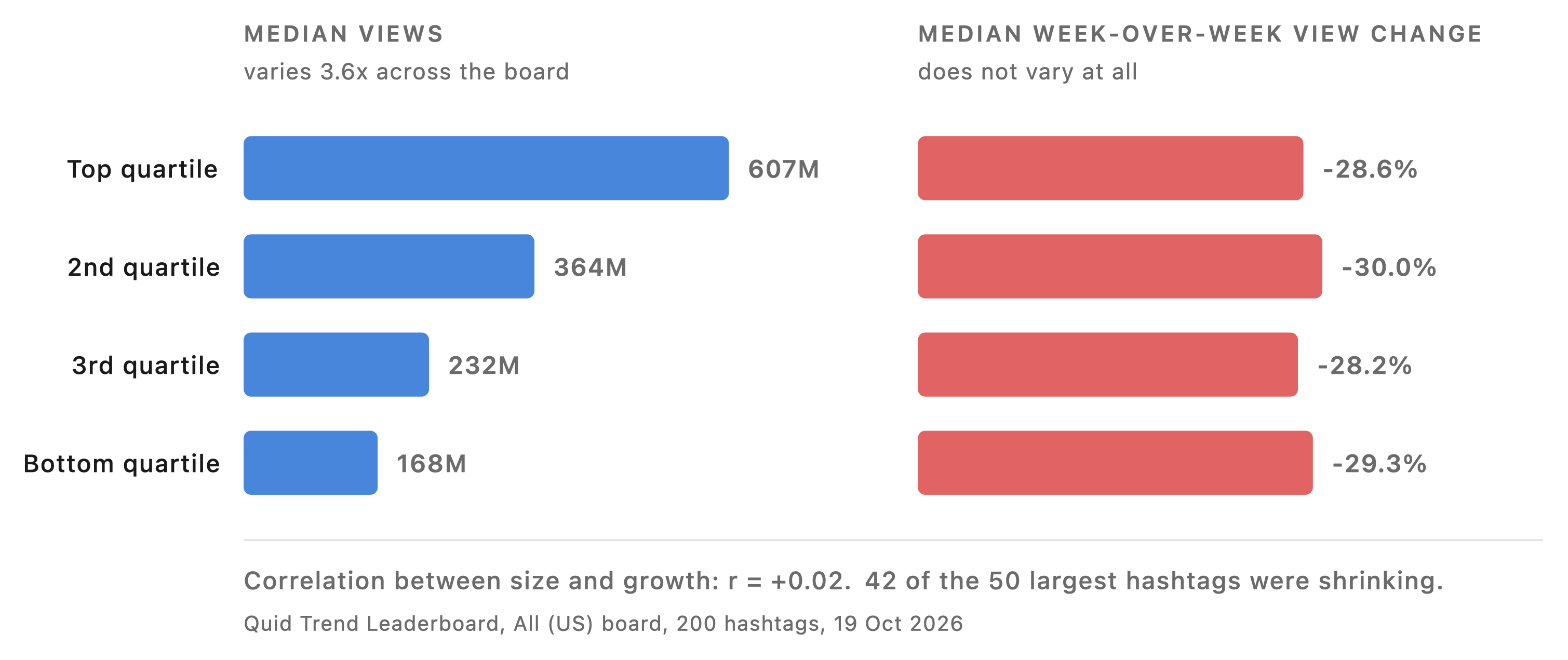
Figure 1. Despite a 3.6-fold difference in median view volume between the largest and smallest groups, median weekly view changes remained close to -28% to -30%. Source: Quid Trend Leaderboard, All (US), October 19, 2026.
The pattern became even more pronounced when we examined the largest individual hashtags. Of the 50 highest-volume topics, 42 were already losing views compared with the previous week.
And perhaps most surprisingly, the trend-status category with the highest median number of views was Cool Down, at 457 million, compared with 285 million for Emerging Trend.
Consider what that means for a brand whose trend reporting is organized primarily around the most-viewed hashtags. The topics receiving the greatest visibility in a report may have attracted that attention over a period when interest was stronger, even though current momentum is moving in the opposite direction.
For a marketing team assessing the cultural landscape, those established conversations may still be useful. Large topics provide context about what audiences have been discussing and which ideas have achieved significant reach.
But when the objective is to identify new opportunities, popularity alone offers limited guidance. A brand could spend time evaluating a widely recognized conversation while overlooking a smaller topic that is gaining traction.
This doesn't mean large hashtags are inherently poor opportunities, nor does a single snapshot prove that the biggest topics always decline. It demonstrates why view volume and view growth need to be considered separately, especially when decisions depend on identifying changes before they become obvious.
When we organized the same 200 hashtags by their trend classifications, a much clearer relationship emerged.
Hashtags classified as Emerging Trend recorded median week-over-week view growth of 59.9%, while the Steady & Emerging Trend group grew by a median of 3.4%. Every other classification showed negative median growth during the measured period.
| Trend Status | Hashtags | Median 7-Day View Change | Share Growing |
|---|---|---|---|
| Emerging Trend | 16 | +59.9% | 62% |
| Steady & Emerging Trend | 23 | +3.4% | 57% |
| Steady & Growing Trend | 5 | -7.9% | 40% |
| Evergreen | 115 | -31.2% | 1% |
| Cool Down | 28 | -29.8% | 0% |
| Steady & Declining Trend | 10 | -30.4% | 0% |
| Dropping Trend | 3 | -44.3% | 0% |
Source: Quid Trend Leaderboard, All (US), October 19, 2026.
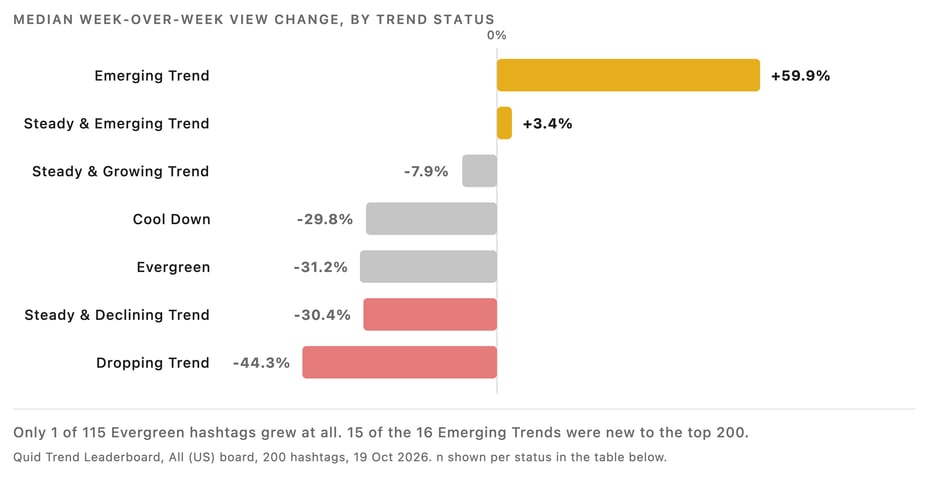
Figure 2. Emerging Trend hashtags recorded median weekly view growth of +59.9%, compared with -31.2% for Evergreen hashtags. Source: Quid Trend Leaderboard, All (US), October 19, 2026.
Two details are especially revealing.
First, only one of the 115 hashtags classified as Evergreen was growing during the period. These were established topics with persistent visibility, but nearly all were experiencing declining audience attention.
Second, 15 of the 16 Emerging Trend hashtags were new entrants to the top 200.
That finding suggests something important about the timing of consumer trend detection. A developing topic doesn't necessarily announce itself by reaching the top of a ranking. It may first become visible when it enters the list at all, offering researchers an opportunity to investigate before it accumulates the audience size associated with more established conversations.
Of course, a new entrant isn't automatically a future breakout. Even within the Emerging Trend classification, only 62% of hashtags had positive weekly view growth. The classification helps narrow the field, but it shouldn't be mistaken for a prediction.
The next consideration is whether increased activity is coming from audiences or creators, because those signals can move in very different directions.
Take #baristalife. The hashtag entered the top 200 with a Sudden Score of 47.4, reflecting a sharp spike in posting activity. Yet its audience views had fallen 36% week over week.
Creators were producing more content using the hashtag, but that activity wasn't accompanied by growing viewership. For a brand deciding whether to invest in a campaign around the topic, interpreting the spike as rising audience interest could lead to a very different decision than examining both metrics together.
This distinction is especially relevant in categories where creators, brands, and consumers regularly participate in the same conversations. A growing supply of content may indicate that more people are trying to capitalize on a topic, even as the audience begins moving elsewhere.
Together, these findings suggest that new ranking entries, rank movement, and audience growth are more useful for investigating early momentum than popularity alone. But they still leave a critical question unanswered.
What are people actually paying attention to?
To understand how often strong momentum signals might lead researchers in the wrong direction, we turned to the US Food & Beverage leaderboard.
Eight hashtags met the criteria of being classified as emerging while also showing positive week-over-week view growth. Based on those measurements alone, all eight could reasonably have entered a shortlist of potential food-related trends worth investigating.
But once we examined the underlying conversations, four of the eight were gaining attention for reasons unrelated to food consumption or interest in the products their names suggested.
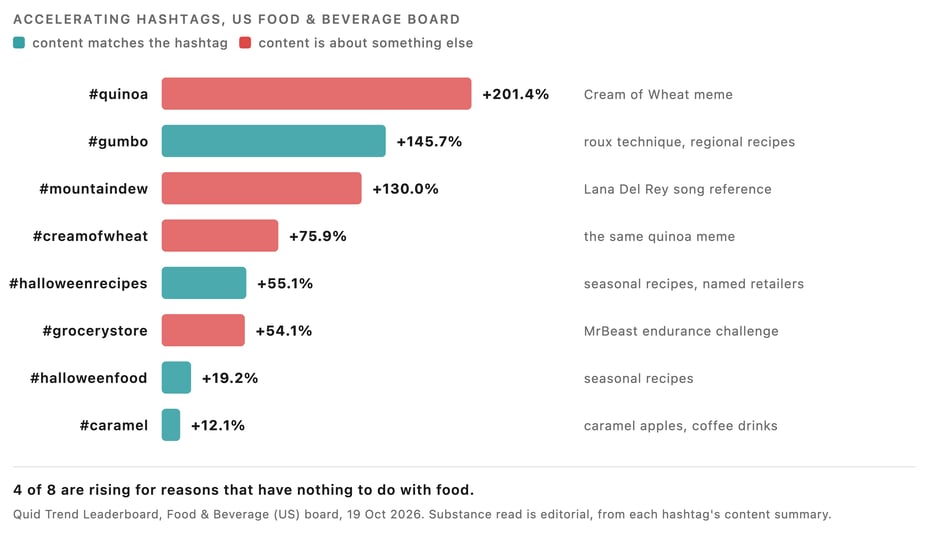
Figure 3. Four of eight accelerating hashtags were classified as off-topic following an editorial review of the conversations and content attributes behind them. Source: Quid Trend Leaderboard, Food & Beverage (US), October 19, 2026.
The examples illustrate several different ways an apparently promising trend can become misleading.
The clearest examples were the two hashtags that opened this article.
With weekly views up 201%, #quinoa appeared to be experiencing a significant increase in attention. But Cream of Wheat was the most-mentioned product in its content attributes, appearing 21 times, while actual quinoa products appeared only once each.
The relationship was reciprocal. Under #creamofwheat, quinoa appeared 36 times.
What initially looked like two separate food trends was largely the same joke spreading across related hashtags.
For a brand monitoring the category, the difference is substantial. A spike connected to cooking preferences, nutritional interests, or product experimentation might justify further research into consumer demand. A spike driven by a meme has a different significance, particularly when the objective is product development rather than short-term social content.
The hashtag names and growth rates alone didn't reveal that distinction. The underlying posts did.
The #mountaindew conversation presented a different kind of misleading signal.
Rather than reflecting a surge in interest in the beverage itself, much of the activity centered on Lana Del Rey's song "Diet Mountain Dew," including covers, lyrics, and nostalgia-related content. The song appeared nine times among the products named in the hashtag's content attributes.
A researcher reviewing only the hashtag name and its rate of growth might interpret the activity as renewed interest in the drink. But the content suggests the immediate driver was a cultural reference rather than a demonstrated change in beverage consumption.
That doesn't make the attention irrelevant to the brand. Pop culture can influence brand familiarity, associations, and opportunities for creative engagement. It simply means the business implications require a different interpretation than the hashtag's growth might initially suggest.
The #grocerystore hashtag offered another example of how a conversation can be relevant to a category in name without reflecting the behavior a business wants to understand.
Much of the activity centered on MrBeast-style endurance challenges filmed in supermarkets, alongside survival-themed entertainment and store rankings. Grocery stores provided the setting for the content, but the conversations weren't primarily about grocery purchasing decisions or evolving shopping preferences.
For a retailer seeking insights into consumer needs, that difference matters. The content may offer clues about entertainment formats or creator engagement, but it provides little direct evidence that shoppers are changing what they buy or how they shop.
The four hashtags that passed the content relevance check were #gumbo, #halloweenrecipes, #halloweenfood, and #caramel. Their underlying posts were directly connected to food preparation, recipes, products, and culinary experiences.
The #gumbo conversation included discussions about roux preparation, Cajun and Creole cooking, and regional recipe variations. Roux appeared 19 times in the content attributes, suggesting that cooking techniques were an important part of the conversation.
For a food brand, that level of detail provides a much more useful starting point than simply learning that gumbo is trending. It creates an opportunity to investigate whether interest is driven by home cooking, preparation techniques, regional cuisine, or something else. Those possibilities could have very different implications for product development and content strategy, and the available evidence would need to be examined further before choosing among them.
Similarly, #caramel included conversations about caramel apples, cinnamon rolls, coffee drinks, and other applications. The variety of contexts matters because a flavor becoming more visible doesn't necessarily indicate a single, uniform consumer preference. Understanding where and how people are using an ingredient can reveal more useful opportunities than tracking interest in the ingredient alone.
The Halloween-related hashtags also contained genuine food conversations, including recipes, seasonal cooking ideas, and references to retailers such as Target, Walmart, and Trader Joe's.
Yet those conversations introduce another consideration: seasonality.
Growing interest in Halloween food during October is hardly surprising. The more interesting question for a brand is whether something within that seasonal conversation is changing compared with previous years. Are particular ingredients gaining attention? Are new preparation methods emerging? Are consumers gravitating toward different products or retailers?
Answering those questions requires historical context that a single weekly growth figure can't provide.
Across the eight hashtags, the lesson is the same. A rising conversation can provide an early indication of consumer interest, but the substance of that conversation determines what researchers can reasonably conclude from it.
In this particular Food & Beverage sample, reviewing the content eliminated half of the initial candidates as misleading food-related signals. That result isn't a universal false-positive rate for trend detection, but it demonstrates how much the interpretation can change once the content behind the numbers is examined.
Brands can identify emerging consumer trends earlier by combining three types of evidence: novelty, acceleration, and substance. Examining these signals in sequence helps researchers narrow a large universe of trending topics into a more manageable set of opportunities worth investigating.
The order is useful because each step answers a progressively more involved question. Rank changes can quickly reveal what's newly visible. Audience growth helps determine whether attention is building. Understanding the underlying conversation then requires examining the content itself.
The first step is identifying topics that are new to a relevant category or showing meaningful movement within its rankings.
New entries deserve attention because emerging consumer interests often begin gaining visibility before they accumulate enough views to compete with established topics. In Quid's analysis, 15 of the 16 Emerging Trend hashtags were new entrants to the top 200, making ranking novelty a particularly useful starting point.
This doesn't mean every new topic represents an opportunity. Some may be temporary, too narrow to matter commercially, or unrelated to a brand's audience. But monitoring new entries helps researchers look beyond the familiar topics that already dominate a category.
When available, historical comparisons also help establish whether a conversation is genuinely new or simply returning after a predictable period of inactivity.
Once a topic has been identified, the next step is determining how audience attention is changing.
Week-over-week view growth provides a useful indication of whether interest is increasing or declining. Comparing that movement with posting activity can also help researchers distinguish growing audience engagement from an increase in content supply.
The #baristalife example illustrates why the distinction matters. More content was being created around the hashtag, but fewer views were being generated. A brand using posting activity as a proxy for demand could easily reach the wrong conclusion.
Whenever possible, growth should also be compared with the broader category and with previous periods. A topic accelerating while similar conversations remain relatively flat may warrant different attention than one rising simply because an entire category is entering its seasonal peak.
The final step is examining the conversations, themes, products, and behaviors behind the numbers.
This is where consumer trend analysis moves beyond statistical detection and begins to explain what the data represents.
A rising hashtag might reflect an emerging product preference, an unmet consumer need, growing dissatisfaction, an entertainment trend, or a completely unrelated cultural reference. Those possibilities can produce similar growth curves while suggesting very different business responses.
The #quinoa example demonstrates the risk of skipping this step. The hashtag cleared the initial tests for novelty and acceleration, but reviewing the underlying content changed the interpretation entirely.
Substance validation can involve analyzing post content, recurring themes, product mentions, audience language, and the context in which people discuss a topic. AI-assisted analysis can make this work more efficient across large datasets, while source-level review and human judgment remain important for validating conclusions that may influence significant investment.
For the eight accelerating Food & Beverage hashtags in this analysis, the substance check removed four misleading candidates. That left a smaller group of conversations with a genuine connection to food, although further research would still be needed to determine which represented meaningful, lasting changes in consumer behavior.
The advantage of this three-part approach is that it gives each piece of evidence an appropriate role. Novelty helps identify potential opportunities early, acceleration shows whether attention is developing, and substance provides the context needed to understand what that attention may mean.
Consumer trend analysis becomes useful for business decisions when emerging signals are connected to specific consumer needs, tested against additional evidence, and evaluated in the context of the decisions a company is considering.
The level of evidence required should reflect the scale of the decision.
A social media team considering a timely piece of content may be able to act on a developing conversation with relatively little additional research, particularly when the cost of testing an idea is low. A product development team considering a new formulation or a retailer planning a significant inventory commitment needs substantially more confidence that the underlying behavior will persist.
Consider the food examples from our analysis.
The #gumbo conversation showed genuine engagement with cooking techniques and regional recipes, including repeated references to roux. A food company could use that finding to investigate preparation habits, look for recurring questions or frustrations, and explore whether consumers are seeking help with a particular step in the cooking process.
That investigation might eventually reveal an opportunity involving recipe content, ingredients, or convenient preparation solutions. But the initial data doesn't establish which of those opportunities, if any, consumers would actually purchase. It provides a direction for research.
The #caramel conversation offers another illustration. Rather than treating growing interest in caramel as evidence for a new caramel-flavored product, a brand could examine which applications are generating attention, whether particular audiences are driving the discussion, and how the conversation compares with previous seasonal patterns.
For a coffee brand, the implications of growing interest in caramel beverages could be quite different from those for a confectionery company looking at caramel desserts. The underlying trend may be relevant to both, but the opportunity depends on how that interest intersects with each company's products and customers.
This is also where combining data sources becomes valuable. Social conversations may reveal early changes in language and interest, while search behavior, consumer reviews, competitive activity, customer research, and sales data can help establish whether those changes are becoming more widespread or translating into purchasing behavior.
A useful research process should also preserve the evidence behind rejected ideas. If a hashtag is removed from consideration because its growth came from an unrelated meme, documenting that finding helps prevent the same mistake from resurfacing in future reports.
Over time, those records can help teams distinguish which early signals consistently lead to useful opportunities, which tend to produce false positives, and where additional validation is most valuable.
Meaningful consumer trend detection identifies developing changes in consumer interests and provides enough context to explain why those changes may matter. The strongest research goes beyond tracking a rising topic to examine the motivations, behaviors, and market conditions surrounding it.
Quid has explored this approach across several categories.
In Whimsy Is a Demand Signal That Will Help Brands Win in 2026, the analysis examines how a developing cultural mood can reveal opportunities across different consumer categories. Unlike a narrowly defined product trend, a cultural shift may first become visible through changes in the language, aesthetics, and experiences people gravitate toward.
Witch's Brew: Fall's Spookiest Contender for the Next Pumpkin Spice explores a more specific seasonal conversation, examining how a developing flavor trend might create opportunities within an already established seasonal market.
Meanwhile, Hydration Is Having a Moment, But the Trend Runs Deeper demonstrates why the motivations underlying a popular category can be more informative than the headline trend itself.
These examples involve different types of consumer change, but they share an important characteristic: understanding the context makes the findings more useful than knowing the topic is popular.
For brands trying to anticipate what's next, that deeper understanding helps connect early signals with specific questions about products, audiences, and market opportunities.
Quid helps brands identify emerging consumer trends by combining early trend detection with analysis of the conversations, themes, and market conditions that give those trends meaning.
The Quid Trend Leaderboard tracks TikTok activity across categories, making it easier to identify new entrants, changes in ranking, and shifts in audience momentum. Instead of relying exclusively on the most popular topics, teams can investigate which conversations are gaining visibility and how their performance is changing over time.
Quid's Trending TikTok Hashtags Q Agent adds another layer of context by allowing researchers to explore the content and attributes associated with individual trends. This includes the topics and products appearing in conversations, audience characteristics, and the underlying information needed to interpret what a hashtag's growth represents.
Through Quid Terminal, those findings can be examined alongside broader consumer and market intelligence, helping teams connect a developing conversation to what is happening across their category, competitive landscape, and audience.
That broader perspective is particularly useful when the next step involves deciding whether to investigate a consumer need, test a product idea, develop a campaign, or continue monitoring a topic before taking action.
After all, recognizing that a hashtag is growing is only the beginning of the work. Understanding why it's growing, whether the underlying interest is relevant, and how that information should influence a business decision is where consumer trend intelligence becomes valuable.
The brands best positioned to identify emerging consumer trends are those that can recognize early signs of change, investigate the behaviors behind them, and turn the evidence into informed decisions while there's still time to respond.
Explore Quid's Consumer Insights Solutions

A consumer trend is a change in people's interests, preferences, values, or behaviors that influences what they buy, use, and expect from brands. Consumer trends may develop gradually across entire industries or emerge more quickly within individual product categories and communities. Businesses analyze these shifts to better understand evolving consumer needs and inform decisions about innovation, marketing, and growth.
An emerging consumer trend is a developing change in consumer interests or behavior that is gaining momentum before reaching widespread adoption. These early-stage shifts can provide valuable opportunities for businesses to investigate developing needs, test new ideas, and respond before a trend becomes widely recognized.
You can identify emerging consumer trends by examining three signals: novelty, acceleration, and substance. Novelty reveals new or rising topics, acceleration measures whether audience interest is increasing, and substance helps determine whether the underlying conversation represents a meaningful consumer interest. In Quid's October 19, 2026 analysis, examining the underlying content eliminated four of eight accelerating food hashtags as misleading category signals.
Macro consumer trends are broad behavioral or cultural shifts that develop over longer periods and influence multiple industries, while micro consumer trends are narrower changes emerging within specific categories, products, or communities. Macro trends often inform long-term positioning and business strategy, whereas micro trends can reveal more immediate opportunities for product testing, marketing, and innovation.
The difference between a consumer trend and a fad is whether the underlying change persists after the initial excitement fades. A consumer trend reflects a developing or sustained shift in preferences or behavior, while a fad typically experiences rapid popularity without producing a lasting change. Identifying the difference requires examining growth over time, consumer motivations, and supporting behavioral evidence.
Popularity alone is a poor indicator of emerging consumer trends because high view counts don't establish whether attention is growing or declining. In Quid's analysis of 200 US TikTok hashtags, the correlation between total views and week-over-week growth was +0.02, while 42 of the 50 highest-volume hashtags were losing views. Growth and context provide more useful information when the objective is early detection.
Brands can begin detecting potential emerging consumer trends as soon as relevant topics appear in rankings, gain unusual momentum, or attract growing attention within smaller communities. In Quid's October 19, 2026 analysis, 15 of 16 hashtags classified as Emerging Trend were new entrants to the top 200. These early signals help identify what deserves investigation, although additional evidence is needed to establish whether interest will persist.
Steady Score measures how consistently a hashtag has maintained its presence over time, while Sudden Score measures a recent spike in posting activity. Neither independently establishes consumer demand. In Quid's analysis, #baristalife had a Sudden Score of 47.4 while its weekly views declined 36%, demonstrating that increased content creation doesn't necessarily correspond with increased audience interest.
AI can help identify emerging consumer trends by detecting unusual patterns in large datasets, examining growth, organizing related conversations, and analyzing the language and themes behind them. While automated systems can make trend research faster and more comprehensive, additional validation is important when interpreting whether a rising conversation represents genuine consumer behavior or a commercially significant opportunity.
Social media trends can provide early signals of changing consumer interests, but they cannot independently confirm future purchasing demand. Brands can develop a more reliable understanding by examining the substance of social conversations and comparing those findings with search behavior, product reviews, customer research, sales data, and other available evidence.
There is no universal false-positive rate for consumer trend detection tools, but Quid's October 19, 2026 analysis found that four of eight accelerating hashtags examined within US Food & Beverage were driven by unrelated conversations. This 50% result applies only to the specific sample analyzed and should not be generalized across industries or tools. It illustrates why content validation is an important part of consumer trend research.
Brands should analyze consumer trends at a frequency that reflects how quickly their market changes and the decisions they need to make. Daily monitoring may be appropriate for fast-moving social conversations, while broader changes in preferences, product demand, and competitive positioning often require weekly, monthly, or longer-term comparisons. Looking across multiple periods is also essential for distinguishing meaningful growth from temporary spikes and recurring seasonal behavior.
Quid's emerging consumer trends analysis used two US TikTok Trend Leaderboard snapshots captured October 19, 2026, covering 400 ranked hashtag entries across All (US) and Food & Beverage (US). The analysis examined ranking movement, view volume, weekly view changes, trend classifications, and underlying content attributes to evaluate which signals were useful for early detection and where misleading trends could emerge.
The findings in this article are based on two Quid Trend Leaderboard snapshots captured October 19, 2026: All (US) and Food & Beverage (US), containing 200 ranked hashtag entries each. The analysis used leaderboard-provided classifications, ranking changes, view counts, and week-over-week growth metrics. Median values were used for central comparisons because view distributions can be heavily influenced by exceptionally large topics.
The classification of four Food & Beverage hashtags as unrelated to food was based on editorial examination of the content summaries and product mentions associated with those hashtags, rather than an automated assessment of purchase intent.
These findings represent a specific snapshot of TikTok activity. They describe patterns in audience attention and conversation content, not confirmed changes in purchasing behavior or predictions of long-term consumer demand. Establishing whether an emerging signal develops into a sustained trend requires additional observations and supporting evidence over time.