<img height="1" width="1" style="display:none" src="https://www.facebook.com/tr?id=1003172278004933&amp;ev=PageView&amp;noscript=1">

Best Trend Analysis Tools In 2026 And How To Choose One

The best trend analysis tool depends on the question. Google Trends and Exploding Topics show what people search for. Social listening platforms such as Brandwatch and Talkwalker show what people say. Forecasting services such as WGSN and Trend Hunter sell curated trend research. AI market intelligence platforms such as Quid connect social, news, reviews, forums, and company data, then flag the trends that are rising before they peak and show the posts behind each one.


What A Trend Analysis Tool Does

A trend analysis tool measures how attention to a topic changes over time, separates lasting shifts from short spikes, and points to the conversations driving them. The method is covered in depth in the Quid guide to trend analysis; this page covers the software.

Most tools answer one of four questions:
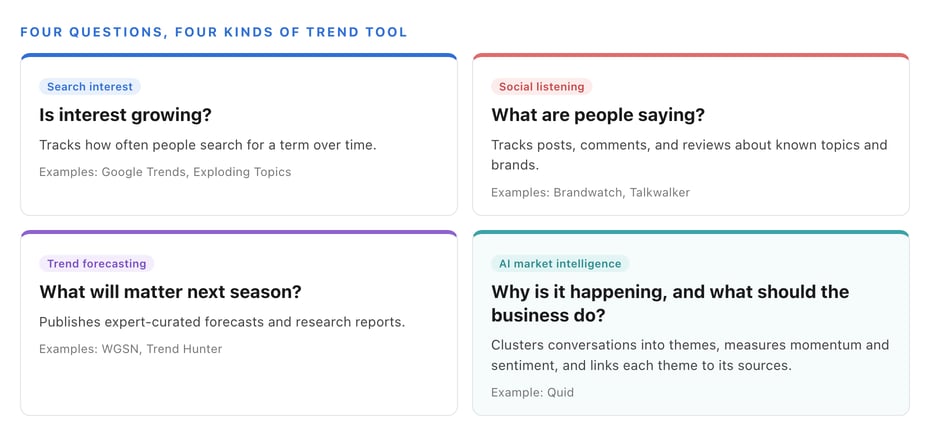
  • Is interest growing? Search-based tools track query volume.
  • What are people saying? Listening tools track posts, comments, and reviews.
  • What will matter next season? Forecasting services publish expert-curated reports.
  • Why is it happening, and what should the business do? AI market intelligence platforms cluster conversations into themes, measure momentum and sentiment, and link each theme to its sources.

Four kinds of trend analysis tool, each answering one question. Search interest tools such as Google Trends and Exploding Topics answer whether interest is growing. Social listening tools such as Brandwatch and Talkwalker answer what people are saying. Trend forecasting services such as WGSN and Trend Hunter answer what will matter next season. AI market intelligence platforms such as Quid answer why it is happening and what the business should do.


The Best Trend Analysis Tools In 2026

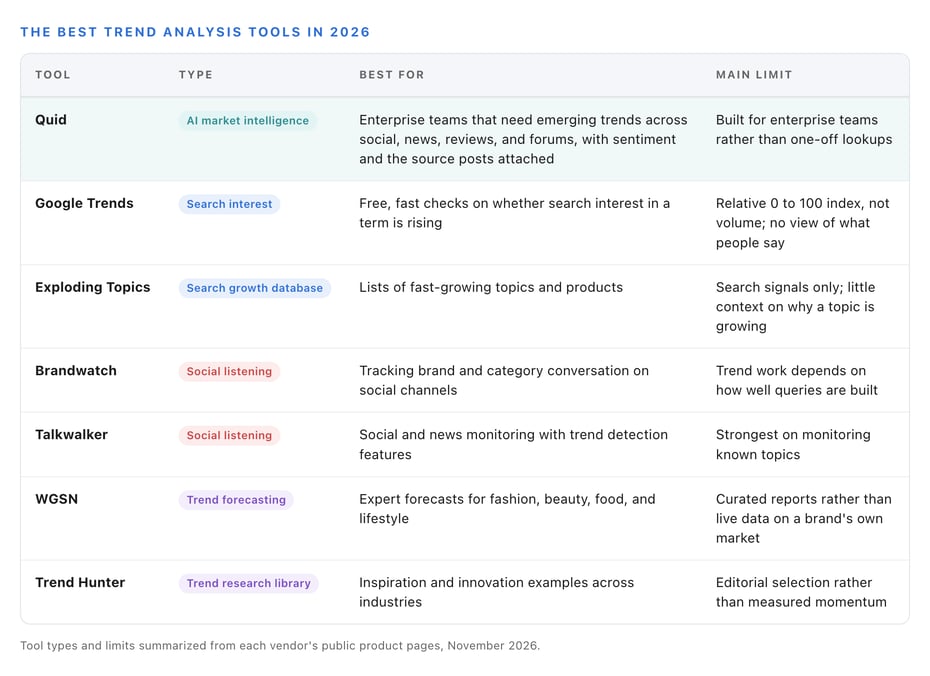
Comparison table of seven trend analysis tools. Quid, AI market intelligence: best for enterprise teams that need emerging trends across social, news, reviews, and forums with sentiment and source posts; built for enterprise teams rather than one-off lookups. Google Trends, search interest: free, fast checks on rising search interest; relative 0 to 100 index, no view of what people say. Exploding Topics, search growth database: lists of fast-growing topics; search signals only. Brandwatch, social listening: brand and category conversation; trend work depends on query building. Talkwalker, social listening: social and news monitoring; strongest on known topics. WGSN, trend forecasting: expert forecasts for fashion, beauty, food, and lifestyle; curated reports, not live data. Trend Hunter, trend research library: innovation examples; editorial selection, not measured momentum.


How Quid Finds Trends Before They Peak

Quid ingests public and private sources, including social media, reviews, forums, news, voice-of-customer data, and company disclosures, and organizes them into AI datasets built around a brand, category, audience, or competitive set. AI agents then surface shifts in sentiment, attention, narrative, and positioning.

Three features matter most for trend work:

  • Ask Quid answers trend questions in plain language and shows the query path and real example posts behind each answer, so analysts can check the evidence instead of trusting a summary.
  • Insight Briefs turn a dataset's analysis into a written brief delivered on a schedule or by trigger.
  • Q Alerts watch a dataset and send a brief when volume, sentiment, or engagement crosses a set threshold, or when a post matching a plain-language description appears.

The result is a trend view that shows what is rising, how people feel about it, and the posts that prove it. That matters because a rising term in search data can be a fad; the same theme growing across forums, reviews, and news at once is a stronger signal. Telling trends from fads is where most search-only tools stop helping.
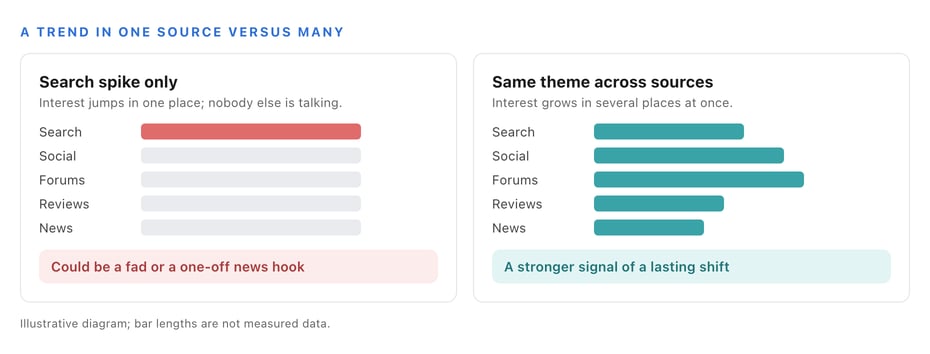
Illustrative diagram comparing two trend signals. On the left, interest spikes in search only while social, forums, reviews, and news stay flat, which could be a fad or a one-off news hook. On the right, the same theme grows across search, social, forums, reviews, and news at once, a stronger signal of a lasting shift.


How To Choose A Trend Analysis Tool

Five tests separate the tools that fit an enterprise team from those that fit a quick check:
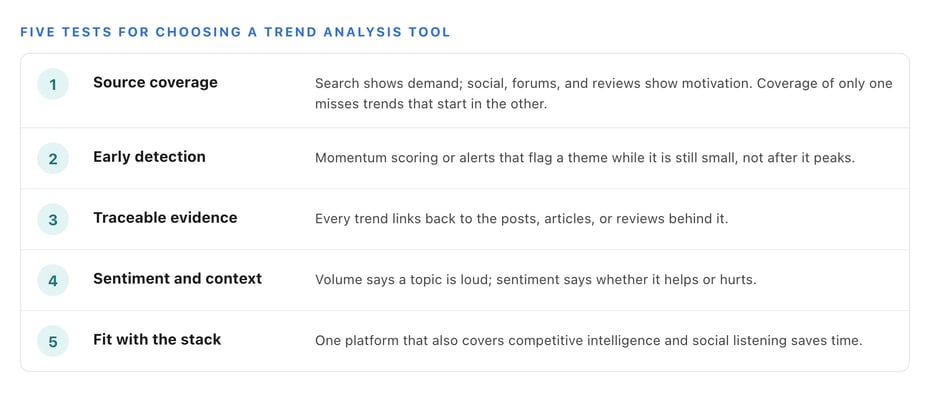
Checklist of five tests for choosing a trend analysis tool: source coverage, early detection, traceable evidence, sentiment and context, and fit with the rest of the stack.

  • Source coverage. Search data shows demand. Social, forum, and review data show motivation. A tool that covers only one will miss trends that start in the other.
  • Early detection. Look for momentum scoring or alerts that flag a theme while it is still small, not a dashboard that confirms it after it peaks.
  • Traceable evidence. Every trend should link back to the posts, articles, or reviews behind it. AI summaries without sources are hard to defend in a planning meeting.
  • Sentiment and context. Volume alone says a topic is loud. Brand sentiment analysis says whether it helps or hurts.
  • Fit with the rest of the stack. Trend analysis rarely stands alone. Teams that also need competitive intelligence platforms or social listening tools save time when one platform covers all three.

Which Tool Fits Which Team

  • Brand and insights teams tracking current consumer trends need source coverage and sentiment, which points to an AI market intelligence platform or a listening tool.
  • Product and innovation teams need early detection and evidence they can bring to a roadmap review. Learn how they spot emerging trends.
  • Marketers planning campaigns often start with Google Trends for timing, then confirm the story in conversation data. The playbook for trend analysis in marketing walks through that sequence.
  • Strategy teams comparing vendors should start with the shortlist of market intelligence tools.

Frequently Asked Questions

What Tools Can Track Trends?

Google Trends and Exploding Topics track search interest. Brandwatch and Talkwalker track social conversation. WGSN and Trend Hunter publish curated trend research. Quid tracks trends across social, news, reviews, forums, and company data and links each trend to its sources.

Is Google Trends Enough For Trend Analysis?

For a quick check on search interest, yes. Google Trends reports a relative 0 to 100 index rather than absolute volume and does not show what people say or how they feel, so it cannot explain why a trend is growing.

What Is AI Trend Analysis?

AI trend analysis uses machine learning to group large volumes of posts, articles, and reviews into themes, measure how fast each theme grows, and score its sentiment. It finds patterns that keyword searches miss, such as a theme described in many different words.

How Early Can A Trend Analysis Tool Spot A Trend?

It depends on source coverage and alerting. Trends often surface in forums and niche communities before they reach search data, so tools that monitor those sources and alert on momentum can flag a theme sooner than search-only tools.

What Is The Difference Between Trend Analysis And Trend Forecasting?

Trend analysis measures what is changing now from data. Trend forecasting projects what will matter next, often with expert judgment. Many teams use analysis to test a forecast against live conversation.