


Zoox shows up in AI answers about robotaxis, but rarely as the answer. When ChatGPT and Google AI Mode answered 12 non-branded rider questions, Zoox was named in 6 of 24 responses and its own site was linked in 2; Waymo was named 16 times. Across six AI platforms, zoox.com earns a third to two-thirds of the citations waymo.com gets, and every major model names Waymo the safest and best robotaxi service. The gap is fixable. Zoox's pages hide their text from crawlers that don't run JavaScript, its pricing and service facts are missing from the places AI models look, and several rider questions have no brand in their AI answers at all. This post sets out 25 AI prompts Zoox should track, with today's baseline for each, and the content and website changes aimed at them.
This post is a worked example of an AEO opportunity analysis. It combines Quid's answer engine optimization agents and a Quid Monitor topic of 2.11M robotaxi posts with keyword and AI citation data from Ahrefs and Semrush. Zoox, Amazon's robotaxi company, is the example; Waymo, Tesla, May Mobility, and Motional are the benchmark. All data was pulled between Aug 18 and Nov 18, 2026.
The analysis found that AI models mention Zoox but recommend Waymo, largely because AI crawlers can't read the text on zoox.com and no single Zoox page settles its basic facts. Five findings stand out:
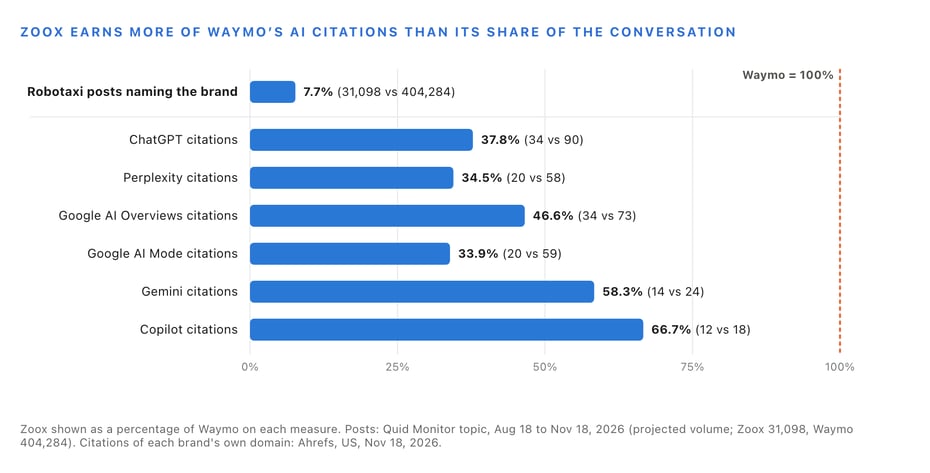
Zoox is cited in AI answers more often than its small share of conversation would predict, but recommended far less often than Waymo. Zoox accounts for 2% of the posts that name one of the five robotaxi brands, against 25% for Waymo and 73% for Tesla's robotaxi and self-driving conversation. Yet zoox.com is cited 34 times in ChatGPT answers to Waymo's 90, 34 times in Google AI Overviews to Waymo's 73, and 20 times in Perplexity to Waymo's 58. May Mobility and Motional barely register, with one AI citation between them on the six platforms measured.
Being cited is not the same as being recommended. The Quid Narrative AEO agent ran 14 robotaxi prompts across eight models, including ChatGPT, Gemini, Claude, Perplexity, Copilot, and Google AI Overviews. Every model mentioned Zoox, usually positively; the agent summed up their view as "a well-executed but geographically limited driverless service." Every model also picked Waymo for "safest," "most trusted," and "who leads." Associated Press stories were the most-used source by a wide margin; zoox.com was not among the top 20 sources in either prompt set.
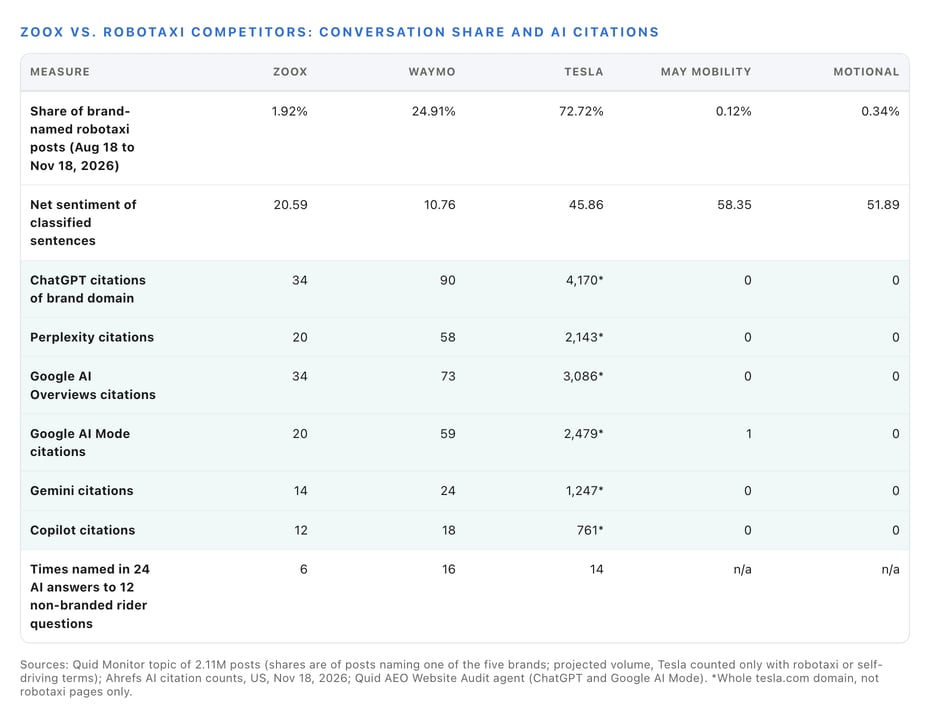
AI answers get Zoox wrong for two reasons: AI crawlers can't read the text on zoox.com, and no first-party page settles Zoox's basic facts, so models piece them together from news coverage and other sites. Depending on the model, Zoox rides in Las Vegas are free, invitation-only, $15 to $30, or matched to standard Uber fares. Launch dates range from September 2025 to September 2026. Several models put the approved fleet at 2,500 vehicles a year, while news coverage in the data reports up to 5,000 cars over two years and paid rides since Aug 10, 2026. One ChatGPT answer cited zoox.com as "context; not a service-open announcement" while telling the reader only Waymo offers public driverless rides.
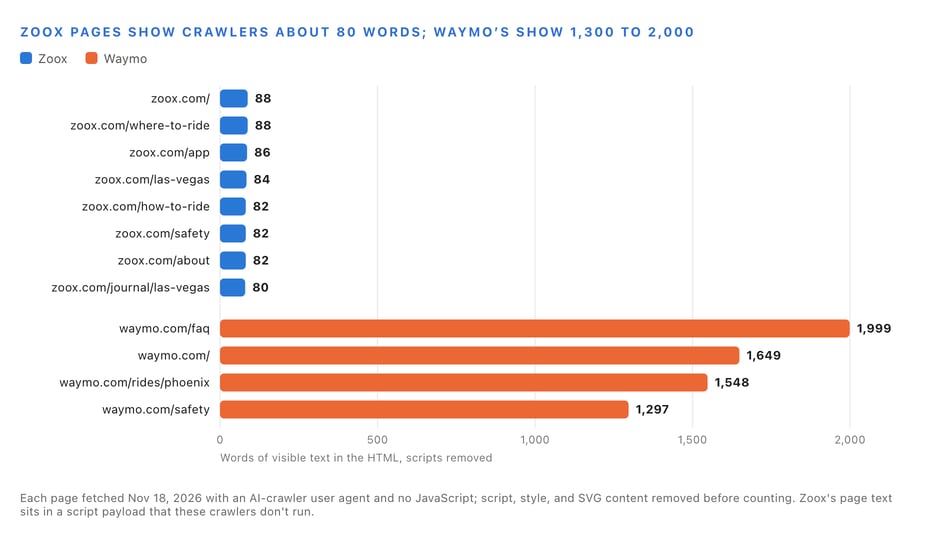
The technical cause is how zoox.com loads its words. The server sends a nearly empty page, and a small program in the visitor's browser fills in the text. People's browsers run that program, so riders see complete pages; many AI crawlers don't, so they see only the navigation menu. The Quid AEO Website Audit agent read 49 zoox.com pages and found none with enough text to score. A direct check of eight key pages, including /las-vegas, /how-to-ride, and /safety, confirmed it: each returns 80 to 88 words of navigation to a crawler that doesn't run JavaScript. The body copy ships inside a script payload, and none of the eight pages carries FAQ schema. Waymo's home, safety, FAQ, and Phoenix pages serve 1.3K to 2K words each the same way, and its FAQ page has FAQ schema. Zoox's robots.txt allows every major AI crawler; they just find little to quote.
The rest is editorial. The Quid Brand & Product AEO agent rated the lack of any pricing narrative across AI answers, search, and social as Zoox's top gap. With no first-party price page to cite, models fill in from third parties.
Conversation data reveals the questions people actually bring to AI assistants, and many of them barely register in keyword tools. Keyword tools rank opportunities by search volume, and the questions that shape AI answers often have almost none. "How do robotaxis work" gets 20 to 30 searches a month. "Car with no steering wheel" gets 70 to 100. Ranked by volume, both would fall to the bottom of a content plan.
Social and community data changes that order. In the Monitor topic, "steering wheel" appears in 83K posts and "cost" in 105K, and the most common Zoox complaint in the Brand Sentiment agent brief is access: waitlists, limited destinations, and "mostly Vegas." Those are the questions people bring to AI assistants, which is why social conversation affects AI search visibility more than search volume alone suggests.
The combination also explains the citation paradox. Zoox has a thirteenth of Waymo's conversation but more than a third of its AI citations on most platforms, because AI models reach for Zoox whenever a question is specific: Las Vegas, the cabin, a purpose-built vehicle. Semrush shows zoox.com cited in 1,361 Google AI Overviews, 26% of the keywords it ranks for, against 8% for Waymo. Almost all of those are branded or Las Vegas searches. The opportunity is to give AI models the same specific, quotable facts on the questions where Waymo wins by default.
Zoox should track 25 AI prompts in three groups: nine questions about Zoox itself, eight category questions that decide who leads robotaxis, and eight emerging questions no competitor owns. Every piece of content and every website change in this plan targets these prompts. They come from the rider questions AI models were asked in this analysis, the questions Google's People Also Ask box shows for Zoox, and questions riders post on Reddit, Instagram, and X. Each has a baseline from the latest AI answer runs. Tracking them monthly on ChatGPT, Gemini, Claude, Perplexity, Copilot, and Google AI Overviews and AI Mode shows whether Zoox is mentioned, whether zoox.com is cited, whether Zoox is recommended, and whether its facts are right.
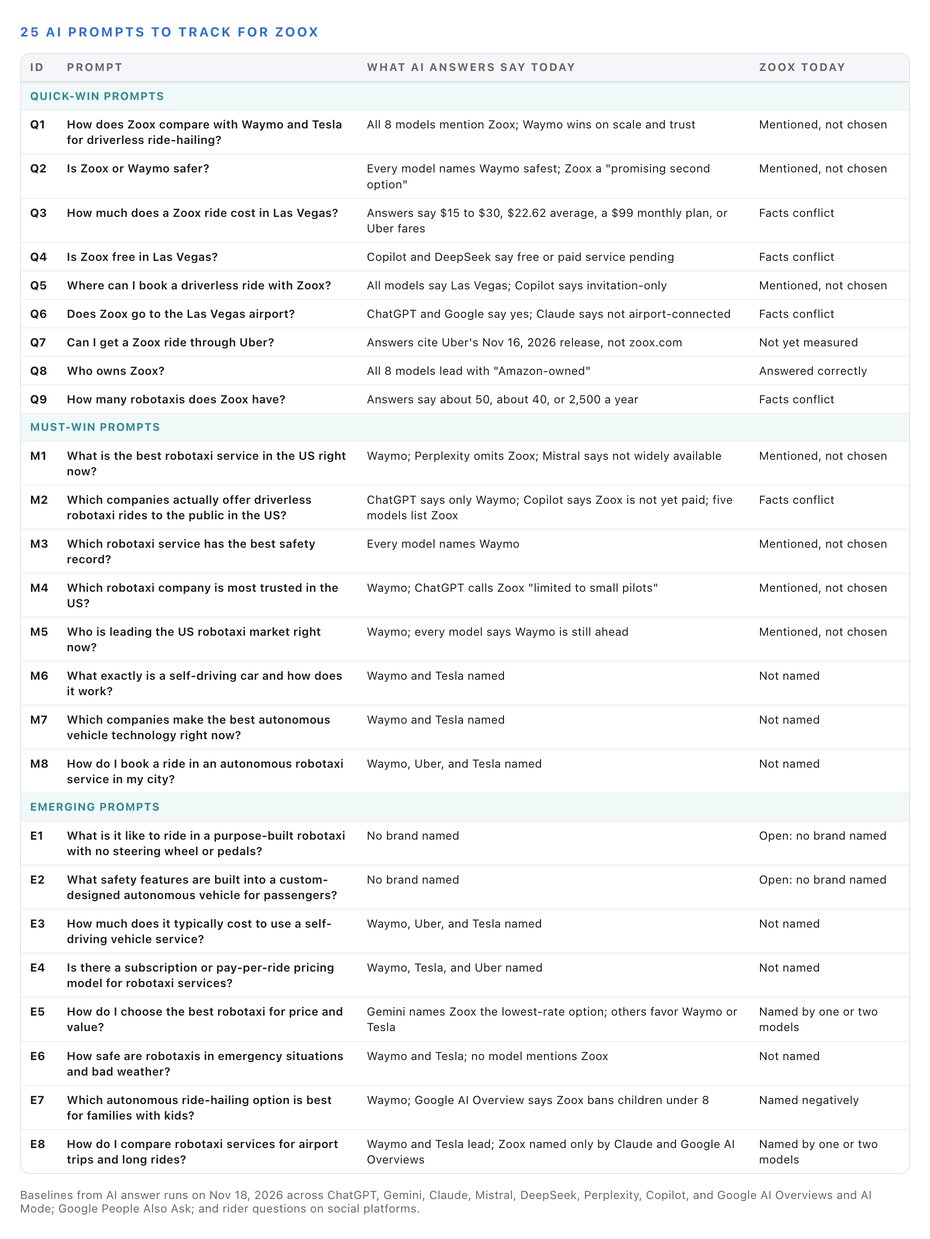
Zoox's quick-win prompts are direct questions about Zoox, where AI models mostly mention the brand but disagree on its facts or hand the comparison to Waymo. Four of the nine have conflicting answers on price, access, airport service, or fleet size. One first-party answer page settles most of them.
Zoox's must-win prompts are the category questions that decide who leads robotaxis, and Waymo leads every one today. Each needs a hub page and a series of supporting answers over two to three quarters.
Zoox's emerging prompts are newer rider questions no competitor owns. Two drew AI answers that named no brand at all, and the rest name Zoox rarely or not at all. They map to Zoox's strengths: the purpose-built cabin, pricing, and airport trips.
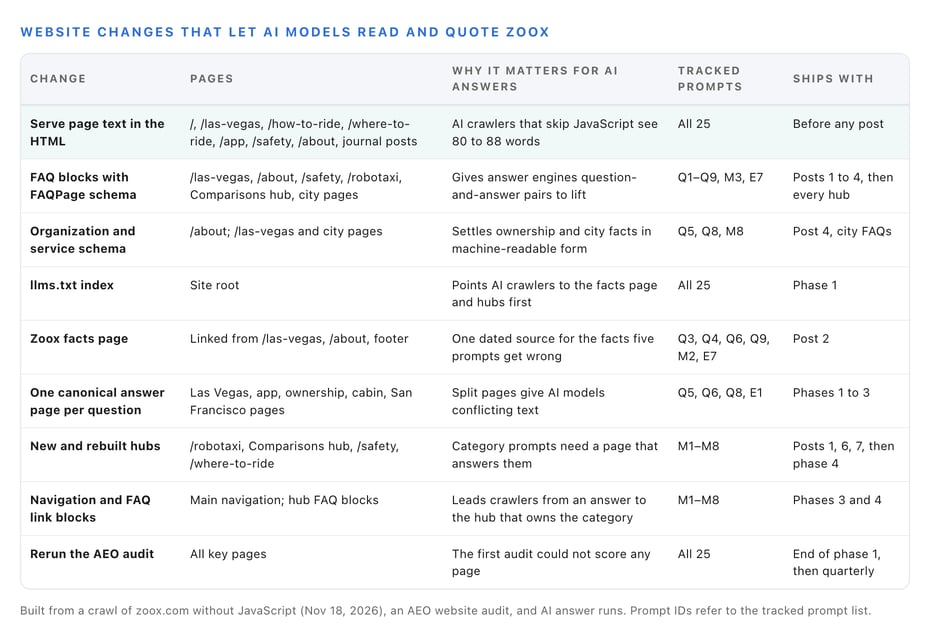
Zoox should publish seven answer pages first, starting with Zoox vs. Waymo and a Las Vegas pricing page, because those settle the facts AI models disagree on. Each one ships with the website change it needs, and the first change comes before any of them: Zoox's web team would need to serve page text in the HTML so AI crawlers that skip JavaScript can read it, then rerun the AEO audit.
Each answer should open with a two- or three-sentence response in the prompt's own words, use the prompt as a heading or FAQ question with FAQPage schema, and state price, hours, cities, airport service, and fleet approval exactly as the facts page does. The category series follows: a "What Is A Robotaxi?" pillar for M1, M6, and M7, and a rebuilt safety hub with first-party data for M3, M4, E2, and E6.
Zoox's site should be organized into six hubs. A hub is one pillar page that gives Zoox's definitive answer to a group of related prompts, plus a handful of answer pages that each cover one prompt in depth, all linked together and drawing every fact from one facts page. Hubs give AI models a single, consistent page to cite for each topic instead of several pages that disagree. Robotaxis Explained and Robotaxi Safety carry the must-win prompts. Riding Zoox In Las Vegas, Comparisons, Cities, and Company carry the quick-win prompts.
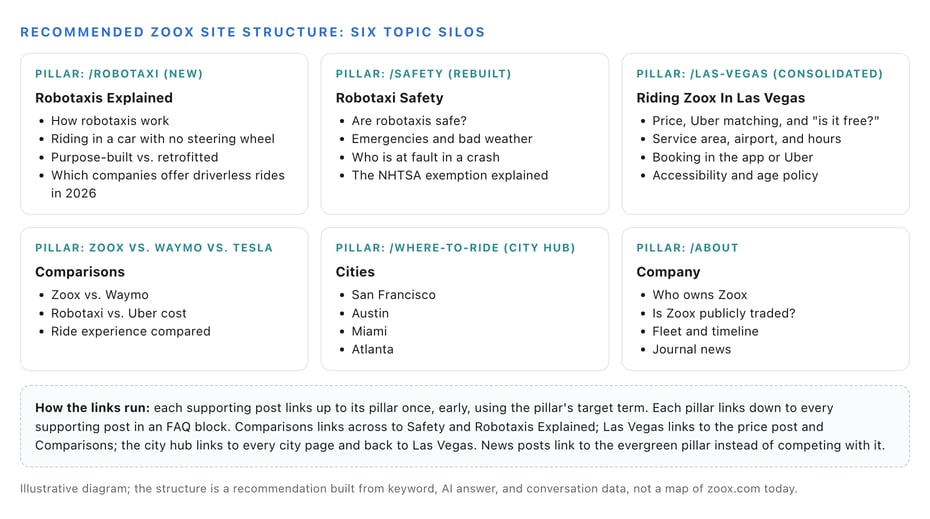
Internal links run in three directions. Each supporting post links up to its pillar once, early, with the pillar's topic as anchor text. Each pillar links down to every supporting post from an FAQ block, which also gives answer engines a clean list of questions and answers. Sideways links go only where the reader's next question lives: the price post to Uber matching, the safety pillar to emergencies, Comparisons to both Safety and Robotaxis Explained. News posts in Zoox's journal link to the evergreen pillar instead of competing with it.
The most important website change is serving page text in the HTML, so AI crawlers that skip JavaScript can read zoox.com. Content alone won't change AI answers until that happens. Nine website changes run alongside the content plan, each aimed at specific tracked prompts:
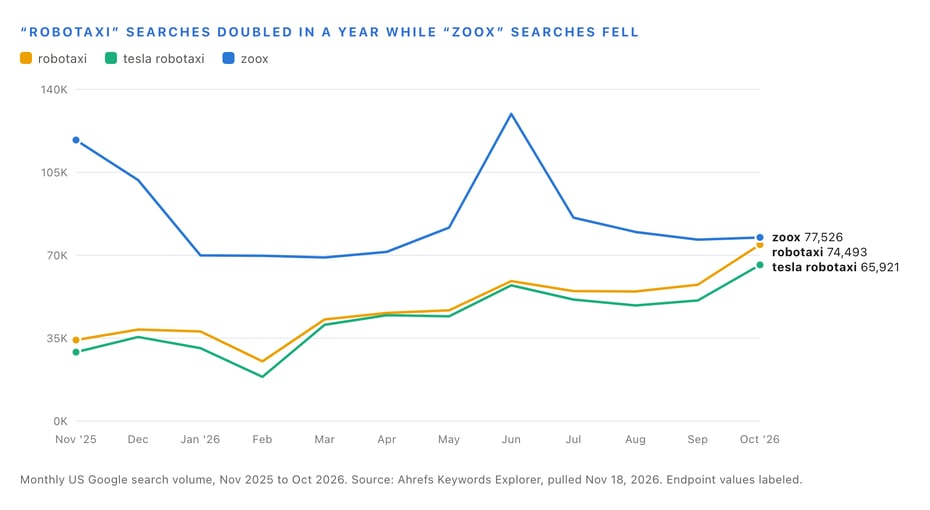
In search, Zoox wins its own brand name and little else. Search is the layer AI Overviews and AI Mode draw from, and it tells the same story. About 77% of zoox.com's organic traffic comes from two branded searches, "zoox" and "zoox las vegas." Tesla holds "robotaxi," and Waymo, Tesla, and Wikipedia hold "self-driving cars" and "autonomous vehicles." Searches for "robotaxi" doubled to 74K a month over the past year while searches for "zoox" fell from 119K to 78K. One search gain lines up directly with prompt Q1: "zoox vs waymo" draws 400 to 480 searches a month at a keyword difficulty of 1 in Ahrefs, and Zoox doesn't rank for it.
The analysis combined conversation data, AI answer audits, and search data. A Quid Monitor topic collected 2.11M English-language posts about Zoox, Waymo, Tesla's robotaxi program, May Mobility, Motional, and robotaxis generally from Aug 18 to Nov 18, 2026. Eleven Q Agents produced 12 briefs on it and the wider category, including the three AEO agents, the Theme Discovery agent, Brand Sentiment, Subject Sentiment, and a pulse of r/SelfDrivingCars. Ahrefs and Semrush supplied AI citation counts by platform plus US search data on Nov 18, 2026. Each tracked prompt's baseline comes from the most recent AI answer run that asked it; one prompt, Q7, has no baseline yet. AI answers are point-in-time snapshots and change between runs.
The same workflow applies to any brand: pair competitive intelligence on who owns each answer with social listening on what people actually ask, then check both against standard competitor analysis tools for social media and SEO. The Q Agents page lists every agent used here.
An AEO opportunity analysis measures how often AI assistants name and cite a brand for the questions in its category, finds where competitors win instead, and turns those gaps into a prioritized content plan. It combines AI answer data, keyword data, and conversation data so the plan targets the questions people actually ask.
AEO and SEO differ in their goal. SEO aims for a high ranking in search results. AEO aims to be the source an AI assistant quotes or recommends in its answer. The two overlap, since AI Overviews and assistants often draw on top-ranking pages, but AEO puts more weight on direct answers, consistent facts, FAQ structure, and pages that crawlers can read without running scripts.
Waymo gets cited more because it has more conversation, more search reach, and more readable pages. In this analysis Waymo had about 13 times Zoox's share of robotaxi conversation, about nine times its ranking keywords in Semrush, and the safety data AI answers cite most. Its pages are also easier for crawlers to read: Waymo's key pages served 1.3K to 2K words without JavaScript, while Zoox's served about 80 words of navigation.
Conversation data matters for AEO because people phrase AI prompts the way they talk, not the way they search. Social and community data shows which questions, complaints, and comparisons come up most often, including low-volume questions keyword tools would rank last. For Zoox, posts about cost, the missing steering wheel, and access pointed to prompts no competitor answers well.
A brand should track the prompts that decide whether it is recommended: direct questions about the brand, the category questions that name a leader, and newer questions no competitor answers well yet. Pull them from AI answer audits, People Also Ask, and the questions customers post on social platforms, record a baseline for each, and rerun them monthly on the major AI assistants.
Zoox first needs to serve its page text in the HTML so AI crawlers that skip JavaScript can read it. After that come FAQ blocks with FAQPage schema, Organization and service schema, an llms.txt index, a facts page on price and access, new hub pages for robotaxis, safety, and comparisons, and one canonical answer page per question.
A content hub for AEO is one pillar page that answers a group of related questions, plus answer pages that each cover one question in depth, all linked together and drawing facts from one source. Hubs give AI models a single, consistent page to cite for each topic.
llms.txt is a short plain-text file at the root of a website that lists the pages AI tools should read first, such as fact pages and topic hubs. It works like a reading list for AI crawlers.
A brand should rerun its tracked prompts monthly on the major AI assistants. AI answers are snapshots that change between runs, and a monthly baseline shows whether new content and site changes are moving mentions, citations, and accuracy.
Yes, AI crawlers can miss a site that allows them. Many AI crawlers read a page's HTML without running its JavaScript. If a site builds its text in the browser, those crawlers see little more than navigation even when robots.txt lets them in, which is what the audit found on zoox.com.